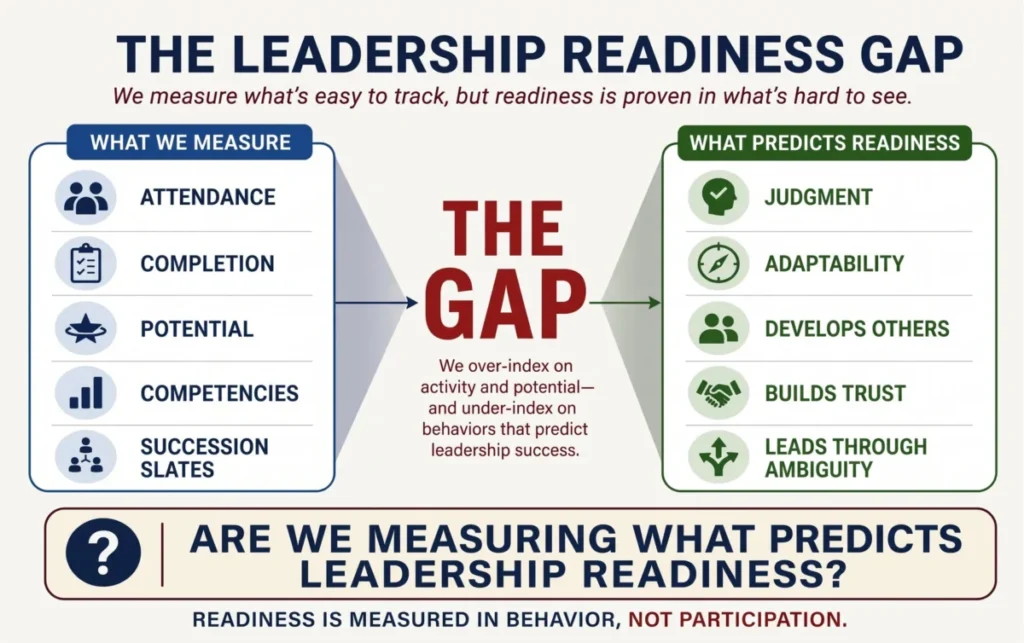
Global corporations are currently facing a critical inflection point in human capital management as the traditional models of succession planning fail to meet the demands of a volatile business environment. For decades, organizations have funneled billions of dollars into identifying high-potential talent and enrolling them in prestigious leadership development programs. However, a growing body of evidence suggests that while companies are successful at identifying who might lead in the future, they are failing to ensure those individuals are prepared to lead when the moment of transition arrives. This phenomenon, increasingly described by human resources experts as the “leadership readiness gap,” represents a systemic failure to distinguish between an individual’s latent potential and their immediate capability to execute in complex, high-stakes roles.
The urgency of this issue is underscored by recent industry data. According to the DDI Global Leadership Forecast 2025, one of the most comprehensive longitudinal studies of leadership trends, 80 percent of organizations report a significant lack of confidence in their own leadership pipelines. This statistic is particularly jarring given that investment in leadership training has reached record highs. The disparity suggests that the problem is not a lack of talent or a lack of spending, but rather a fundamental misalignment in how "readiness" is defined, assessed, and cultivated within the corporate hierarchy.
The Evolution of the Leadership Crisis: A Chronology of Succession Planning
To understand the current readiness gap, it is necessary to examine the chronological evolution of how organizations have approached talent management over the last several decades. In the late 20th century, succession planning was largely a clerical exercise—a "replacement chart" that listed the next person in line for a specific role based on seniority and technical proficiency.
By the early 2000s, the focus shifted toward "competency models." Organizations began to define the specific traits and behaviors associated with success. This era saw the rise of the "High Potential" (HiPo) designation, where young, ambitious employees were identified early and fast-tracked through various departments. However, this model often prioritized general intelligence and ambition over specific situational experience.
The 2010s introduced the "War for Talent," characterized by heavy investment in formal leadership academies and external executive coaching. Despite these efforts, the rapid digital transformation and the global disruptions of the early 2020s revealed that many "high-potential" leaders were ill-equipped to handle the ambiguity of modern crises. Today, in 2024 and looking toward 2025, the focus is shifting once again. The industry is moving away from the abstract concept of potential and toward a rigorous, evidence-based assessment of readiness.
Distinguishing Potential from Contextual Readiness
At the heart of the readiness gap is a failure to recognize that leadership is inherently contextual. A manager who excels at leading a stable, established team may falter when tasked with leading a corporate turnaround, a digital transformation, or a period of aggressive global expansion. Readiness is not a permanent state of being; it is a specific alignment between a leader’s capabilities and the immediate challenges the organization faces.
In professional services and corporate environments, such as those analyzed by leaders at BDO Canada, the distinction between potential and readiness often becomes visible only when a promotion occurs. The "potential" of a high performer is frequently measured by their individual contributions, technical expertise, and ambition. Yet, the requirements of the next level of leadership—such as leading through others, influencing stakeholders without direct authority, and making high-level strategic trade-offs—are fundamentally different from the skills that earned the employee their "high-potential" status in the first place.
When an organization promotes based on potential alone, it risks exposing the individual to failure. This exposure does more than just hurt the company’s bottom line; it can erode the confidence and motivation of the talented individual, potentially derailing a promising career. Industry analysts argue that when a promotion fails, the blame should not rest solely on the individual but also on the organizational system that declared them "ready" without providing the necessary experiential evidence.
The Three Fundamental Shifts in Organizational Thinking
Closing the leadership readiness gap requires a departure from traditional HR metrics and a move toward a more integrated, systemic approach. Experts suggest three primary shifts in thinking that organizations must adopt to ensure their succession pipelines are robust and reliable.
1. From Abstract Potential to Demonstrated Readiness
Potential indicates what an employee might become in an ideal future, whereas readiness measures what they can consistently demonstrate in the present. To bridge this gap, organizations must move beyond "on-paper" assessments. This involves asking a more difficult set of questions: What specific experiences does this person lack? Have they ever managed a budget of this size? Have they ever led a team through a period of downsizing or rapid growth?

By identifying specific "readiness gaps," organizations can move away from the assumption that a promotion will naturally result in the development of necessary skills. Instead, the focus turns to what the individual needs to experience and practice before the move is made.
2. From Isolated Programs to Integrated Leadership Systems
While formal leadership programs provide valuable theoretical frameworks, they are often disconnected from the day-to-day realities of the business. Readiness is best developed through a "leadership system"—a continuous cycle of succession decisions, identified gaps, targeted development experiences, and rigorous reassessment.
A robust leadership system integrates development into the flow of work. If a candidate needs to improve their strategic thinking, the system should assign them to a high-level project that requires long-term forecasting and market analysis. This "lived performance" allows the organization to observe the candidate’s judgment in real-time. According to the DDI research, organizations that utilize these systematic, experience-based approaches are significantly more likely to have a "bench" of leaders who are prepared to step into critical roles at a moment’s notice.
3. From Participation Metrics to Impact-Based Measurement
One of the most significant hurdles in leadership development is the tendency to measure success through activity rather than impact. Traditional metrics—such as the number of employees who attended a seminar or the total hours of training delivered—provide no insight into whether leadership behavior has actually changed.
At BDO Canada, the Talent Development function, influenced by the philosophy of Chief Learning and Development Officer Dr. Keith Keating, began challenging the value of these activity metrics. The focus shifted toward a progression of: Activity → Capability → Behavior → Impact.
Under this model, the question is no longer "Who attended the training?" but "What value are they adding now?" Organizations must seek evidence that leaders are behaving differently on the job—whether they are having more effective difficult conversations, coaching their subordinates more frequently, or making better-informed decisions under pressure.
Broader Industry Implications and Economic Impact
The failure to address the leadership readiness gap has profound economic implications. Research from various management consulting firms suggests that the cost of a failed executive hire can be as high as 200 to 215 percent of their annual salary. Beyond the direct financial loss, failed leadership transitions lead to decreased team morale, increased turnover among subordinates, and lost strategic momentum.
Furthermore, the "Great Resignation" and the subsequent shift in workforce dynamics have left many organizations with "hollowed-out" middle management. As senior leaders approach retirement, the lack of ready successors creates a vacuum that can destabilize entire industries. In this context, leadership readiness is not just a human resources concern; it is a matter of long-term organizational resilience and national economic stability.
Expert Reactions and the Path Forward
Human resources practitioners are increasingly calling for a "partnership with the business" to solve these issues. The consensus among talent experts is that leadership development can no longer be a siloed HR function. It requires active participation from the CEO and the board of directors to ensure that development experiences are aligned with the company’s strategic goals.
The closing challenge for modern organizations is to move past the superficial comfort of a long list of "high-potential" names. Real succession planning requires the courage to look at that list and ask: "Who is actually ready for the specific challenges of 2025 and beyond?"
As the business landscape continues to evolve, the organizations that thrive will be those that view leadership not as a title to be granted, but as a state of readiness to be meticulously built, observed, and verified through evidence-based systems. The shift from "Who’s next?" to "Who’s ready?" is the defining challenge for the next generation of corporate leadership.