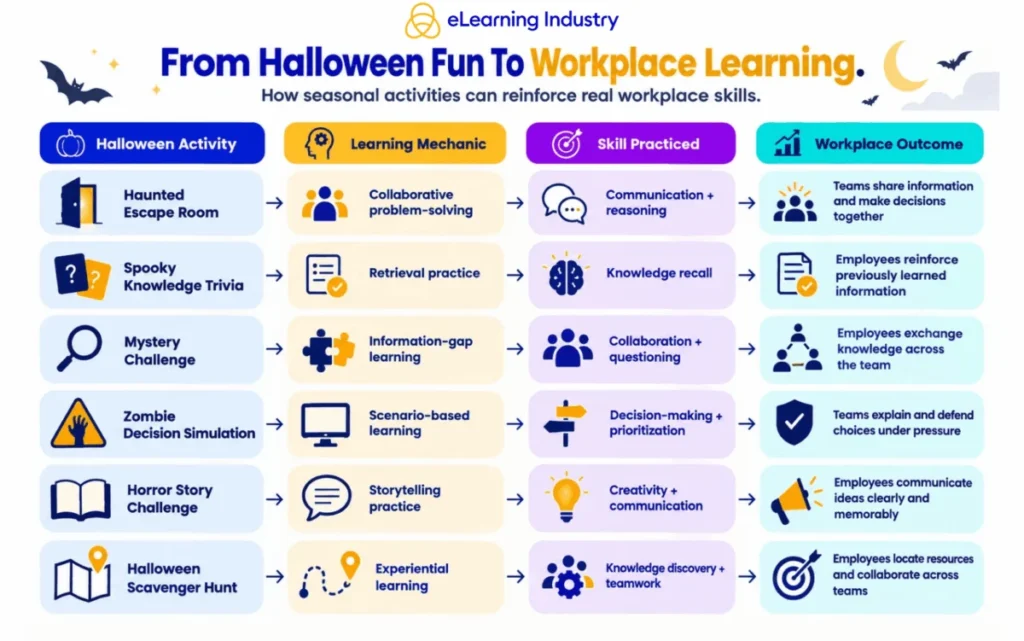
The traditional corporate Halloween celebration, often characterized by plastic pumpkins and mandatory costume contests, is undergoing a significant transformation as Human Resources (HR) and Learning and Development (L&D) departments seek more meaningful ways to engage a modern workforce. In an era where employee engagement is directly linked to retention and productivity, organizations are moving away from "mandatory fun" toward "purposeful play." By integrating educational objectives into seasonal festivities, companies are finding that the "spooky season" provides a unique, low-stakes environment to sharpen high-stakes professional skills such as crisis management, collaborative problem-solving, and narrative intelligence.
The Evolution of Workplace Festivities into Experiential Learning
The shift toward skill-based Halloween activities reflects a broader trend in corporate education known as experiential learning. According to the Association for Talent Development (ATD), employees retain significantly more information when they "learn by doing" rather than through passive observation. Halloween, with its inherent themes of mystery, transformation, and storytelling, serves as an ideal backdrop for these activities.
Historically, office parties were viewed as a distraction from productivity. However, modern workplace psychology suggests that social bonding and informal learning are critical for breaking down departmental silos. By utilizing the month of October to host structured activities, L&D professionals can reinforce previous training sessions, introduce new concepts like Generative AI, and observe team dynamics in a setting that encourages risk-taking without the fear of professional failure.
Strategic Alignment: Matching Activities to Learning Objectives
For a Halloween activity to be effective, it must be designed with a specific outcome in mind. HR leaders emphasize that the "Outcome → Audience → Format → Activity" workflow is essential for ensuring that the event provides a Return on Investment (ROI).
| Desired Competency | Recommended Activity |
|---|---|
| Agility and Decision-Making | Zombie Apocalypse Simulation |
| Cross-Functional Communication | Mystery-Solving Team Challenge |
| Information Retrieval | Knowledge-Based Scavenger Hunt |
| Narrative Intelligence | Two-Minute Horror Story Challenge |
| Project Management | "Escape the Deadline" Game |
| AI Literacy | AI-Powered Scenario Generation |
A Deep Dive into 15 Skill-Building Halloween Activities
1. The Haunted Escape Room Challenge
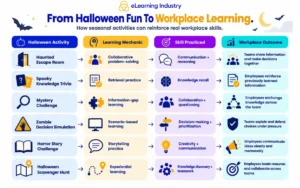
Escape rooms have become a staple of team building because they require immediate, high-pressure collaboration. In a corporate setting, these can be adapted to include clues based on company history, recent product launches, or industry-specific terminology. This activity tests a team’s ability to delegate tasks, manage time, and think critically under a ticking clock.
2. Information-Based Scavenger Hunts
Moving beyond finding physical objects, a learning-focused scavenger hunt requires participants to navigate the company’s Learning Management System (LMS), intranet, or policy handbooks. This encourages "self-service" information retrieval, a skill that reduces the administrative burden on HR departments by teaching employees how to find answers independently.
3. Spooky Knowledge Trivia
Trivia sessions can serve as a form of "retrieval practice," a proven cognitive science technique that strengthens long-term memory. By mixing Halloween lore with compliance updates or technical training questions, organizations can reinforce critical knowledge in a relaxed environment that reduces "test anxiety."
4. Zombie Apocalypse Crisis Simulation
This activity mirrors real-world crisis management. Teams are given a scenario with limited resources and must prioritize actions to "survive." This reveals leadership styles and decision-making biases. Post-activity debriefs allow teams to analyze how they handled conflicting information and resource scarcity.
5. Asymmetric Information Mystery Challenges
In this exercise, each team member is given a unique piece of information that others do not have. To solve the mystery, they must communicate effectively. This is a direct simulation of cross-departmental projects where "siloed" information often prevents success.
6. "Escape the Deadline" Project Simulation
This game replaces supernatural monsters with the "horror" of a failing project. Teams must navigate shifting requirements, stakeholder changes, and technical debt. It serves as an excellent refresher for Agile or Waterfall project management methodologies.
7. Scenario-Based "What Would You Do?" Cards
Using Halloween-themed prompts—such as "A vampire is violating the remote work policy"—teams discuss ethical dilemmas or HR procedures. This gamifies the often-dry subject of corporate compliance and ethics.
8. The Two-Minute Narrative Challenge
Storytelling is a vital skill for sales, marketing, and leadership. Participants are given three unrelated workplace terms and one Halloween prompt and must weave them into a coherent, persuasive narrative. This builds "verbal agility" and creative thinking.
9. The Haunted Customer Journey
Teams are presented with a "horrific" customer experience map filled with errors and friction points. Their task is to "exorcise" the bad design and create a streamlined, empathetic user journey. This reinforces User Experience (UX) principles and customer-centricity.
10. Learning Design "Horror" Critique
For L&D teams specifically, analyzing a poorly designed training module (the "horror") allows for professional peer review. Participants identify issues like cognitive overload, lack of accessibility, and poor alignment between objectives and assessments.
11. Peer-to-Peer Microlearning Sessions
Employees are invited to give five-minute "lightning talks" on a skill they possess. Adding a seasonal theme makes these sessions less intimidating for first-time presenters, fostering a culture of knowledge sharing.
12. Digital-First Virtual Escape Challenges
With approximately 35-40% of the modern workforce operating in remote or hybrid capacities, virtual activities are essential. These use breakout rooms and collaborative digital whiteboards to ensure remote employees are not just observers, but active participants in the team-building process.
13. AI-Assisted Scenario Generation
To build AI literacy, participants use tools like ChatGPT or Midjourney to create Halloween-themed business scenarios. This teaches "prompt engineering" and helps employees understand the capabilities and limitations of Generative AI in a creative context.
14. Positive Behavior "Bingo"
Rather than a one-day event, "Skills Bingo" can run throughout October. Squares are filled with desirable workplace behaviors, such as "Provided constructive feedback" or "Used a new software shortcut." This uses positive reinforcement to build long-term habits.
15. The Meta-Game: Design Your Own Activity
Teams are tasked with designing their own five-minute learning game. This requires them to think about learning objectives, mechanics, and engagement—skills that are directly transferable to management and training roles.
The BOO Framework: A Pedagogical Approach to Fun
To ensure these activities translate into actual workplace improvement, L&D experts suggest the BOO Framework:
- Behavior: Clearly define the professional behavior you want to see (e.g., "active listening").
- Opportunity: Create a Halloween activity that necessitates that behavior.
- Observation: Dedicate time at the end for reflection. This "debrief" is where the most significant learning occurs, as employees connect the game’s mechanics to their daily responsibilities.
Ensuring Inclusivity and Psychological Safety
As organizations become more diverse, the "horror" of Halloween can inadvertently create an exclusionary environment. HR professionals emphasize several key principles for maintaining a professional and inclusive atmosphere:
- Voluntary Participation: Engagement should never be forced. Employees may opt out for religious, cultural, or personal reasons without fear of retribution or being labeled "not a team player."
- Cultural Sensitivity: Costumes and themes must avoid stereotypes. Many corporations now provide "Inclusive Holiday Guidelines" to prevent the appropriation of cultures or the use of insensitive imagery.
- Accessibility: Physical activities like scavenger hunts must be accessible to those with mobility issues, and digital games must be compatible with screen readers and other assistive technologies.
- Psychological Safety: Themes involving realistic violence or trauma should be avoided, as they can be triggering for some employees. The focus should remain on "spooky fun" rather than genuine fear.
Broader Impact and Industry Implications
The move toward integrated, skill-based celebrations is part of a larger shift in "Employer Branding." In a competitive labor market, companies that demonstrate a commitment to both employee well-being and continuous development are more likely to attract top talent.
Data from Gallup suggests that highly engaged business units see a 21% increase in profitability. By repurposing Halloween as a catalyst for engagement and learning, companies are not just throwing a party; they are investing in their human capital. The long-term implication is a workplace culture that values creativity and collaboration year-round, proving that the best "treat" an employer can provide is the opportunity for growth.