Today, UNREAL’s distinctive products, known for their commitment to less sugar and superior ingredients, are available in over 35,000 retail locations nationwide, including major players like Target, Costco, and Whole Foods. This widespread distribution underscores the brand’s remarkable journey from a niche challenger to a mainstream success story, directly taking on established confectionery giants. McCarthy’s leadership has not only guided the company through rapid expansion but also navigated the complexities of building a thriving organization while personally growing into the demanding role of a CEO. He has championed a fully remote team scattered across the country, meticulously fostering a strong company culture without the traditional anchor of a physical office, and demonstrating a sustainable approach to business in an era often characterized by relentless, around-the-clock work.
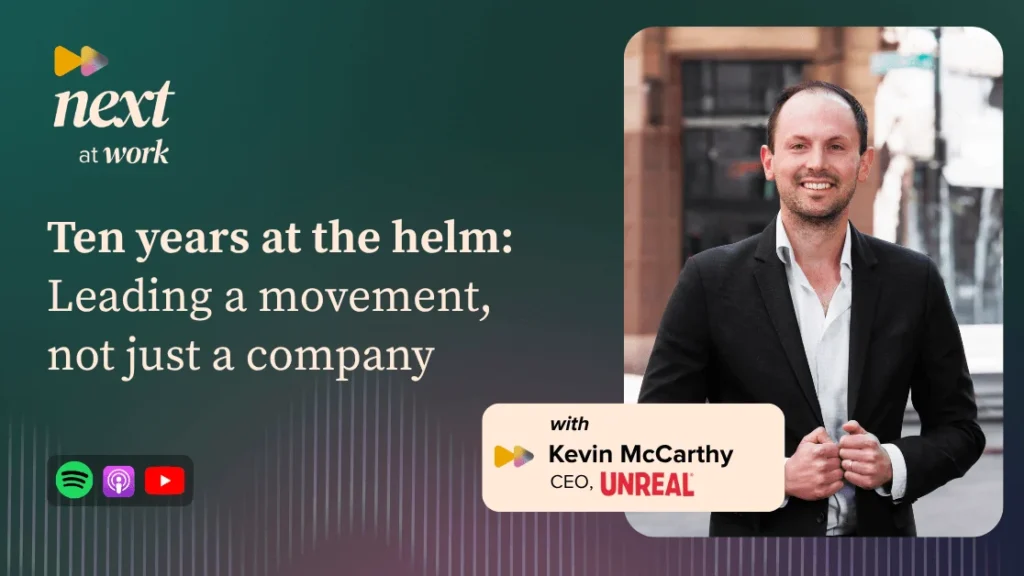
McCarthy’s insights into leadership, entrepreneurship, and the operational realities of a mission-driven enterprise were recently highlighted in an episode of the Next at Work podcast, where he engaged in a candid conversation with host Brendan Jeannetti. Their discussion illuminated several pivotal lessons gleaned from McCarthy’s decade at the helm, including the fallacy of waiting to feel "ready," the critical importance of protecting employees and leaders from burnout, the intricacies of cultivating trust within a distributed workforce, and the strategic imperatives for transforming an ambitious vision into an enduring business.
The Rise of the "Better-for-You" Movement and UNREAL’s Genesis
UNREAL emerged during a pivotal shift in consumer behavior, as health consciousness began to permeate every aspect of the food industry. The traditional candy aisle, long dominated by high-sugar, artificial-ingredient-laden products, suddenly faced scrutiny from an increasingly informed public. Consumers, armed with nutritional knowledge and a desire for cleaner labels, started seeking alternatives that offered indulgence without compromise. This growing demand fueled the "better-for-you" snack market, a segment that has witnessed exponential growth over the past decade.
Industry reports indicate that the global healthy snacks market, valued at approximately $85 billion in 2022, is projected to reach over $140 billion by 2030, growing at a compound annual growth rate (CAGR) of over 7%. Within this burgeoning sector, "better-for-you" confectionery, specifically, has carved out a significant niche. UNREAL’s founding principle—to create a world where all food is 100% real—positioned it perfectly to capitalize on this trend. While the original article doesn’t detail UNREAL’s exact founding story, it’s clear it began as a passion project, likely stemming from a desire to offer a healthier alternative to beloved chocolate treats. This mission, rather than mere profit, became the bedrock of the company’s identity and strategy.
A Decade of Transformative Leadership: Kevin McCarthy’s Journey
McCarthy’s journey with UNREAL began not as its CEO, but as an employee. He spent two formative years immersed in the operational intricacies of the business, gaining a comprehensive understanding of its supply chain, manufacturing processes, and market dynamics. This hands-on experience proved invaluable, equipping him with practical knowledge that few 24-year-olds in a leadership position typically possess. His ascension to CEO at such a young age is a testament to both his innate capabilities and the board’s foresight. While the decision to entrust a young leader with the reins of a growing company might seem unconventional, it speaks volumes about the conviction McCarthy exuded regarding UNREAL’s mission and his demonstrable understanding of its operational blueprint. A hypothetical statement from a board member might have emphasized McCarthy’s "unwavering belief in our vision, coupled with a rare operational acumen for someone his age, which convinced us he was the right leader to steer UNREAL through its next phase of growth."
Under McCarthy’s decade-long leadership, UNREAL has transitioned from a promising startup into a national brand. The 15% year-over-year growth in mainstream retailers is a powerful indicator of its sustained momentum and ability to resonate with a broad consumer base. This growth wasn’t achieved without significant challenges, particularly in a market dominated by entrenched players with vast marketing budgets and distribution networks. UNREAL’s success signifies a fundamental shift in consumer loyalty, demonstrating that quality, transparency, and a compelling mission can indeed disrupt long-standing market hierarchies.
Insight 1: Readiness is a Trap – The Entrepreneurial Spirit
One of McCarthy’s most profound revelations, as shared on the Next at Work podcast, is the notion that "readiness is a trap." When questioned about feeling prepared to lead a company at 24, he candidly admitted, "I don’t think you’re ever, like, ready ready." This sentiment challenges conventional wisdom, which often advocates for a linear career path, accumulating credentials and experience before aspiring to top leadership roles. McCarthy’s experience suggests that genuine belief in a mission and the courage to act are often more potent catalysts for success than a perfectly curated resume.
His advice, "Stop chasing roles. Find something you genuinely care about solving," resonates deeply with the entrepreneurial ethos. It posits that intrinsic motivation—a passion for addressing a problem or fulfilling a need—is a more reliable compass for career trajectory than the pursuit of titles or perceived prestige. This perspective aligns with psychological studies on motivation, which consistently show that purpose-driven work leads to higher engagement and resilience. For McCarthy, this meant putting pressure on himself to deliver for UNREAL’s mission, not for the sake of a CEO title. The board, in turn, recognized this authentic drive, seeing past his age to the potential for impact.
When building his initial team of ten, McCarthy consciously sought out individuals who mirrored his own entrepreneurial hunger and mission-driven mindset. He looked for those "willing to risk stability for a mission" and possessing "no ego about the work." The fact that eight of those original team members remain with UNREAL nearly a decade later is a testament to the power of shared purpose and a culture built on genuine commitment. This stability in leadership and core team members has undoubtedly been a significant factor in UNREAL’s consistent growth and cultural cohesion.
Insight 2: Burnout is a Leadership Problem – Fostering Sustainable Work
In an era where "hustle culture" is often glorified, McCarthy offers a stark counter-narrative: "There’s a lot of celebration of the grind and working super hard. That’s not sustainable. That can be a sprint, but everything is a marathon in life." This statement underscores a critical challenge facing modern workplaces: the pervasive issue of employee burnout, which carries significant human and economic costs. Research from organizations like Gallup consistently highlights high rates of burnout among employees globally, leading to decreased productivity, increased turnover, and adverse health outcomes.
McCarthy understands that leadership plays a pivotal role in preventing burnout. Leaders, by their actions, model acceptable behavior. If a CEO is constantly working late, responding to emails at all hours, and never truly disconnecting, it implicitly communicates to the team that such behavior is expected, if not required. This creates a vicious cycle of stress and exhaustion. For McCarthy, protecting boundaries isn’t just a personal choice; it’s a strategic imperative. "You need your team healthy. You need yourself to be healthy. Burnout costs people and execution." This approach transforms wellness from a soft benefit into a core business strategy.
Practically, McCarthy advocates for proactive measures to build capacity and resilience. This includes the classic leadership adage of "hiring people better than you at things you’re weak in," thereby distributing expertise and alleviating individual burden. He also emphasizes building a strong mentorship network and consistently evaluating personal and professional fulfillment, ensuring that the work remains challenging and enjoyable. Looking ahead, anticipating the company’s future needs and proactively building the necessary capacity ensures that growth doesn’t come at the expense of human capital. This forward-thinking approach is particularly vital for a fully remote company like UNREAL, where the lines between work and personal life can easily blur without intentional boundaries.
Insight 3: Culture Follows Mission – The Remote Work Paradigm
UNREAL’s core mission—to create a world where all food is 100% real—is not merely a marketing slogan; it is the fundamental operating principle that permeates every aspect of the company, including its culture. McCarthy’s anecdote about finding a "dark office with no energy" when he first joined twelve years ago highlights the transformative effort required to align the company’s internal ethos with its external brand promise of "fun, transparent, mission-driven."
A standout example of this mission-driven culture is UNREAL’s "Chocolate Expensing Policy." This unique perk allows employees to purchase and expense chocolate from any brand. The statistic that employees purchased over 3,900 pounds of chocolate in 2025, just seven months after the policy’s rollout, is not merely a fun fact. It serves a profound strategic purpose: it encourages employees to deeply understand the competitive landscape, experience customer pain points and delights firsthand, and remain intimately connected to the product and the "why" behind UNREAL’s work. It fosters a culture of curiosity, market awareness, and product empathy.
The transition to a fully remote model for roughly 100 employees, scattered across the United States, presented its own set of cultural challenges. McCarthy openly acknowledges the difficulties: "You can’t grab lunch. You can’t read the room on Zoom. Communication gets distorted." These are common pain points for distributed teams, where informal interactions and non-verbal cues are often lost. His answer, however, is resolute: "You have to put real effort in. You can’t declare it solved and move on." Remote culture, unlike its in-office counterpart, demands continuous, intentional cultivation. It requires leaders to be exceptionally proactive in fostering connection, clarity, and psychological safety. When McCarthy models healthy boundaries and work-life integration, it creates a cascading effect, empowering his team members to adopt similar practices, thereby mitigating the risks of remote work isolation and burnout. This intentionality extends to communication strategies, virtual team-building events, and ensuring equitable access to information and opportunities, regardless of geographical location.
What It All Comes Down To: Product, Purpose, and Performance
Over the past decade, Kevin McCarthy has steered UNREAL with an unwavering focus on the fundamentals: the product and the consumer experience. He consciously eschews the modern business trend of prioritizing personal branding or the allure of being a "young CEO." Instead, his attention remains fixed on critical business metrics that truly reflect market acceptance and sustainability: "Do people buy the product again? Do they recommend it to others? What’s the repeat purchase rate?" These questions cut through the noise, grounding the company’s strategy in tangible consumer behavior.
This product-centric approach, coupled with his philosophy of treating his career as a marathon, has been instrumental in UNREAL’s trajectory. By surrounding himself with individuals who genuinely believe in the company’s mission and cultivating a culture that authentically reflects the brand’s values, McCarthy has built a resilient and growing enterprise. The transformation of UNREAL from a struggling startup to the leading "better-for-you" chocolate brand in America, achieving a consistent 15% year-over-year growth in mainstream retail, stands as a testament to this holistic strategy.
McCarthy’s perspective on the burgeoning emphasis on personal branding among business leaders is refreshingly straightforward: "It shouldn’t be about any one person. It’s about how you build something serving consumers." This statement encapsulates his leadership philosophy and offers a counterpoint to a business landscape often fixated on individual celebrity. As consumer preferences continue to evolve towards indulgent products made with simpler, recognizable ingredients, UNREAL is exceptionally well-positioned to capitalize on this enduring shift. While Kevin McCarthy’s personal story is undeniably compelling and inspiring, his preference remains for the spotlight to shine on the company, its transformative mission, and the delicious, real products that keep consumers coming back for more. For current and aspiring leaders grappling with the pressures of visibility and personal branding, McCarthy’s journey with UNREAL offers a powerful alternative: a profound emphasis on purpose, product, and people as the true drivers of sustainable success.
For those interested in delving deeper into these leadership insights, the full Next at Work episode featuring Kevin McCarthy is available on Apple Podcasts, Spotify, and YouTube. The podcast itself is a production of Workable, an all-in-one talent platform renowned for its comprehensive solutions in hiring and team management. Workable empowers over 30,000 companies across 100 countries with its AI-backed tools for recruiting, employee management, time-off tracking, and payroll. To connect further with Kevin McCarthy and UNREAL, follow them on LinkedIn and Instagram, or explore their range of delicious products at unrealsnacks.com.