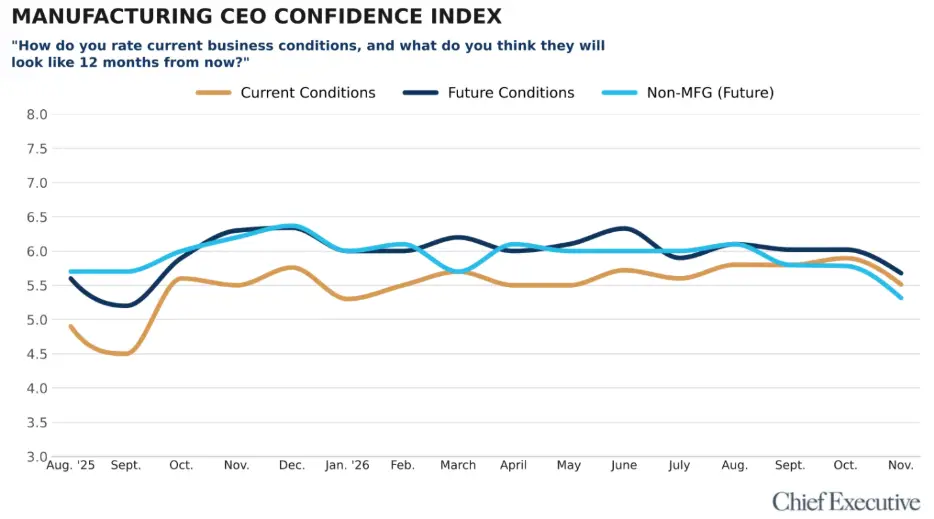
Manufacturing chief executive officers (CEOs) expressed a notable increase in caution in November, with their outlook for the year ahead declining to its lowest point of 2026. This downturn in sentiment was largely influenced by responses gathered before the midterm election results were fully known. Interestingly, manufacturers who provided their assessments after the midterm outcomes were clearer exhibited a level of optimism nearly on par with that observed in October, suggesting a degree of stabilization or relief following the electoral uncertainty.
The latest CEO Confidence Index, compiled by Chief Executive and surveyed between November 3rd and 5th among 435 U.S. CEOs, revealed that manufacturing leaders rated current business conditions at an average of 5.5 out of 10. This score, on a scale where 1 signifies "Poor" and 10 denotes "Excellent," represents a 7 percent decrease from the 5.9 recorded in October and marks the sector’s lowest reading since May of 2026. Their outlook for the next twelve months also experienced a dip, falling 6 percent to 5.7 from 6.0, falling below the average of 6.1 that had been sustained throughout much of 2026.
In comparison, CEOs in the non-manufacturing sector saw a more pronounced decline, with both current conditions and year-ahead outlooks dropping by 8 percent. Their current conditions score settled at 5.3, down from 5.8 in October, indicating that the manufacturing sector, despite its own dip, maintained a lead in perceived business health for the third consecutive month.
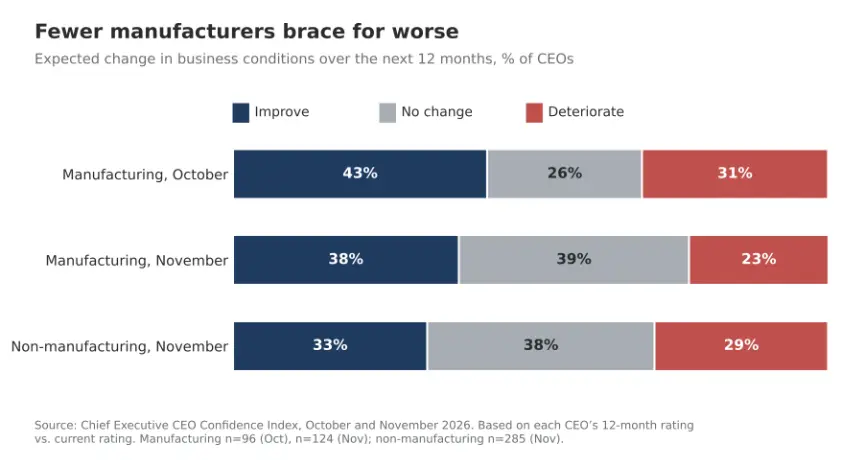
The sentiment shift among manufacturers is further illustrated by the reduced percentage expecting conditions to improve over the next twelve months. This figure dropped to 38 percent in November, down from 43 percent in October. However, the proportion bracing for a deterioration in business conditions fell at a more significant rate, decreasing to 23 percent from 31 percent. This suggests that a larger segment of manufacturing CEOs are now anticipating a period of stagnation rather than outright decline, with 39 percent expecting conditions to remain unchanged, a notable increase from the 26 percent who held this view in October. Non-manufacturing CEOs, meanwhile, displayed a gloomier disposition on both improvement and deterioration metrics.
Demand Dynamics and Sectoral Variations
Demand continues to be the primary catalyst influencing the outlook for manufacturing CEOs. Within the industrial segment, this demand is currently concentrated in a select group of high-growth markets. These include burgeoning sectors such as data centers, extensive power and utility infrastructure projects, the critical semiconductor industry, and the robust aerospace and defense sectors. Scott Wood, representing LISI Aerospace Fasteners North America, a producer of specialized aerospace fasteners, expressed a highly positive view, rating current conditions a perfect 10 and highlighting the sustained strength in aerospace, defense, and space exploration initiatives.
While not the sole driver, the outcome of the midterm elections also played a discernible role in shaping CEO perceptions. One CEO of a mid-sized industrial manufacturing firm attributed an improved outlook, in part, to the perceived recovery within the automotive industry and the results of the elections. Conversely, another executive expressed concerns about a potential slip in conditions, citing the persistent impact of ongoing tariffs and the inherent uncertainty that the midterm results might introduce into the broader business climate.
The Midterm Election Effect
The influence of the midterm elections on CEO confidence mirrors broader trends observed across all industries. Analysis of the survey data indicates that the election results provided a tangible boost to the outlook for manufacturers. CEOs who completed the survey on November 3rd, prior to the full dissemination of election outcomes, rated their twelve-month outlook at 5.5. In contrast, those who responded after the results were known reported a higher outlook of 5.9. Their assessment of current conditions, however, showed minimal variation between the two groups. Furthermore, among respondents who provided feedback post-election, 43 percent anticipated an improvement in business conditions, compared to only 34 percent of those surveyed earlier, with no corresponding increase in expectations of worsening conditions. This suggests that a clearer political landscape, even with its inherent complexities, provided a degree of reassurance.
Divergent Performance Within Manufacturing
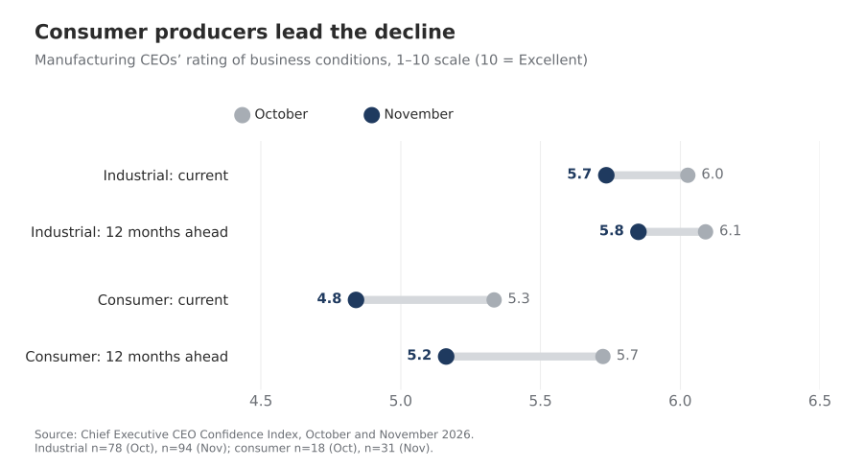
The pressures and outlooks within the manufacturing sector are not uniform, with significant divergences observed between different sub-sectors. Producers of consumer goods are bearing a more substantial portion of the current decline. Their rating of current business conditions saw a 9 percent fall, settling at 4.8, while their year-ahead forecast experienced a 10 percent reduction, reaching 5.2. Industrial manufacturers, in contrast, experienced less pronounced declines, with their current conditions rating at 5.7 and their year-ahead forecast at 5.8. This disparity has widened the gap in perceived current conditions between consumer goods and industrial manufacturers to 0.9 points, up from 0.7 in the previous month.
The CEO of a small consumer goods manufacturing company offered insight into this trend, noting, "Consumers may still be spending money, but they are becoming increasingly selective about where and how they spend it." This indicates a shift in consumer behavior, characterized by increased price sensitivity and a focus on value, directly impacting businesses reliant on discretionary spending.
Economic Outlook: A Divided Landscape
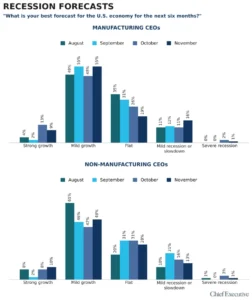
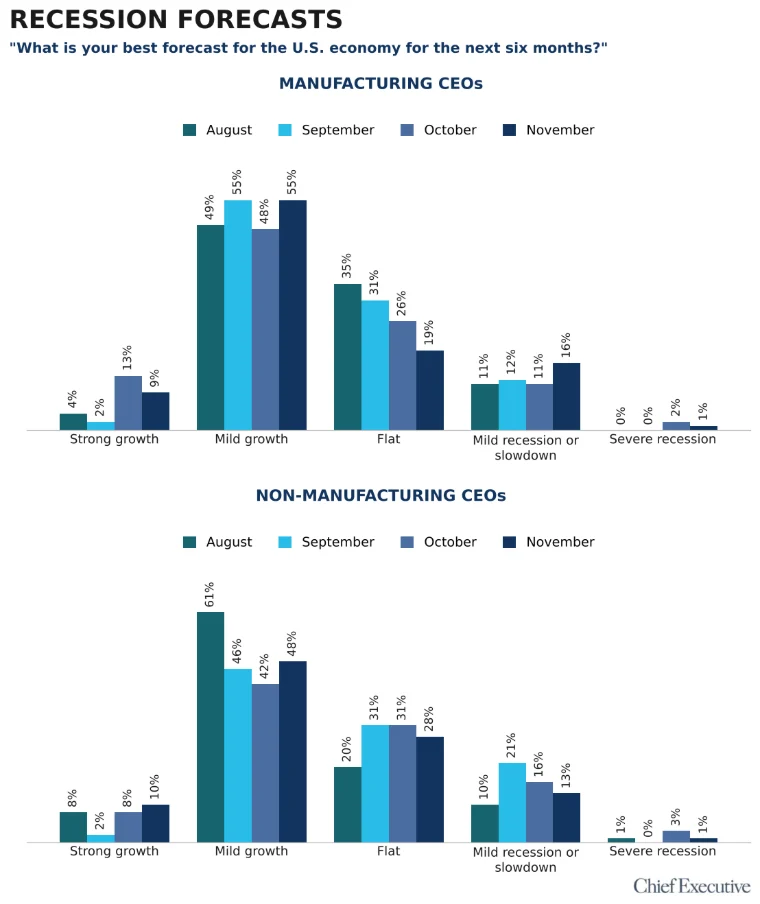
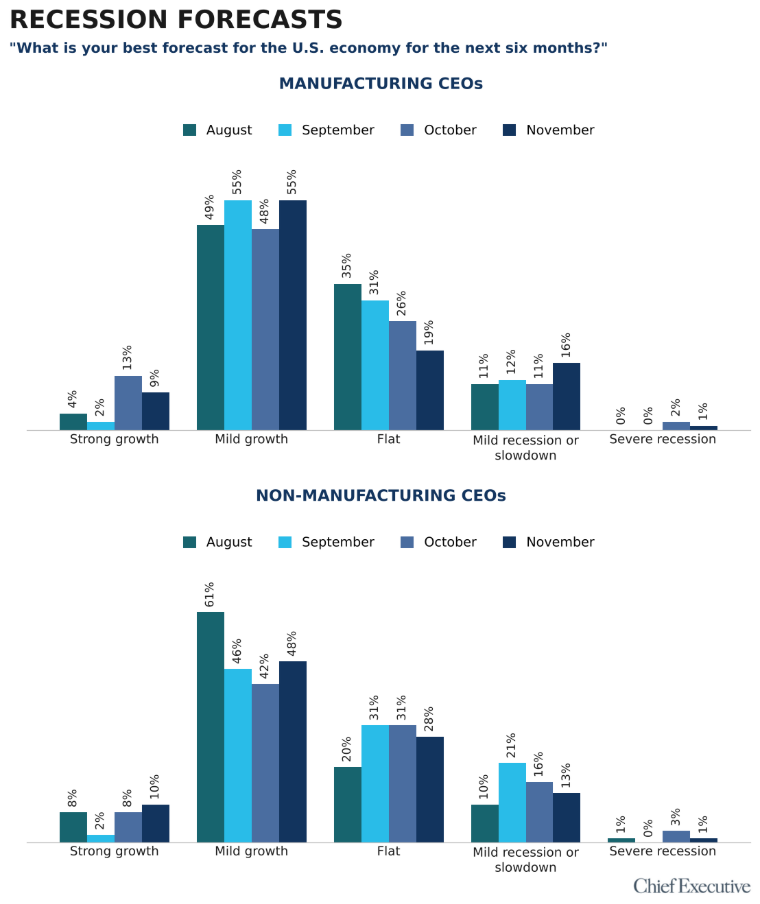
The broader economic outlook, as perceived by manufacturers, is exhibiting a more polarized trend, with opinions spreading towards both optimistic and pessimistic extremes. Sixty-four percent of manufacturers forecast some form of economic growth over the next six months, an increase from 60 percent in October. Concurrently, the proportion anticipating flat economic conditions declined to 19 percent from 26 percent. However, the share of respondents predicting a recession also rose, moving from 14 percent to 17 percent.
Non-manufacturing CEOs also showed a slight inclination towards growth, with the percentage forecasting growth increasing to 58 percent from 50 percent. Their recession forecasts, however, decreased to 14 percent from 19 percent. This leaves manufacturers as both more optimistic about overall growth prospects than their non-manufacturing counterparts and more prone to forecasting a recession. The middle ground, where CEOs expect flat economic conditions, is less populated among manufacturers, with 19 percent holding this view compared to 28 percent of non-manufacturers. This suggests a greater willingness among manufacturers to take a definitive stance on the economic trajectory.
Consumer goods manufacturers emerge as the more pessimistic group within this economic assessment. A significant 29 percent of them forecast a recession, a stark contrast to the 13 percent of industrial manufacturers who share this concern. This divergence likely stems from the differing sensitivities of these sectors to consumer spending patterns and economic downturns.
Persistent Cost Pressures and Interest Rate Concerns
Persistent cost pressures remain a significant drag on the manufacturing sector’s outlook. Across all respondents who elaborated on their reasoning, approximately one in five cited inflation or rising input costs—ranging from raw materials like steel to energy prices—as a key concern. Additionally, about one in ten pointed to the impact of increasing interest rates. Jim Nelson, CEO of Parr Instrument Company, a manufacturer of specialized laboratory equipment, articulated this concern, stating, "Rising interest rates will slow the economy in 2027." This sentiment underscores the anticipation of tighter monetary policy having a tangible effect on economic activity in the coming year.
Softer Outlook, Yet Steady Investment Plans
Despite the more cautious outlook regarding the broader business climate, manufacturers’ forecasts for their own companies’ performance have held up more resiliently. A substantial 75 percent of manufacturers expect to conclude 2026 with higher revenues compared to 2025, and 67 percent anticipate increased profits, showing a slight uptick from 71 percent and 62 percent, respectively, in October. These figures demonstrate a continued confidence in their individual business strategies and market positions. Non-manufacturing CEOs trail behind on both these measures, reporting 65 percent for revenue growth and 61 percent for profit growth.
Looking ahead to 2027, compared with their performance in 2026, manufacturers are projecting continued expansion across key metrics. They are more likely than non-manufacturers to anticipate increases in revenue, profits, and unit volume. Capital spending plans also show a robust trajectory, with a higher proportion of manufacturers intending to increase their capital expenditures. This figure saw a notable rise of 13 percent from October, while the proportion of non-manufacturers planning similar increases declined by 6 percent, settling at 50 percent. This indicates a divergence in investment strategies, with manufacturers prioritizing investment in operational capacity and technological upgrades.
Hiring expectations among manufacturers have seen a slight slip of 4 percent, continuing a trend observed in the previous month where investment was more directed towards equipment and technology rather than expanding payrolls. This suggests a strategic focus on enhancing productivity and efficiency through capital investment.
Cost expectations have seen the most significant movement. A substantial 82 percent of manufacturers now anticipate an increase in operating expenses in 2027, a considerable jump from the 65 percent who projected increases in October. Non-manufacturers’ cost expectations have also climbed, rising to 78 percent from 68 percent. This widespread expectation of rising costs highlights the persistent inflationary pressures and the need for manufacturers to factor these into their financial planning and pricing strategies.
Navigating Uncertainty with Experience and Intuition
For some business leaders, the path forward involves a combination of data-driven analysis and seasoned judgment. The CEO of a mid-sized, family-owned industrial manufacturer emphasized the enduring importance of experience and intuition, stating, "Experience, judgment and the willingness to trust your gut still matter. Sometimes leadership means making a decision before the numbers can fully justify it." This sentiment reflects a nuanced approach to leadership, acknowledging that while data is crucial, strategic decision-making often requires a degree of foresight and an understanding of underlying business dynamics that may not yet be fully quantifiable.
About the CEO Confidence Index
The CEO Confidence Index, a long-standing initiative by Chief Executive Group since 2002, regularly polls hundreds of U.S. CEOs across organizations of all types and sizes. This comprehensive survey aims to track confidence levels in both current and future business environments by analyzing CEOs’ observations on various economic and business components. For further insights into the Index methodology and historical data, readers are encouraged to visit ChiefExecutive.net/category/CEO-Confidence-Index/.