In the contemporary corporate landscape, the definition of an effective manager has evolved. According to recent industry data, the "accidental manager"—an individual promoted due to technical excellence rather than leadership potential—remains a prevalent challenge for Human Resources and Learning and Development (L&D) departments. Research from the Chartered Management Institute suggests that as many as 82% of people entering management roles have not received formal leadership training. This gap underscores the critical necessity of identifying and cultivating a specific set of competencies that allow a manager to transition from "doing" to "leading."
The Katz Framework: Categorizing Managerial Competencies
To understand the architecture of management, organizational psychologists often refer to the foundational framework established by Robert Katz. This model categorizes management skills into three distinct pillars: technical, human, and conceptual.
Technical skills involve role-specific methods, processes, and specialized knowledge. For an L&D manager, this might include the ability to oversee a training budget or navigate a complex Learning Management System (LMS). Human skills, often referred to as "soft skills," center on the ability to work effectively with others, build trust, and coach subordinates. Conceptual skills represent the highest level of managerial thinking, involving the ability to see the organization as a whole, understand how various functions depend on one another, and anticipate how changes in one department will affect the entire enterprise.
As a professional ascends the corporate ladder, the reliance on technical skills typically decreases, while the demand for conceptual and human skills increases exponentially. A senior executive may never touch the software used by their entry-level staff, but their ability to connect a learning investment to a five-year business strategy is what defines their success.
Analysis of the 10 Essential Management Skills
Modern management requires a diverse toolkit that balances empathy with efficiency. The following ten skills have been identified by industry experts as the primary drivers of team performance and organizational health.
1. Communication and Active Listening
Effective communication is the bedrock of management, yet it is often misunderstood as the mere act of giving instructions. True managerial communication involves active listening—the ability to hear not just the words, but the intent and concerns of the speaker. In practice, this means turning vague stakeholder requests into actionable briefs and ensuring that silence in a meeting is not mistaken for universal agreement.
2. Delegation and Empowerment
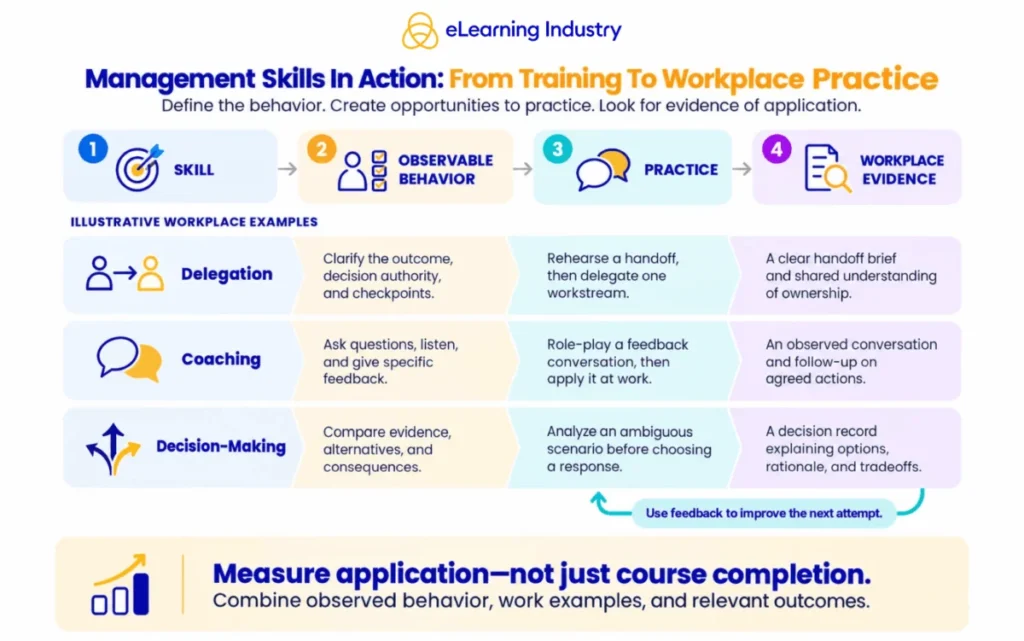
Delegation is not the act of "piling on" work; it is the strategic assignment of tasks to the right people with the right level of authority. High-performing managers set clear boundaries and define what success looks like, then step back to allow their team members to navigate the "how." This fosters a sense of ownership and prevents the bottlenecking effect common in micromanaged environments.
3. Planning, Prioritization, and Resource Allocation
With the rise of "hustle culture" and the "always-on" digital workplace, the ability to prioritize has become a survival skill. Managers must be able to identify which projects move the needle and which are merely distractions. This involves making difficult trade-offs and communicating the "why" behind postponed deadlines to ensure the team remains focused on high-value targets.
4. Coaching and Constructive Feedback
The shift from a "boss" to a "coach" is a hallmark of modern leadership. Instead of correcting a subordinate’s work directly, a skilled manager uses the opportunity to build the employee’s judgment. By asking probing questions and reviewing iterations together, the manager ensures the employee develops the skills to solve the problem independently in the future.
5. Performance Management and Accountability
Accountability is often viewed through a lens of discipline, but in a healthy management structure, it is about consistency. Managers must link performance standards with the necessary support systems. If a team member falls behind, a manager’s first step is to analyze whether the failure was due to a lack of resources, unclear expectations, or a genuine skill gap before determining the next course of action.
6. Emotional Intelligence (EQ) and Inclusion
Emotional intelligence involves self-awareness and the ability to regulate one’s reactions under pressure. In a diverse and often remote workforce, inclusive management ensures that all voices—regardless of personality type or physical location—are heard. Managers with high EQ can navigate tense project reviews without becoming defensive, fostering a culture of psychological safety.

7. Conflict Resolution and Negotiation
Conflict is inevitable in any high-stakes environment. Effective managers do not avoid disagreement; they mediate it. By bringing the conversation back to shared goals and objective data, managers can separate personal friction from professional debate, ensuring that the best ideas win rather than the loudest voices.
8. Decision-Making and Problem-Solving
Managerial decision-making requires a balance of speed and evidence. Before committing company resources to a new initiative, a manager must evaluate alternatives and potential consequences. This prevents the "familiar solution" trap, where teams repeatedly apply the same fixes to symptoms without ever addressing the root cause of a problem.
9. Strategic Thinking and Business Acumen
Strategic thinking allows a manager to connect daily tasks to the organization’s "North Star." It involves understanding market trends, financial constraints, and competitive advantages. A manager with strong business acumen can justify their team’s budget not just as an expense, but as a strategic investment that fills a specific capability gap within the company.
10. Digital Fluency and Change Management
In the era of Artificial Intelligence and rapid digital transformation, managers must be comfortable with technology. However, digital fluency is not just about knowing how to use a tool; it is about managing the human transition to that tool. Effective change management involves testing workflows, gathering user feedback, and adjusting rollout strategies to ensure that technology serves the people, not the other way around.
The Data Behind Managerial Development
The impact of management quality on the bottom line is supported by extensive empirical data. A 2017 meta-analysis of 335 studies conducted by leadership researchers found that management training is most effective when it is not treated as a one-time event. The study highlighted that programs incorporating needs analysis, feedback loops, and spaced practice sessions resulted in significantly higher behavioral change than traditional "one-and-done" workshops.
Furthermore, Gallup’s "State of the American Manager" report reveals that managers account for at least 70% of the variance in employee engagement scores. Companies that invest in developing these ten essential skills see higher retention rates, better productivity, and increased profitability. Conversely, the cost of "bad management" is estimated to cost the global economy trillions of dollars in lost productivity annually.
Chronology of Skill Acquisition: A Career Roadmap
The development of management skills is a chronological journey that evolves with a professional’s level of responsibility.
- The New Manager Phase: Focuses on the transition from peer to supervisor. Key skills to develop include delegation, basic communication, and time management.
- The Mid-Level Manager Phase: Focuses on managing managers. Key skills include conflict resolution, cross-departmental collaboration, and performance coaching.
- The Senior Leader Phase: Focuses on organizational health. Key skills include strategic thinking, financial acumen, and large-scale change management.
For L&D teams, the goal is to create a continuous learning path that mirrors this chronology. This is often achieved through a combination of digital simulations, peer mentoring, and "just-in-time" resources that managers can access in the flow of work.
Distinguishing Management from Leadership
While the terms are often used interchangeably, management and leadership serve different functions within an organization. Management is primarily concerned with complexity—bringing order and consistency to quality and profitability. Leadership is concerned with change—defining a vision for the future and aligning people to achieve it.
A successful professional must be able to switch between these roles. During an LMS implementation, for example, management skills are required to track the budget and timeline, while leadership skills are required to inspire the team to embrace a new way of working despite the initial friction of change.
Implications for the Future Workforce
As AI begins to automate routine administrative tasks, the "human" and "conceptual" elements of management will become even more valuable. Future managers will spend less time scheduling and more time coaching. The ability to navigate ambiguity, foster innovation, and maintain team morale in a volatile market will be the defining characteristics of the next generation of leaders.
Ultimately, management skills are not static traits but dynamic competencies that must be practiced and refined. For organizations looking to thrive in the coming decade, the focus must shift from merely hiring experts to building a robust pipeline of managers who can translate that expertise into collective success. The evidence is clear: when managers grow, their teams grow, and the organization follows suit.