The global landscape of corporate training and professional development is undergoing a fundamental transformation as organizations grapple with the limitations of "one-size-fits-all" educational models. As workforce demographics become increasingly diverse in terms of prior experience and digital literacy, the demand for responsive, data-driven training environments has reached a critical inflection point. Adaptive learning, a methodology that leverages real-time data to customize the educational experience for each individual, has emerged as the primary solution to this challenge. By shifting the focus from static content delivery to dynamic performance adjustment, this approach promises to resolve the long-standing tension between the need for scalable training and the necessity of personalized instruction.
The Current State of the Learning and Development Market
Recent industry data highlights a significant discrepancy between the expectations of corporate leaders and the current capabilities of the educational technology market. According to 2026 research conducted by eLearning Industry, approximately 65% of Learning and Development (L&D) buyers identify personalization as the most valuable application of artificial intelligence in the workplace. Despite this high demand, the supply side of the industry is lagging; only 44% of technology vendors report that they are currently building or planning to implement such features.
The integration of these advanced systems remains in its early stages. The research further reveals that only 7.5% of organizations have fully integrated AI-driven adaptive systems into their learning environments. However, a significant 45% of buyers indicate plans to adopt these technologies in the near future. This gap suggests that while the strategic value of adaptive learning is widely recognized, the technical and structural implementation remains a hurdle for the majority of global enterprises.
Defining Adaptive Learning in a Professional Context
At its core, adaptive learning is an educational method that uses data-driven algorithms to adjust the path, pace, and content of a course in response to a learner’s specific needs. Unlike traditional eLearning, where every participant follows the same linear sequence of modules, an adaptive system creates a unique feedback loop. It continuously monitors how a learner performs on assessments, how much time they spend on specific tasks, and where they demonstrate hesitation or mastery.
It is essential to distinguish between "personalized learning" and "adaptive learning." While the terms are often used interchangeably, they represent different levels of technical sophistication. Personalized learning is a broad strategy that might involve a learner choosing their own path or receiving course recommendations based on their job title. Adaptive learning is the specific mechanism—often powered by AI or complex rule-based logic—that changes the actual instructional experience in real-time based on performance data.
A Chronology of Instructional Evolution
The journey toward modern adaptive learning has been shaped by decades of technological advancement:
- The Era of Traditional Instruction (Pre-1990s): Training was largely instructor-led and classroom-based. Personalization was only possible through one-on-one tutoring, which was impossible to scale across large organizations.
- The Rise of the Learning Management System (LMS) (1990s–2000s): Digital modules allowed for self-paced learning. However, these were largely static, "click-next" presentations where every employee received the same information regardless of their prior knowledge.
- The Data Revolution (2010s): The introduction of xAPI and better data tracking allowed organizations to see more than just "completion" status. They began to see how learners interacted with content.
- The AI and Adaptive Integration (2020s–Present): Modern systems now use machine learning, knowledge graphs, and predictive analytics to make autonomous instructional decisions. This allows for "test-out" options and micro-adjustments that respect the learner’s time and existing expertise.
The Core Components of an Adaptive System
For an adaptive learning platform to function effectively, four distinct models must work in synchronized harmony:
1. The Content Model
This is the library of information, broken down into "micro-learning" objects. Each piece of content is tagged with metadata regarding its difficulty, the specific skill it teaches, and how it relates to other concepts. Without a well-structured content model, the algorithm has no "map" to navigate.
2. The Learner Model
The system creates a digital profile for every individual. This model is updated every time the learner interacts with the platform. It tracks what they have mastered, where they are struggling, and even their confidence levels if the system includes self-assessment features.
3. The Instructional Model
This represents the "brain" of the system. It contains the logic or algorithms that decide what happens next. If a learner misses three questions about data privacy, the instructional model might decide to present a different explanation or a video case study rather than just repeating the same text.
4. The Technology Environment
This is the user interface and the underlying engine that facilitates the data exchange. In modern contexts, this often involves cloud-based platforms that can integrate with an organization’s existing Human Resources Information System (HRIS).
The Adaptive Learning Cycle: A Step-by-Step Process
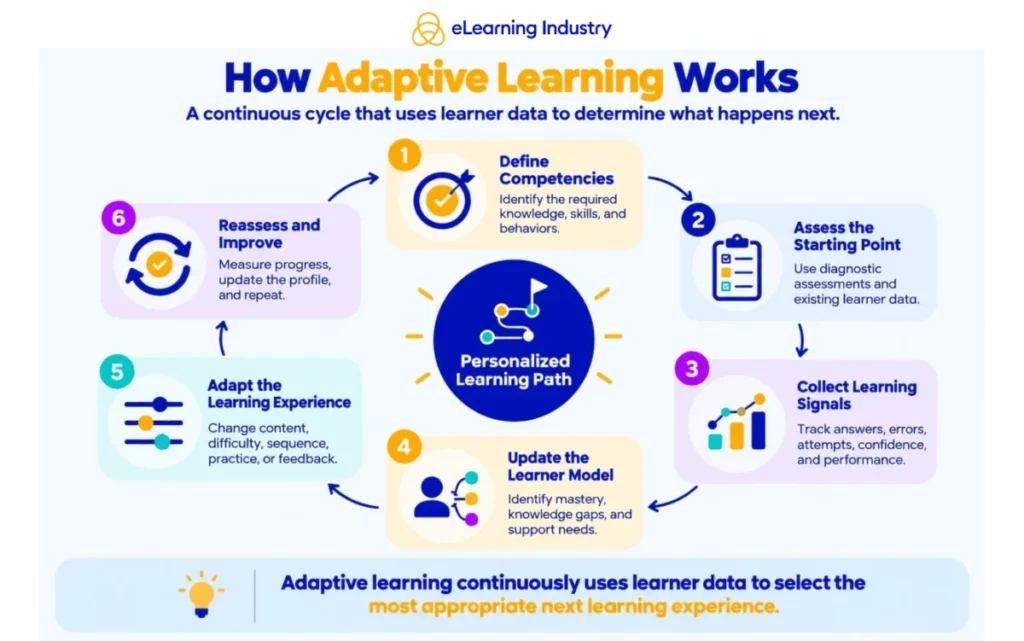
The functionality of these systems follows a continuous, repeating cycle rather than a linear start-to-finish path.
- Competency Definition: The organization identifies the specific target skill, such as "Advanced Cybersecurity Protocols."
- Baseline Establishment: The learner takes a diagnostic assessment to determine their starting point.
- Signal Collection: As the learner progresses, the system gathers "signals"—correct/incorrect answers, time spent on slides, and repeated mistakes.
- Model Update: The system adjusts the learner’s profile based on these signals.
- Experience Selection: The algorithm chooses the next activity, which could be a harder challenge, a remedial module, or a skip-ahead option.
- Continuous Reassessment: The cycle repeats until the learner demonstrates the required level of mastery.
Strategic Benefits for the Modern Workforce
The implementation of adaptive learning provides several measurable advantages for large-scale organizations.
Efficiency and Time-to-Competency
One of the most significant wastes in corporate training is the "knowledge redundancy" problem, where experienced employees are forced to sit through basic training. Adaptive systems allow these individuals to prove their mastery and move directly to advanced topics. This significantly reduces the total time spent in training while ensuring that competency standards are met.
Enhanced Visibility for L&D Leaders
Traditional metrics—such as "course completion rates"—offer very little insight into whether an employee actually understands the material. Adaptive learning provides granular data. Managers can see exactly which concepts are causing the most confusion across the entire company, allowing them to adjust their broader business strategies or provide targeted coaching.
Scalable Personalization
In the past, the only way to provide truly personalized instruction was through a human mentor. Adaptive technology allows an organization with 50,000 employees to provide each one with a customized learning path that feels like a private tutoring session, all without the prohibitive cost of human-led instruction for every module.
Industry Reactions and Implementation Challenges
While the potential is vast, industry experts and Chief Learning Officers (CLOs) have expressed a mix of optimism and caution. Many argue that the success of adaptive learning depends less on the "intelligence" of the AI and more on the quality of the content.
"An algorithm is only as good as the content it has to choose from," notes one industry analyst. "If you have poor instructional design, the most advanced AI in the world will simply deliver bad content more efficiently."
Furthermore, there are significant logistical hurdles:
- Content Complexity: Creating modular, tagged content requires more upfront work from instructional designers than creating a standard slide deck.
- Data Privacy: As systems collect more behavioral data, organizations must navigate strict privacy regulations such as GDPR.
- The "Black Box" Problem: Some leaders are hesitant to trust an algorithm to decide who is "competent," preferring more transparent, human-verifiable testing methods.
A Roadmap for Implementation
For organizations looking to transition to adaptive models, a structured six-step approach is recommended:
- Identify a Specific Performance Gap: Avoid a general rollout. Start with a high-stakes area like sales training or technical certification where performance differences are easy to measure.
- Define Mastery Standards: Clearly articulate what "success" looks like. Is it a test score, or the ability to complete a simulation without errors?
- Launch a Focused Pilot: Test the system with a specific department to compare results against traditional training methods.
- Modularize Assets: Break existing long-form courses into smaller, searchable units that an algorithm can easily re-sequence.
- Establish Adaptation Logic: Decide the "rules of the road." For instance, how many times can a learner fail a module before a human instructor is notified?
- Evaluate and Scale: Use metrics such as "reduction in training time" and "improvement in job performance" to justify a wider rollout.
Future Implications: The Shift Toward Predictive Learning
As adaptive learning systems become more sophisticated, the industry is moving toward "predictive learning." Future platforms may not just react to what a learner does, but predict what they will need to know next based on their career trajectory, industry trends, and emerging skill gaps in the company.
In conclusion, adaptive learning represents a move away from passive consumption toward active, performance-based development. While the technology requires a significant shift in how content is designed and managed, the result is a more responsive, efficient, and respectful training experience. As AI continues to evolve, the gap between vendor capabilities and buyer expectations is expected to close, making adaptive learning a standard component of the global corporate ecosystem. Technology, in this context, serves as the ultimate facilitator for a more human-centric approach to growth, ensuring that every employee receives the exact support they need at the precise moment they need it.