The modern corporate landscape is undergoing a fundamental shift in how intellectual capital is managed, as organizations increasingly recognize that internal expertise must be transformed from a personal attribute into a collective organizational asset. In an era defined by rapid technological disruption and the rise of hybrid work models, the ability to effectively share knowledge has become a primary determinant of competitive advantage. While every organization possesses "hidden experts" capable of solving complex problems and navigating intricate tasks, the critical challenge remains the democratization of this expertise—ensuring that the right information reaches the right people at the precise moment of need.
The Evolution of Workplace Learning and Knowledge Acquisition
The traditional paradigm of workplace learning, once confined to formal training sessions and structured courses, has evolved into a multi-faceted ecosystem. Learning and Development (L&D) leaders now operate in an environment where knowledge is fluid, moving through informal conversations, digital collaboration tools, professional communities, and direct project experience. This shift is driven by the realization that as much as 70% to 80% of workplace learning occurs through social interactions and on-the-job experiences rather than formal instruction.
With the integration of Artificial Intelligence (AI) and the prevalence of distributed teams, the mechanisms for finding and verifying information have changed. Organizations are no longer just repositories of data; they are living networks of expertise. To thrive, these networks require robust systems to capture, share, and validate knowledge, moving beyond simple tool implementation toward a holistic integration of culture, technology, and governance.
Defining the Parameters: Knowledge Sharing vs. Knowledge Management
To implement a successful strategy, it is essential to distinguish between knowledge sharing and the broader umbrella of knowledge management (KM). While often used interchangeably, they represent different layers of the organizational intelligence framework.
Knowledge management is the overarching discipline concerned with how an organization identifies, captures, organizes, and maintains its intellectual capital. It provides the infrastructure—the databases, the governance policies, and the structural environment. Knowledge sharing, conversely, is the active process of exchange. it is the movement of insights, skills, and practical know-how between individuals and groups.
Industry experts often describe knowledge management as the "plumbing" of an organization, while knowledge sharing is the "water" that flows through it. A repository full of documents is a product of management, but it only gains value through the act of sharing—when that information is retrieved and applied to solve a problem or make a critical decision.
The Strategic Value of Open Information Flows
The cost of "knowledge silos"—where information is trapped within specific departments or individuals—is significant. Research by the International Data Corporation (IDC) has historically suggested that Fortune 500 companies lose roughly $31.5 billion annually by failing to share knowledge effectively. The benefits of breaking these silos are measurable across several key performance indicators:
Accelerated Problem Solving
When teams have access to a shared history of solutions, they avoid the "reinventing the wheel" syndrome. By leveraging lessons learned from previous projects, employees can bypass known pitfalls and apply proven methodologies to current challenges.
Operational Efficiency and Reduced Redundancy
A significant portion of the workday is often spent searching for information or recreating resources that already exist elsewhere in the company. Effective sharing ensures that templates, processes, and presentations are reused, allowing staff to focus on high-value innovation rather than administrative duplication.

Streamlined Onboarding and Talent Retention
For new hires, the "ramp-up" period is drastically shortened when they have access to more than just policy manuals. Access to the "tribal knowledge" of an organization—how things actually get done and who to call when standard procedures fail—is essential for early-stage productivity. Furthermore, robust sharing protocols mitigate the risk of "brain drain" when key employees retire or resign.
Enhanced Learning Transfer
L&D initiatives often suffer from a lack of "stickiness." Knowledge sharing reinforces formal training by providing a platform for ongoing peer discussion, expert demonstration, and the practical application of new skills in a real-world context.
The Taxonomy of Expertise: Explicit and Tacit Knowledge
Effective knowledge sharing requires an understanding that not all information is created equal. Modern organizations deal with two primary types of knowledge, each requiring a distinct approach for dissemination.
Explicit Knowledge is information that is easily codified and recorded. This includes standard operating procedures (SOPs), checklists, technical manuals, and white papers. Because this knowledge is tangible, it is best shared through digital repositories, intranets, and searchable knowledge bases.
Tacit Knowledge, however, is the "know-how" gained through years of experience. It involves intuition, judgment, and the ability to navigate nuances. For example, while a manual can explain how to use a software tool, it cannot easily teach the professional judgment required to handle a disgruntled high-stakes client. Tacit knowledge is best shared through human-centric methods such as mentoring, job shadowing, and storytelling.
| Type of Knowledge | Workplace Example | Optimal Sharing Method |
|---|---|---|
| Explicit | Technical Documentation | Knowledge Base / Wiki |
| Tacit | Expert Intuition | Mentoring / Coaching |
| Project-Based | Lessons Learned | Post-Mortem / Retrospectives |
| Emerging | New Market Trends | Communities of Practice |
| Formal | Core Competencies | LMS + Social Learning |
Eight Proven Methodologies for Knowledge Dissemination
To move beyond theory, organizations must implement practical activities that facilitate the flow of information.
- Knowledge Sharing Sessions: Brief, focused presentations where internal experts demonstrate a specific workflow or share a success story. These are often more effective than formal training because they are rooted in the organization’s specific context.
- Communities of Practice (CoPs): Groups of employees with shared professional interests who meet regularly to solve problems and share best practices. CoPs are vital for breaking down departmental silos.
- Peer-to-Peer Learning: Encouraging employees to teach one another through collaborative projects and feedback loops. This decentralizes the role of the "teacher" and empowers all staff.
- Mentoring and Shadowing: High-touch methods designed specifically for the transfer of tacit knowledge and leadership nuances.
- After-Action Reviews (AARs): Structured debriefs following a project’s conclusion to document what went well and what failed. This turns temporary experience into permanent organizational memory.
- Expert Demonstrations: "Show, don’t just tell" sessions, such as a top salesperson recording a mock call to demonstrate objection handling.
- Dynamic Knowledge Bases: Managed wikis and playbooks that are regularly updated. The key here is governance; a knowledge base that contains outdated information quickly loses user trust.
- Digital Collaboration Channels: Using platforms like Slack or Microsoft Teams to create dedicated spaces for FAQs and resource sharing. To be effective, these must be curated so that vital insights do not disappear in a "scroll of oblivion."
The Six-Stage Knowledge Sharing Strategy
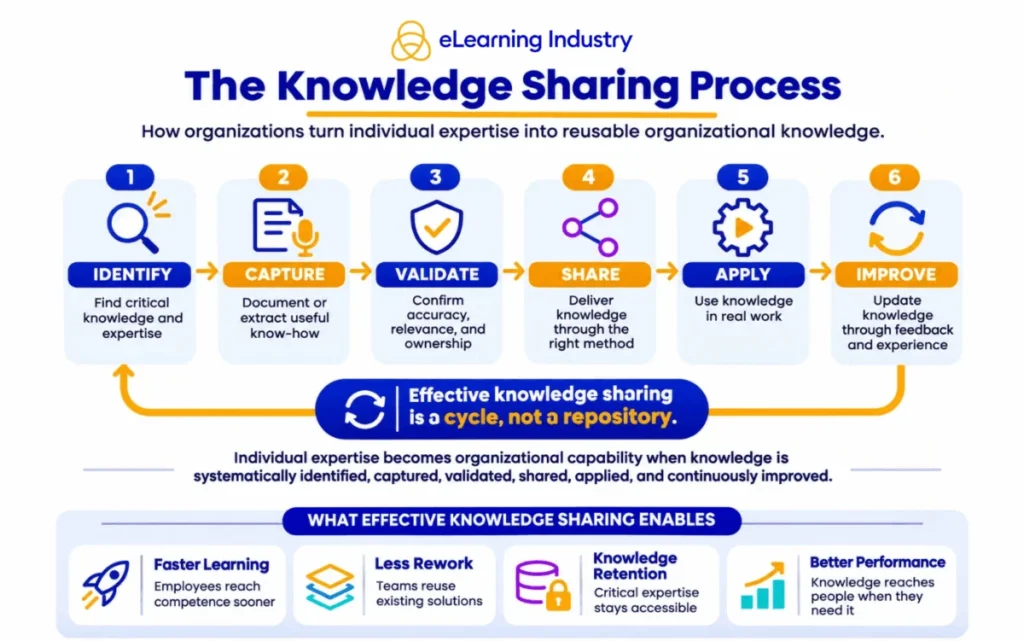
Building a sustainable culture of sharing requires a systematic approach. L&D and business leaders should follow a structured lifecycle:
- Identification: Pinpointing the most critical knowledge—often the information that exists in the heads of only one or two people.
- Capture: Utilizing interviews, video recordings, or documentation to bring that knowledge into the light.
- Validation: Ensuring the information is accurate and up to date through peer review or subject matter expert (SME) approval.
- Distribution: Placing the knowledge in a format and location where it is easily discoverable.
- Application: Encouraging employees to use the shared knowledge in their daily tasks.
- Refinement: Treating knowledge as a "living document" that is updated as the business environment changes.
Overcoming Cultural and Structural Barriers
Despite the clear benefits, many organizations struggle with implementation. According to a 2026 survey by the American Productivity & Quality Center (APQC), 40% of organizations identified "culture" as the single greatest threat to knowledge management success.
Common barriers include:
- The "Knowledge is Power" Mindset: Employees may hoard information, fearing that sharing it makes them replaceable. Organizations must pivot to reward systems that recognize those who contribute to the collective intelligence.
- Time Constraints: If sharing is seen as "extra work" on top of a full workload, it will be neglected. Sharing must be integrated into the natural flow of work.
- Tool Overload: Using too many platforms can lead to "fragmented knowledge," where employees don’t know where to look. Consolidation and clear "systems of record" are essential.
- Lack of Trust: If the shared information is perceived as inaccurate or the environment lacks psychological safety, employees will hesitate to contribute or use the system.
Conclusion: The Future of the Intelligent Organization
The transition from a "need to know" culture to a "need to share" culture is no longer optional. As AI begins to automate routine information retrieval, the human element of sharing—context, judgment, and experience—becomes even more valuable. The goal for modern leadership is not to capture every byte of data, but to create a friction-less environment where expertise flows naturally to where it is most needed. By prioritizing knowledge sharing, organizations do more than just improve efficiency; they build a resilient, learning-capable entity that is prepared for the uncertainties of the future. Knowledge, when shared, does not divide; it multiplies.