
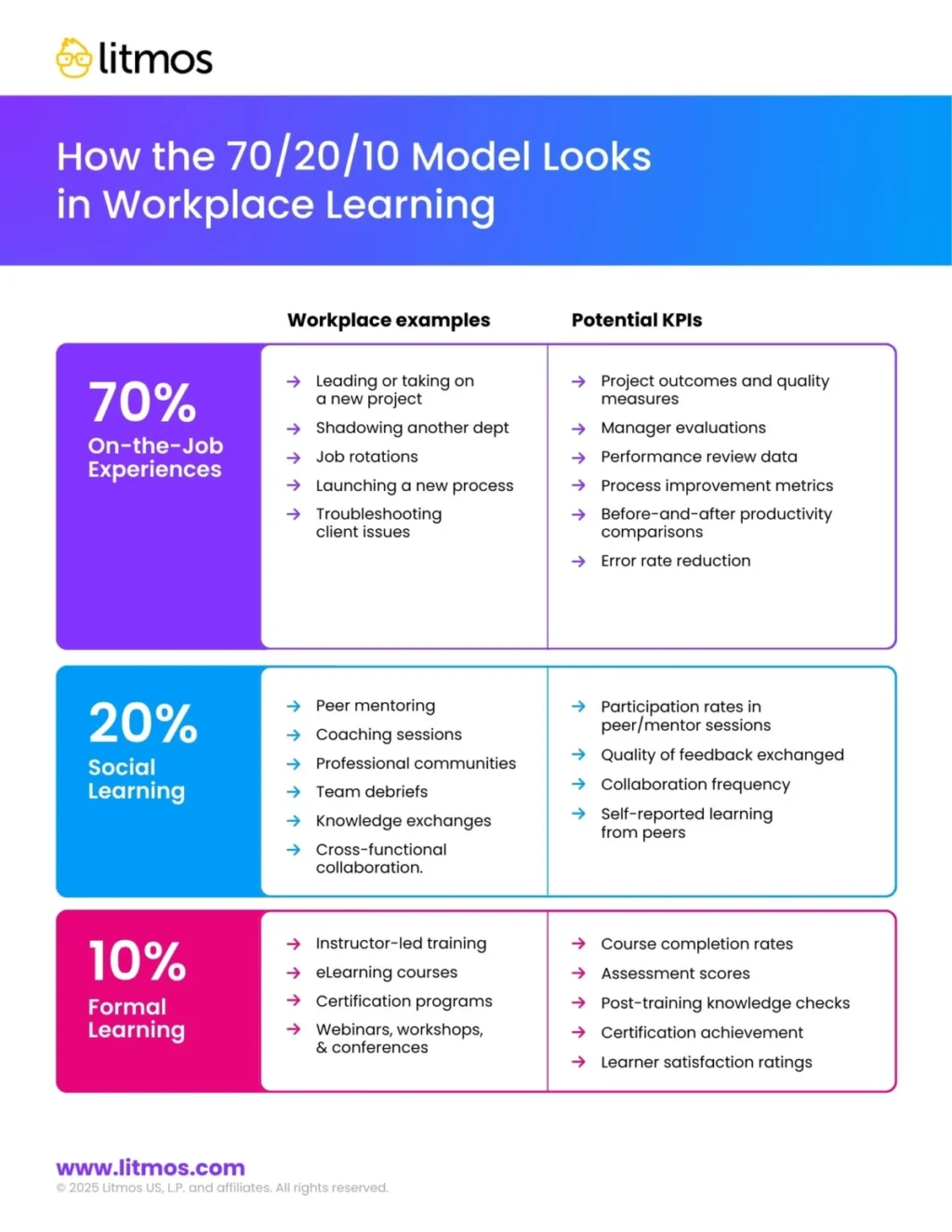
In the rapidly shifting landscape of corporate development, organizations are increasingly moving away from the traditional reliance on isolated training seminars and toward a more integrated philosophy of talent cultivation. Central to this transformation is the 70/20/10 learning model, a framework that challenges the conventional wisdom of the "classroom-first" approach. As the global economy becomes more digitized and agile, Learning and Development (L&D) professionals are utilizing this ratio to better align corporate education with the natural ways in which human beings acquire and retain professional proficiency.
The 70/20/10 model posits that individuals obtain 70 percent of their knowledge from job-related experiences, 20 percent from interactions with others, and only 10 percent from formal educational events. While the model has existed for decades, its relevance has surged in the post-pandemic era as companies grapple with skills gaps and the need for continuous upskilling in a hybrid work environment.
The Historical Genesis of the 70/20/10 Framework
The origins of the 70/20/10 framework can be traced back to the 1980s, arising from the research of Morgan McCall, Michael Lombardo, and Robert Eichinger at the Center for Creative Leadership (CCL) in Greensboro, North Carolina. The researchers sought to understand the specific developmental experiences of successful and effective managers.
Through a series of intensive interviews with nearly 200 executives, the CCL team identified that the most significant career breakthroughs did not occur in the classroom. Instead, they were the result of "hard knocks" and "stretch assignments." The 1988 publication The Lessons of Experience solidified these findings, providing a blueprint for what would become the 70/20/10 ratio.
Chronologically, the model transitioned from a niche academic observation to a cornerstone of human resources strategy in the late 1990s and early 2000s. Companies like Goldman Sachs, Nike, and Ernst & Young began adopting the framework to decentralize learning, moving it out of the training department and directly into the flow of daily operations.
Deconstructing the Three Pillars of Professional Growth
To understand the practical application of the model, one must examine the specific mechanics of each component and how they interact to create a cohesive developmental ecosystem.
The 70 Percent: Experiential Learning in the Flow of Work
The largest portion of the model is dedicated to on-the-job experience. This is often referred to as "learning in the flow of work." It encompasses the daily challenges, mistakes, and successes an employee encounters while performing their duties.
Experiential learning is effective because it provides immediate context and relevance. When an employee encounters a problem and finds a solution, the neural pathways associated with that task are strengthened more effectively than if they had simply read about the solution in a manual. Examples of the 70 percent include:
- Managing a new project or a cross-functional team.
- Troubleshooting a technical failure in real-time.
- Handling a difficult client negotiation.
- Temporary assignments in different departments (job rotation).
The 20 Percent: Social Learning and Developmental Relationships
Social learning focuses on the collaborative nature of the workplace. It acknowledges that human beings are social creatures who learn by observing others, receiving feedback, and participating in professional discourse.
In a modern context, the 20 percent has expanded beyond simple water-cooler conversations. It now includes:
- Mentorship and Coaching: Formal and informal pairings where senior leaders share institutional wisdom.
- Peer Feedback: The "social check" where colleagues review each other’s work.
- Communities of Practice: Digital or physical groups where professionals discuss industry trends and shared challenges.
- Working Out Loud: A practice where employees narrate their work process on internal platforms like Slack or Microsoft Teams, allowing others to learn from their methodology.
The 10 Percent: Formal Education and Structured Training
The smallest slice of the pie—formal training—remains the foundation upon which the other 90 percent is built. While 10 percent may seem negligible, it provides the essential theoretical framework, compliance standards, and baseline skills necessary for an employee to safely and effectively engage in experiential and social learning.
Formal learning includes:
- University degrees and professional certifications.
- eLearning modules and webinars.
- In-person workshops and seminars.
- Instructional manuals and standard operating procedures (SOPs).
Supporting Data and the Business Case for Implementation
The shift toward the 70/20/10 model is not merely a matter of pedagogical preference; it is driven by measurable business outcomes. Data from various industry reports suggest that traditional training methods often suffer from the "forgetting curve," a hypothesis that humans forget approximately 70 percent of new information within 24 hours if it is not applied immediately.

According to a study by the Association for Talent Development (ATD), organizations that offer comprehensive training programs—but integrate them with on-the-job application—see a 218 percent higher income per employee than those without formalized development. Furthermore, LinkedIn’s 2024 Workplace Learning Report indicates that "opportunities to learn and grow" is now the number one driver of work culture, surpassing even work-life balance for many demographic cohorts.
From a cost-efficiency perspective, the 70/20/10 model reduces the overhead associated with large-scale off-site training. By shifting the focus to experiential learning, companies leverage existing assets—their own work projects and senior staff—to educate the workforce, thereby maximizing internal resources.
Strategic Integration: Moving Beyond Ratios
L&D experts caution that the 70/20/10 model should be viewed as a philosophy rather than a rigid mathematical formula. The specific percentages may shift depending on the industry, the role, and the individual’s career stage. For instance, a junior software engineer may require a higher percentage of formal training (the 10 percent) to master a new coding language before they can effectively contribute to a high-stakes project (the 70 percent).
To successfully implement the model, organizations are adopting several key strategies:
Empowering Frontline Managers
Since 70 percent of learning happens on the job, the direct manager becomes the primary "teacher." Organizations are now training managers on how to provide constructive feedback, how to identify "stretch assignments" for their subordinates, and how to act as coaches rather than just taskmasters.
Leveraging Learning Technologies
The rise of Learning Management Systems (LMS) and Learning Experience Platforms (LXP) has made it easier to track the 20 and 70 percent. Modern platforms allow employees to log informal learning activities, such as reading an article or having a mentoring session, providing a more holistic view of their development.
Connecting Formal to Informal
The most effective L&D programs ensure that the 10 percent (formal training) leads directly into the 70 percent (experience). For example, a workshop on leadership should be immediately followed by an assignment where the participant leads a small committee, ensuring the theoretical knowledge is solidified through practice.
Measuring Success: From Vanity Metrics to Impact Analytics
One of the primary challenges in adopting the 70/20/10 model is measurement. Traditional L&D metrics often rely on "vanity metrics," such as course completion rates or "smile sheet" surveys after a seminar. These metrics fail to capture the 90 percent of learning that happens outside the classroom.
To address this, forward-thinking HR departments are utilizing more sophisticated evaluation strategies:
- Behavioral Observations: Assessing whether an employee’s performance has actually changed on the job following a developmental period.
- Network Analysis: Using digital tools to see how often employees are collaborating and sharing knowledge across departments (measuring the 20 percent).
- Business Impact Results: Correlating learning initiatives with Key Performance Indicators (KPIs) such as increased sales, reduced error rates, or improved customer satisfaction scores.
Industry Perspectives and Future Implications
Industry analysts suggest that the 70/20/10 model is currently undergoing another evolution due to the advent of Artificial Intelligence. AI-driven coaching bots and real-time performance support tools are blurring the lines between the three categories. When an employee asks an AI for help with a spreadsheet formula while working, is that formal training (10%), social interaction (20%), or experiential learning (70%)?
"The model is becoming more fluid," says one industry consultant. "We are moving toward a ‘100 percent learning’ environment where the distinction between working and learning is almost non-existent. The 70/20/10 framework provides the necessary structure to ensure that as we move toward this future, we don’t neglect the social and foundational elements that make learning human."
Broader Impact on Workforce Retention and Agility
The long-term implication of the 70/20/10 model is a more resilient and adaptable workforce. By embedding learning into the daily routine, organizations foster a "growth mindset" among employees. This culture of continuous improvement is essential in a global market where the half-life of professional skills is shrinking.
Furthermore, the model plays a critical role in succession planning. By emphasizing the 20 percent (social learning), organizations ensure that institutional knowledge is transferred from retiring veterans to the next generation of leaders through mentorship and collaborative projects.
In conclusion, the 70/20/10 model represents a shift from "training as an event" to "learning as a process." By acknowledging that the vast majority of professional growth occurs through experience and interaction, organizations can design more effective, cost-efficient, and engaging development programs. As the world of work continues to evolve, the ability to learn in the flow of work will likely become the single most important competitive advantage for both individuals and the companies that employ them.






