
In an era defined by rapid information cycles and increasing automation, the capacity for deep cognitive engagement has become a primary differentiator in workforce performance. Instructional designers and organizational leaders are increasingly moving away from simple content delivery toward a more sophisticated model of cognitive engineering. This shift focuses on "levels of thinking"—a hierarchical framework that describes how individuals process information, ranging from immediate, reactive recall to complex, systemic reasoning. By understanding and implementing these levels, organizations can transition from shallow learning outcomes to transformative behavior changes that drive long-term strategic value.
The Evolution of Cognitive Frameworks in Professional Development
The concept of thinking levels is not a new phenomenon in educational psychology, but its application in the corporate sector has evolved significantly over the last decade. Historically, training programs were heavily influenced by early iterations of Bloom’s Taxonomy, which categorized learning into levels such as knowledge, comprehension, and application. However, the modern business environment—characterized by volatility, uncertainty, complexity, and ambiguity (VUCA)—requires a more agile approach.
Today’s instructional design landscape distinguishes between "thinking types," which describe the nature of the cognitive process (such as creative or critical thinking), and "thinking levels," which describe the depth of that process. While thinking styles refer to individual preferences, cognitive depth determines the efficacy of decision-making and problem-solving in high-stakes environments. The integration of these concepts allows for the creation of "smarter" courses that do not merely inform but actively reshape how an employee perceives and interacts with their professional ecosystem.
The Three Levels of Cognitive Engagement
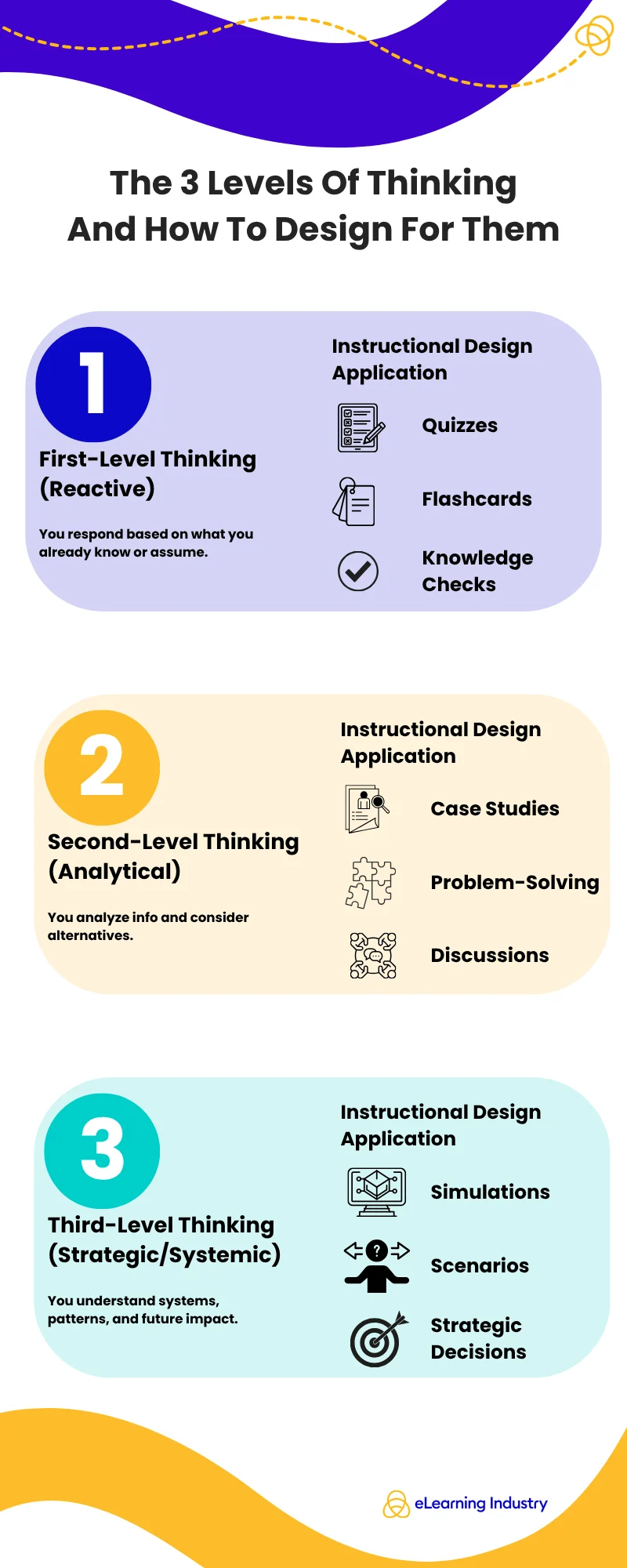
To effectively design learning experiences, professionals must categorize cognitive activity into three distinct levels. Each level serves a specific function within an organization, but the highest levels are where the most significant business impact is realized.
Level 1: Reactive Thinking (The First Order)
First-level thinking is characterized by speed and automaticity. It relies heavily on heuristics, past experiences, and immediate pattern recognition. In a workplace context, this often manifests as "autopilot" behavior. While essential for routine tasks and quick responses under pressure, reactive thinking is susceptible to bias and fails to account for long-term consequences.
In many compliance-based training programs, Level 1 thinking is the primary target. Learners are asked to recognize a violation or recall a specific rule. While necessary for foundational knowledge, relying solely on this level limits an organization’s ability to innovate or adapt to novel challenges.
Level 2: Analytical Thinking (The Second Order)
Second-level thinking represents a significant step forward in cognitive depth. It involves the deliberate evaluation of alternatives, the questioning of initial assumptions, and the weighing of potential outcomes. This is where critical thinking skills are most frequently deployed.
Analytical thinking is the cornerstone of effective management and risk assessment. When an employee engages at this level, they are not just identifying a problem; they are analyzing the data behind it and comparing different solutions. Instructional designers target this level through scenario-based learning and case studies that require learners to justify their choices based on evidence rather than intuition.
Level 3: Systemic and Strategic Thinking (The Third Order)
Third-level thinking is the most advanced stage of cognitive processing. It moves beyond the immediate problem and the individual solution to look at the entire system. This level considers the "ripple effects" of a decision across different departments, stakeholders, and future timelines.
In leadership development, Level 3 thinking is indispensable. It requires the ability to see how a change in one part of the organization affects the whole. This systemic view allows for strategic foresight, enabling leaders to navigate complex organizational changes and long-term market shifts. Training for this level often involves high-fidelity simulations and multi-layered projects that mirror the interconnected nature of modern business.
A Taxonomy of Thinking Types for Instructional Design
While the three levels provide a hierarchy of depth, instructional designers also utilize various "types" of thinking to activate specific cognitive pathways. A comprehensive learning strategy integrates these ten essential types to ensure a holistic development experience:

- Critical Thinking: The objective analysis and evaluation of an issue to form a judgment. It is the primary tool for identifying biases and risks.
- Creative Thinking: The ability to look at things differently and find new ways of solving problems. It is the engine of innovation.
- Analytical Thinking: The process of breaking down complex information into manageable parts to understand relationships and patterns.
- Reflective Thinking: The practice of reviewing past experiences to gain insights. This is crucial for continuous improvement and "learning how to learn."
- Logical Thinking: Reasoning conducted according to strict principles of validity. It is essential for troubleshooting and technical procedures.
- Divergent Thinking: A thought process used to generate creative ideas by exploring many possible solutions.
- Convergent Thinking: The opposite of divergent thinking, this involves bringing together different ideas from various sources to find a single, best solution.
- Abstract Thinking: The ability to think about objects, principles, and ideas that are not physically present. This is key to understanding organizational culture and strategy.
- Concrete Thinking: A literal thinking style that focuses on the physical world and immediate facts. It is the foundation for task-based training.
- Lateral Thinking: Solving problems through an indirect and creative approach, typically through viewing the problem in a new and unusual light.
Industry Data: The Rising Demand for Higher-Order Thinking
Data from global economic forums and workforce analysts suggest that the demand for higher-order thinking is reaching a critical point. According to the World Economic Forum’s Future of Jobs Report, analytical thinking and creative thinking remain the most important skills for workers in 2024 and beyond.
The report highlights that as AI takes over routine (Level 1) tasks, the human workforce must excel in Level 2 and Level 3 thinking. Employers are increasingly reporting a "skills gap" not in technical knowledge, but in the ability to apply that knowledge critically and systemically. Furthermore, LinkedIn Learning’s annual reports consistently place "problem-solving" and "strategic thinking" at the top of the most in-demand soft skills globally.
For Learning and Development (L&D) departments, this data translates to a clear mandate: training programs must move up the cognitive hierarchy. Programs that remain stuck in Level 1 recall are seeing diminishing returns on investment (ROI), as they do not prepare the workforce for the complexities of the modern economy.
Strategic Implementation: Moving from Theory to Practice
Instructional designers are now employing specific strategies to ensure their courses trigger the appropriate level of thought. The transition from "content delivery" to "cognitive activation" involves several key tactical shifts:
Aligning Objectives with Cognitive Depth
Every instructional objective must be mapped to a thinking level. Instead of "Learners will be able to list the steps of the sales process" (Level 1), a more effective objective would be "Learners will be able to analyze a client’s unique needs and adapt the sales process to maximize long-term value" (Level 3).
Matching Format to Thinking Type
The choice of media—whether it be video, interactive simulation, or peer-to-peer discussion—should be driven by the desired thinking type. For instance, reflective thinking is best supported by journaling prompts or "after-action reviews," while divergent thinking is better served by collaborative whiteboarding sessions or design sprints.
Assessment Beyond Multiple Choice
To measure higher-level thinking, assessments must evolve. While multiple-choice questions can effectively test Level 1 recall, they often fail to capture Level 2 or 3 proficiency. Instead, designers are utilizing performance-based assessments, where learners must complete a task in a simulated environment, or portfolio-based assessments, where they demonstrate the application of systemic thinking over time.
Stakeholder Perspectives and Organizational Impact
The shift toward deeper thinking models has garnered significant support from C-suite executives and Chief Learning Officers (CLOs). Many leaders argue that the primary goal of corporate education should be the development of "judgment."
"In a world where information is a commodity, the ability to process that information into sound judgment is our most valuable asset," says one industry analyst. "Organizations that train for ‘what’ to think are falling behind those that train for ‘how’ to think."
From a learner’s perspective, the impact is equally significant. Employees report higher levels of engagement when training challenges them to solve real problems rather than just memorizing facts. This engagement leads to better knowledge retention and a higher likelihood of "transfer"—the application of learned skills to the actual job.
Conclusion: The Future of Cognitive-Centric Design
As organizations continue to navigate an increasingly complex global landscape, the role of the instructional designer will continue to shift toward that of a "cognitive architect." By intentionally designing for the three levels of thinking and integrating diverse thinking types, L&D professionals can build a workforce that is not only knowledgeable but also agile, analytical, and strategically minded.
The long-term implications of this shift are profound. Organizations that prioritize cognitive depth will be better equipped to innovate, manage risks, and maintain a competitive edge. Ultimately, the goal of modern learning design is to foster a culture of "third-level thinking," where every employee understands their role within the broader system and possesses the cognitive tools to drive the organization forward.






