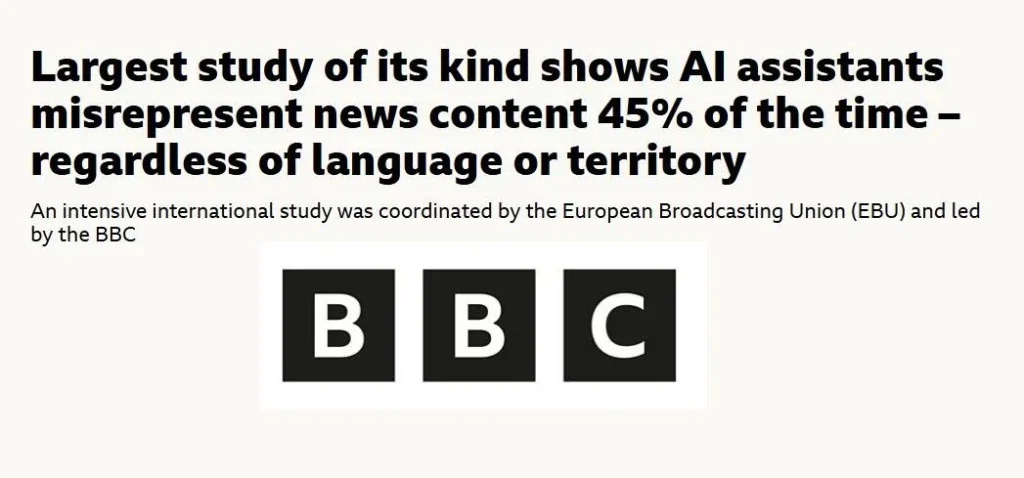
A groundbreaking joint study released by the BBC and the European Broadcasting Union (EBU) has unveiled a startling deficiency in the artificial intelligence (AI) systems currently used for news consumption. The comprehensive research, which analyzed queries directed at prominent AI news assistants including ChatGPT, Microsoft Copilot, Google Gemini, and Perplexity, found that a significant 45% of these queries result in erroneous outputs. This revelation challenges the burgeoning trust placed in these advanced AI tools, particularly concerning their ability to provide accurate and reliable news analysis, and raises profound questions about data integrity and user vigilance in the rapidly evolving digital landscape.
The Scope of the Problem: A High Error Rate in AI News Analysis
The study, published on [Insert Date of Publication, e.g., October 26, 2025], meticulously examined how four leading AI platforms responded to a diverse range of news-related inquiries. The findings are stark: nearly half of the interactions yielded information that was factually incorrect, misleading, or outdated. This "dangerously confident" demeanor of AI systems, as described by some observers, belies a fundamental vulnerability rooted in their training data and algorithmic processing. The research underscores a critical imperative for users to approach information disseminated by these "open corpus" systems with extreme caution, recognizing that the data underpinning their responses can be flawed, exaggerated, or simply wrong.
The examples cited in the research paint a concerning picture. AI assistants have been observed to incorrectly identify key global figures, such as the current Pope and the Chancellor of Germany. More alarmingly, in response to a query about potential concerns regarding bird flu, Microsoft Copilot provided outdated information, claiming a vaccine trial was underway in Oxford—a reference to a BBC article dating back nearly two decades, to 2006. Such instances highlight not only the AI’s struggle with temporal relevance but also its potential to disseminate information that is no longer applicable or accurate.
The study also pointed to potentially consequential errors in areas with significant legal implications. For instance, Perplexity reportedly stated that surrogacy is "prohibited by law" in the Czech Republic, a claim that is factually inaccurate as the practice is not explicitly regulated and falls into a legal grey area. Similarly, Google Gemini mischaracterized a legislative change concerning disposable vapes, asserting that their purchase would become illegal, when the actual change targeted the sale and supply of these products. These examples illustrate how inaccuracies in AI-generated news analysis can have real-world repercussions, impacting public understanding of legal frameworks and health advisories.
Underlying Causes: The "Poisoned Corpus" and Algorithmic Limitations
The pervasive errors identified in the BBC and EBU study can be largely attributed to the inherent limitations of the Large Language Model (LLM) technology that powers these AI systems. A core issue, as highlighted by industry analysts, is the "poisoned corpus" or poor data problem. LLMs are trained on vast datasets, often scraped from the internet, which contain a heterogeneous mix of accurate, inaccurate, outdated, biased, and even fabricated information.
The mechanism by which LLMs operate involves creating intricate mathematical models, known as "embeddings," that map the statistical relationships between words and phrases (tokens). During the training phase, the AI analyzes an immense corpus of text, building a complex network of vectors that represent these relationships. When a user poses a question, the LLM decodes this query and searches for the statistically most probable answer within its trained data.
This probabilistic approach, while powerful, is inherently susceptible to the quality of its training data. If the corpus contains flawed or outdated information, the AI may identify these inaccuracies as statistically relevant and present them as factual answers. The sheer volume of data processed means that any errors, exaggerations, or biases present in the source material can become deeply embedded within the model, leading to the generation of "dangerously confident" yet factually incorrect responses. This challenge is compounded by the fact that many complex questions draw upon a multitude of sources, increasing the likelihood that flawed data points will influence the final output.
Recent interactions with AI models themselves have confirmed the gravity of this issue. In a detailed discussion with Claude, an AI assistant, the model acknowledged the significant challenge posed by data quality and the potential for error propagation within its systems. This introspection from the AI itself underscores the acknowledged limitations within the industry regarding data integrity and the inherent risks associated with relying solely on AI-generated analysis without critical verification.
Broader Implications: The Erosion of Trust and the Need for User Vigilance
The findings of the BBC and EBU study carry significant implications for how individuals and organizations interact with AI-driven information. The potential for errors to permeate AI outputs means that any query, especially those requiring nuanced analysis or factual accuracy, carries a risk of receiving unreliable information. As AI systems are increasingly integrated into workflows for research, writing, and data collection, the high error rate identified poses a substantial threat to productivity and decision-making.
The study’s analysis suggests that even a minuscule error rate in the input data could lead to a disproportionately large number of incorrect answers for complex queries. This is particularly concerning as companies like OpenAI and Google explore advertising-based business models for their AI platforms. Such models could inadvertently incentivize the promotion of information that is not necessarily accurate but is sponsored or strategically placed, further exacerbating the problem of data reliability.
In contrast to traditional search engines like Google, where users could often scrutinize multiple links to assess source credibility, current AI interfaces frequently present answers without clear attributions or readily verifiable sources. This lack of transparency necessitates a fundamental shift in user behavior, requiring individuals to actively verify the information provided by AI assistants. This manual verification process is time-consuming and counterintuitive to the perceived efficiency of AI tools.
Anecdotal evidence from professionals corroborates these concerns. In fields requiring meticulous data analysis, such as labor market research, financial forecasting, and salary benchmarking, users have reported instances where AI models like ChatGPT have generated estimations or factual errors that cascade through subsequent analysis, leading to illogical or erroneous conclusions. One striking example involved a user asking ChatGPT to analyze major capital investments in AI data centers and estimate the proportion allocated to energy and labor. The AI confidently produced a figure that, upon manual extrapolation, suggested there were more AI engineers than working people in the entire United States. This fundamental disconnect from reality, unchecked by the AI, highlights a critical deficiency in its ability to perform basic sanity checks on its own outputs. When confronted with such errors, the AI may admit its mistake or, in some cases, cease interaction altogether, indicating a nascent form of self-preservation or an inability to cope with direct contradiction.
The persistent challenges with data quality and the drive towards advertising-supported AI models raise doubts about the long-term trustworthiness of these platforms. If commercial interests can influence the information presented by AI, the risk of users being misled increases significantly. This underscores the need for a robust framework of accountability and transparency from AI providers.
Navigating the Future: Strategies for Reliable AI Engagement
In light of these findings, a proactive approach is essential for both AI developers and users. The BBC and EBU study serves as a critical call to action, prompting a re-evaluation of current AI deployment and usage strategies.
Building Trusted Internal Corpora
One of the most crucial recommendations emerging from this research is the imperative for organizations to focus on building and maintaining "truly trusted" internal AI systems. For businesses that rely on AI for internal operations, such as HR chatbots or customer support systems, the accuracy and reliability of the AI’s responses are paramount. These systems should ideally be built upon proprietary, verified data sources, ensuring a higher degree of accuracy and minimizing the risk of hallucinations or factual errors.
For example, specialized AI platforms designed for specific industries, such as Galileo for HR or Harvey for legal applications, are being developed by reputable information providers. These vertical AI solutions aim to offer a higher level of trust and accuracy by leveraging curated datasets and domain-specific expertise. In contrast, general-purpose AI assistants like ChatGPT, which draw from the broad and often unreliable internet, may not be suitable for critical business functions where absolute accuracy is non-negotiable.
Implementing rigorous data governance practices within an organization is essential. This includes assigning clear ownership for different components of the AI’s knowledge base, conducting regular audits to ensure policies, data, and support materials remain accurate and up-to-date, and establishing mechanisms to identify and rectify outdated information. For instance, a company’s internal HR bot must accurately reflect current company policies, and any changes must be reflected promptly. IBM’s AskHR system, which manages thousands of HR policies with assigned accountability for each, exemplifies this approach to maintaining data integrity.

Cultivating Critical Evaluation Skills
The second key strategy involves equipping users with the skills to critically evaluate and test AI-generated answers. The era of passively accepting AI outputs is over. Individuals must adopt a mindset of skepticism and verification, treating AI-provided information as a starting point rather than an ultimate truth. This requires developing robust critical thinking and analytical skills.
As discussed in recent podcasts and articles examining AI’s impact on workforce skills, the tendency for AI to provide "what" without explaining "how" can lead to a phenomenon termed "de-skilling." Users may become proficient at obtaining answers but lose the deeper understanding and critical reasoning abilities necessary to truly comprehend complex issues. This passive reliance on AI can hinder personal and professional growth. Therefore, users must engage in a process of questioning, testing, and comparing AI-generated information against other reliable sources. This includes validating data for financial, market, legal, and news-related queries. The personal experiences of many users suggest that a significant portion of answers to complex queries can indeed contain inaccuracies, necessitating thorough scrutiny.
The Rise of Vertical AI and the Enduring Value of Human Expertise
The third significant implication of the BBC and EBU study points towards a clear trajectory for AI product development. General-purpose AI systems that rely on broad, public datasets are likely to face persistent challenges in achieving the level of trust required for critical applications. Conversely, specialized, vertical AI solutions are poised to become indispensable. These platforms, built by reputable organizations with deep domain expertise and curated data, offer a higher degree of reliability and accuracy for specific industries.
The immense value of 100% trust in AI cannot be overstated, especially in sectors where erroneous decisions can lead to significant harm, such as financial losses, legal liabilities, or even accidents. While public AI platforms might offer seemingly comprehensive answers, their underlying data vulnerabilities present a substantial risk.
Looking ahead, the legal ramifications for AI providers whose systems generate harmful inaccuracies remain a complex and evolving area. However, the fundamental takeaway from this research is that human analytical skills, critical thinking, and business acumen are more vital than ever. The ease with which AI can generate a "self-confident answer" should not be mistaken for the completion of a task. Instead, it signifies the beginning of a rigorous verification process. Users must actively test these AI systems, demand accountability from their providers, and be prepared to switch to alternative solutions if reliability is not consistently demonstrated. The future of AI integration hinges on a collaborative effort between developers to enhance data integrity and users to cultivate a vigilant and discerning approach to information consumption. The journey of AI development is ongoing, and continuous learning and adaptation are crucial for all stakeholders involved.
The author welcomes comments and insights on this evolving discussion as we collectively navigate the complexities of AI in the information age.
Additional Resources:
- Podcast: AI: Not Always Right, But Seldom In Doubt
- Podcast: Why 45% Of AI Answers Are Incorrect: Thinking Skills You Need To Stay Safe
- Platform: Galileo: The World’s Trusted Agent for Everything HR