The pervasive integration of Artificial Intelligence (AI) into the fabric of daily professional life is fundamentally reshaping the landscape of management. This evolution, marked by a departure from traditional hierarchical structures, necessitates a new breed of leader – the "Supermanager." A recent research initiative, aptly titled "The Rise of the Supermanager," delves into this critical shift, exploring how AI is not merely an operational tool but a catalyst for a profound transformation in how organizations are led and how work is accomplished. This report aims to dissect the historical context of management, illuminate the unique characteristics of AI’s impact, and analyze the emergent role of the Supermanager in driving organizational success in the AI era.
The Historical Evolution of Management
For decades, management theory, heavily influenced by foundational thinkers like Peter Drucker, has operated under a distinct division of labor: managers "manage," and workers "do work." The appointed roles of managers, team leaders, and supervisors were historically conceived as entities responsible for setting strategic direction, ensuring team alignment, establishing priorities, and equipping individuals with the necessary skills and resources for success. This paradigm implicitly included the responsibility to address performance gaps through coaching, reassignment, or termination.
This traditional framework, while enduring, has always acknowledged the inherent complexities and challenges of leadership. Managers are tasked with making difficult, often high-stakes decisions regarding hiring, promotions, and fostering optimal team performance. Consequently, various management philosophies and models have emerged over time, reflecting different approaches to these responsibilities. From the results-driven "Jack Welch" style, emphasizing aggressive goal attainment, to Howard Schultz’s "servant leadership" ethos, prioritizing employee well-being, and Jeff Bezos’s customer-centric "press release" approach, each has offered distinct strategies. More recently, Elon Musk’s "first principles" thinking has gained prominence, advocating for a return to fundamental truths to drive innovation.
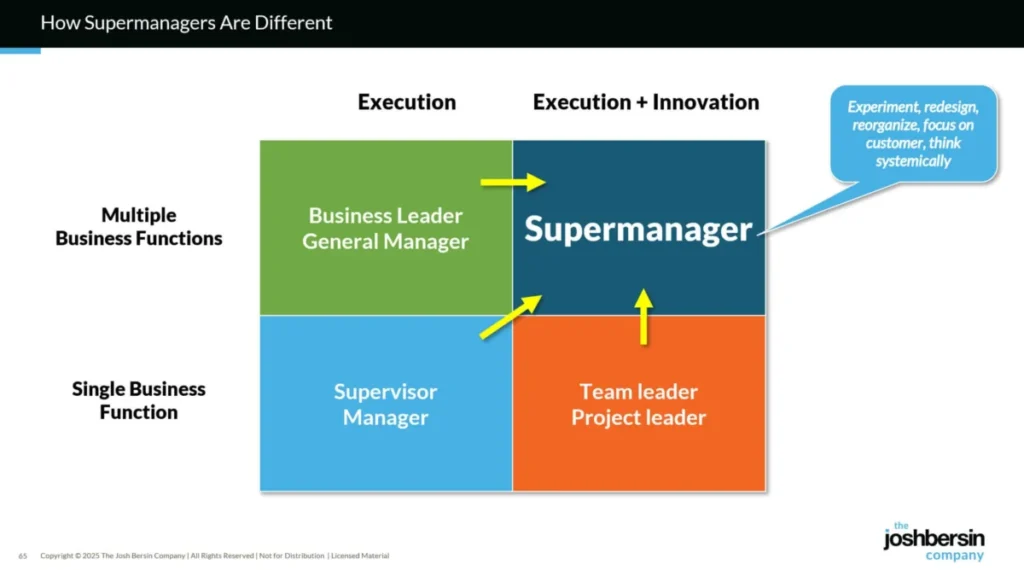
However, the current wave of AI integration presents a fundamentally new dimension to these established leadership paradigms. The question is no longer solely about optimizing existing processes or managing human capital within a static framework. Instead, organizations are grappling with how to foster experimentation, embrace rapid change, and drive the reinvention of teams in an environment where AI is rapidly augmenting human capabilities and transforming business functions. This new imperative is giving rise to the concept of the Supermanager.

The Transformative Nature of AI in the Workplace
The assertion that AI is simply another technological tool to be implemented overlooks its distinct and transformative nature. Unlike previous productivity systems that offered incremental improvements, AI possesses the unique capacity to learn, adapt, and personalize its interactions with individuals and teams. This personalization grants unprecedented power to workforces, enabling teams to unlock vast insights from enterprise data and fostering the emergence of sophisticated tools like "Digital Twins."
Consequently, AI integration represents not just an implementation of new software, but a comprehensive exercise in enablement, continuous learning, and fundamental reinvention. This necessitates a shift in organizational structure and leadership, where front-line managers, traditionally reliant on directives from corporate innovation hubs, must now actively lead and champion this transformative change from the ground up.
AI Transformation: A Dual Approach
Emerging research and real-world case studies underscore that AI-driven transformation operates effectively through both bottom-up innovation and top-down strategic direction. Front-facing teams, often in close proximity to operational challenges and customer needs, are frequently the pioneers of novel AI applications.
Illustrative Examples of Bottom-Up Innovation:
- Inventory Management Breakthrough: A distribution center in Thailand, leveraging a self-developed photo-based application on an AI platform, achieved a remarkable 75% reduction in monthly inventory processing time. This grassroots innovation was subsequently shared with corporate, leading to its company-wide replication.
- Workforce Planning Optimization: An analyst at the International Air Transport Association (IATA) utilized an AI agent to construct a comprehensive staffing and skills planning model for the global airline industry. This self-developed tool significantly accelerated workforce planning efforts and is now being disseminated to airline leaders worldwide.
- Personalized Financial Advisory: An individual investment advisor at a major bank developed a bespoke portfolio advisory tool within the company’s secure AI agent platform. This initiative, born from individual ingenuity, is now being leveraged by the IT department to build a global portfolio management system for high-net-worth clients.
These anecdotes, representative of a broader trend, highlight the vast potential for AI transformation across diverse domains, including marketing content generation, job analysis, employee performance data crunching, and performance appraisal writing. The common thread is that many of the most impactful ideas originate from frontline employees. Supermanagers play a pivotal role in cultivating an environment where these innovations can flourish by enabling, encouraging, and empowering their teams – the "three E’s" of AI transformation.

The Emergence of the Supermanager: Executing and Innovating Simultaneously
Supermanagers, as identified in the research, possess an exceptional ability to harmoniously balance the pursuit of tangible "results" with a drive for continuous "reinvention." This is not achieved through rebellious disruption but through a distinct set of capabilities that foster both efficiency and creativity.
While many organizations have established AI steering committees and dedicated technology teams to develop standardized platforms and manage large-scale initiatives, these centralized bodies often lack the granular insight to identify every potential innovation. For instance, Standard Chartered’s development of a global onboarding platform aims to streamline complex talent acquisition across 80+ countries, a significant undertaking. However, the sheer volume and specificity of potential improvements often reside within individual teams.
Supermanagers bridge this gap by cultivating a culture where their teams are empowered to generate new ideas, effectively prioritize initiatives, and proactively present their innovations. Instead of passively awaiting corporate-driven solutions, they actively champion and support employee-led innovation.
Bridging the Productivity Gap: The Critical Role of Supermanagers
A significant challenge in the current AI landscape is the widening disparity between technological advancement and actual business productivity. As illustrated by the rapid evolution of tools like Microsoft Copilot, the potential of AI is immense. However, the ability of individuals and teams to effectively leverage these tools requires time, training, and a supportive organizational environment. This often results in a growing gap between the accelerating pace of technological development (represented by a green arrow in illustrative charts) and the lagging growth of business productivity (represented by a red arrow).
Supermanagers act as the crucial accelerant, the "fuel and energy" required to bend the productivity curve upwards and close this gap. Traditional managers might adopt a passive stance, waiting for IT to deliver solutions or issuing general directives for increased productivity. This approach is often insufficient in the face of AI’s dynamic capabilities.

In contrast, Supermanagers actively engage with AI. They gain a hands-on understanding of its potential, encourage experimentation within their teams, collaborate proactively with IT departments, and foster a mindset of innovative problem-solving. These localized, frontline innovations generate valuable momentum, build essential experience, and inform IT departments about emerging needs. The cumulative effect is a company characterized by a multitude of innovations, each contributing to a significant upward trajectory in productivity. As new AI features emerge, these Supermanaged teams, composed of highly capable "Superworkers," continue to drive innovation.
The ease with which AI systems can be programmed and customized is a key enabler of this phenomenon. The ability for individuals to create prompts, manage data within AI agents, and develop applications, often as intuitively as using a spreadsheet (as is the case with open systems like Galileo), empowers Supermanagers to lead this charge effectively.
Organizational Imperatives for Cultivating Supermanagers
To foster the rise of Supermanagers and harness the full potential of AI, organizations must critically evaluate and adapt their existing leadership models and reward systems.
Key Areas for Organizational Focus:
- Leadership Model Re-evaluation: Current leadership models should be scrutinized for their emphasis on execution and results versus innovation and creation. The degree of autonomy granted to managers to reassign roles, create new job functions, and drive organizational change requires careful consideration.
- Job Design and Organizational Change Training: Organizations must actively incorporate training on job design principles and organizational change management into their leadership development programs. This equips managers with the strategic tools necessary to navigate evolving work structures.
- AI Familiarization for Leaders: There is an urgent imperative for leaders at all levels to develop a robust understanding of AI. This is no longer an optional skill but a fundamental requirement for effective leadership in the contemporary business environment. HR leaders, in particular, must set an example by prioritizing their own AI upskilling.
- Reward System Alignment: Existing reward systems should be reviewed and potentially redesigned to acknowledge and incentivize the behaviors characteristic of Supermanagers, such as fostering innovation, empowering teams, and driving AI adoption.
The focus on cultivating Supermanagers may represent one of the most significant strategic investments organizations can make in their AI transformation journey. This proactive approach ensures that organizations are not merely adopting new technologies but are fundamentally evolving their leadership capabilities to thrive in an AI-augmented future.

Further Resources:
For deeper insights into the evolving role of leadership in the age of AI, the following resources are recommended:
- Research Paper: "The Rise of the Supermanager" provides a comprehensive analysis of the research findings.
- Podcast: "The Rise of the Supermanager" offers an auditory exploration of the key themes and implications.
- AI Tool: Galileo for Managers provides an AI agent designed to support leaders at all levels.
- Article: "Introducing Galileo® for Managers, The Leadership Guru At Your Fingertips" details the capabilities of this innovative AI tool.