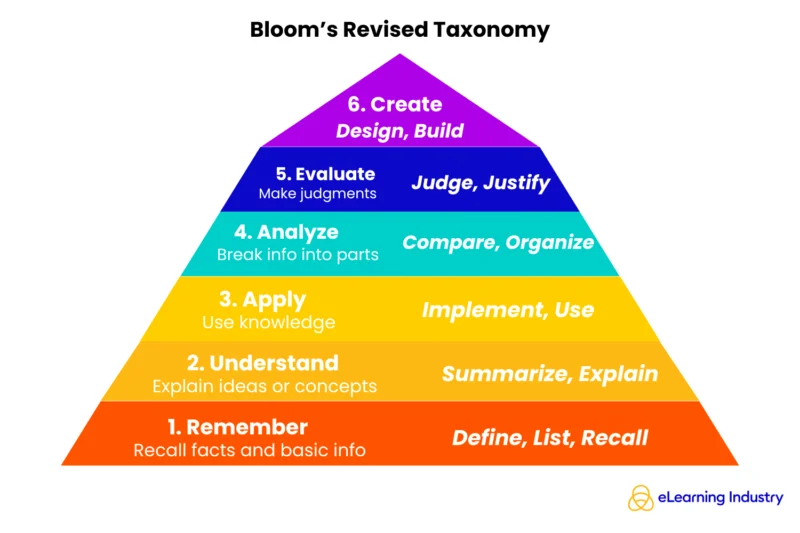
Mastering Bloom’s Revised Taxonomy serves as a foundational pillar for educators and Instructional Designers worldwide, providing a systematic framework for classifying learning objectives according to their cognitive complexity. In the rapidly evolving landscape of corporate training and academic instruction, this taxonomy has transitioned from a theoretical educational model into a vital strategic tool for developing measurable, high-impact learning outcomes. By moving beyond the mere memorization of facts, the revised framework emphasizes active learning and the practical application of knowledge, ensuring that learners are equipped with the higher-order thinking skills necessary for the 21st-century workforce.
The framework, originally established in the mid-20th century, underwent a significant transformation in 2001 to address the limitations of the original model and to align with modern cognitive science. This shift from noun-based categories to verb-based actions—such as "Remembering" instead of "Knowledge"—reflects a fundamental change in how educators perceive the learning process. Today, Bloom’s Revised Taxonomy is widely utilized to bridge the gap between theoretical understanding and workplace performance, allowing organizations to cultivate talent that can not only follow instructions but also innovate and lead.
The Evolution of Cognitive Classification: A Chronology of Bloom’s Taxonomy
The history of Bloom’s Taxonomy is a narrative of continuous refinement aimed at perfecting the measurement of human intelligence and learning potential. The journey began in the post-World War II era and has evolved through decades of pedagogical research.
1948 – The Genesis: During the American Psychological Association Convention in Boston, Benjamin Bloom and a group of colleagues discussed the need for a theoretical framework to facilitate communication among examiners and to promote the exchange of test items. The goal was to create a common language for learning goals.
1956 – The Original Framework: After eight years of collaborative effort, "Taxonomy of Educational Objectives: The Classification of Educational Goals. Handbook I: Cognitive Domain" was published. It introduced six levels: Knowledge, Comprehension, Application, Analysis, Synthesis, and Evaluation. This model dominated education for nearly half a century.
The 1990s – The Push for Revision: As cognitive psychology advanced, critics argued that the original taxonomy was too rigid and did not reflect the complexities of how the human brain processes information. There was a growing need to differentiate between the "content" of thinking and the "procedures" used to solve problems.
2001 – The Revised Taxonomy: Led by Lorin Anderson (a former student of Bloom) and David Krathwohl (a co-author of the original model), a team of cognitive psychologists and curriculum theorists published "A Taxonomy for Learning, Teaching, and Assessing." This update introduced two major changes: the shift to verbs to denote active thinking and the reordering of the top two levels, placing "Create" at the apex of cognitive achievement.
Detailed Analysis of the Six Cognitive Levels
The revised model operates on a hierarchy of complexity, where each level serves as a prerequisite for the one above it. In a professional L&D (Learning and Development) context, these levels dictate the depth of the training intervention.
1. Remember: The Foundation of Recall
At the base of the pyramid, "Remember" involves retrieving, recognizing, and recalling relevant knowledge from long-term memory. While often dismissed as "low-level," it is the essential bedrock of all expertise.
- Action Verbs: Define, list, identify, name, state.
- Corporate Application: An employee must be able to recall specific safety protocols or identify the components of a new software interface before they can use them.
2. Understand: Determining Meaning
Understanding goes beyond rote memorization. It requires learners to build connections and explain ideas or concepts in their own words. This level proves that the information has been internalized.
- Action Verbs: Summarize, interpret, classify, compare, explain.
- Corporate Application: A manager explains the underlying "why" behind a new company pivot to their team, demonstrating a grasp of the strategic shift rather than just repeating a memo.
3. Apply: Knowledge in Action
The "Apply" level is where theoretical knowledge meets real-world execution. It involves using a procedure or method in a given situation.
- Action Verbs: Implement, execute, solve, use, operate.
- Corporate Application: A customer service representative applies conflict-resolution techniques during a live interaction with a frustrated client.
4. Analyze: Deconstructing Information
Analysis involves breaking material into constituent parts and detecting how the parts relate to one another and to an overall structure. This is critical for troubleshooting and logical reasoning.
- Action Verbs: Differentiate, organize, attribute, deconstruct, outline.
- Corporate Application: A data analyst examines quarterly sales figures to identify specific market trends and differentiate between seasonal fluctuations and long-term declines.
5. Evaluate: Making Informed Judgments
Evaluation requires making judgments based on criteria and standards. It involves critiquing, checking, and validating the quality of work or the viability of a strategy.
- Action Verbs: Critique, judge, assess, justify, recommend.
- Corporate Application: A senior executive evaluates three different vendor proposals for a new ERP system, justifying their final choice based on cost-efficiency, scalability, and security.
6. Create: The Peak of Innovation
The highest level of the taxonomy, "Create," involves putting elements together to form a novel, coherent whole or making an original product. It represents the transition from a consumer of knowledge to a producer of value.
- Action Verbs: Design, develop, formulate, construct, devise.
- Corporate Application: An R&D team designs a proprietary algorithm that optimizes supply chain logistics, creating a unique competitive advantage for the firm.
Strategic Implementation in Corporate Learning and Development
For Instructional Designers, Bloom’s Revised Taxonomy is more than a list of verbs; it is a blueprint for curriculum architecture. Modern organizations are increasingly moving away from "knowledge-heavy" training toward "performance-based" training.
Precision in Learning Objectives
One of the most significant implications of the taxonomy is the elimination of vague terminology. Professional educators argue that words like "understand" or "know" are nearly impossible to measure accurately. By utilizing Bloom’s verbs, L&D professionals can create SMART (Specific, Measurable, Achievable, Relevant, Time-bound) objectives. For instance, instead of stating "Learners will understand the CRM," a high-quality objective would be: "Learners will be able to execute a lead-generation report using the CRM within five minutes."
Alignment of Assessment and Activity
Data suggests that training failure often occurs because the assessment does not match the cognitive level of the objective. If a training program aims to teach employees how to evaluate risk (Level 5), but the final exam only asks them to identify definitions (Level 1), the training has failed to validate the required skill. Bloom’s Taxonomy ensures that the learning activities and the assessments are synchronized at the same cognitive depth.
Impact on Upskilling and Leadership
In the context of the "Great Reskill," the taxonomy provides a roadmap for career progression. Entry-level roles often focus on the "Remember" and "Understand" levels. As employees move into management and executive leadership, their roles shift almost exclusively into "Analyze," "Evaluate," and "Create." By mapping training programs to these levels, HR departments can more effectively identify and groom high-potential talent for strategic roles.
Supporting Data and Broader Implications
The relevance of Bloom’s Revised Taxonomy is supported by its integration into modern digital learning standards. According to industry reports, organizations that utilize structured instructional design frameworks like Bloom’s see a significantly higher Return on Investment (ROI) in their training programs.
Educational Psychology Insights: Research in cognitive load theory suggests that by structuring learning according to Bloom’s levels, educators can prevent cognitive overload. By ensuring the "Remember" and "Understand" phases are mastered before moving to "Apply" or "Analyze," the brain is better able to build the necessary "schema" for complex problem-solving.
The Digital Shift: The rise of "Bloom’s Digital Taxonomy" has further enriched the model. This extension incorporates digital actions—such as "googling" (Remembering), "blogging" (Creating), and "validating" (Evaluating)—ensuring the framework remains relevant in an era dominated by Artificial Intelligence and remote work.
Global Economic Impact: The World Economic Forum’s "Future of Jobs Report" consistently identifies critical thinking, analytical thinking, and creativity as the top skills required by 2025. These correspond directly to the top three tiers of Bloom’s Revised Taxonomy. Therefore, the adoption of this framework is not merely an academic exercise but a vital economic necessity for nations looking to maintain a competitive workforce.
Conclusion: Driving Performance Through Cognitive Clarity
Bloom’s Revised Taxonomy remains an indispensable tool because it provides a clear, actionable path from ignorance to mastery. By categorizing the complexities of human thought into six manageable levels, it allows for the design of educational experiences that are both rigorous and rewarding.
For the modern Instructional Designer, the taxonomy offers a safeguard against "passive learning," ensuring that every minute spent in a classroom or an eLearning module contributes to a measurable increase in capability. For the corporate leader, it offers a language to describe the skills their organization needs to thrive. As we move further into an age where information is infinite but the ability to process and innovate is rare, Bloom’s Revised Taxonomy provides the essential structure to transform that information into meaningful, high-level human performance. Through its continued application, the bridge between learning and doing remains stronger than ever, fostering an environment of continuous growth and strategic excellence.