Organizations seeking to cultivate a thriving workforce and drive sustained success are increasingly recognizing that superficial perks and ephemeral engagement initiatives fall short of fostering genuine employee morale. True morale, a deep-seated sentiment about one’s work, management, and the perceived impact of their contributions, is the bedrock of a productive and resilient organization. Research by Gallup underscores this, revealing that organizations prioritizing employee engagement witness a substantial 18% surge in productivity and a 23% climb in profitability. For companies in growth phases, this translates directly into improved productivity, enhanced retention rates, and the crucial ability to scale effectively without succumbing to constant employee turnover.
At the heart of this engagement lies a powerful, yet often underutilized, strategy: recognition. This isn’t about annual awards or sporadic gestures, but rather consistent, timely, and meaningful appreciation that reinforces the value of employees’ efforts. This article delves into 15 practical, scalable strategies for boosting employee morale, emphasizing impact, simplicity, and measurable results, applicable from mid-market to enterprise-level organizations.
The Pillars of Sustainable Employee Morale
Building a culture where employees feel valued and motivated requires a multifaceted approach. While tangible rewards and recognition are critical, they must be integrated within a broader framework that addresses the holistic employee experience. The following strategies offer a comprehensive roadmap for organizations aiming to move beyond temporary fixes and cultivate lasting morale.
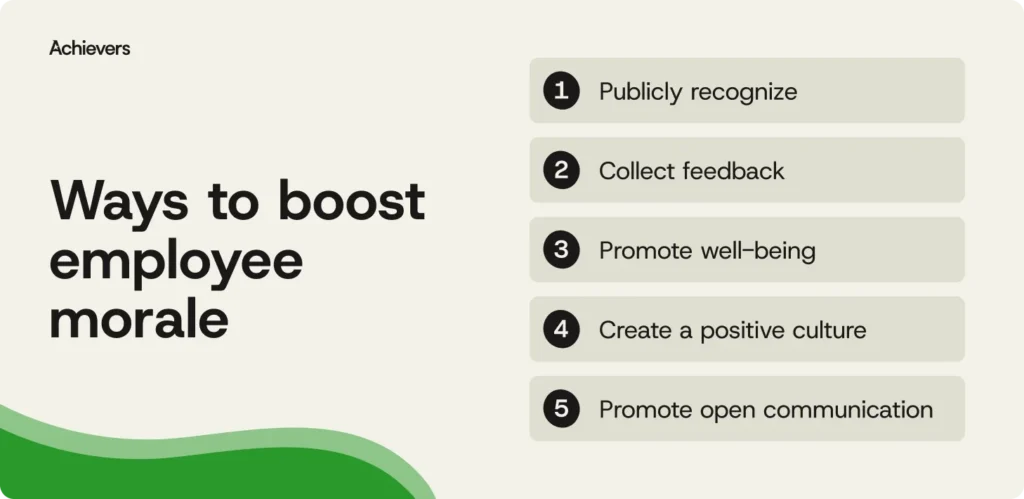
1. Cultivating a Culture of Frequent and Visible Recognition
A recent study by Achievers, the 2026 Engagement and Retention Report, highlights a significant disconnect: only 25% of employees report feeling appreciated at work. This substantial gap directly contributes to disengagement, increased turnover, and low adoption rates for recognition programs, especially when these programs rely on manual processes or inconsistent follow-through. The objective is not to proliferate numerous programs, but to establish a single, effective recognition system that is actively utilized. To achieve this, recognition must be frequent, visible, and easy to administer. This ensures that appreciation becomes an ingrained part of the daily work experience, rather than an afterthought.
2. The Power of Listening: Regular Feedback Collection and Action
Soliciting employee input without demonstrating a commitment to acting upon it is a potent morale killer. Conversely, actively listening to feedback and implementing changes based on it is a powerful trust-builder across teams. Organizations that establish clear channels for feedback, such as regular pulse surveys, anonymous suggestion boxes, or dedicated feedback sessions, and then visibly demonstrate how this input has informed decisions, foster an environment of psychological safety and shared ownership. This proactive approach signals that employees’ perspectives are not only heard but also valued, leading to a more engaged and invested workforce.
3. Prioritizing Well-being and Work-Life Balance
The modern workplace often demands high levels of commitment, but when employees are stretched too thin or facing burnout, morale inevitably plummets. Demonstrating a genuine commitment to employee health and well-being is paramount. This can be achieved by integrating well-being initiatives into the company culture and its benefits packages. Examples include offering flexible work arrangements, promoting mental health resources, encouraging regular breaks, and ensuring manageable workloads. When employees feel supported in maintaining a healthy work-life balance, their overall job satisfaction and morale significantly improve.
4. Nurturing a Positive and Inclusive Workplace Culture
An organization’s true culture is not defined by its mission statement or careers page, but by the daily lived experiences of its employees. When individuals feel a strong alignment with the company’s values and are supported by empathetic leadership, morale and motivation naturally flourish. Fostering this environment involves promoting open dialogue, encouraging collaboration, celebrating diversity, and ensuring equitable treatment for all. A culture that champions inclusivity and belonging creates a space where every employee feels seen, respected, and empowered to contribute their best work.
5. Championing Open Communication and Connection
Breakdowns in communication are often precursors to declining morale. Strong interpersonal relationships and transparent communication practices are vital for maintaining high morale and ensuring teams remain aligned with organizational goals. This can be facilitated through regular team meetings, clear communication channels, accessible leadership, and opportunities for informal social interaction. When employees feel informed and connected to their colleagues and the company’s direction, they are more likely to feel engaged and committed.
6. Investing in Professional Development and Growth
In many mid-market organizations, career development can stagnate, not due to a lack of leadership care, but because growth pathways are not clearly defined. When employees cannot envision their future within the company, their morale declines, and they may begin seeking opportunities elsewhere. Addressing this doesn’t necessitate complex career frameworks. Instead, it requires providing visible opportunities for skill development, recognizing achievements in learning, and clearly signaling that professional growth is a priority. By investing in employees’ futures, organizations demonstrate their commitment to their long-term success, fostering loyalty and sustained engagement.
7. Connecting Daily Efforts to a Larger Purpose
Employee morale is significantly enhanced when individuals perceive their work as meaningful and impactful. Helping employees understand how their day-to-day contributions connect to the broader organizational mission and recognizing the impact they are making along the way is crucial. This can be achieved through regular updates on company progress, highlighting how individual roles contribute to key objectives, and celebrating team successes in the context of the larger vision. When employees see the "why" behind their work, their motivation and sense of purpose soar.
8. Empowering Managers as Morale Architects
In numerous organizations, managers bear a significant responsibility for employee morale, often without adequate formal training or support in people leadership. When managers lack the tools or skills to provide effective recognition or identify early signs of disengagement, morale can suffer rapidly. Empowering managers with simple, intuitive tools, clear expectations, and built-in guidance is one of the most expedient ways to improve morale without increasing HR overhead. Equipping managers to be effective coaches and champions of their teams is a strategic investment in organizational well-being.

9. Fostering Autonomy and Trust
Micromanagement is a significant detractor from employee morale. Granting employees the autonomy to manage their work and the flexibility to approach tasks in ways that best suit them fosters a sense of trust and empowerment. When employees feel trusted to perform their duties, they are more likely to be engaged, innovative, and satisfied with their roles. This approach not only boosts morale but also enhances efficiency and problem-solving capabilities.
10. Celebrating Achievements and Milestones, Big and Small
Every milestone achieved, whether a major product launch or a minor process improvement, warrants recognition. Celebrating these achievements consistently keeps motivation levels high and makes progress visible. This can range from formal acknowledgments to informal team celebrations, reinforcing the value of collective effort and individual contributions. Consistent acknowledgment of progress, however incremental, fuels a positive feedback loop that encourages continued effort and dedication.
11. Encouraging Peer-to-Peer Appreciation
While top-down recognition is valuable, it should not be the sole avenue for acknowledging contributions. When employees are empowered and encouraged to celebrate each other’s successes, it strengthens interpersonal relationships and cultivates a culture where appreciation is a shared responsibility. Peer-to-peer recognition platforms or simple acknowledgment rituals can foster a sense of camaraderie and mutual respect, making the workplace a more supportive and positive environment.
12. Championing Diversity, Equity, Inclusion, and Belonging (DEIB)
Employees cannot experience genuine well-being at work if they do not feel safe, seen, or supported. DEIB is not merely a compliance metric but a fundamental driver of morale, trust, and engagement. Creating an environment where individuals from all backgrounds feel a sense of belonging, are treated equitably, and have equal opportunities to thrive is essential for fostering a truly positive and productive workplace. This commitment requires ongoing effort, education, and the active dismantling of systemic barriers.
13. Aligning Recognition with Core Organizational Values
Recognition gains deeper meaning when it is explicitly linked to an organization’s core values. By connecting appreciation to these guiding principles, employees gain a clearer understanding of what constitutes exemplary work and how to embody the company culture. This approach reinforces desired behaviors and ensures that recognition efforts are not only about acknowledging tasks completed but also about celebrating the embodiment of the organization’s ethos.
14. Recognizing Career Milestones and Life Events
Beyond professional achievements, acknowledging career milestones, such as anniversaries, and significant life events, such as births or graduations, demonstrates that an organization values its employees as whole individuals. Celebrating these moments across the employee lifecycle shows that their personal journeys are recognized and appreciated at every step, fostering deeper loyalty and a stronger sense of connection.
15. Facilitating Meaningful Team-Building Activities
Team morale is not solely derived from meeting Key Performance Indicators; it is also built through strong interpersonal connections. Shared experiences, whether through structured team-building exercises or informal social gatherings, help to build trust, spark creativity, and inject joy into the workday. These activities create opportunities for colleagues to bond on a personal level, strengthening team cohesion and improving overall collaboration.
Employee Morale in Action: Wesley’s Recognition Success Story
Wesley, a purpose-driven non-profit organization, recognized that to genuinely improve employee morale, they needed to move beyond good intentions and implement a consistent, values-aligned approach to recognizing and rewarding their people. Facing the challenge of scaling appreciation without increasing administrative burden, Wesley partnered with Achievers to launch "Inspire," a social recognition platform designed to celebrate both everyday achievements and significant moments.
The "Inspire" platform enabled employees to provide and receive recognition in real-time, nominate peers for monthly awards, and accumulate points redeemable for personalized rewards. The core objective was to cultivate a culture where appreciation was visible, frequent, and directly connected to Wesley’s overarching mission. For Wesley, like many mid-market organizations, the challenge lay in achieving consistency. Their solution involved embedding recognition into daily workflows and directly linking it to their mission, transforming morale from a fleeting initiative into a measurable, sustainable strategy.
The impact of this integrated approach was significant. While specific quantifiable results from Wesley’s implementation are detailed in their case study, the underlying principle highlights how making recognition a part of the daily experience can transform appreciation into a potent morale-boosting strategy that yields measurable improvements. This strategic integration of recognition into the fabric of daily operations demonstrates a commitment to employee well-being that resonates deeply and drives tangible positive outcomes.
Recognizing More, Boosting Morale, and Moving the Needle
It is an undeniable truth that employee morale does not spontaneously improve simply by introducing another perk or a new tool that employees lack the time to manage. The most effective and rapid method for boosting morale lies in investing in recognition that is straightforward to implement, simple to manage, and demonstrably drives results. This type of recognition is integrated into the daily workflow, actively utilized by managers, and its impact is measurable.
This is precisely where Achievers offers its expertise. With industry-leading recognition frequency, built-in adoption support, and analytics that validate impact, Achievers empowers mid-market organizations to elevate employee morale without introducing additional complexity. The result is heightened engagement, stronger retention, and teams that are poised to grow alongside the company. For organizations ready to move beyond superficial gestures and embrace a strategic approach to boosting employee morale, partnering with Achievers offers a proven path to sustained success.