In an increasingly competitive global talent landscape, a significant challenge facing organizations is the alarming rate of candidate reneging – instances where an accepted job offer is rescinded by the candidate before their official start date. This issue, often discovered only after the fact, leaves talent acquisition teams scrambling to backfill critical roles, incurring substantial financial and operational costs. Traditional recruitment processes frequently lack a systematic approach to pre-start candidate engagement, resulting in a reactive posture where teams only become aware of a candidate’s wavering commitment once they have gone quiet or, worse, formally withdrawn. By this point, a candidate’s decision is often irreversible, underscoring a critical gap in conventional talent management strategies.
The Pervasive Challenge of Candidate Renege
Candidate reneging represents a multifaceted problem with far-reaching implications for businesses. It’s not merely an inconvenience; it’s a significant drain on resources, productivity, and morale. Industry reports indicate that renege rates can fluctuate wildly, but average between 10-20% for certain high-demand roles, with some sectors experiencing even higher figures. For instance, a 2023 survey by a leading HR analytics firm suggested that tech companies, grappling with intense competition for specialized skills, reported renege rates as high as 25% for senior engineering positions.
The reasons behind a candidate’s decision to renege are diverse. Foremost among them is the receipt of a competing offer, often with better compensation, benefits, or career progression opportunities. However, other factors play a crucial role, including personal circumstances that may change post-offer, a lingering sense of uncertainty about the role or company culture, or, critically, a perceived decline in engagement from the hiring organization during the pre-start period. When communication wanes after an offer is accepted, candidates can feel deprioritized, leading them to question their decision and become more receptive to external approaches. The financial impact of a renege is substantial. Estimates suggest that the cost of replacing a single employee can range from 50% to 200% of their annual salary, factoring in recruitment fees, advertising, onboarding expenses, and the productivity loss incurred while the position remains vacant. For specialized roles, this cost can be even higher, sometimes exceeding $100,000 per instance.
Shifting from Reactive to Proactive: A New Paradigm
Recognizing the detrimental effects of late detection, leading organizations are now advocating for a paradigm shift: treating engagement signals as crucial leading indicators rather than waiting for a formal withdrawal. This proactive approach focuses on continuous monitoring and strategic intervention during the critical "pre-start period" – the time between offer acceptance and the first day of employment. This window, often overlooked, is precisely when candidates are most susceptible to external influences and internal doubts.
The core of this new strategy lies in systematically assessing a candidate’s "Engagement Health." Instead of hoping for the best, talent teams are deploying structured scorecards that categorize candidates based on their observable behaviors and interactions. This allows for tailored, timely interventions, transforming a traditionally passive waiting period into an active phase of relationship building and commitment reinforcement.
The Engagement Health Scorecard: A Methodical Approach
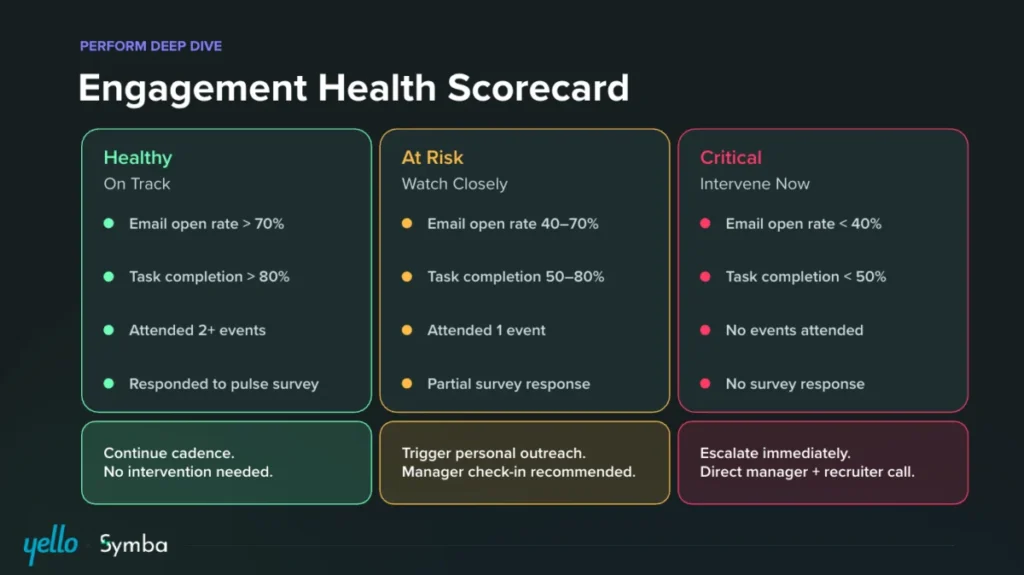
A robust Engagement Health Scorecard typically categorizes candidates into three distinct groups, each defined by specific behavioral thresholds and requiring different levels of intervention:
Healthy Candidates: Maintaining Momentum
Candidates categorized as "Healthy" demonstrate consistent and strong engagement during the pre-start period. Their behavior signals a high level of commitment and enthusiasm for the upcoming role. Key indicators include:
- Email Open Rates: Consistently above 70%. This indicates active interest in company communications, updates, and preparatory materials.
- Task Completion: Prompt and thorough completion of any administrative or onboarding tasks assigned, such as submitting background check forms, reviewing benefits information, or setting up IT accounts.
- Event Attendance: Participation in multiple pre-start events, which could include virtual coffee chats with future teammates, departmental webinars, or company-wide town halls.
- Survey Responses: Active and thoughtful responses to any pre-onboarding surveys designed to gauge expectations or gather initial feedback.
For these candidates, the recommended action is to "continue the cadence and stay the course." This involves maintaining the regular schedule of communications, providing helpful resources, and ensuring a smooth transition. The goal is to sustain their positive momentum and reinforce their decision, without overwhelming them with unnecessary interventions.
At-Risk Candidates: Targeted Outreach within 48 Hours
The "At-Risk" category identifies candidates whose engagement signals show a noticeable decline, suggesting potential wavering or disengagement. This group requires prompt, personalized attention to prevent further erosion of commitment. Indicators for at-risk candidates typically include:
- Declining Email Open Rates: Falling within the 40-70% range. This signals a potential decrease in attention to company communications, possibly due to distraction or waning interest.
- Limited Event Attendance: Sporadic or no attendance at optional pre-start events, indicating a lack of proactive engagement with the future team or company culture.
- Incomplete Survey Responses: Partial or delayed responses to surveys, suggesting a lack of focus or reluctance to fully engage with preparatory tasks.
- Reduced Responsiveness: Slower replies to emails or messages, or a general quietness compared to initial interactions.
For candidates falling into the At-Risk category, immediate, personal outreach within 48 hours is crucial. Generic, mass-distributed communications are ineffective at this stage. Instead, interventions should be tailored and direct:
- Personal Message from the Program Manager: A direct, warm message from the individual responsible for their onboarding program can make a significant difference. This message should express excitement about their upcoming start, offer support, and invite an open dialogue.
- Individualized Event Invitation: Rather than a mass email, a personal invitation to an upcoming event, highlighting specific reasons why their participation would be valuable or enjoyable, can re-engage them. This shows that their presence is specifically desired.
- Hiring Manager Check-in: A brief, informal call or message from the future hiring manager can be highly impactful. This reinforces the manager’s personal investment in the candidate and provides an opportunity for the candidate to voice any concerns directly. Often, these personalized touches can quickly turn the situation around, addressing minor anxieties or questions before they escalate.
Critical Candidates: Immediate Escalation and Direct Dialogue
The "Critical" category represents candidates exhibiting almost no engagement, signaling a high probability of reneging. These situations demand immediate and direct escalation, as time is of the essence to salvage the offer. Indicators for critical candidates include:
- Alarmingly Low Email Open Rates: Consistently below 40%, indicating a near-complete disengagement from company communications.
- No Event Attendance: A complete absence from all pre-start events, signifying a lack of interest in connecting with the organization.
- No Survey Responses: Complete failure to respond to any surveys, indicating a total lack of participation in preparatory activities.
- No Activity in Three or More Weeks: A prolonged period of silence and inactivity across all engagement channels.
For Critical candidates, the approach shifts to urgent, high-touch interventions aimed at uncovering and addressing the root cause:
- Direct Call from the Hiring Manager: This is a non-negotiable step. A direct, personal call from the future manager demonstrates the seriousness of the situation and the company’s commitment. It provides an opportunity for a candid, two-way conversation.
- Personal Touchpoint from the Recruiter: The recruiter who initially built rapport with the candidate should also reach out, offering a supportive and understanding ear. Their established relationship can sometimes bridge the communication gap.
- Real Conversation About "What’s Going On": The goal of these escalated touchpoints is not just to check in, but to have an honest discussion about the candidate’s current situation. Often, the root cause is a competing offer, a significant personal circumstance, or simple uncertainty about the role, team, or company. By catching these issues in time, organizations can sometimes address concerns, negotiate terms, or provide necessary support, thereby retaining valuable talent.
Supporting Data and Industry Adoption
The efficacy of proactive engagement strategies is increasingly supported by data. Companies that implement robust engagement scorecards and intervention playbooks report significant reductions in renege rates, sometimes by as much as 30-50%. A study by a major HR technology provider found that organizations leveraging advanced candidate relationship management (CRM) tools for pre-start engagement experienced an average 15% lower backfill cost compared to those relying on traditional methods. Furthermore, these companies often report higher candidate satisfaction scores and improved employer brand perception, as candidates appreciate the sustained attention and personalized experience.
Technology plays a pivotal role in enabling these strategies. Modern Applicant Tracking Systems (ATS) and dedicated Candidate Relationship Management (CRM) platforms now offer features for tracking engagement metrics, automating personalized communications, and flagging at-risk candidates. This technological backbone allows talent teams to scale their proactive efforts without increasing manual workload disproportionately. The integration of AI and machine learning is also beginning to enhance these systems, allowing for more sophisticated predictive analytics to identify potential reneges even earlier.
Expert Perspectives and Organizational Responses
Leading HR and talent acquisition executives are increasingly vocal about the necessity of this shift. "The days of simply sending an offer letter and hoping for the best are over," states Sarah Jenkins, VP of Talent Acquisition at Apex Solutions. "In today’s candidate-driven market, the period between offer acceptance and start date is a critical battleground for talent. Our implementation of an engagement health scorecard has transformed our approach, allowing us to proactively address concerns and solidify commitment. We’ve seen a tangible decrease in our renege rates and a noticeable improvement in our new hires’ preparedness and enthusiasm on day one."
Dr. Eleanor Vance, a prominent industrial-organizational psychologist specializing in talent retention, emphasizes the psychological aspect. "For candidates, accepting an offer can be exhilarating but also fraught with anxiety. They’re making a significant life decision, and any perceived silence or lack of interest from their future employer can amplify doubts. Proactive engagement isn’t just about preventing reneges; it’s about validating their choice, reinforcing their value, and building psychological safety. It sets the stage for a positive employee experience long before they even step foot in the office."
Companies are also recognizing the long-term benefits beyond just reducing reneges. "The insights we gain from monitoring pre-start engagement are invaluable," says Mark Thompson, Head of HR Operations at Global Innovate. "It helps us refine our onboarding processes, identify common candidate concerns, and ultimately build a stronger, more resilient workforce. It’s an investment in our talent pipeline that pays dividends in retention and overall organizational performance."
Broader Impact and Strategic Implications
The shift towards data-driven, proactive candidate engagement carries significant broader implications for talent management and organizational strategy:
- Enhanced Employer Brand: A thoughtful and engaging pre-start experience contributes positively to the employer brand. Candidates who feel valued and supported are more likely to share positive feedback, attracting future talent. Conversely, a poor or disengaged experience can lead to negative reviews and reputational damage.
- Improved Onboarding Efficiency: By addressing candidate concerns and building rapport early, the actual onboarding process becomes smoother and more efficient. New hires arrive feeling more prepared, less anxious, and ready to contribute from day one, accelerating their time-to-productivity.
- Strategic Talent Planning: Consistent data on engagement health allows organizations to identify patterns and refine their recruitment and retention strategies. For instance, if a particular role consistently shows high "At-Risk" numbers, it might indicate issues with the job description, compensation package, or the pre-start communication strategy for that specific position.
- Cost Savings and ROI: The most immediate and tangible benefit is the reduction in recruitment costs. Every renege prevented saves the organization the substantial expense of reopening a search, interviewing new candidates, and repeating the offer process. This translates directly into a higher return on investment for talent acquisition efforts.
- Competitive Advantage: In a highly competitive talent market, organizations that master proactive engagement gain a distinct advantage. They are not only more successful at securing top talent but also at retaining it, building a stable and high-performing workforce.
The difference between teams that successfully retain candidates and those that are perpetually scrambling to backfill is almost always the same: the first group is looking at data continuously, not just reacting when a renege email arrives. Resources like "The KEEP Playbook," which offer comprehensive engagement health scorecards with defined thresholds, recommended actions, step-by-step intervention playbooks, and post-cycle review templates, provide organizations with the structured framework needed to continuously improve their pre-start engagement strategies. By embracing this proactive, data-informed approach, companies can transform a vulnerability into a strategic strength, ensuring that accepted offers translate reliably into productive, engaged employees.