Last week, Jack Dorsey, the co-founder of Twitter and CEO of Block Inc., a financial technology giant known for its Square and Cash App platforms, announced a seismic shift in the company’s workforce strategy. In a move that has sent ripples across the tech and business world, Dorsey revealed plans to lay off approximately 40% of Block’s workforce, totaling around 4,000 employees, with the stated intention of replacing these roles with artificial intelligence. The announcement, delivered with characteristic brevity, lacked specific details on the execution of this ambitious transformation, leaving many to speculate on the precise mechanisms and broader implications of this AI-centric overhaul.
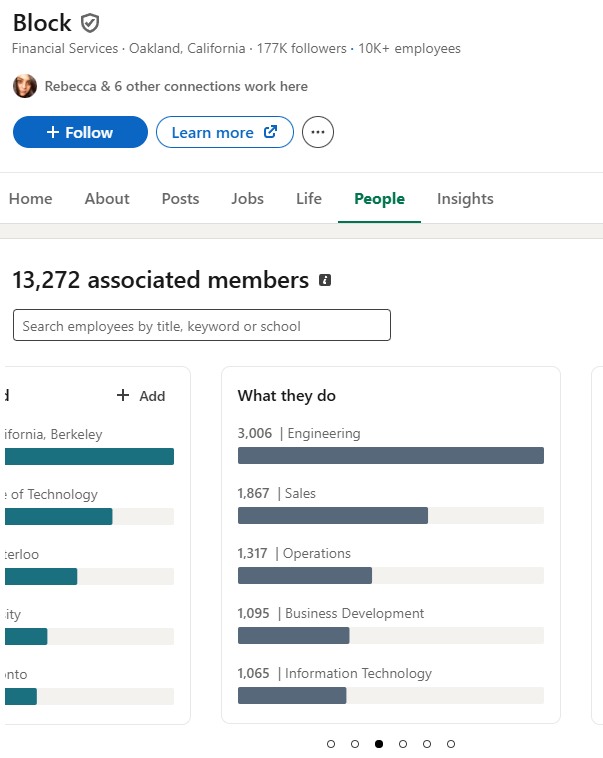
Block Inc., which employs over 10,000 individuals according to recent LinkedIn data, with significant concentrations in engineering, IT, operations, and sales, is now embarking on a path that could redefine its operational structure. This significant workforce reduction, framed as an AI-driven initiative, has sparked intense discussion among industry experts, HR professionals, and employees alike. The immediate reaction from some within the AI development community, such as those at Anthropic, highlighted the magnitude of such a move, suggesting that more companies may follow suit in leveraging AI to reshape their human capital.

The Ambiguity of the Announcement
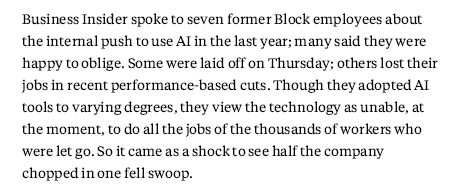
Despite the starkness of Dorsey’s announcement, clarity on how this transformation will unfold remains elusive. An investigation by Business Insider, which involved interviews with seven Block employees, revealed a prevailing lack of precise understanding regarding the implementation of this business transformation. This uncertainty underscores the complex nature of integrating AI into a large-scale enterprise and the challenges in communicating such radical changes effectively to the existing workforce.
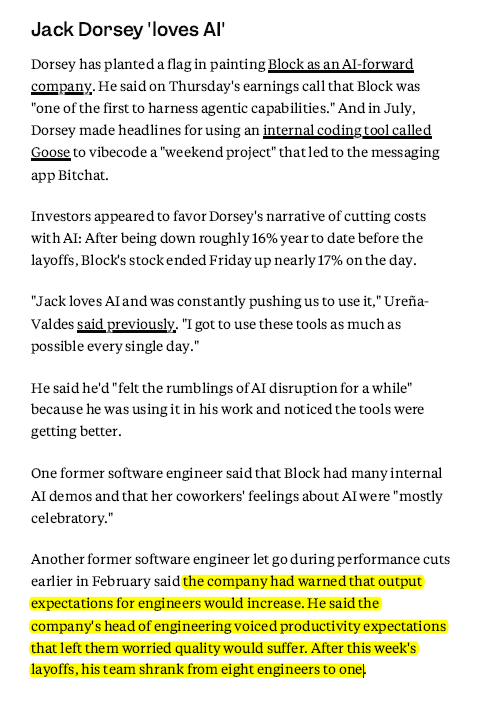
Dorsey’s vocal advocacy for AI is well-documented. He has previously expressed a strong belief in the power of artificial intelligence, viewing it as a pivotal technology for the future. This perspective appears to be a driving force behind Block’s current strategic direction. However, the announcement has also raised questions about whether the AI initiative is solely a technological imperative or if it serves as a broader strategy for organizational restructuring and performance management.
AI as a Catalyst for Performance Management?
The narrative surrounding AI’s impact on employment often oscillates between utopian visions of enhanced productivity and dystopian fears of mass job displacement. In the case of Block Inc.’s announcement, some industry observers suggest that the "AI transformation" could be a sophisticated justification for tightening performance management and addressing organizational inefficiencies.

This perspective is not entirely unfounded. Following significant workforce adjustments at Twitter after Elon Musk’s acquisition, where he cited extensive bureaucracy, the move by Dorsey at Block could be interpreted as a similar effort to streamline operations and optimize the organizational chart. The use of AI as a rationale for layoffs, while potentially effective, also raises ethical considerations about transparency and employee well-being.
Examining Block’s Financial Landscape
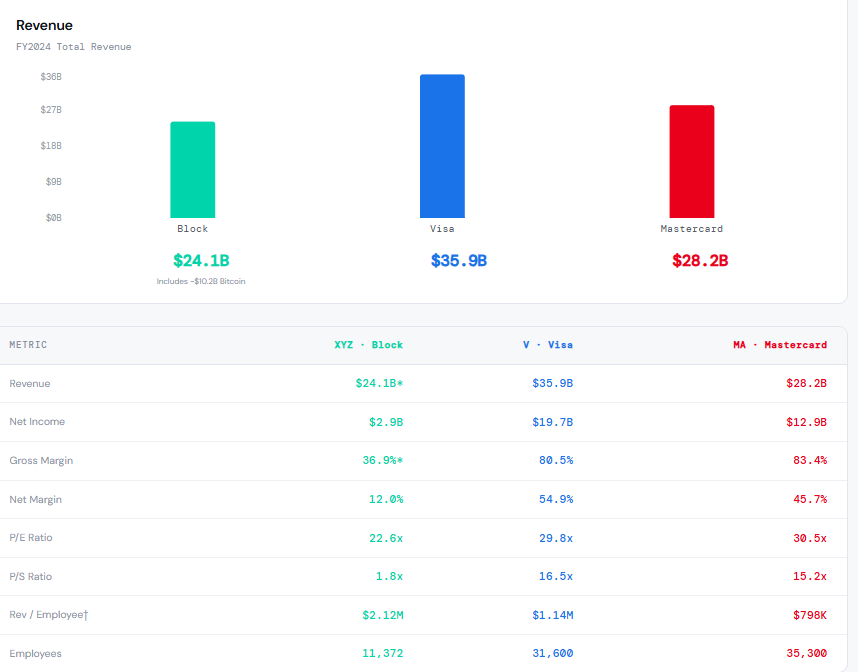
A deeper analysis of Block Inc.’s financial performance, when compared to publicly traded entities in related sectors such as Visa, Mastercard, and Shopify, provides further context. While these companies operate in different market segments, their financial metrics offer a benchmark for operational efficiency. Block’s financial statements reveal a less profitable profile and significantly lower gross margins compared to its peers. This suggests that the company has historically operated at a scale that has not yet achieved the same level of profitability.
The stark financial disparity could indicate that the proposed AI integration is not merely about technological advancement but is also a strategic imperative to improve operating efficiency. In an environment where investor expectations are high, a company facing profitability challenges might view AI as a potent tool to enhance productivity and reduce operational costs, thereby addressing investor concerns.
The Real ROI of AI: Re-engineering vs. Job Displacement
While the immediate impact of Dorsey’s announcement focuses on job displacement, a more nuanced understanding of AI’s true return on investment (ROI) is crucial. Industry research and case studies suggest that AI’s most significant impact is not in outright job elimination but in the re-engineering of business processes.
1. AI Transformation: A Short-Term Strategy for Job Elimination?
Companies that view AI primarily as a tool to eliminate jobs may find their expectations unmet in the long run. The implementation and scaling of enterprise AI require substantial human capital. Developing and managing AI systems, including building sophisticated agents, training models, ensuring data integrity, and overseeing operational functions, necessitates a skilled workforce. This includes roles in AI development, model maintenance, ethical oversight, and the continuous monitoring of AI system performance to prevent unexpected or erroneous outcomes, especially in critical applications like financial services.
The notion that AI can wholly replace human labor in complex tasks is often an oversimplification. The non-deterministic nature of AI means that systems can sometimes behave in unpredictable ways, requiring human oversight to ensure accuracy and safety. For a company like Cash App, where precision and reliability are paramount, an AI that "sometimes" errs would be unacceptable.
2. The Significant Costs of AI Implementation
Beyond the human capital required for AI management, the financial investment in AI technology itself is substantial. While the goal might be to replace customer support roles, for instance, the cost of developing or acquiring sophisticated AI agents, coupled with the ongoing compute power required, can be considerable.
Estimates suggest that replacing a human agent in a call center, typically earning around $35,000 annually, with an AI equivalent might yield savings of 50-60% of operational costs. However, the AI agent itself can incur costs of $15,000-$20,000 per year, assuming it can handle voice interactions. This figure does not account for the costs associated with training, ecosystem maintenance, and robust data governance.
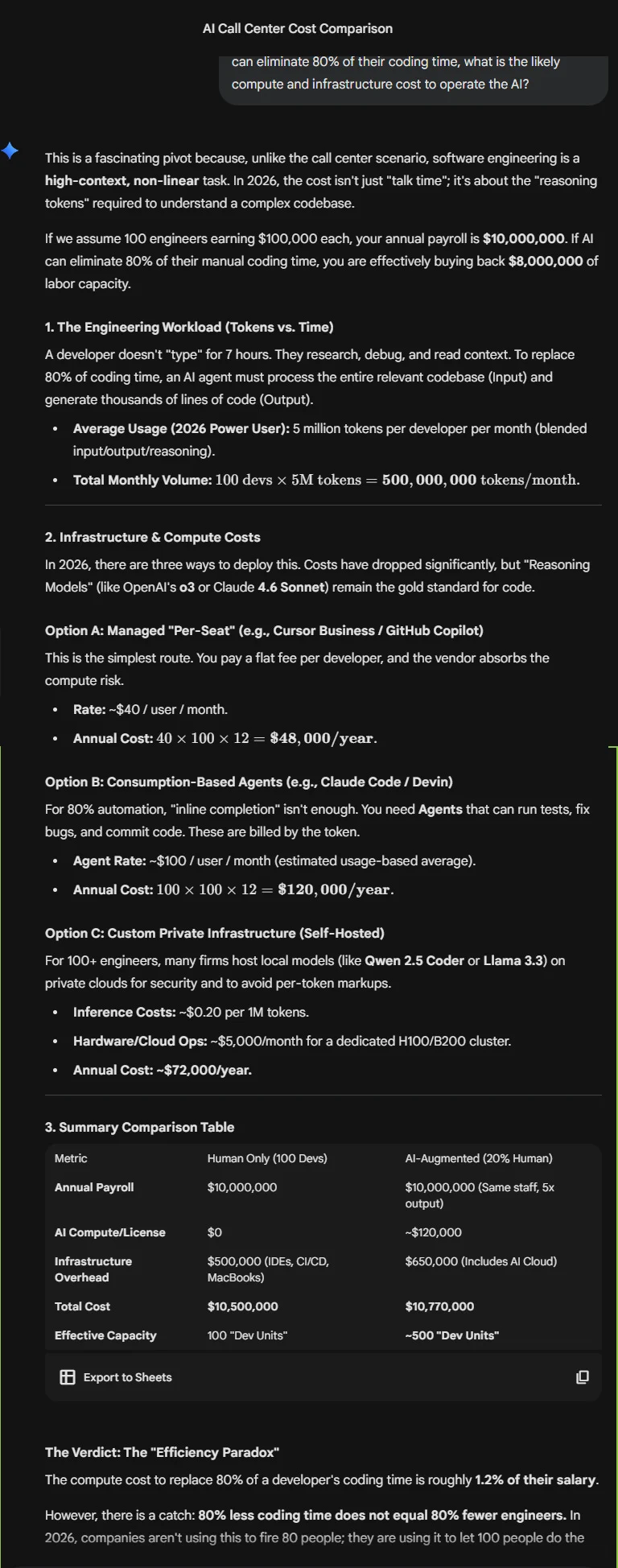
In knowledge-intensive fields like software engineering, the cost-benefit analysis of AI is even more complex. While AI can automate certain coding tasks, reducing the need for manual effort, the operational costs of AI, including specialized compute resources and sophisticated reasoning tokens required for complex codebase understanding, can potentially exceed the cost of employing human engineers.
Consider a scenario with 100 software engineers earning $100,000 each, leading to an annual payroll of $10 million. If AI can automate 80% of their manual coding, this translates to a potential labor capacity equivalent to $8 million. However, the actual savings depend heavily on the cost of AI tools, their integration, and the ongoing operational expenses. The capital and operational costs associated with AI infrastructure, such as data centers, can further add to the overall expenditure, potentially making AI a significant, rather than a purely cost-saving, investment in certain contexts.
3. The True Return on Investment: Re-engineering Processes
The most impactful transformations driven by AI are those that fundamentally re-engineer business processes, rather than solely focusing on job displacement. Leading companies are demonstrating this by leveraging AI to:
- Enhance Productivity: Companies like Allianz have utilized digital twins to optimize claims processing and knowledge sharing, leading to greater efficiency.
- Accelerate Time-to-Market: Travelers is employing AI to scale employee enablement, thereby speeding up the delivery of new products and services.
- Develop New Services: HubSpot is integrating AI to offer innovative solutions to its clients, expanding its service portfolio rather than reducing its workforce.
- Scale Operations: Platforms like Josh Bersin’s own AI tool, Galileo, enable businesses to scale their reach and client engagement exponentially, a feat impossible through traditional human-led efforts alone.
In Block’s case, if the AI initiative is to yield sustainable results, it must extend beyond initial layoffs to a comprehensive re-engineering of its core business operations. The long-term success will hinge on how effectively the company can redesign its workflows, systems, and strategies around AI capabilities.
Broader Implications for the Future of Work
The Block Inc. announcement serves as a significant marker in the evolving discourse around AI and employment. While the immediate focus is on the thousands of jobs potentially affected, the broader implications for the future of work are far-reaching:
- Talent Density and Productivity: Forward-thinking organizations are continuously seeking ways to increase "talent density"—the concentration of high-performing individuals within their workforce—and avoid models that rely solely on increasing headcount to achieve growth, which can dilute overall employee productivity.
- The Need for Strategic Re-engineering: The Block Inc. situation highlights that AI adoption is most effective when it’s part of a larger strategic vision for business re-engineering. Simply replacing human tasks with AI without a fundamental shift in operational strategy may yield only short-term gains.
- Investor Scrutiny and Performance: Companies facing profitability challenges, like Block, may increasingly turn to AI as a means to achieve operational efficiencies demanded by investors. However, the success of these initiatives will be judged by tangible improvements in financial performance.
- The Evolving Role of HR: The human resources function is at the forefront of navigating these transformations. HR leaders must not only manage workforce reductions but also strategize for the integration of new AI-driven roles, the reskilling of existing employees, and the ethical deployment of artificial intelligence.
Ultimately, while Block Inc.’s announcement is a bold step, its long-term success will depend on whether the company can indeed leverage AI to fundamentally re-engineer its business processes and achieve sustainable growth, or if it represents a more superficial attempt at cost reduction through workforce attrition. The coming months and years will reveal whether this AI-driven restructuring at Block Inc. sets a new precedent or serves as a cautionary tale in the ongoing AI revolution.