The modern workplace is grappling with a fundamental challenge: how to authentically foster a "people-first" culture when the underlying infrastructure often fails to see, understand, or leverage the full potential of its workforce. A people-first environment, by definition, is one where an employee’s skills, aspirations, and developmental trajectory are not just acknowledged but are actively integrated into the fabric of how work is structured and how decisions are made. This necessitates a proactive investment from leadership and HR departments, grounded in a deep understanding of individual capabilities and future potential. While many organizations aspire to this ideal, driven by strong values and well-intentioned leadership, the practical implementation has historically been hampered by a critical deficiency: a lack of granular visibility into the workforce.
For decades, organizational data infrastructure has been built primarily around transactional processes and static job roles, rather than dynamic individual growth and evolving skill sets. This disconnect has created a chasm between the stated intent of being people-first and the lived employee experience. A significant global survey conducted by Deloitte underscores this pervasive issue. The report, which polled over 900 companies worldwide, revealed that a staggering 83% of organizations reported a low maturity level in their people analytics capabilities. This data starkly illustrates that good intentions alone are insufficient to create the deeply integrated, data-informed people-first culture that employees increasingly expect and that successful businesses require. The advent of AI-powered talent intelligence is emerging as a pivotal force in rectifying this imbalance, offering the promise of a more insightful and actionable approach to workforce management.
The Elusive Nature of the People-First Workplace
The aspiration to be a people-first organization is widespread. When HR leaders are polled, the vast majority express that their company operates with this ethos. However, a disconnect often emerges when employees are asked the same question, with responses frequently indicating a more complex or less positive reality. This disparity between intention and experience is a recurring theme, particularly in areas where organizational data systems lack the depth and agility to capture the nuances of individual growth and evolving skill sets.
Consider the traditional toolkit of many HR departments. Job descriptions, often drafted years prior, may no longer accurately reflect the demands of current roles. Annual performance reviews, while offering a snapshot, are ill-equipped to capture the continuous development and trajectory of an employee’s career. Crucially, skills data, if captured at all, frequently resides in disparate, siloed systems, rendering it inaccessible for holistic analysis or strategic deployment.
Simultaneously, the workforce itself is in a state of constant flux. Roles are not static; they are morphing, integrating new responsibilities and requiring novel capabilities. Employees are continuously acquiring new skills, evolving their expertise, and expanding their potential – often in ways that existing organizational systems are not designed to systematically track or recognize. This creates a blind spot for leadership, making it difficult to identify internal talent that is perfectly suited for emerging opportunities or to understand the evolving skill landscape of the organization.
The Cost of Unseen Talent: Employee Attrition and Missed Opportunities
The consequences of this lack of visibility can be profound and costly. When an employee’s burgeoning skills go unnoticed or unacknowledged, it can lead to feelings of invisibility and a sense that their contributions are not fully appreciated by leadership. When developmental conversations feel generic and disconnected from an individual’s actual growth and aspirations, employees may begin to disengage emotionally from their roles. This disengagement can be a precursor to seeking opportunities elsewhere.
Furthermore, the phenomenon of internal opportunities being filled by external candidates, even when qualified internal individuals exist but are less visible, can be a significant driver of attrition. This scenario, far from being an anomaly, is a common occurrence that can prompt valued employees to explore external avenues for career advancement. According to iHire’s 2025 Talent Retention Report, a significant percentage of voluntary departures – nearly 19% – are directly attributable to a perceived lack of growth or advancement opportunities within the organization. This statistic highlights the critical need for employers to not only provide opportunities but also to ensure those opportunities are visible and accessible to their existing workforce.
The disconnect becomes particularly acute when companies launch well-intentioned "people-first growth initiatives." Managers might be encouraged to support internal mobility, and HR may communicate these opportunities broadly. However, if the underlying systems have not been modernized, an employee who has recently developed valuable, AI-adjacent skills may have no mechanism to surface these capabilities to leadership. An open role that represents a natural next step in their career path might remain unknown to the hiring manager, who is unaware of the employee’s relevant expertise. The tragic outcome is that, months later, this highly capable individual may accept an offer from a competitor that has recognized and valued their evolving skillset. The intention to foster internal growth was present, but the infrastructure to support it was absent, leading to talent loss and a missed opportunity for both the employee and the organization.
AI-Powered Talent Intelligence: Illuminating the Workforce Landscape
This is where AI-powered talent intelligence offers a transformative solution. It aims to preserve the essential human element of HR while equipping leaders with the unprecedented visibility required to manage workforces at the scale and pace demanded by today’s dynamic business environment. Talent intelligence systems provide a real-time, dynamic picture of what is happening within an organization. They illuminate existing skill sets across the entire workforce, track how roles are evolving, identify emerging skill gaps, and pinpoint employees who possess the adjacent capabilities needed to step into new and challenging opportunities.
Essentially, AI-powered talent intelligence shifts workforce data from a historical rearview mirror, offering insights into past performance, to a forward-looking lens, providing clarity on the present and near-future workforce landscape. This proactive approach is crucial for strategic workforce planning and talent development.
Key Capabilities of AI-Powered Talent Intelligence:
-
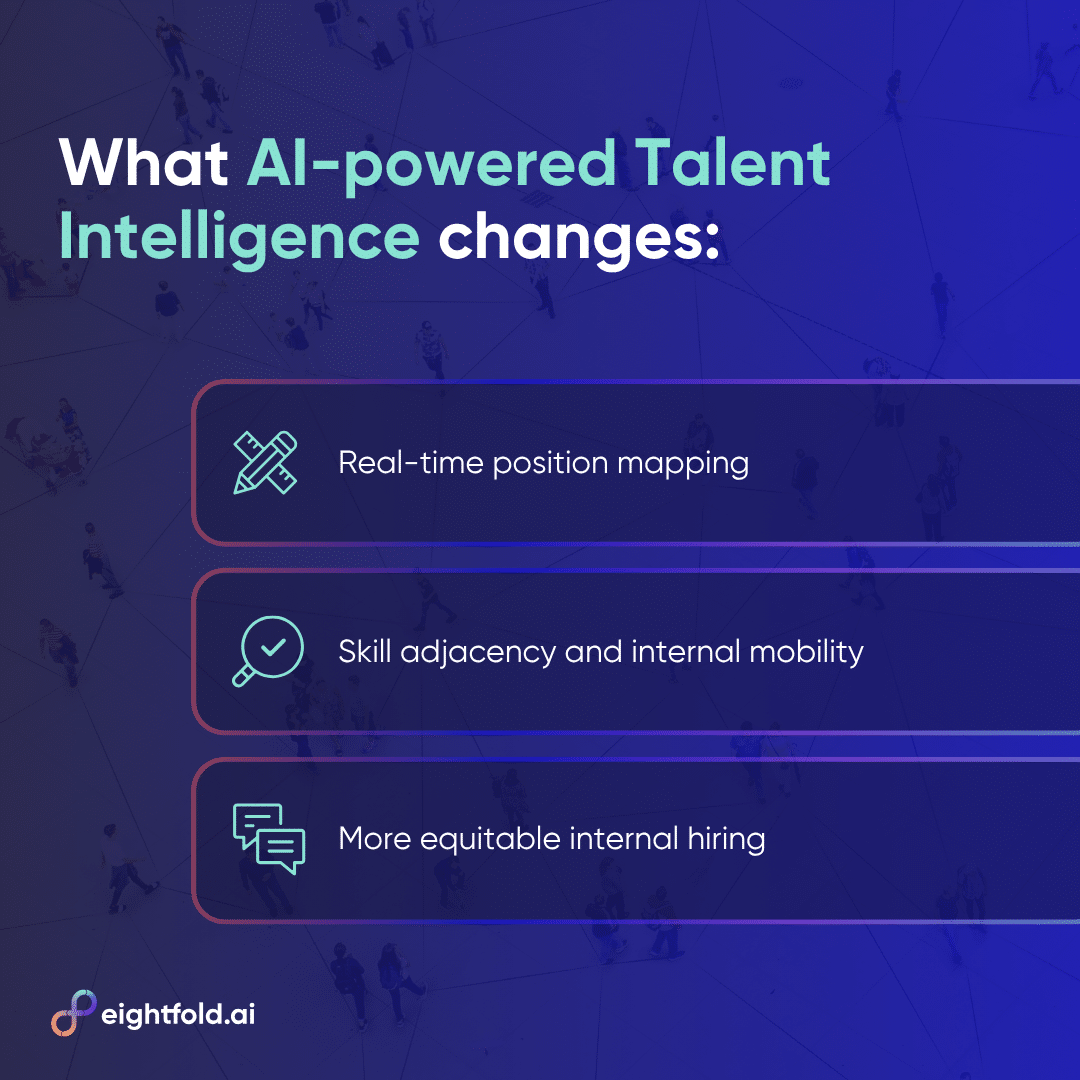
Real-Time Position Mapping: The nature of many job roles has changed dramatically in recent years. A marketing analyst role, for instance, now often encompasses responsibilities like prompt engineering, AI-assisted content analysis, and automation oversight – skills that may not be reflected in a job description written three years ago. AI-powered position mapping continuously tracks how roles are evolving in real time. This ensures that both employees and leaders have an accurate understanding of the skills and competencies required for current work. For employees, this provides essential clarity regarding their responsibilities and developmental needs. For organizations, it leads to more effective hiring decisions, more impactful development conversations, and improved employee retention.
-
Skill Adjacency and Internal Mobility Enhancement: One of the most powerful contributions of AI-powered talent intelligence is its ability to reveal career pathways that would otherwise remain hidden. Consider a customer support specialist who possesses strong communication skills and has been actively gaining experience with AI tools. Intuitively, there’s a natural progression toward a product operations role. Without a data-driven approach, this potential career path might never be identified. When internal mobility is underpinned by real, quantifiable skills data, it transforms from a matter of chance or proactive employee pursuit into a strategic organizational capability. This allows companies to proactively identify and cultivate internal talent for future needs.
-
More Equitable Internal Hiring Processes: In traditional internal hiring processes, roles can often be filled by the most visible employees, irrespective of whether they are the most qualified. Skills-driven hiring fundamentally alters this dynamic. A hiring manager might discover, through AI analysis, that an employee they have limited direct interaction with possesses a significant percentage of the capabilities required for an open position. This match might never have been surfaced through a traditional resume update, networking effort, or performance review. The result is a hiring process that is demonstrably faster, more accurate, and, crucially, fairer, promoting meritocracy and leveraging the full spectrum of internal talent.
The Inseparable Link: Business Case and People Case
While the discussion around fostering a people-first culture often centers on values and employee well-being, the business case for investing in AI-powered talent intelligence is equally compelling, and these two aspects are inextricably linked.
When employees clearly see viable internal pathways for growth and development, their commitment and retention rates improve. This means that invaluable institutional knowledge remains within the organization, rather than walking out the door with departing employees. Furthermore, when internal hiring decisions are informed by comprehensive skills intelligence, the time-to-fill for open positions can be significantly shortened. This is because candidates who already possess a deep understanding of the company’s operations and culture can be identified and considered much earlier in the process.
Moreover, when leaders have a clear and accurate view of the organization’s collective workforce capabilities, they are better equipped to redeploy talent swiftly in response to shifting priorities or market changes. This agility builds organizational resilience, preventing the need for frantic scrambling when circumstances demand rapid adaptation. Collectively, these outcomes contribute to a workforce that is not only more engaged and more capable but also more strategically aligned with the overarching business objectives. This alignment is critical for navigating the complexities of the modern business landscape and achieving sustained success.
From Promise to Practice: Operationalizing a People-First Culture
The organizations that are poised to lead in fostering exceptional workplace cultures over the next decade will not be those with the most sophisticated policies or the most inspiring value statements alone. Their success will hinge on their ability to truly see their people – their skills, their potential, their growth trajectories – and to act upon this understanding in meaningful and timely ways.
When thoughtfully implemented, AI-powered talent intelligence makes this level of actionable insight achievable. The critical factor is ensuring that skills data is clean, connected, and readily accessible. When AI-powered tools are seamlessly integrated into existing workflows, leaders and managers can transition from relying on intuition to making decisions grounded in data-driven insight, leading to tangible and measurable impact.
This integration closes the persistent gap between an organization’s stated values and the actual employee experience. This alignment is what transforms a people-first aspiration into a tangible reality, fostering retention that is not merely passive but actively cultivated through mutual growth and understanding. As organizations continue to navigate the evolving demands of the global economy, the strategic adoption of AI-powered talent intelligence is emerging not as a luxury, but as a fundamental requirement for building a thriving, resilient, and truly people-first workplace. This approach ensures that the promises made to employees are met with demonstrable action and measurable results, creating a virtuous cycle of engagement, development, and organizational success.