The dawn of a new fiscal year often brings a surge of opportunity for government agencies, as authorized positions become available for recruitment. However, for many public sector human resources departments, this influx of openings presents a formidable challenge, particularly when faced with lean recruiting teams and the inherent complexities of government hiring processes. The pressure to fill crucial roles swiftly is matched only by the unwavering obligation to ensure fairness, transparency, and compliance in every step. This intricate balancing act, a hallmark of public sector recruitment, is now finding a powerful ally in artificial intelligence, specifically through AI-powered interviewing solutions.
Government hiring operates within a framework meticulously designed to uphold public trust. This necessitates structured processes, standardized evaluations, and thoroughly documented decisions. While these safeguards are essential, they can inadvertently create significant bottlenecks, especially when confronting high-volume recruitment scenarios. A typical situation might involve an agency receiving authorization to fill 40 positions, only to have a recruiting team of three attempting to manage an already overflowing applicant portal. Compounding this, hiring managers are often fully committed for weeks, leaving the initial screening and assessment phases critically strained.
This scenario is not an anomaly but rather a recurring reality for HR leaders across federal, state, and local government entities. Unlike their private sector counterparts, who often possess the autonomy to streamline operations at will, government agencies are bound by stringent regulations and established protocols. These requirements, though vital for maintaining integrity, create a persistent tension: how can agencies accelerate their pace to attract top talent in a competitive market while simultaneously adhering to the rigorous standards demanded by public hiring?
Artificial intelligence, particularly AI interviewing technology, is emerging as one of the most promising answers to this perennial challenge. Agencies at all levels of government are increasingly adopting AI interviewers, not as replacements for human judgment, but as sophisticated tools to manage the overwhelming volume of early-stage recruitment work that currently leads to significant delays. When implemented thoughtfully and responsibly, this technology does not circumvent compliance requirements; rather, it enhances the ability to sustain compliance at scale.
The Universal Challenges Facing Government Hiring
Before delving into the specific applications of AI interviewing across different governmental tiers, it is crucial to acknowledge the common ground shared by federal, state, and local agencies. The challenges in public sector hiring, while manifesting differently, are remarkably similar.
1. Unwavering Compliance and Auditability: At every level of government, adherence to compliance and auditability standards is non-negotiable. Whether an agency operates under federal merit system principles, state civil service regulations, or local equal employment opportunity ordinances, the documentation requirements are substantial. Every hiring decision must be explainable, processes must be consistent, and all candidates must be afforded a fair opportunity. This bedrock principle necessitates meticulous record-keeping and a transparent process from application to offer.
2. Lean and Stretched Recruiting Teams: Government HR functions have historically been lean, often stretched thin by years of hiring freezes, budget constraints, and workforce reductions. The teams tasked with filling dozens, and sometimes hundreds, of positions are frequently small. They must manage this high volume alongside other critical HR functions such as onboarding, classification, and employee relations, creating a constant demand for efficiency.
3. High Applicant Volume: Government positions, with their inherent stability, comprehensive benefits, and the opportunity to serve the public, consistently attract a large pool of applicants, particularly for entry- and mid-level roles. While this strong candidate interest is a positive indicator, it places immense pressure on the initial screening stages, often leading to an administrative backlog.
4. Structured and Sequential Processes: The government hiring process is intentionally structured and sequential. This design reflects the core values of public service – fairness, equity, and accountability. However, it also means that delays at any stage can cascade, creating compounding bottlenecks. A delay in screening can lead to subsequent delays in panel interviews, approval processes, and the final offer stage, significantly extending the overall hiring timeline.
AI interviewing directly addresses the bottleneck that typically occurs at the transition point from application submission to structured candidate screening. By automating and optimizing this critical early phase, it allows agencies to manage high volumes more effectively.
Federal Government: Scaling Recruitment Without Expanding Headcount
Federal hiring is characterized by one of the most process-intensive talent acquisition functions in any sector. Agencies are bound by strict merit system rules, and the documentation required for selection decisions is extensive. For competitive service positions, in particular, every step of the hiring process must be traceable and justifiable.
Simultaneously, federal agencies frequently receive hundreds, if not thousands, of applications for a single job posting. A popular federal job announcement can generate a volume of applications that would take a small HR team weeks to screen manually. Consequently, federal hiring processes often extend for months, a timeframe that places these agencies at a significant disadvantage when competing for in-demand skills against private sector employers who can often hire in days or weeks.
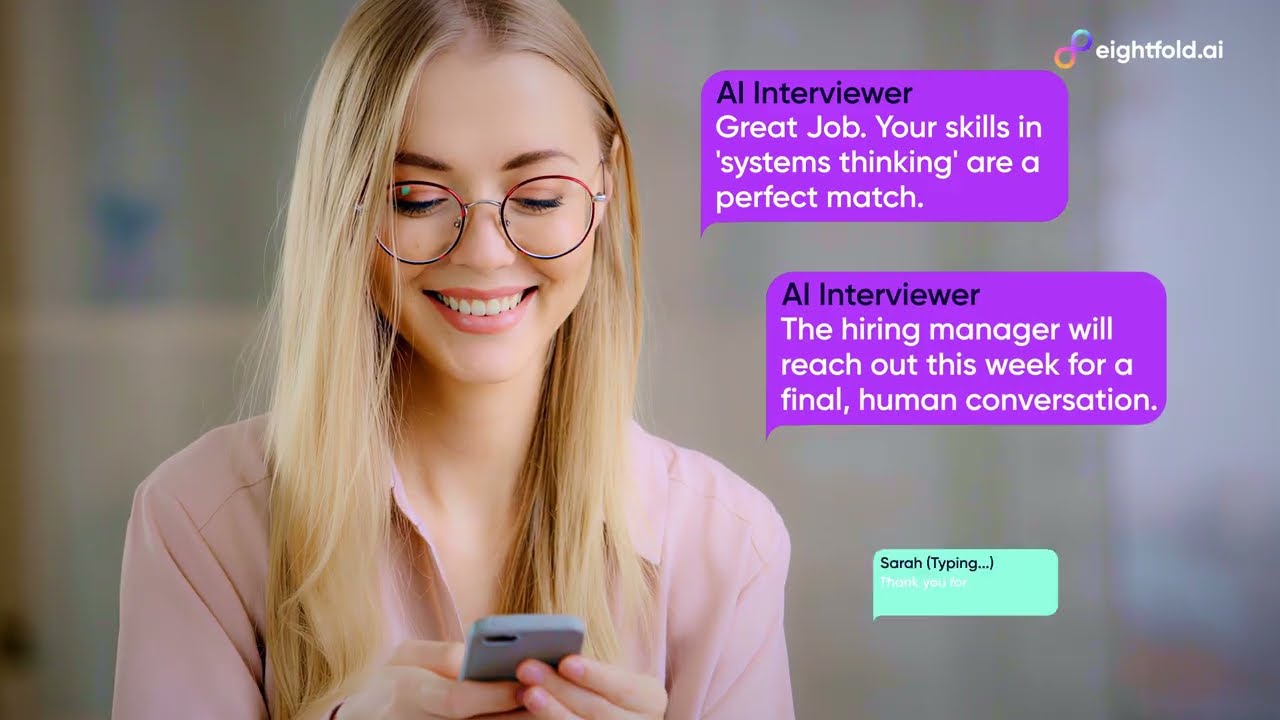
AI interviewing technology offers a solution by creating a consistent, documented screening layer capable of absorbing high application volumes without requiring an increase in headcount. Instead of recruiters conducting individual phone screens with every qualified applicant, an AI interviewer can conduct structured assessments with all candidates simultaneously, operating around the clock. This approach generates standardized output for every applicant, ensuring a uniform evaluation against predefined criteria.
Crucially for federal HR, this technology ensures that every interview is conducted in the same manner. Candidates receive identical questions, and their responses are evaluated against the same objective criteria. This consistency directly supports the merit system principles that govern federal hiring: treating all candidates equitably and making selection decisions based on job-relevant factors.
The Eightfold Talent Intelligence Platform, for instance, is engineered to support the structured, auditable workflows essential for federal agencies. Its AI Interviewer is certified to ISO/IEC 42001:2023, the international management system standard for artificial intelligence, and holds FedRAMP and DISA IL4 authorizations. These certifications make it one of the few hiring tools cleared for deployment within sensitive federal environments, a critical factor for agencies needing to demonstrate the integrity and reliability of their hiring processes.
State Government: Harmonizing Consistency Across Diverse Departments
State agencies present a unique set of complexities, often requiring a centralized HR function to support hiring across departments with vastly different needs. These can range from transportation and public health to corrections, environmental regulation, and revenue services. Each department possesses its own distinct job families, technical requirements, and hiring managers. The central HR team, however, must maintain consistent processes across all these varied entities.
This scenario creates an inherent tension between the need for standardization and the necessity for flexibility. The HR team requires a uniform process to ensure compliance and fairness, yet the specific hiring needs of a public health nurse recruiter differ significantly from those of a civil engineer recruiter. These differences must be reflected in how candidates are evaluated.
AI interviewing in state government helps to resolve this tension. A platform like the AI Interviewer can be configured to align with the specific role requirements and competency frameworks of different departments while maintaining a consistent underlying operational process. For example, a candidate applying for a fiscal analyst role within the Department of Revenue and another applying for a program coordinator position within the Department of Aging would undergo the same structured interview experience. The questions would be tailored to their respective positions, and their responses would be evaluated against criteria specifically developed for each role.
For state HR leaders, this translates into a single, enterprise-wide tool that serves all departments without necessitating that each one build its own recruitment process from scratch. Furthermore, when questions arise regarding consistency across departments—a common occurrence in state civil service systems—the answer is intrinsically built into the tool’s functionality. This ensures a standardized approach to candidate assessment, regardless of the department or specific role.
Local and Municipal Government: A Force Multiplier for Resource-Constrained Teams
Cities and counties often grapple with the most acute version of the government hiring challenge. Their HR teams are frequently small, sometimes comprising just a single individual responsible for all talent acquisition and management for an organization of hundreds. The roles span an enormous spectrum, including public works, parks and recreation, utilities, code enforcement, emergency services, and finance.
The pressure to hire is particularly acute at the local level. Turnover in frontline positions tends to be high, and community members feel the immediate impact of vacancies in essential services. For a city HR director managing dozens of open positions with a lean team, the interview stage can become a critical bottleneck. The sheer volume of applications often exceeds the available hours for personal screening, yet the imperative to fill positions quickly is constant.
AI interviewing in local government functions as a potent force multiplier and a strategic investment. A single recruiter can efficiently move a large cohort of candidates through the initial screening stage without becoming the primary constraint in the process. The AI interviewer engages every candidate in the same structured conversation, generates consistent, reviewable output, and effectively surfaces the strongest candidates for the subsequent human-led stages of the hiring process.
This technology also addresses a consistency challenge that small teams often face. When one or two individuals are solely responsible for all initial screening, their judgment, however skilled, can be inherently variable across a high volume of interviews. Factors such as fatigue, context-switching, and time pressure inevitably affect human interviewers. An AI interviewer, however, operates without these limitations, ensuring that the hundredth candidate receives the same standardized experience as the first. This democratizes the initial assessment phase, ensuring a more equitable experience for all applicants. The accessibility of such enterprise-grade tools, designed for straightforward implementation and sustained management by smaller teams, is as critical as the advanced capabilities they offer.
Quantifying the Impact: Data-Driven Insights into AI Interviewing in Government
The performance data generated by AI Interviewers offers valuable insights, particularly when viewed through the lens of government hiring priorities, which emphasize consistency and candidate experience alongside speed.
Systems like the Eightfold AI Interviewer have demonstrated the capacity to automate up to 80% of manual recruiter work in the screening stage, maintaining an impressive 92.5% interview completion rate. Furthermore, candidates who engage with the AI Interviewer consistently report positive experiences, reflected in a 93% Net Promoter Score (NPS). This high candidate satisfaction is paramount in government hiring, as it directly influences an agency’s reputation as an employer and its ability to attract and retain talent in a competitive landscape.
The impact on hiring timelines is also significant. AI interviewing can compress hiring cycles to as few as 1.3 days for certain stages, a dramatic reduction compared to the weeks or months that often characterize traditional government hiring processes. The system’s ability to operate 24/7 and support over 22 languages is particularly relevant for agencies serving diverse communities, ensuring accessibility for candidates who may not be equally comfortable in English.
Crucially, the AI Interviewer evaluates candidates based solely on the content of their responses. It avoids the use of biometric cues, video analysis, or vocal tone, addressing key concerns about fairness and potential bias that are paramount for public sector employers. The system incorporates candidate identity verification through trusted partners, tracks signals of interview integrity, and grounds its assessments in the analysis of 1.6 billion real-world career trajectories and 1.6 million skills. This approach ensures that evaluations are based on actual work realities rather than generalized language patterns or subjective interpretations.
The Imperative of Speed, Fairness, and Defensibility in Government Hiring
The scenario presented at the outset of this discussion—a high volume of requisitions, a lean team, and a process designed for a different era—is not an exception but rather the standard operating condition for many government HR departments. These are structural realities that demand innovative solutions.
AI interviewing in government does not alter the fundamental rules governing public hiring; instead, it makes those rules more manageable and scalable. By ensuring that every candidate is evaluated consistently, every decision is meticulously documented, and every step of the process is auditable, it transforms compliance requirements from potential obstacles into integral design criteria for the technology.
For government agencies striving to bridge the gap between the recruitment demands they face and the capacity they possess, AI interviewing solutions are purpose-built. With robust certifications, a meticulously designed architecture, and a proven track record, these tools are poised to support high-stakes public sector deployments, ensuring that government hiring is not only efficient but also remains steadfastly fair and defensible.
Agencies looking to modernize their recruitment strategies and address the persistent challenges of high-volume, compliance-heavy hiring can explore AI interviewing as a strategic investment. Requesting a demonstration or delving into specialized public sector solutions can provide a clearer understanding of how this technology can be leveraged to meet the unique needs of federal, state, and local government recruitment.