In a significant development that underscores the rapidly intensifying competition within the core HR technology sector, Gloat, a prominent player in skills intelligence and talent marketplaces, has officially entered the realm of AI Agents for Human Resources. This strategic move signals a new frontier in how organizations will leverage artificial intelligence to manage their workforce, moving beyond traditional systems to more dynamic, context-aware solutions.
The launch of Gloat Agentic HR introduces a comprehensive toolset designed to empower businesses to rapidly build and deploy AI Agents. These agents are engineered to integrate seamlessly with existing enterprise systems, including established HR Information Systems (HRIS) like Oracle, Workday, and SuccessFactors, by leveraging their inherent business rules and security protocols. The power of these agents will be accessible through widely used communication and collaboration platforms such as Microsoft Copilot, Teams, Slack, and other emerging AI applications, promising a more intuitive and integrated employee experience.
The Evolving Architecture of Agentic AI in HR
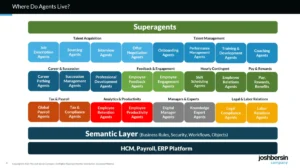
To fully grasp the significance of Gloat’s announcement, it is crucial to understand the foundational architecture of agentic AI within the enterprise landscape. This architecture can be broadly categorized into five distinct layers, each building upon the one below it.
1. Systems of Record: At the base of this pyramid lie the fundamental systems that house and manage critical organizational data. These include the robust Human Capital Management (HCM) applications from vendors like Workday, SAP, Oracle, and UKG, which are built upon complex databases. These databases are the bedrock for all information pertaining to financials, customers, employees, inventory, and products, serving as the ultimate source of truth for an organization.
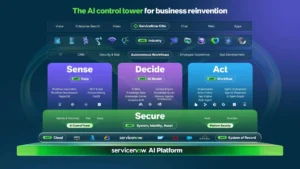
2. Cross-System Applications and Employee Experience Platforms: The second layer comprises applications that bridge the gap between disparate systems. Given that no single vendor offers a complete suite of HR solutions, companies frequently develop custom portals, mobile applications, and intricate workflows to connect these systems. This layer also includes hundreds of specialized applications, such as Learning Management Systems (LMS), Applicant Tracking Systems (ATS), IT provisioning tools, and time-tracking software. A typical large enterprise manages an average of 400 such applications, with over 100 directly impacting the employee experience. Over the past two decades, as technology migrated from on-premise to the cloud, a rich ecosystem of solutions has emerged. Companies like ServiceNow, a multi-billion dollar enterprise software company, have become dominant players in this space, offering platforms that facilitate the integration and management of these diverse applications. Employee experience platforms, including Microsoft Viva, Slack, Google Workspace integrations, and others, are also prevalent, though many were not originally designed with "agentic" capabilities.
3. Agentic AI Layer: This is the emergent layer where AI Agents reside. Unlike static portals or simple workflows, these agents possess a degree of intelligence, maintaining a personalized understanding of individual users and capable of performing tasks on their behalf. The HR technology market is currently witnessing an influx of hundreds of agent tools, ranging from offerings by agile startups to integrated solutions from established enterprise system providers. These agents are designed to facilitate the creation of cross-functional HR solutions tailored to the needs of people management.
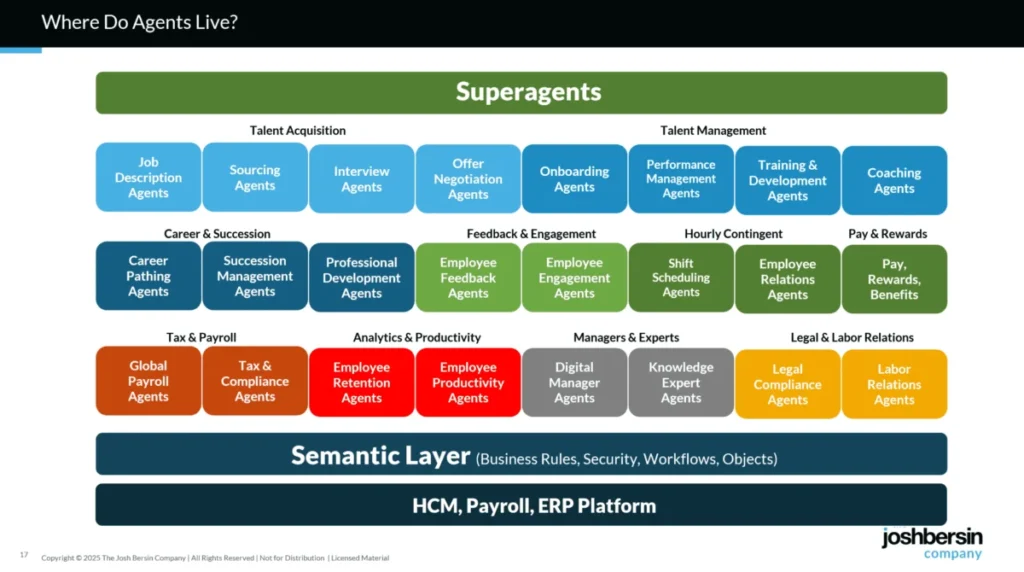
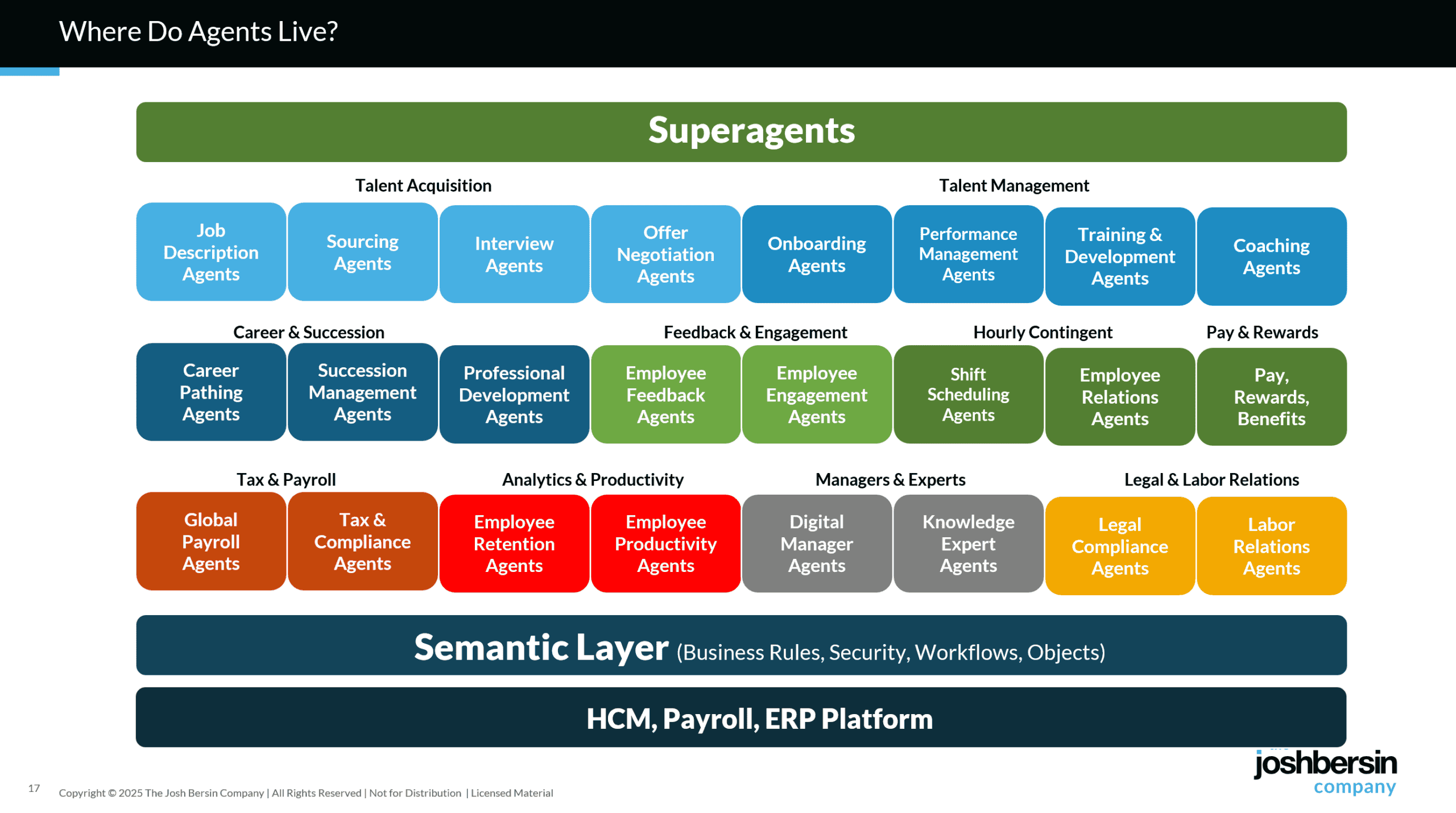
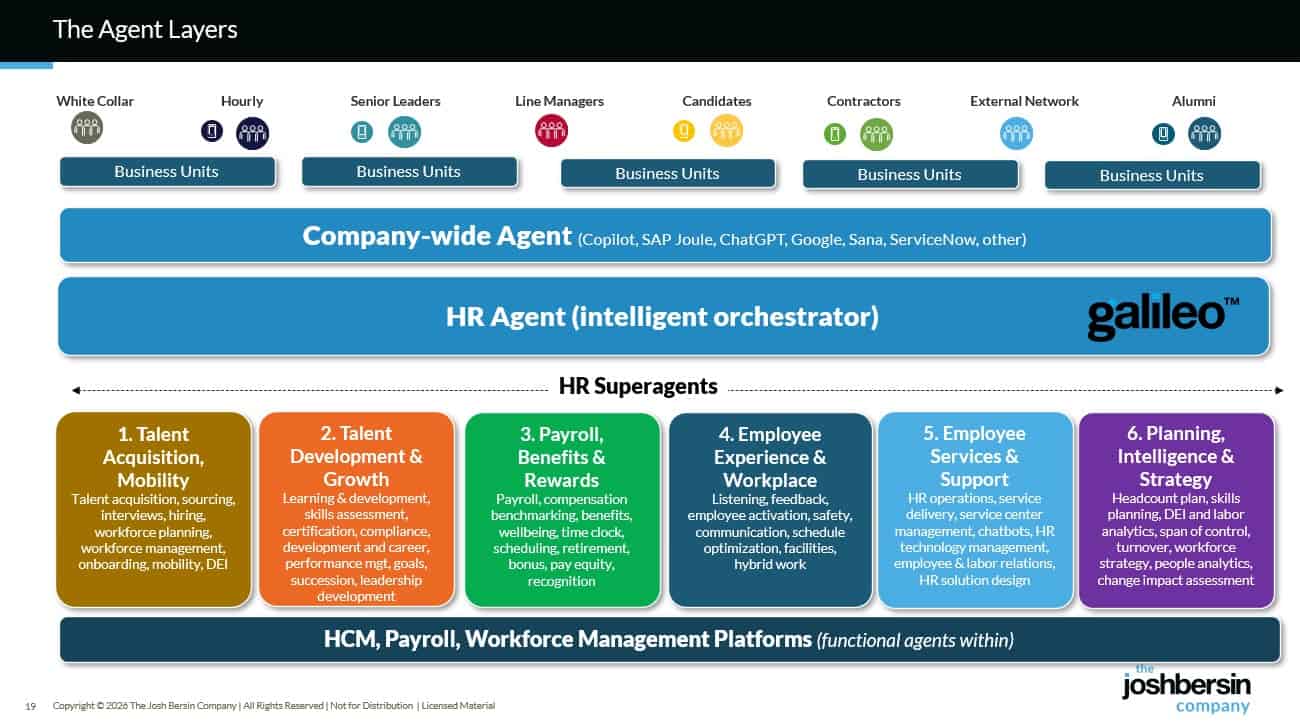
4. Superagents: Positioned at the apex of this architecture are "Superagents." These sophisticated tools are designed to orchestrate and access multiple functional agents, creating a highly streamlined and intuitive user experience. The goal is to provide users with a "walk up and use" interaction, abstracting away the underlying complexity of individual agent functions.
The proliferation of tools within the agentic AI layer is evident. Major players like Workday (with Sana), Oracle (Oracle Agent Studio), Microsoft (Microsoft Copilot Studio), and SAP (Joule Studio) are actively developing their own agent-building platforms. Startups such as Leena.ai and established integration platforms like ServiceNow (enhanced by acquisitions such as MoveWorks) are also contributing to this dynamic ecosystem. Furthermore, foundational AI model providers like Anthropic, OpenAI, and Google are increasingly embedding their capabilities into enterprise solutions.
The Operationalization of AI Agents: Navigating Complexity
While the concept of AI Agents holds immense promise, their practical implementation is often complicated by the intricate web of business rules, security protocols, and legacy systems that define most enterprise environments.
Consider a payroll reconciliation agent, for instance. Such an agent, offered by vendors like Workday, SAP, or Oracle, is designed to monitor payroll transactions, reconciling discrepancies related to taxes, timecards, employee status changes (new hires, terminations), and pay adjustments. However, its efficacy is entirely dependent on its ability to be "trained" with the specific business rules and security configurations of an individual company. Furthermore, to perform advanced functions like monitoring pay equity or factoring in performance-based adjustments, it must be able to interact with other specialized agents.
This highlights the critical importance of "agent architecture." A hypothetical scenario illustrates this complexity: imagine an organization needing to redeploy 5,000 employees from an existing business unit to new roles. An AI agent tasked with identifying suitable candidates would need to assess job fit, identify skill gaps, and gauge redeployment potential. To achieve this, the agent would require access to and integration with a multitude of other systems and data sources, including skills databases, career pathing tools, and performance management systems. A "Superagent," such as the one developed by Galileo, designed to act as an HR advisor, would need to understand these intricate relationships to provide employees and managers with informed options, recommend relevant training, and consider factors like location, licensing, union agreements, and compensation levels.
The complexity of building and deploying such sophisticated agents is substantial. Common use cases extend across a broad spectrum of HR functions, including global onboarding, internal promotions, annual performance reviews and compensation cycles, talent acquisition, employee certification tracking, and time and schedule management.
The Emerging Battlefield: Securing Business Rules in the Enterprise Agent War
The race to provide AI-powered solutions for HR is intensifying, with virtually every major HR technology vendor actively developing agent capabilities. While some offerings focus on simpler coaching functionalities, others delve into more profound operational applications. Leading vendors, particularly Workday, Oracle, SAP, and ServiceNow, are investing heavily in "AI studios" to democratize the creation of these agents.
However, the fundamental challenge is not merely about selecting or building individual agents. The true battleground lies in the ability to seamlessly integrate these agents and orchestrate their interactions. This integration hinges on effectively managing business rules, security policies, existing workflows, and what can be termed "business objects"—customized frameworks and models unique to each organization, such as a specific career framework or performance review rubric.
These unique rules and rubrics represent the core value proposition and operational model of a company. As business strategies evolve, so too do these internal constructs. The objective is to avoid hard-coding these dynamic elements directly into individual agents. Instead, agents need to access a "semantic layer" that accurately reflects and maintains this organizational knowledge.
Established HCM vendors, including Workday, Oracle, SAP, and UKG, already possess sophisticated semantic layers, often manifested as proprietary business process frameworks. They are now integrating these into their agent development tools. Consequently, any HR agent or agent development platform will ideally seek to leverage this crucial layer. This trend suggests a potential shift in the market, where "systems of context" may become as, if not more, important than traditional "systems of record."
Gloat’s Strategic Play: Loomra and the Agentic HR Platform
Gloat’s latest initiative aims to liberate organizations from the constraints of legacy approaches by offering a novel solution. The company has developed an "agent-driven auto-discovery ‘injestion’ system" named Loomra. This sophisticated technology mines and replicates the entities, workflows, and business rules embedded within an organization’s existing HCM systems, critically, it continuously synchronizes these elements as the HCM landscape evolves. Loomra effectively mirrors the rules and objects of the core HR system, providing a robust foundation for building custom applications and agents.
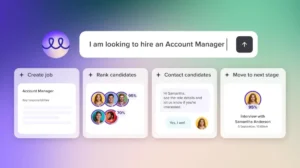
Building upon this semantic layer, Gloat offers an intuitive agent builder. This visual tool allows users to construct and deploy their own AI Agents directly within platforms like Microsoft Teams, Copilot, and Slack. Gloat has already developed pre-built agents addressing key areas where it possesses significant expertise, including Workforce Redeployment, Career Development, Internal Talent Sourcing, Succession Planning, and Learning & Reskilling.
Workforce Context as a Differentiator
What sets Gloat’s Agentic HR platform apart is the underlying workforce context layer powered by Loomra. This engine is built on nearly a decade of enterprise-scale workforce data, encompassing intricate models of skill adjacencies, career trajectories, organizational patterns, and workforce relationships drawn from millions of employees globally.
This rich contextual understanding enables Gloat’s agents to transcend mere information retrieval. Instead of simply answering queries like "show me employees who know Python," these agents can perform sophisticated reasoning. They can identify employees with the potential to transition into AI engineering roles within the current year, pinpoint teams most vulnerable to future skill gaps, and recommend optimal talent redeployment strategies as business priorities shift.
Competitive Landscape and Gloat’s Position
Gloat’s approach presents a compelling proposition: organizations can potentially "start with Gloat" to rapidly build the AI capabilities they need, bypassing the often-lengthy development cycles of their core HCM vendors. The open nature of the Gloat platform also facilitates integration with other internal systems. Moreover, Gloat’s contextual engine is a unique differentiator, as few, if any, existing HCM vendors appear to have developed a comparable system.
However, the market for agent tools is fiercely competitive. Organizations deeply invested in specific HCM ecosystems are likely to gravitate towards native solutions. For example, ServiceNow users will lean towards ServiceNow’s agent capabilities, Workday customers may opt for Sana, Oracle users will utilize Oracle AI Studio, and SAP customers will engage with Joule Studio. Gloat faces the challenge of convincing potential clients that its tools offer superior ease of use, deeper integration, and more sophisticated contextual awareness compared to these entrenched alternatives. As the enterprise technology landscape pivots from a focus on "systems of record" to "systems of context," Gloat has the potential to emerge as a leader in this transformative shift.
Future Outlook and Market Dynamics
The evolution of application development tools has historically shown a pattern where new platforms emerge and gain traction based on their alignment with existing infrastructure and organizational needs. Gloat’s new platform represents an innovative step forward for the agent industry, pushing the boundaries of what is possible in HR technology.
As Gloat begins to onboard early customers and deploy its agentic solutions, insights into their real-world performance and impact will become increasingly valuable. The coming months will be critical in observing how this innovative approach is adopted and how it influences the broader trajectory of AI in enterprise HR. The development and adoption of these advanced agentic capabilities will undoubtedly shape the future of work, offering organizations new ways to enhance efficiency, empower employees, and strategically manage their most valuable asset: their people.