The modern talent landscape presents an increasingly complex challenge for organizations: retaining accepted candidates in the crucial pre-start period. A significant number of recruitment programs operate without a structured process for monitoring candidate engagement after an offer is extended and accepted, often leading to the discovery of a renege only after the candidate has already mentally, if not formally, withdrawn. By the time a candidate falls silent or becomes unresponsive, their decision to pursue other opportunities or reconsider their commitment has frequently solidified, leaving companies scrambling to backfill critical roles at substantial cost and disruption. This reactive approach, long prevalent in many industries, is proving unsustainable in today’s competitive and candidate-driven market. The prevailing solution emerging from leading talent acquisition teams is the adoption of sophisticated, data-driven engagement health scorecards, which treat candidate interaction signals as crucial leading indicators of retention risk.
The Escalating Challenge of Candidate Renege in a Dynamic Labor Market
Candidate reneging, the act of withdrawing an acceptance of a job offer, has become an increasingly pronounced issue for employers globally. Reports from recruitment analytics firms indicate that renege rates can fluctuate significantly, but often hover between 10% and 20% for certain industries and roles, particularly in high-demand sectors like technology, healthcare, and specialized engineering. The financial implications are staggering; industry estimates suggest that the cost of replacing a reneged candidate can range from 1.5 to 3 times their annual salary, encompassing lost productivity, additional recruitment fees, extended onboarding expenses, and the intangible impact on team morale and project timelines.
Several factors contribute to this phenomenon. A robust economy often creates a candidate’s market, where skilled professionals receive multiple offers, leading to increased leverage and choice. The rise of remote work has broadened talent pools but also intensified competition, allowing candidates to consider opportunities from anywhere. Furthermore, a perceived lack of engagement or clarity from the hiring company during the pre-start phase can sow seeds of doubt, making candidates more susceptible to competing offers or personal uncertainties. Historically, many organizations have viewed the offer acceptance as the final hurdle, underestimating the psychological and logistical transition period a candidate undergoes before their official start date. This oversight creates a critical vulnerability in the talent pipeline.
Shifting to Proactive Engagement: A Paradigm Change
The most effective organizations are moving away from this reactive posture towards a proactive, data-informed strategy. The core principle is simple yet profound: instead of waiting for a renege to occur, identify early warning signs of disengagement and intervene strategically. This shift is analogous to predictive maintenance in manufacturing, where sensor data is used to anticipate equipment failure rather than merely reacting to breakdowns. In human capital, this translates to continuously monitoring candidate "vital signs" during the often-overlooked period between offer acceptance and the first day of employment.
This pre-start phase, which can span weeks or even months, is a critical window for fostering commitment and mitigating risk. Candidates are often navigating personal logistics such as relocation, notice periods with their current employer, and emotional transitions. It’s also a time when they are most vulnerable to counter-offers or new opportunities. A structured engagement strategy acknowledges this sensitivity and aims to reinforce the positive decision they’ve already made, integrate them virtually into the team culture, and address any potential concerns before they escalate.
The Engagement Health Scorecard: A Data-Driven Framework for Retention
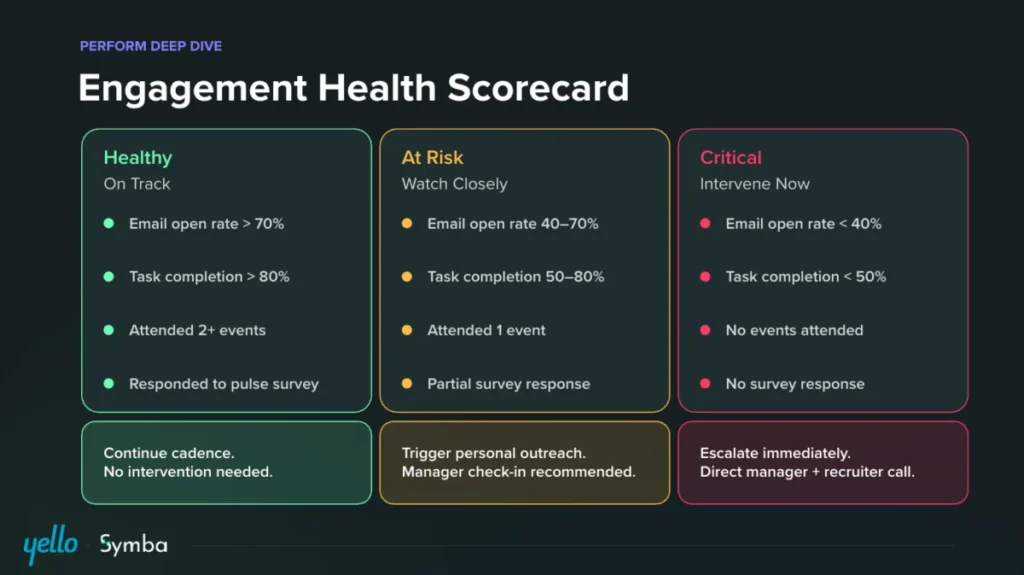
At the forefront of this proactive approach is the Engagement Health Scorecard, a sophisticated system designed to categorize candidates based on their observable behavior during the pre-start period. This scorecard leverages various data points – digital interactions, task completion, event participation, and survey responses – to assign a dynamic health status to each incoming hire, enabling talent acquisition teams to deploy targeted interventions.
The scorecard typically classifies candidates into three distinct categories: Healthy, At-Risk, and Critical. This tiered system provides clarity and dictates the urgency and nature of required actions, ensuring resources are allocated effectively and interventions are timely.
Healthy Candidates: Sustaining Momentum and Reinforcing Commitment
Healthy candidates exhibit strong and consistent engagement signals, indicating a high level of enthusiasm and commitment to their upcoming role. Their behavior patterns typically include:
- Email Open Rates: Consistently opening recruitment-related emails at a rate above 70%, suggesting active interest in company communications, onboarding instructions, and welcome messages.
- Task Completion: Promptly completing administrative tasks, such as background checks, benefits enrollment, and digital paperwork, demonstrating responsibility and readiness.
- Event Attendance: Actively participating in multiple pre-start events, such as virtual meet-and-greets with future teammates, company webinars, informational sessions, or social gatherings. This indicates a desire to integrate and understand the company culture.
- Survey Responses: Providing timely and thoughtful responses to pre-onboarding surveys, offering valuable feedback and indicating attentiveness.
For this group, the recommended action is to "continue the cadence and stay the course." This involves maintaining the established communication schedule, providing relevant information, and offering opportunities for continued engagement without overwhelming the candidate. The goal is to reinforce their positive decision, build anticipation, and ensure a smooth transition, leveraging their existing positive momentum. This consistent, positive reinforcement strengthens the psychological contract between the candidate and the organization, making them less susceptible to external influences.
At-Risk Candidates: Timely Intervention is Key
The "At-Risk" category signals a concerning, but often reversible, decline in engagement. These candidates present early warning signs that require immediate and personalized attention to prevent further disengagement. Indicators for this tier typically include:
- Declining Engagement Metrics: Email open rates falling into a range of 40-70%, suggesting a waning interest or a prioritization of other communications.
- Limited Event Attendance: Sporadic or no attendance at scheduled pre-start events, indicating a potential lack of investment in team integration or an overcommitment elsewhere.
- Incomplete Survey Responses: Partial or delayed submission of surveys, potentially signaling distraction, reduced focus, or emerging hesitations.
When a candidate is flagged as At-Risk, the protocol dictates personal outreach within a strict 48-hour window. This urgency is paramount; delays can allow minor doubts to fester into significant issues. Effective interventions include:
- Personalized Direct Message: A direct, empathetic message from the program manager or a dedicated HR contact, acknowledging their value and offering support. This personal touch differentiates from mass communications.
- Individualized Event Invitations: Rather than generic invites, a tailored invitation to an upcoming event, highlighting specific benefits for the candidate or connecting them with a relevant team member. This makes the candidate feel seen and valued.
- Hiring Manager Check-in: A brief, informal check-in call from the hiring manager, not to pressure, but to reiterate excitement, answer questions, and offer mentorship. This demonstrates leadership commitment and direct support.
These personalized actions aim to re-establish a connection, address unvoiced concerns, and re-engage the candidate before their commitment erodes further. Often, a simple conversation can uncover minor issues that, if left unaddressed, could lead to a renege.
Critical Candidates: Immediate Escalation for Retention
The "Critical" category represents the highest level of risk, indicating severe disengagement that demands immediate, high-level intervention. These candidates are often on the verge of reneging or have already made up their mind to do so. Their engagement profile typically shows:
- Minimal Engagement: Email open rates consistently below 40%, often coupled with no recent activity or responses to communications.
- No Event Attendance: Complete absence from all pre-start events, signaling a profound lack of interest in the team or company culture.
- Zero Survey Responses: No submissions for any surveys, indicating a complete disconnect or a deliberate withdrawal from the process.
- Extended Inactivity: No recorded activity or communication for three or more weeks, suggesting a prolonged period of disengagement.
For critical candidates, the response must be swift and direct. This level of disengagement requires immediate escalation to senior stakeholders within the hiring process:
- Direct Call from the Hiring Manager: A personal call, not an email, from the hiring manager is crucial. This direct, high-level engagement conveys the company’s commitment and the importance of the candidate to the team.
- Personal Touchpoint from the Recruiter: A dedicated recruiter should follow up with a personal call, offering support and attempting to uncover the root cause of disengagement.
- A Real Conversation: The objective of these interventions is to facilitate an honest, open dialogue about what is truly happening. Common root causes include a competing offer, a significant personal circumstance (e.g., family illness, relocation issues), or simple uncertainty about the role or company culture. Catching these issues in time allows the organization to potentially address them through negotiation, flexibility, or additional reassurance, often salvaging the hire.
The Strategic Imperative of Continuous Data Monitoring
The fundamental difference between organizations that successfully retain accepted candidates and those that are perpetually scrambling to backfill roles lies in their approach to data. The former group is continuously monitoring engagement data, transforming raw interactions into actionable insights. This continuous oversight allows for predictive analytics, enabling talent acquisition teams to anticipate potential problems rather than merely reacting to them.
This approach integrates seamlessly with broader trends in talent analytics and HR technology. Modern recruitment platforms and CRM systems can automate the tracking of engagement metrics, flagging candidates for intervention based on predefined thresholds. The "KEEP Playbook," for instance, exemplifies such a comprehensive framework, providing not only the full engagement health scorecard with specific thresholds and recommended actions for each tier but also a step-by-step intervention guide and a post-cycle review template. This allows organizations to institutionalize best practices, learn from each hiring cycle, and continuously refine their retention strategies.
Industry Perspectives and Broader Implications
HR and talent acquisition leaders increasingly recognize the strategic value of proactive engagement. "In today’s hyper-competitive market, securing an acceptance is only half the battle," states Sarah Chen, VP of Talent Acquisition at a major tech firm. "The period between offer and start date is a fragile bridge. Investing in tools like the Engagement Health Scorecard isn’t just about preventing reneges; it’s about building a strong foundation for employee loyalty and reducing our overall cost-per-hire. It transforms a reactive firefighting exercise into a proactive relationship-building strategy."
The implications extend beyond mere cost savings. A robust pre-start engagement strategy significantly enhances the candidate experience, which in turn strengthens the employer brand. Candidates who feel valued and supported from the moment they accept an offer are more likely to become advocates for the company, contributing positively to recruitment efforts and fostering a more engaged, productive workforce. Conversely, a poor pre-start experience can quickly sour perceptions, leading to negative word-of-mouth and reputational damage.
Furthermore, by understanding the common reasons for reneges through data analysis, organizations can refine their entire recruitment process – from initial outreach to offer construction – making it more resilient and candidate-centric. This continuous feedback loop drives incremental improvements across the talent acquisition function, creating a virtuous cycle of attraction, engagement, and retention.
In conclusion, the era of passive pre-start candidate management is rapidly drawing to a close. As the battle for top talent intensifies, organizations that embrace data-driven engagement health scorecards and proactive intervention strategies will distinguish themselves. By treating candidate engagement as a critical leading indicator, companies can significantly reduce renege rates, optimize their talent pipeline, bolster their employer brand, and ultimately secure a more stable and high-performing workforce, positioning themselves for sustained success in an ever-evolving market.