The modern workplace is defined by its relentless pace of change. From rapid technological advancements, particularly the seismic impact of artificial intelligence, to evolving market dynamics and global uncertainties, disruption has become the default setting. This constant flux, while presenting opportunities, is also demonstrably depleting the vital energy leaders need to foster growth within themselves, their teams, and their organizations. Amidst this whirlwind, the foundational truth remains: human leaders are, and will continue to be, the primary architects of organizational success. These individuals, often feeling drained by the cumulative weight of these persistent obstacles, possess an often-overlooked human superpower—a potent psychological fuel that quietly propels organizations forward, enabling them to not just survive, but to thrive. This invaluable resource, so intrinsic to our daily experience that its absence is starkly felt, is known as psychological capital, or PsyCap.
PsyCap is more than just a buzzword; it is a critical component of leadership resilience and effectiveness, serving as the internal engine that sustains leaders through challenging times and empowers them to guide their organizations toward a brighter future. It is a resource that leaders both require to perform optimally and, through their actions and environment, actively produce. Understanding and cultivating PsyCap is therefore paramount for unlocking the full potential of leadership and achieving what is humanly possible in today’s complex business landscape.
Understanding the Pillars of Psychological Capital
Psychological capital, as commonly defined in academic literature, refers to an individual’s positive psychological state, encompassing four key elements that collectively form its bedrock. These are:
- Hope: This is the belief in one’s ability to generate pathways to desired goals and to motivate oneself to use those pathways. It’s about having a clear vision for the future and the conviction that it is achievable.
- Self-Efficacy: Also known as confidence, this is the belief in one’s own capability to mobilize the motivation, cognitive resources, and courses of action necessary to meet situational demands. It’s the inner voice that says, "I can do this."
- Resilience: This is the capacity to bounce back from adversity, uncertainty, conflict, and even positive or rapid change. It’s the ability to persevere and adapt when faced with setbacks.
- Optimism: This is the positive attributions that individuals make about future success. It involves seeing challenges as temporary and specific, rather than permanent and pervasive.
Research consistently underscores the profound impact of high PsyCap. Studies reveal that employees who exhibit elevated levels of psychological capital demonstrate increased commitment to their work, exhibit superior performance, experience greater overall well-being, and are significantly less susceptible to burnout. This foundational understanding of PsyCap’s components is crucial for appreciating its vital role in leadership.
The Indispensable Role of Psychological Capital in Leadership
In the intricate dance of organizational leadership, PsyCap acts as a critical differentiator. Leaders who cultivate high levels of psychological capital are more likely to embody authentic leadership behaviors. These behaviors, such as profound self-awareness, transparency in their dealings with others, and a strong moral compass, foster deeper trust within their teams and translate directly into improved organizational performance.
Leadership itself, broadly defined as a dynamic social process, is fundamentally fueled by human energy, motivation, and psychological capacity. Sustaining this vital energy, especially in environments characterized by multifaceted complexity, demands more than just a toolkit of technical skills. It requires a deeper wellspring of inner strength and adaptability.
Leaders require robust mental resources to not only persevere through difficulties but also to adapt to evolving circumstances and, ultimately, to flourish. This is precisely where psychological capital emerges as a cornerstone. Decades of dedicated research into PsyCap have yielded compelling findings, consistently identifying it as a powerful predictor of key organizational success indicators, including enhanced performance, heightened employee engagement, and improved retention rates. PsyCap effectively encapsulates the unique human strengths that empower leaders to navigate the unpredictable currents of disruption and to propel their organizations toward their strategic objectives.
A critical aspect of psychological capital is that it is not an immutable trait. It is, by its very nature, developable. Through carefully curated experiences, dedicated coaching, and robust organizational support systems, leaders can actively cultivate and sustain their psychological capital over time. This developable nature of PsyCap positions it as a high-impact lever for leadership development initiatives, demonstrating a significant return on investment.
Empirical evidence from the Center for Creative Leadership’s flagship Leadership Development Program (LDP)® provides a compelling illustration of this principle. Their research indicates that PsyCap is not merely a passive outcome of development programs; rather, it is a fundamental mechanism that explains why these programs are effective. Leaders who exhibited heightened levels of hope and optimism post-program also reported more robust goal attainment and greater team engagement. This suggests that a core objective of effective leadership development should be the intentional enhancement of leaders’ psychological capital.

Cultivating PsyCap: The Transformative Power of Leadership Development
The experience of leadership development programs, when designed effectively, consistently reveals a pattern: leaders who are provided with opportunities to step back from their daily demands, engage in deep reflection, receive candid and constructive feedback, and experiment with new approaches do not simply acquire new skills. They also cultivate the essential inner fuel required to effectively deploy those skills, particularly when faced with adversity. In essence, their psychological capital grows.
The impact of such programs on PsyCap can be readily observed by comparing leaders’ psychological capital levels before and after their participation. The Center for Creative Leadership has meticulously examined this phenomenon across numerous custom programs for education leaders. Across these diverse cohorts, a consistent and meaningful growth in PsyCap has been observed over the course of the programs.
In a representative cohort, the percentage of leaders reporting "high PsyCap" saw a dramatic increase, rising from a baseline of 36% prior to the program to an impressive 79% upon its conclusion. This compelling data underscores the capacity of leadership development to foster significant growth in psychological capital.
This observation naturally leads to a pertinent question: What specific elements within the development experience contribute to this enhancement of psychological capital? A closer examination of program data reveals a nuanced trajectory. PsyCap does not always improve incrementally; in fact, data collected during the LDP program has shown that it can experience a temporary dip midway through the experience. This dip often coincides with the period when leaders receive challenging feedback, such as that derived from 360-degree assessments, which naturally increases their self-awareness. However, following this phase of introspection and integration, PsyCap rebounds and typically surpasses its initial levels as leaders internalize new skills and strategies to address their identified challenges.
This temporary dip is a significant observation because it highlights a normal, albeit sometimes uncomfortable, aspect of profound learning. When individuals are genuinely grappling with feedback and confronting areas for growth, their confidence or optimism may waver momentarily before strengthening as they gain clarity and develop actionable plans. The critical factor, then, is what happens next, and this is where dedicated support becomes indispensable.
The Pivotal Role of Coaching in Nurturing Leader PsyCap
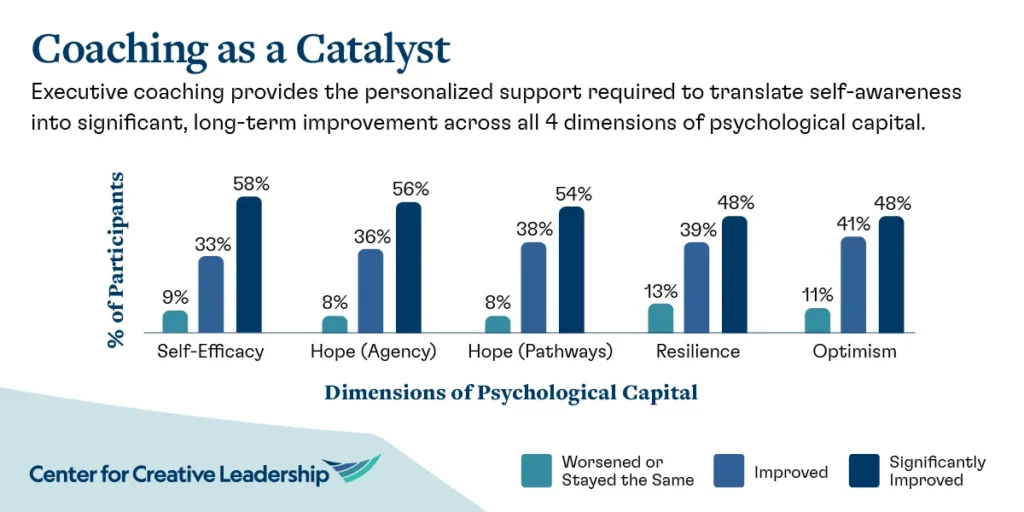
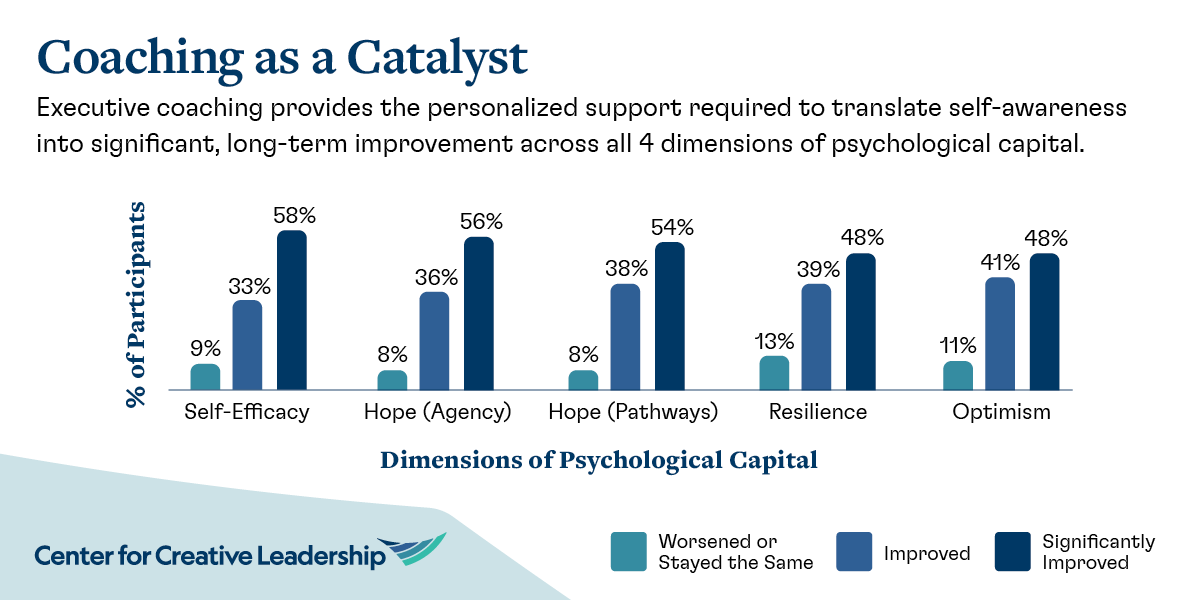
Coaching stands out as one of the most direct and effective avenues through which leaders receive intentional, personalized support. Furthermore, an evaluation conducted by the Center for Creative Leadership found that coaching provides a tailored approach for leaders to continue addressing their challenges, even after formal program completion. This engagement in goal-achieving behaviors through coaching has a direct and positive impact on their psychological capital.
Even highly seasoned leaders who engage in executive coaching services consistently report positive improvements in their PsyCap. This aligns perfectly with the core purpose of coaching: to move beyond the mere impartation of new skills and to foster the self-awareness and internal work necessary for more effective leadership. Coaching serves to replenish the energy of leaders who diligently apply these enhanced behaviors in their daily roles.
An infographic titled "Coaching as a Catalyst for Psychological Capital" visually represents this dynamic, illustrating how coaching interventions can effectively bolster hope, self-efficacy, resilience, and optimism, thereby strengthening a leader’s overall PsyCap.
The Efficacy of Bite-Sized Interventions in Building PsyCap
The cultivation of psychological capital is not solely dependent on lengthy, immersive, in-person leadership development experiences. Encouraging evidence also suggests that PsyCap can be significantly strengthened through short, targeted online leadership training initiatives, particularly when the learning is directly linked to a real-world work challenge.
The Center for Creative Leadership piloted a self-paced online course specifically designed to enhance leaders’ PsyCap. Participants who completed this course reported a meaningful and statistically detectable increase in their psychological capital. On average, PsyCap increased by just under one point on a 1-to-5 scale (+0.74), with a remarkable 86% of leaders in the online course indicating that they experienced overall improvement. The particular advantage of this format lies in its focus on the leader’s key challenges, ensuring that personalized reflections and practice opportunities remain anchored in the practical realities of their work.
Diverse Leadership Journeys: PsyCap Among Neurodiverse Leaders
A growing body of research highlights the significant benefits that organizations derive from neurodiverse leadership teams and workforces. However, findings from the Center for Creative Leadership suggest that, when compared to neurotypical leaders, leaders who identify as neurodivergent (such as those with ADHD or autism) tend to report lower overall levels of psychological capital.
These findings are crucial and do not indicate a deficit in leadership potential. Instead, they underscore the reality that leaders bring a diverse range of strengths and unique needs related to their own psychological resources into their roles. For organizations, this reinforces the imperative to cultivate the necessary psychological conditions that enable all leaders to sustain their impact, regardless of their neurotype. An accompanying infographic, "PsyCap Among Neurodiverse Leaders," visually details these comparative findings.
Psychological Capital: The Essential Fuel for Navigating Ongoing Disruption
In an era defined by persistent disruption, leadership development must transcend the mere acquisition of skills. It possesses the capacity, and indeed the responsibility, to provide the vital psychological fuel that leaders require to remain effective amidst ambiguity, demanding workloads, and rapid environmental shifts.
Psychological capital serves as this essential fuel, and the data unequivocally demonstrates that it is significantly strengthened through targeted leadership development interventions. Across various modalities—including immersive programs, personalized coaching, and accessible digital learning experiences—PsyCap flourishes when leaders are exposed to an optimal blend of enhanced self-awareness, meaningful challenges, and supportive environments that empower them to translate insights into tangible action.
It is important to acknowledge that this growth is not always a linear progression. It frequently involves a temporary dip as leaders internalize difficult feedback and confront their areas for development. However, with the right support structures in place, this dip can serve as a powerful turning point, empowering leaders to regain agency, clarity, and the confidence necessary to adopt new, more effective ways of operating.
This phenomenon is not solely an individual experience; it has profound organizational implications. While leadership sets the initial tone, it is the organizational culture that ultimately channels and amplifies this cultivated energy. Organizations that actively foster cultures supporting PsyCap—by normalizing feedback, celebrating progress, and championing recovery as much as performance—witness a multiplicative effect of positive impact. High-performing organizations cultivate environments where hope, self-efficacy, resilience, and realistic optimism gain momentum, flowing outward from leaders to their teams and cascading throughout the entire organization.
However, it is critical to emphasize that developing psychological capital is not a panacea that absolves organizations of their responsibility to address systemic issues. Building leader resilience and optimism to their fullest potential requires them to be paired with fundamental systemic support, genuine psychological safety at work, and thoughtfully established boundaries. The ultimate aim is not to cultivate leaders who can merely endure any circumstance, but rather to empower them with the inner resources needed to confront hard realities, identify sustainable solutions, and inspire a future that benefits everyone within the organization and beyond.
Taking the Next Step: Investing in Leadership’s Inner Fuel
The imperative to explore and strengthen the human dimension of leadership has never been more critical. Organizations and individuals are encouraged to take proactive steps in building this essential capacity, both within themselves and across their leadership ranks. Programs such as the Center for Creative Leadership’s renowned Leadership Development Program (LDP)® and their comprehensive executive coaching services are specifically designed to cultivate the psychological capital and inner resources that enable leaders to perform at their highest level, particularly during periods of heightened challenge. Investing in these areas is not merely a developmental choice; it is a strategic imperative for sustained organizational success in an unpredictable world.