
Updated February 3, 2026
A well-structured performance review template is far more than a bureaucratic formality; it is a foundational tool for cultivating clarity, fostering trust, and driving tangible employee development within an organization. When performance review forms are thoughtfully designed, they create a clear line of sight between managers and employees regarding expectations, enabling a focused approach on meaningful behaviors and quantifiable results. This structured framework facilitates fair and productive conversations, ultimately leading to increased transparency, enhanced employee development, and a more engaged workforce across the entire organization.
The Cornerstone of Employee Growth: Constructive Feedback
At the heart of any effective performance review lies the critical component of constructive feedback. This feedback is instrumental in not only bolstering individual employee performance but also in accelerating professional growth. It empowers managers to guide their team members in developing their skills, overcoming challenges, and achieving their full potential. The characteristics of truly effective feedback are multi-faceted, encompassing specificity, timeliness, actionable insights, and a forward-looking perspective.

Research consistently highlights the profound impact of frequent feedback on employee engagement and retention. For instance, studies by Quantum Workplace indicate that employees who receive more regular feedback are twice as likely to be engaged, three times less likely to seek alternative employment, and 1.4 times more likely to remain with their current organization. This underscores that helpful feedback is not merely a suggestion but a critical driver of both employee satisfaction and organizational stability. To further assist in this process, a comprehensive resource of over 170 performance review examples, comments, and phrases is available to inspire and guide managers in crafting impactful evaluations.
Defining the Performance Review Template
A performance review template serves as a standardized framework designed to guide and structure employee evaluation discussions. Its primary purpose is to ensure consistency among managers, clearly outline performance expectations, enable fair assessment based on defined criteria, and meticulously document employee progress. A robust template ensures that employees possess a clear understanding of how their performance is evaluated, what they are excelling at, and where opportunities for development exist.
The utilization of such templates—whether referred to as performance review templates, employee review templates, or employee review forms—streamlines the evaluation process, making it more focused, organized, and manageable for both managerial staff and employees. For Human Resources departments, the consistency provided by templates is paramount. It aids in mitigating unconscious bias, standardizing performance dialogues throughout the organization, strengthening compliance documentation, and generating comparable performance data. This data is invaluable for identifying overarching trends, providing effective support to managers, and continuously refining the performance management system.

The Indispensable Value of Performance Review Templates
The implementation of a performance review template significantly simplifies the task for managers in understanding the multifaceted role of performance reviews and in delivering feedback that genuinely contributes to employee development. A structured employee review template or form ensures that these crucial conversations remain focused, equitable, and consistent across the board.
Furthermore, templates empower managers to provide constructive feedback by clearly articulating an employee’s strengths and identifying areas for improvement in a manner that is motivating rather than demotivating. From an HR perspective, this standardization is vital, guaranteeing that every employee receives clear, actionable guidance, fostering fair evaluations, and simplifying the tracking and analysis of performance data across the entire organization.
Key Elements of an Effective Performance Review Template
Best practices in performance review forms emphasize the inclusion of clear and specific performance criteria. An effective template should present examples of both employee accomplishments and areas necessitating improvement, thereby adopting a balanced approach. While a rating system can be a component, it should not overshadow the qualitative feedback. Ample space for comments and feedback from both the reviewer and the employee is essential. Crucially, the template should maintain a future-oriented perspective, actively contributing to employee growth through the establishment of goals and development plans.
The foundational components of an effective performance review process are designed to ensure that review conversations are not only meaningful but also transparent and fair. A well-crafted performance appraisal template provides a consistent structure that reduces the administrative burden on managers, enabling them to initiate and conduct effective conversations with greater ease.
Pitfalls to Avoid in Employee Performance Review Templates
Certain common pitfalls can detract from the effectiveness of performance reviews. Thoughtfully designed performance review templates can proactively address some of these issues. Common mistakes include vague or subjective criteria, a lack of specific examples, insufficient opportunity for employee input, and a focus solely on past performance without adequate attention to future development.
A Spectrum of Solutions: Performance Review Template Types
Employee review templates bring consistency, clarity, and structure to performance conversations. They serve as valuable guides for managers and employees, facilitating aligned goals and thoughtful reflection. By integrating various employee review templates throughout the performance cycle, organizations can establish a rhythm of meaningful, growth-oriented dialogues.
1. The GOOD Performance Review Template
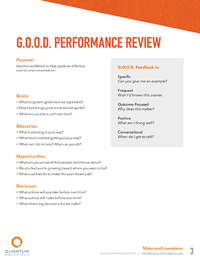
Quantum Workplace utilizes its proprietary GOOD template for its internal monthly manager-employee performance discussions, highlighting its significance within their company culture. GOOD is an acronym for Goals, Obstacles, Opportunities, and Decisions, making it an ideal framework for monthly one-on-one meetings. This approach encourages managers and employees to step back and assess the broader context of their work.
- Goals: Clearly defined objectives for the period.
- Obstacles: Identification of any impediments to achieving goals.
- Opportunities: Exploration of potential avenues for improvement or innovation.
- Decisions: Specific actions or choices to be made moving forward.
Pros: Fosters open dialogue, encourages reflection, and supports future planning.
Cons: Does not inherently include metrics for quantitative comparison, aligning with Quantum Workplace’s philosophy against direct employee comparison.
2. Quarterly Check-In Template
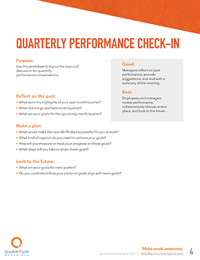
For organizations where monthly performance conversations are not feasible, quarterly check-ins offer a valuable alternative. This template guides collaborative discussions between managers and direct reports, focusing on performance review, action planning, and future outlook.
- Reflect on the Past: Reviewing achievements and challenges from the previous quarter.
- Make a Plan: Developing concrete action steps for the upcoming period.
- Look to the Future: Setting objectives and discussing career aspirations.
Pros: Allows for timely action based on insights and quicker adjustments.
Cons: May sometimes lack a strong focus on long-term organizational and employee goals.
3. Mid-Year Performance Review Template
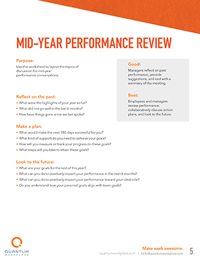
The mid-year review is a crucial juncture for assessing progress towards annual goals and making necessary adjustments. This template emphasizes key highlights, identified obstacles, and strategic planning for the remainder of the year.
- Reflect on the Past: Summarizing performance and key milestones achieved.
- Make a Plan: Outlining strategies to address any performance gaps or capitalize on opportunities.
- Look to the Future: Setting revised goals and development objectives.
Pros: Provides an essential opportunity for recalibration before the year concludes.
Cons: If this is the sole formal review, it leaves a significant gap between evaluations.
4. Annual Performance Review Template
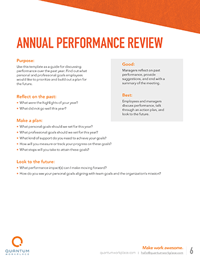
The annual performance review serves as a comprehensive summary of an employee’s performance throughout the year. It also offers a valuable opportunity to identify and prioritize goals for the subsequent review cycle.
- Reflect on the Past: A holistic review of the year’s performance and accomplishments.
- Make a Plan: Setting performance goals and development objectives for the next year.
- Look to the Future: Discussing long-term career aspirations and growth trajectories.
Pros: Offers a broad perspective on an employee’s annual performance.
Cons: Can be challenging to capture the nuances of an entire year’s performance in a single conversation.
5. One-Page Performance Review Template
For organizations seeking a concise and straightforward evaluation, a one-page template provides a quick overview. These forms typically feature a defined rating scale for efficiency.
Pros: Rapid and direct, with a clear rating structure.
Cons: Limited space for detailed feedback and may not encourage in-depth, two-way discussion.
6. Self-Assessment Template
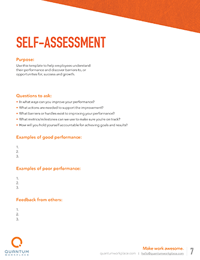
A self-assessment empowers employees to critically reflect on their own performance, identify personal barriers, and pinpoint areas for growth. This template fosters employee ownership of their career development and provides valuable insights for managers.
- Questions to Ask: Prompts for self-reflection on strengths, weaknesses, and contributions.
- Share examples of good performance: Highlighting specific achievements.
- Share examples where you could improve: Identifying areas for development.
Pros: Cultivates self-awareness and encourages employees to take an active role in their performance.
Cons: Lacks the perspective of peers and managers, which is crucial for a holistic view.
7. Upward Feedback Template
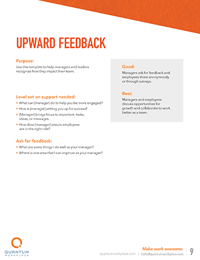
It is equally important for managers to solicit feedback on their leadership and management style. Upward feedback allows employees to provide constructive input to their manager’s superior, fostering accountability and driving managerial improvement.
- Level set on support needed: Employees can articulate their requirements from their manager.
- Ask for feedback: Structured questions to gather insights on managerial effectiveness.
Pros: Opens avenues for crucial two-way dialogue regarding managerial performance.
Cons: Employees may hesitate to provide candid feedback due to potential repercussions.
8. Team Performance Review Template
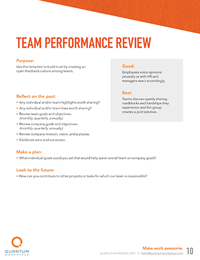
High-performing teams are fundamental to organizational success. This template facilitates discussions that build trust and encourage an open feedback culture within teams, enabling them to share roadblocks and collaboratively develop solutions.
- Reflect on the Past: Reviewing team successes and challenges.
- Review team goals and objectives: Assessing progress against collective targets.
- Make a Plan: Developing strategies for future team endeavors.
- Look to the Future: Setting ambitious team goals.
Pros: Provides insight into the collective performance of a team, beyond individual contributions.
Cons: Extreme performance variations among individuals can skew the overall team assessment.
9. 360 Performance Review Template
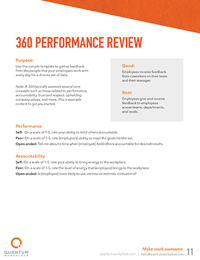
A 360-degree review gathers feedback from a comprehensive set of sources, including peers, subordinates, and supervisors. This multi-rater approach provides managers with a broader perspective on an employee’s performance, highlighting strengths and challenges that might otherwise go unnoticed.
- Performance Self: Self-evaluation of key performance areas.
- Accountability Self: Assessment of personal responsibility and contribution.
Pros: Offers a holistic view of an employee’s impact and behavior from multiple viewpoints.
Cons: Can be challenging for individuals to provide accurate and objective evaluations of others.
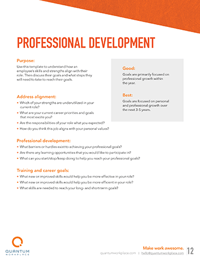
10. Professional Development Template
Professional development and career growth are significant drivers of employee engagement and performance. This template facilitates discussions about aligning employee strengths, skills, and goals with their current role and future career trajectory, focusing on development over the next 3-5 years.
- Address alignment: Evaluating the fit between employee capabilities and job requirements.
- Discuss development: Identifying opportunities for skill enhancement and career progression.
- Talk through training and goals: Planning specific learning initiatives and career milestones.
Pros: Ensures that individual development plans are aligned with organizational needs.
Cons: Can sometimes be too general if not anchored with specific, measurable objectives.
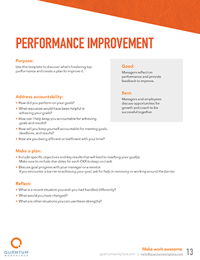
11. Performance Improvement Template
When an employee is not meeting expectations, a formal Performance Improvement Plan (PIP) is often necessary. This template helps identify performance gaps, understand contributing factors, and establish a clear plan for improvement, fostering collaboration between managers and employees.
- Address accountability: Clearly defining performance expectations and responsibilities.
- Make a plan: Outlining specific steps, resources, and timelines for improvement.
- Reflect: Establishing checkpoints to monitor progress and provide ongoing feedback.
Pros: Offers a structured approach to address and rectify declining performance, providing employees with a clear path to success.
Cons: Requires commitment and active participation from both the employee and the manager to be effective.
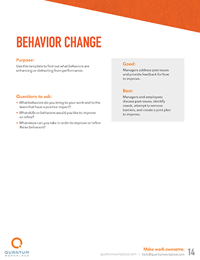
12. Behavior Change Template
Employee behaviors can significantly impact individual and team success. This template is designed to facilitate discussions about behaviors that either enhance or hinder performance, encouraging self-awareness and proactive adjustments.
- Questions to ask: Prompts to explore the impact of behaviors and identify underlying causes.
Pros: Helps managers and employees collaboratively identify issues, needs, and potential barriers to positive behavior change.
Cons: The effectiveness of the conversation heavily relies on the employee’s willingness to engage in self-reflection and acknowledge areas for improvement.
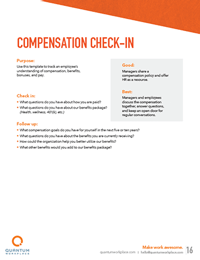
13. Compensation Check-In
Open and transparent discussions about compensation are vital for employee satisfaction and retention. This template provides a framework for conversations about salary, benefits, bonuses, and pay, ensuring alignment and addressing employee queries.
- Check in: Initial discussion regarding compensation and benefits.
- Follow up: Addressing any outstanding questions and outlining future review processes.
Pros: Promotes pay transparency and fosters trust between employees and management.
Cons: Employee compensation expectations may not always be met, requiring careful communication.
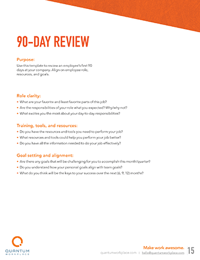
14. 90-Day Review Template
For new hires, the first 90 days are critical for assimilation and understanding expectations. This template facilitates a review of their initial period, helping to set short-term goals, establish a shared vision, and align on role clarity and resources.
- Role clarity: Ensuring the new hire understands their responsibilities and expectations.
- Training, tools, and resources: Assessing the adequacy of support provided.
- Goal setting and alignment: Establishing clear objectives for the initial period.
Pros: Provides crucial early feedback and clarity for new employees, aiding in successful onboarding.
Cons: May not be universally applicable to all roles, particularly those that are highly specialized or project-based.

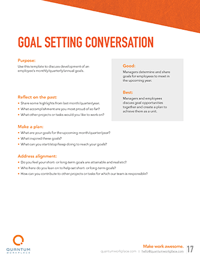
15. Goal Setting Conversation Template
Effective goal setting is a cornerstone of performance management. This template guides conversations to establish clear, measurable, and aligned goals for employees on a monthly, quarterly, or annual basis.
- Reflect on the past: Reviewing previous goals and outcomes.
- Make a plan: Collaboratively defining new, actionable goals.
- Address alignment: Ensuring goals are connected to broader team and organizational objectives.
Pros: Facilitates the creation of well-defined and measurable goals that are aligned with organizational strategy.
Cons: Requires consistent follow-up and regular discussions throughout the performance cycle to remain effective.

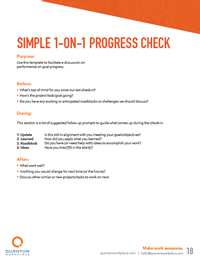
16. Simple 1-on-1 Progress Check
Beyond formal reviews, regular weekly check-ins are essential for maintaining open communication and addressing issues in real-time. This template provides a structure for brief, focused conversations about ongoing performance and progress.
- Progress check: Quick review of current tasks and achievements.
- Obstacles: Identifying and addressing any immediate roadblocks.
Pros: Enables frequent communication and fosters agility in addressing challenges.
Cons: Requires managers to dedicate specific time for these regular check-ins with each employee.
Elevating Performance Reviews: From Administrative Task to Strategic Initiative
Performance reviews, when executed effectively, serve as powerful tools for aligning teams with organizational objectives, driving both employee and business success, and enhancing engagement and company culture. By emphasizing the value of feedback, these reviews transform from mere administrative tasks into strategic initiatives that foster development and career growth. Simple yet effective performance review templates empower HR professionals and managers by providing:
- Structured Frameworks: Ensuring consistency and fairness in evaluations.
- Clear Expectations: Aligning individual performance with organizational goals.
- Actionable Feedback: Guiding employees toward growth and development.
- Data-Driven Insights: Enabling informed decision-making regarding talent management.
- Enhanced Engagement: Fostering a culture of continuous improvement and recognition.
Leveraging Quantum Workplace for Streamlined Performance Reviews
Performance conversations need not be a source of stress or inefficiency. Quantum Workplace’s platform is designed to keep managers and employees aligned and engaged through intuitive performance review processes. The software provides robust context, enabling more objective and impactful discussions.
Key Features of Quantum Workplace’s Performance Review Software:
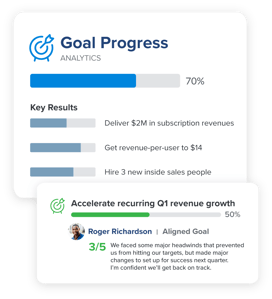
- Customizable Reviews: Tailor review modules to align with specific organizational needs and cultural nuances, allowing for flexible measurement across different teams.
- Manager Habit Building: Integrate performance management into existing workflows, making it easier for managers to coach effectively and establish consistent touchpoints through formal conversation cycles.
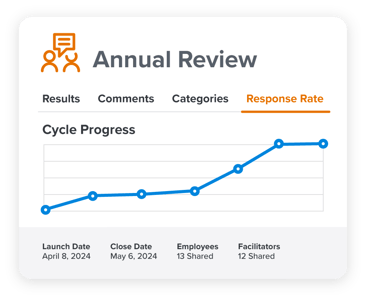
- Response Rate Tracking: Monitor the status of review cycles in real-time, ensuring accountability and providing visibility into performance ratings.
- Integrated Performance Goals: Seamlessly embed performance goals directly into evaluations, facilitating objective, growth-oriented conversations.
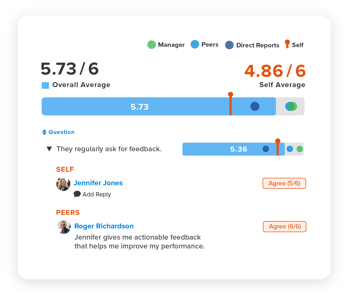
- Multi-Rater Feedback Integration: Incorporate feedback from peers and other stakeholders to provide a comprehensive view, orienting conversations around development.
- Performance Data Visualization: Utilize a talent dashboard to gain a holistic view of organizational talent, enabling informed decisions for talent retention and development.
Performance Review Template FAQs
What are the most important sections in an employee review template?
The most effective templates include clear, structured sections that guide meaningful conversations. Essential components typically include:
- Performance Goals: Clearly defined objectives and their outcomes.
- Key Responsibilities: Assessment of core job duties.
- Skills and Competencies: Evaluation of essential abilities.
- Areas for Development: Identification of opportunities for growth.
- Employee Comments: Space for the employee’s perspective.
- Manager Comments and Future Goals: Managerial assessment and forward-looking plans.
These sections ensure consistency, fairness, and alignment, while also providing HR with valuable insights into performance trends.
How to write a good performance review template?
Writing an effective template involves creating a framework that promotes clarity, alignment, and actionable outcomes. Begin by defining what constitutes excellent performance within your organization and then craft prompts that encourage reflection and future-focused planning. A well-designed employee review form should:
- Be aligned with organizational goals.
- Include clear and objective performance criteria.
- Provide space for specific examples and qualitative feedback.
- Encourage two-way dialogue.
- Focus on future development and goal setting.
The best templates balance structure with flexibility, supporting both strategic evaluation and human-centered conversations.
What is an example of a good performance review?
A good performance review effectively highlights achievements, evaluates progress against goals, and sets clear expectations for the future. For instance, Quantum Workplace’s GOOD Performance Review Template uses four pillars—Goals, Obstacles, Opportunities, and Decisions—to foster a holistic, two-way conversation. A strong example includes:
- Specific achievements: Quantifiable results and contributions.
- Progress on goals: A clear assessment of movement towards objectives.
- Constructive feedback: Balanced insights on strengths and areas for growth.
- Future-oriented development plan: Concrete steps for continued improvement and career advancement.
This approach builds trust, enhances clarity, and supports both employee engagement and overall organizational performance.
What are the 5 words for a performance review?
When crafting an employee review form that fosters productive conversations and actionable growth, remembering these five words can be beneficial:
- Goals: What needs to be achieved?
- Obstacles: What are the challenges?
- Opportunities: Where can we improve or innovate?
- Decisions: What actions will be taken?
- Development: How can we grow and learn?
Quantum Workplace’s G.O.O.D. model—Goals, Obstacles, Opportunities, Decisions—is a widely shared framework for structuring meaningful reviews and check-ins.
How can HR create effective performance review templates?
HR teams can design effective templates by prioritizing fairness, clarity, and strategic alignment. Key steps include:
- Define Performance Standards: Clearly articulate what constitutes successful performance at all levels.
- Incorporate Feedback Mechanisms: Include sections for self-assessment, manager feedback, and potentially peer feedback.
- Focus on Development: Integrate goal setting and professional development planning.
- Ensure Simplicity and Clarity: Use straightforward language and a logical structure.
- Pilot and Refine: Test templates with a small group and gather feedback for iterative improvement.
An effective employee review form should simplify performance conversations, not complicate them.
Quantum Workplace’s performance review software is designed to make the performance review process more effective, efficient, and engaging. It empowers managers and teams to prepare, conduct, and follow up on reviews, ultimately leading to improved performance outcomes.