
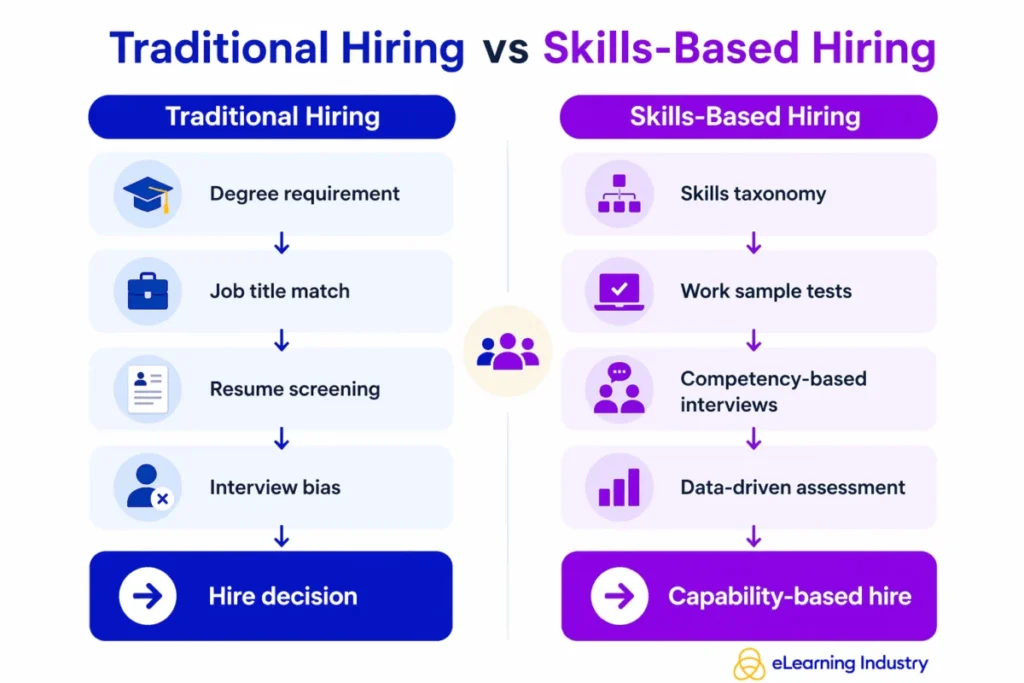
The global labor market is currently undergoing a structural transformation as organizations move away from traditional credential-based recruitment toward a model that prioritizes specific competencies and demonstrable abilities. This transition, widely known as skills-based hiring, is fundamentally altering how human resources (HR) leaders identify, evaluate, and retain talent in an era defined by rapid technological disruption. By focusing on what a candidate can actually do rather than where they studied or the titles they previously held, companies are attempting to bridge a widening skills gap that traditional education systems have struggled to address. This shift is not merely a reaction to labor shortages but a strategic realignment designed to foster organizational agility and long-term productivity.
The Paradigm Shift: From Credentials to Competencies
For decades, the four-year university degree served as the primary proxy for professional capability. However, the shelf life of technical skills is shrinking, now estimated by some analysts to be less than five years. As job requirements evolve faster than academic curricula, the reliance on formal degrees has created what economists call the "paper ceiling," an invisible barrier that prevents millions of skilled individuals without degrees from accessing higher-paying roles.
Skills-based hiring seeks to dismantle this barrier by implementing a recruitment framework centered on three pillars: clear identification of required competencies, structured assessments of those skills, and task-based evaluations. Unlike traditional models that use resumes as a primary filter, skills-based recruitment utilizes objective data points, such as work-sample tests, technical simulations, and cognitive assessments, to predict job performance. This evidence-based approach allows hiring managers to reduce unconscious bias and make decisions based on merit and potential rather than prestige or pedigree.
A Chronology of the Skills-First Movement
The transition toward a skills-first economy has been building for over a decade, spurred by specific economic and technological milestones.
- The Post-2008 Recovery (2010–2015): Following the Great Recession, "degree inflation" became common, where employers added degree requirements to roles that previously did not require them. This created a bottleneck in the labor market that eventually became unsustainable as the tech sector began to boom.
- The Rise of "New Collar" Jobs (2016–2019): Companies like IBM pioneered the concept of "new collar" roles—jobs that require specialized skills but not necessarily a traditional degree. During this period, major tech firms including Google and Apple began removing degree requirements from several job postings to widen their talent pools.
- The Pandemic Catalyst (2020–2022): The COVID-19 pandemic accelerated digital transformation and forced a mass "reskilling" of the workforce. Remote work and the sudden need for digital literacy highlighted that adaptability and self-taught skills were often more valuable than static credentials.
- The Generative AI Era (2023–Present): The explosion of artificial intelligence has made many traditional tasks obsolete while creating a demand for entirely new competencies. Organizations are now forced to hire for "learnability" and hybrid skills, further cementing the need for a skills-based approach.
Supporting Data: The Case for a Skills-First Strategy
Recent industry data underscores the efficacy of this hiring shift. According to a 2023 report by LinkedIn, job postings that do not require a degree have increased significantly, with more than 45% of recruiters now explicitly using skills data to find candidates. Furthermore, research from TestGorilla indicates that 92% of organizations that have implemented skills-based hiring saw an increase in the diversity of their new hires, and 88% reported a decrease in "mis-hires."
Retention statistics also support the model. Employees hired based on their skills are 9% more likely to stay with a company longer, as their capabilities are better aligned with their daily responsibilities. From a cost perspective, the reduction in time-to-hire is notable; by removing the manual review of long, credential-heavy resumes and replacing them with automated skill assessments, HR departments have reported a 20% to 30% increase in recruitment efficiency.
Official Responses and Corporate Adoption
The move toward skills-based hiring has received significant backing from both the public and private sectors. In the United States, several state governments, including Maryland, Pennsylvania, and Utah, have officially removed degree requirements for thousands of state government positions, citing the need to make public service more accessible and meritocratic.
"We are moving toward a world where a person’s skills matter more than their pedigree," noted a senior HR executive at a Fortune 500 technology firm during a recent industry summit. "The traditional resume is a historical document, but a skills assessment is a predictive one. To stay competitive, we must value what people can build, code, or manage today, not what they studied ten years ago."
Similarly, the World Economic Forum has highlighted that by 2025, 50% of all employees will need reskilling. This global pressure has prompted organizations to integrate "skills intelligence" platforms that use AI to map the existing skills of their workforce and identify gaps that need to be filled through targeted hiring or internal mobility.

Core Components of a Skills-Based Recruitment Strategy
For HR leaders looking to implement this strategy, the process requires a comprehensive redesign of the talent lifecycle.
1. Granular Skill Identification
Organizations must move beyond broad job titles and decompose roles into specific "skill clusters." This includes technical skills (e.g., Python programming, data visualization) and behavioral skills (e.g., critical thinking, emotional intelligence). By defining the exact competencies required for success, hiring teams can create more accurate and inclusive job descriptions.
2. Redesigning Job Architecture
Traditional job descriptions often include "preferred" qualifications that act as exclusionary filters. A skills-based approach replaces these with measurable outcomes. Instead of requiring "5 years of experience in marketing," a job description might require "the ability to demonstrate a 15% increase in lead generation through multi-channel digital campaigns."
3. Implementing Multi-Modal Assessments
To ensure fairness, organizations are adopting a variety of assessment tools. Work-sample tests allow candidates to perform a small portion of the actual job, while situational judgment tests evaluate how they handle professional challenges. These methods provide a more objective basis for comparison than a standard interview.
4. Training for Cultural Change
A significant hurdle in this transition is the mindset of hiring managers who may still harbor a bias toward elite universities or well-known past employers. Comprehensive training is required to help managers trust assessment data and understand the value of non-traditional career paths, such as military service, vocational training, or self-directed learning.
Broader Impact and Economic Implications
The implications of skills-based hiring extend far beyond the HR department; they have the potential to drive significant social and economic change. By removing the degree requirement, organizations can tap into a "hidden workforce" of millions of people who have the skills to succeed but have been excluded by traditional screening processes. This is particularly relevant for veterans, caregivers returning to the workforce, and individuals from underserved communities.
Furthermore, this model promotes a culture of "lifelong learning." When employees realize that their career progression is tied to skill acquisition rather than the initial degree they earned, they are more likely to engage in continuous upskilling. This creates a more resilient workforce capable of navigating the uncertainties of the modern economy.
From a macroeconomic perspective, skills-based hiring can help mitigate the global talent shortage. By expanding the talent pool and improving the accuracy of job matching, companies can reduce the "friction" in the labor market, leading to higher employment rates and increased national productivity.
Conclusion: The Future of the Agile Workforce
As organizations look toward 2025 and beyond, skills-based hiring is no longer an optional experiment but a foundational requirement for survival. The transition requires a departure from the comfort of traditional credentials, but the rewards—better hiring accuracy, increased diversity, and improved employee retention—are substantial.
The move to a skills-first strategy represents a more honest and effective way to manage human capital. By valuing actual capability over historical labels, businesses can build workforces that are not only more diverse and inclusive but also more capable of adapting to the relentless pace of technological change. For HR professionals, the challenge lies in managing this transition gradually, ensuring that technology and human judgment work in tandem to create a more equitable and efficient labor market.






