Nearly 60,000 miles of global travel, encompassing Europe, Asia, and the Middle East, have revealed a significant and undeniable truth: Artificial Intelligence, particularly Generative AI, has transcended its experimental phase and firmly established itself as an indispensable business tool. Hundreds of companies, from nascent startups to multinational corporations, are actively integrating AI into their strategies, demonstrating a clear and accelerating trend of adoption. This widespread integration is not merely theoretical; it is translating into tangible use cases that are continually expanding across various business functions.
The findings are corroborated by a recent survey conducted by Wharton, which indicates a substantial level of engagement with Generative AI among business leaders. The report highlights that 46% of business leaders now utilize Generative AI on a daily basis, with an additional 34% employing it weekly, bringing the total weekly usage to 80%. Crucially, the survey reveals a strong focus on return on investment (ROI), with 72% of these users actively measuring its impact and a remarkable 74% reporting a positive return. This enthusiastic adoption is not confined to specific sectors; Human Resources departments are emerging as a significant area of AI application, ranking third in use cases, closely trailing behind Information Technology and Finance.
This burgeoning adoption is naturally reflected in increased financial commitment. Budgets allocated to AI initiatives are escalating, with 23% of large companies reporting annual spending of $20 million or more, and an additional 43% investing over $10 million annually. This substantial financial backing underscores the strategic importance businesses are placing on AI integration.
The Dawn of Individual Productivity Gains
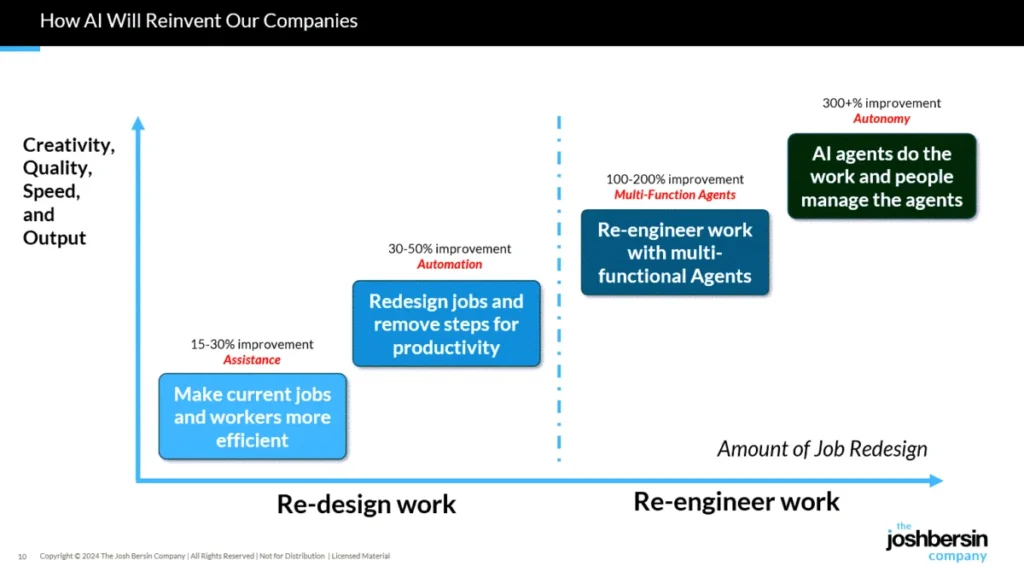
At the forefront of current AI adoption lies the enhancement of individual productivity. This "Stage 1" usage, as it is often termed, focuses on empowering employees with tools that streamline daily tasks. AI is proving instrumental in summarizing lengthy meetings, accelerating data analysis, facilitating rapid information retrieval, and assisting in the creation and review of documents. While these personal productivity benefits are highly tangible and immediately impactful, they represent only the initial phase of AI’s transformative potential.
The current wave of AI tools is drawing parallels to the early days of transformative technologies like word processing, spreadsheets, and internet search engines. These foundational tools initially revolutionized individual efficiency, much like AI is doing today. Microsoft’s Copilot, for instance, is increasingly being positioned as the next evolution of the Microsoft Office Suite, integrating AI capabilities directly into familiar productivity workflows. This integration aims to democratize AI, making its power accessible to a broader user base within organizations.
Expanding Horizons: Corporate Agents and Knowledge Management
Beyond individual task augmentation, AI is rapidly evolving to address more complex organizational needs. Approximately 12% of companies are now deploying "corporate agents," sophisticated AI systems designed to manage knowledge and information. A prime example of this is IBM’s "Ask HR" initiative, which serves as an internal chatbot capable of handling a wide array of employee inquiries. These knowledge management chatbots are poised to become ubiquitous, offering a streamlined alternative to cumbersome internal portals and SharePoint sites, and even extending their capabilities to customer support functions.
The impact of these internal agents is already being felt. One prominent healthcare company has been leveraging an employee chatbot for the past four years. The success of this initiative has been so profound that virtually all HR applications are now being integrated behind this central AI interface. Employees can now access assistance with payroll, benefits, work schedules, and even training opportunities through a single, intuitive platform.
Recruitment processes are also undergoing a significant AI-driven transformation. Job candidates can now engage with AI agents for initial screening, undergo AI-powered assessments, and even participate in AI-driven interviews. This 24/7 accessibility removes the logistical constraints of scheduling with human recruiters or hiring managers, offering a more efficient and flexible application experience.
The Rise of Multifunctional Agents and Workforce Enablement
While highly sophisticated "multifunctional agents" capable of complex, high-ROI tasks are still in their developmental stages (referred to as "Stage 3" in AI adoption models), organizations are actively deploying AI-based coaching and learning tools. Many large enterprises are now implementing AI-native learning systems, which are demonstrating significant improvements in workforce enablement, with some reporting up to a 30-40% reduction in staff requirements for certain training functions.
The demand for specialized AI solutions is fueling growth in dedicated platforms. For instance, the "Galileo" business, which offers a highly tuned HR and learning agent, has experienced a surge in demand. Galileo is evolving into a comprehensive digital HR business partner and "supertutor," capable of providing sophisticated support for both employees and managers.
Crossing the Rubicon: A Point of No Return for AI Integration
The current trajectory of AI adoption signifies a "crossing the Rubicon" moment – a point of no return. Despite ongoing discussions and concerns regarding AI’s potential societal and career impacts, the technology has proven to be a practical, accessible, and increasingly understandable business tool. While imperfections, such as the well-documented tendency for models like ChatGPT to generate erroneous responses, persist, the ability to critically evaluate AI outputs and train models with reliable data sets is mitigating these challenges.
Two years ago, public discourse was dominated by speculative narratives about AI’s more sensational applications. However, with an estimated trillion-dollar investment in infrastructure, engineering, and power generation, the operational aspects of AI have become considerably more robust and secure.
The inherent "probabilistic nature" of AI, where outputs are based on statistical probabilities rather than definitive knowledge, requires a new level of user engagement. This involves a proactive "checking" of AI-generated information to ensure accuracy and reliability. While this process can lead to occasional inaccuracies or poorly constructed reports, the growing familiarity with this validation process is fostering greater user confidence.
However, the expansion of AI infrastructure also presents new environmental and political challenges. The significant water consumption required to power data centers and AI operations, as highlighted by observations in the UAE where each ChatGPT query can consume four liters of water, is emerging as a critical issue demanding innovative solutions.
The Future Landscape: From Single-User Tools to Integrated AI Ecosystems
The current phase of AI adoption is merely the prologue to a much larger transformation. The next significant leap forward will involve the widespread deployment of "multifunctional agents" – AI systems capable of orchestrating complex, end-to-end business processes.

Current AI productivity tools are akin to power steering in a vehicle – they assist with individual tasks but do not autonomously drive the entire operation. The ultimate goal is to develop AI agents that can "take us from place to place," managing entire workflows without constant human intervention.
This shift is already visible in areas like recruiting and training, where integrated agents can manage the entire lifecycle from job requisition creation to candidate screening, interview scheduling, and even onboarding. The vision is for a unified "hiring and career" agent that seamlessly connects these functions. Such a comprehensive agent would move beyond managing individual "steering wheel" tasks to optimizing entire business processes, such as "design to build to distribute to sell" or "position to target to market to close a sale," followed by the entire billing, collection, renewal, and support cycle.
The emergence of these sophisticated agents will necessitate a fundamental re-evaluation of job roles. Positions focused on repetitive "steering wheel" tasks, such as interview schedulers, appointment setters, or basic accounts receivable clerks, may become redundant as AI agents seamlessly integrate these functions within broader workflows.
The "Galileo" platform exemplifies this evolution. What began as an HR assistant has transformed into a system capable of generating courses, answering complex pay and rewards questions, and resolving internal company queries. Galileo is now effectively "building solutions" from initial problems or ideas to demonstrable outcomes, mirroring the autonomous operation of a self-driving car.
The Imperative of Data Governance and Agent Interoperability
The development and efficacy of advanced AI agents are inextricably linked to robust data management practices. Companies with significant AI experience consistently highlight data governance, data labeling, and data quality as paramount disciplines. Inaccurate, outdated, or poorly labeled data can lead to a cascade of errors, significantly diminishing AI performance.
AI models, at their core, operate on probabilities and complex mathematical calculations to generate outputs; they do not possess intrinsic understanding. Even minor data discrepancies can result in a high percentage of incorrect responses, as evidenced by reports indicating that up to 45% of AI queries can produce erroneous answers. This underscores the critical importance of data ownership and meticulous maintenance. IBM’s "Ask HR" agent, for example, manages over 6,000 HR policies, with each policy having a designated owner responsible for its accuracy and currency. IBM is further developing agents to proactively monitor regulatory changes across thousands of jurisdictions, identifying potential compliance issues.
Looking ahead, the ability for AI agents to communicate and collaborate with each other (agent-to-agent communication or A2A) is becoming increasingly vital. While protocols for this interoperability are still maturing, significant progress is being made. Platforms like Galileo are already integrating with others, such as SAP’s Joule, signaling a trend towards interconnected AI ecosystems.
Organizations are advised to exercise caution and avoid the proliferation of numerous single-purpose agents. The true value of AI will be realized when these agents can work in concert, forming a cohesive and intelligent system. This interconnectedness is crucial for preventing a fragmented approach where multiple agents operate in isolation, potentially pulling the organization in different directions. Strategic blueprints for agent integration are being developed to guide businesses in building these cohesive AI ecosystems, ensuring optimal functionality and preventing vendor lock-in with obsolete technologies.
Navigating Vendor Risks and Market Consolidation
The AI landscape is dynamic and presents several vendor-related risks. The future trajectory of major AI providers, such as OpenAI, remains a subject of observation. Microsoft’s Copilot, while widely adopted, is being developed across multiple fronts, and competing platforms like Gemini and Anthropic are facing increasing competition from a growing array of specialized AI providers. The potential for market consolidation, particularly in the event of economic downturns, adds another layer of complexity for businesses evaluating AI investments.
However, the market also offers strong, specialized vendors focusing on pragmatic business applications. Companies like Galileo, Paradox, Eightfold, Sana, and Arist are well-positioned for continued growth and potential acquisition. Similarly, major Human Capital Management (HCM) vendors, including SAP, Workday, ADP, HiBob, and ServiceNow, are actively integrating AI agents into their core payroll and workflow systems, aiming to become comprehensive, end-to-end AI solution providers. Strategic acquisitions by these HCM giants, such as SAP’s purchase of SmartRecruiters and Workday’s acquisitions of HiredScore, Paradox, and Sana, underscore this trend and highlight the evolving competitive landscape.
Addressing Fears of Job Displacement and Worker Degradation
Concerns about AI’s impact on employment and the potential for worker "dumbing down" are prevalent. However, the prevailing sentiment among industry leaders is that embracing this technological revolution is not an option but a necessity. Organizations that fail to adapt risk being left behind. This period represents a unique opportunity to re-engineer business processes and enhance operational efficiency.
The notion that AI will wholly replace human jobs is largely dismissed by experts. The analogy of self-driving cars suggests that while automation may handle routine tasks, humans will likely find value in other pursuits, or in appreciating the aspects of human experience that AI cannot replicate.
The rapid evolution and inherent imperfections of AI create ongoing opportunities for human expertise. Roles as "Superworkers," consultants, and innovators will be crucial in identifying new use cases and optimizing AI applications. History offers precedents: the introduction of spreadsheets, initially feared to displace accountants, instead led to a more efficient and analytical accounting profession, with a greater demand for skilled professionals.
For designers, creators, authors, and analysts, AI should be viewed as a powerful personal supercomputer, augmenting their capabilities rather than replacing them. Just as skilled artisans utilize advanced tools to create intricate works, professionals can leverage AI to achieve new levels of creativity and productivity.
Conclusion: Embracing the AI-Driven Future
The era of AI as a speculative technology is over. The mist has lifted, and Generative AI is a permanent fixture in the business landscape. The journey ahead involves embracing the "Superworker" paradigm, where individuals and organizations actively learn, apply, and leverage this transformative technology. The responsibility now lies with us to navigate this new world, harness its potential, and drive innovation forward. The transition to an AI-augmented workforce is not a distant possibility but a present reality, demanding proactive engagement and strategic foresight from all stakeholders.