
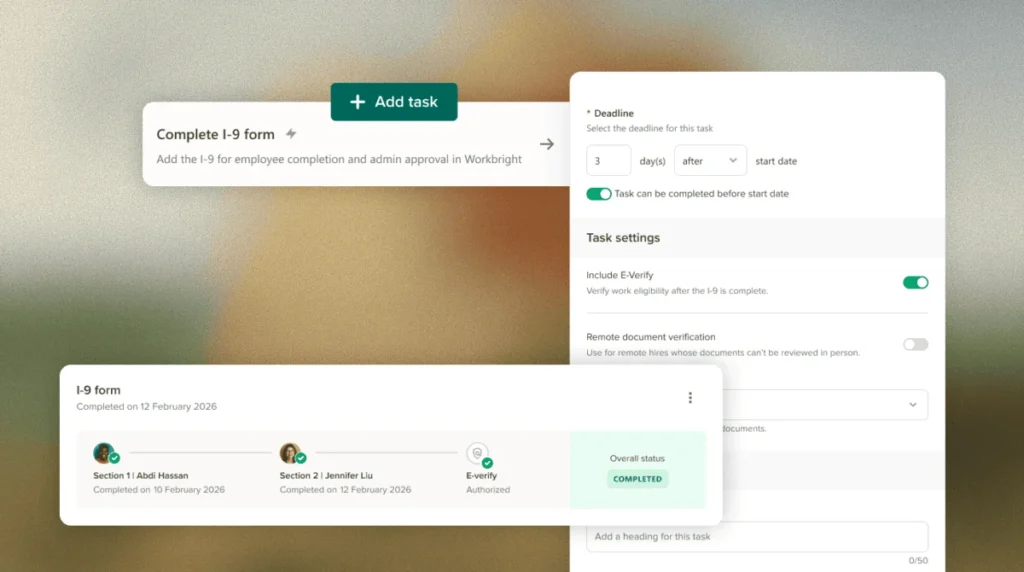
Workable, a prominent provider of hiring software, has announced the launch of a new integrated workflow designed to simplify and ensure compliance for U.S. organizations managing Form I-9 and E-Verify processes. This significant update aims to eliminate the administrative burdens associated with manual employment eligibility verification, offering a seamless, digital experience embedded directly within Workable’s existing onboarding setup. The introduction of this feature directly addresses the persistent challenges faced by human resources departments in navigating complex federal regulations, particularly in an era marked by evolving workforce structures and heightened scrutiny over compliance.
The core of Workable’s new offering is a unified system that allows employees to complete Section 1 of the I-9 form digitally. Subsequently, HR teams can review supporting documents and complete Section 2 within the Workable platform, moving away from cumbersome PDF downloads, redundant data entry, and the necessity of switching between multiple software tools. For organizations that have opted into the E-Verify program, the system automatically submits the necessary information during the verification process, ensuring adherence to federal requirements with enhanced ease and accuracy. This integration marks a crucial step forward for U.S. teams seeking to modernize their HR operations and mitigate the risks associated with non-compliance.
The Imperative of Employment Eligibility Verification: Background and Context
Employment eligibility verification, primarily through Form I-9, is a cornerstone of U.S. immigration and employment law. Mandated by the Immigration Reform and Control Act (IRCA) of 1986, the I-9 form serves as a critical document for employers to verify the identity and employment authorization of all individuals hired in the United States. This requirement applies to every employee, regardless of citizenship status, and must be completed within three business days of the employee’s first day of employment. The process involves the employee attesting to their work authorization and presenting acceptable documents from a list provided by the U.S. Citizenship and Immigration Services (USCIS) to establish both identity and employment eligibility.
Building upon the foundation of the I-9, the E-Verify program was established as an internet-based system that allows employers to confirm the eligibility of their employees to work in the United States. E-Verify compares information from an employee’s Form I-9 with data from U.S. Department of Homeland Security (DHS) and Social Security Administration (SSA) databases. While E-Verify is voluntary for most private employers, it is mandatory for federal contractors and subcontractors holding certain contracts and is also required by law in numerous states for specific employers. The program aims to reduce illegal employment by providing a more robust and timely verification mechanism than the I-9 process alone.
Historically, the management of I-9 and E-Verify processes has been fraught with challenges. Manual systems often involve physical paperwork, requiring HR personnel to collect, inspect, and copy documents, store them securely, and manually input data into various systems. This approach is prone to human error, such as incorrect data entry, failure to meet deadlines, or improper document retention. Such errors can lead to significant penalties, ranging from substantial fines to criminal charges for egregious violations. Moreover, the dynamic nature of I-9 regulations, with periodic updates to the form and acceptable document lists, adds another layer of complexity that often overwhelms HR teams relying on outdated or manual methods.
A Chronology of Compliance Evolution and Workable’s Timely Intervention
The journey of employment verification in the U.S. has seen continuous evolution, culminating in the current landscape that Workable’s new solution addresses.
- 1986: The Immigration Reform and Control Act (IRCA) is passed, introducing the requirement for employers to verify the identity and employment eligibility of all new hires using Form I-9. This marked a fundamental shift in employer responsibility regarding workforce legality.
- 1996: The Illegal Immigration Reform and Immigrant Responsibility Act (IIRIRA) is enacted, establishing pilot programs for electronic employment verification. These programs laid the groundwork for what would eventually become the E-Verify system.
- Late 1990s – Early 2000s: The E-Verify program begins to take shape and expand, initially as a voluntary program for employers to electronically confirm work authorization. Its adoption gradually increases as states and federal agencies begin to mandate its use for certain employers.
- Ongoing: Form I-9 undergoes periodic revisions by USCIS to enhance clarity, reduce errors, and reflect changes in acceptable documentation. Employers must stay updated with the latest versions and guidelines.
- 2020-2023: The Pandemic’s Influence: The COVID-19 pandemic introduced unprecedented challenges, particularly for remote hiring. The DHS implemented temporary flexibilities allowing for remote inspection of I-9 documents, suspending the physical inspection requirement. This temporary measure, extended multiple times, highlighted the critical need for digital and remote-friendly verification solutions.
- July 2023: As the temporary flexibilities were set to expire, DHS announced a new optional alternative procedure for employers enrolled in E-Verify to remotely examine Form I-9 documents. Effective August 1, 2023, this permanent rule allows E-Verify participants in good standing to remotely inspect documents via live video interaction, provided certain conditions are met. This regulatory shift underscored the growing necessity for integrated digital platforms that can support both traditional and remote verification processes.
Workable’s decision to launch its integrated I-9 and E-Verify workflow at this juncture is particularly strategic. It directly responds to the lessons learned during the pandemic and aligns with the new permanent remote inspection rule, offering a comprehensive solution that meets the demands of modern, often distributed, workforces. By providing a digital pathway for both the I-9 and E-Verify processes, Workable positions its users to comply with federal mandates efficiently, regardless of whether employees are onboarded in-person or remotely.
Workable’s Integrated Solution: A Deeper Dive into Functionality and Benefits
The new Workable I-9 and E-Verify workflow is meticulously designed to be intuitive and compliant, embedding the verification process directly into the existing onboarding journey. This integration ensures that employment eligibility verification is not an isolated, manual task but a seamless part of bringing a new employee into the organization.
For the Employee (Section 1 Completion):
Upon receiving an offer, new hires are guided through a digital interface within Workable to complete Section 1 of the I-9 form. This digital experience is structured to be user-friendly, providing clear instructions and prompts to ensure accurate data entry. Employees can electronically attest to their work authorization status and are informed about the types of documents they will need to present for verification. This digital approach eliminates the need for downloading, printing, and manually filling out forms, significantly improving the candidate experience and reducing the likelihood of common errors associated with paper-based processes.
For HR Teams (Section 2 Completion and Document Review):
Once an employee completes Section 1, the HR team receives a notification within Workable. They can then review the employee’s submitted information and proceed with Section 2, which involves inspecting the employee’s identity and employment authorization documents.
- Physical Inspection: For traditional in-person hiring, HR personnel physically examine the original documents presented by the employee. They then digitally record the document information within Workable, sign Section 2 electronically, and confirm the verification.
- Remote Inspection (for E-Verify Participants): Crucially, for Workable customers enrolled in E-Verify, the system facilitates compliance with the new DHS remote inspection rule. HR teams can conduct live video interactions with employees to remotely inspect documents. Workable’s platform ensures that all conditions for remote inspection, such as document retention and clear audit trails, are met. This feature is particularly valuable for organizations with geographically dispersed teams or those embracing hybrid work models.
Automated E-Verify Submission and Case Management:
A significant highlight of Workable’s integration is the automatic submission to E-Verify. For employers who have opted into the E-Verify program, once Section 2 is completed and signed within Workable, the system automatically transmits the necessary data to the DHS and SSA databases. The platform then tracks the E-Verify case status, providing real-time updates. In instances where a Tentative Nonconfirmation (TNC) is issued, Workable guides HR teams through the resolution process, ensuring timely and compliant actions are taken. This automation dramatically reduces the manual effort and potential for delays or errors often associated with separate E-Verify portals.
The tangible benefits for U.S. organizations are manifold:
- Enhanced Efficiency: By centralizing the entire process, HR teams save valuable time previously spent on manual data entry, document scanning, and juggling multiple platforms. This allows HR professionals to focus on strategic initiatives rather than administrative overhead.
- Improved Accuracy and Reduced Errors: Digital forms and guided workflows minimize human error, ensuring that all required fields are completed correctly and that data is consistent across systems. Automated E-Verify submissions further reduce transcription errors.
- Robust Compliance and Risk Mitigation: The integrated solution is designed to align with federal I-9 and E-Verify regulations, providing built-in checks and audit trails. This significantly reduces the risk of non-compliance, which can result in substantial fines and legal repercussions.
- Seamless Onboarding Experience: For new hires, the digital process is streamlined and user-friendly, contributing to a positive initial experience with the company.
- Scalability and Adaptability: Organizations, whether small businesses or large enterprises, can scale their hiring efforts without increasing the administrative burden of compliance. The solution is also inherently adaptable to evolving regulatory landscapes, including support for remote work.
Supporting Data and the Cost of Non-Compliance
The financial and operational implications of I-9 and E-Verify non-compliance are substantial, underscoring the value of integrated solutions like Workable’s. The U.S. Immigration and Customs Enforcement (ICE) routinely conducts audits, and penalties for I-9 violations can be severe.
- Fines: Penalties for substantive and uncorrected technical violations can range from hundreds to thousands of dollars per form, depending on the severity and recurrence. For instance, fines for knowingly hiring or continuing to employ unauthorized workers can range from $2,727 to $21,816 per employee for a first offense, escalating for subsequent offenses. Even technical errors, like missing dates or signatures, can result in fines ranging from $272 to $2,701 per violation.
- Audits: ICE audits have been on the rise. In fiscal year 2018 alone, ICE conducted over 5,200 I-9 audits, resulting in 779 criminal and 1,525 administrative arrests, along with over $10.2 million in financial penalties. These figures highlight the significant enforcement efforts and the associated risks for employers.
- Administrative Burden: Beyond fines, the administrative burden of correcting errors, responding to audits, and managing paper-based systems is immense. Studies and anecdotal evidence from HR professionals consistently point to I-9 compliance as one of the most time-consuming and high-risk administrative tasks. An average organization might spend countless hours annually ensuring I-9 compliance, time that could otherwise be allocated to strategic HR initiatives.
- E-Verify Adoption: The E-Verify program has seen consistent growth, with USCIS reporting over one million employers participating as of late 2023. This widespread adoption reflects an increasing recognition among businesses of the need for robust verification mechanisms, especially as regulatory pressures mount.
Industry Reactions and Expert Perspectives
The introduction of Workable’s integrated I-9 and E-Verify solution has been met with positive anticipation within the HR technology sphere and among compliance experts.
A spokesperson for Workable, while not directly quoted in the provided text, would likely emphasize the company’s commitment to simplifying complex HR processes. "Our mission has always been to empower HR teams to focus on what truly matters: attracting and retaining top talent," an executive might state. "This new integrated I-9 and E-Verify workflow is a direct response to the evolving needs of U.S. organizations, offering a compliant, efficient, and user-friendly solution that removes significant administrative overhead and mitigates risk, particularly in the context of hybrid and remote work environments."
HR professionals, who regularly grapple with the intricacies of employment verification, are expected to welcome such an integration. "Managing I-9s and E-Verify used to be a fragmented nightmare," explains Sarah Chen, a hypothetical HR Manager at a mid-sized tech company. "We had PDFs, external portals, manual checks, and constant worry about compliance. An integrated solution like Workable’s means one less thing to worry about, freeing up our team to focus on employee engagement and strategic talent initiatives. The ability to handle remote inspections within the same system is a game-changer for our distributed team."
Compliance experts consistently advocate for automated, integrated systems to navigate the labyrinthine world of employment law. "In today’s regulatory climate, where enforcement actions are frequent and penalties severe, relying on manual I-9 and E-Verify processes is a significant liability," notes Dr. Eleanor Vance, a hypothetical employment law consultant. "Digital platforms that centralize and automate these functions are no longer a luxury but a fundamental necessity for robust compliance. Workable’s approach, particularly its alignment with the new remote inspection guidelines, provides a vital tool for organizations to ensure legal adherence while maintaining operational efficiency."
Broader Impact and Future Implications
Workable’s new integrated I-9 and E-Verify workflow carries significant implications for the broader HR technology landscape and for U.S. businesses.
For the HR Technology Landscape: This release reinforces the trend towards comprehensive, all-in-one HR platforms. As businesses seek to consolidate their tech stacks and streamline operations, the demand for integrated solutions that cover everything from applicant tracking to onboarding and compliance will continue to grow. Workable’s move positions it competitively against other HRIS and ATS providers, showcasing its ability to adapt and innovate in response to user needs and regulatory changes. It also highlights the increasing sophistication of HR software, moving beyond simple task management to become critical compliance engines.
For Businesses:
- Risk Mitigation and Audit Readiness: The most immediate impact for businesses is a substantial reduction in compliance risk. With digital records, automated checks, and audit trails, organizations are better prepared for potential ICE audits, minimizing the likelihood of fines and reputational damage.
- Operational Efficiency and Resource Allocation: By automating tedious and time-consuming tasks, HR departments can reallocate resources from administrative duties to more strategic functions, such as talent development, employee retention, and fostering a positive workplace culture.
- Enhanced Employee Experience: A streamlined and digital onboarding process contributes to a positive first impression for new hires, reducing anxiety and making the initial days of employment smoother.
- Adaptation to Modern Work Models: The explicit support for remote document inspection within the E-Verify framework makes Workable’s solution particularly relevant for companies embracing hybrid or fully remote work models. This adaptability ensures that compliance does not become a barrier to flexible employment strategies.
Future Outlook: The trajectory of employment verification points towards even greater digitization and automation. Future enhancements might include further AI-driven data validation, predictive analytics for compliance risk, and deeper integrations with other government databases. As regulations continue to evolve and the nature of work transforms, platforms like Workable’s will play an increasingly vital role in ensuring that businesses remain compliant, efficient, and prepared for the challenges of tomorrow’s workforce.
Organizations keen to explore the full capabilities of Workable’s I-9 and E-Verify integration are encouraged to contact their account manager or request a demonstration from the Workable team, thereby taking a proactive step towards modernizing their employment verification processes.






