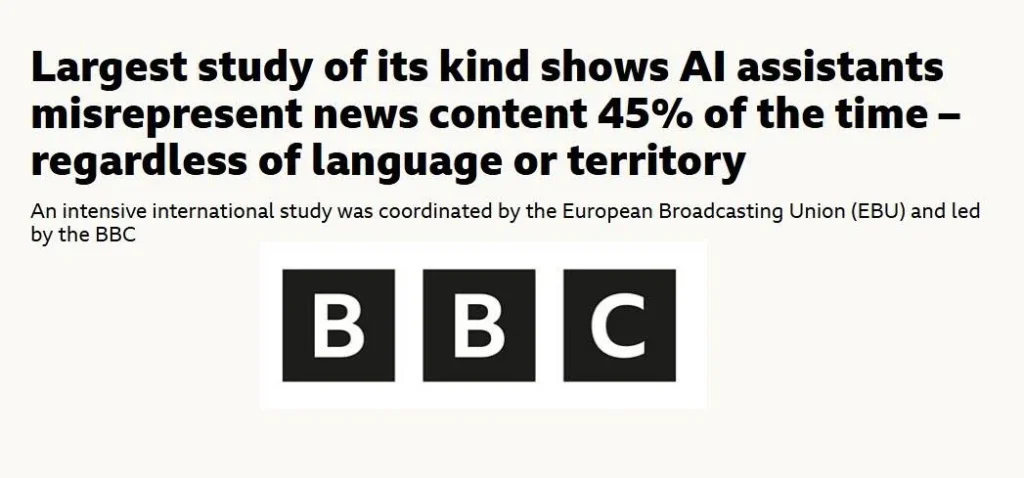
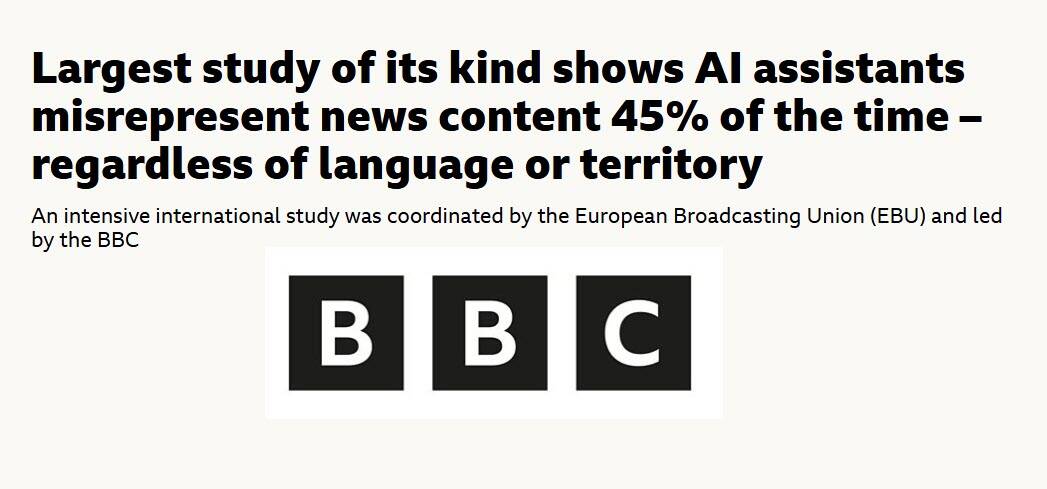
A groundbreaking study released by the BBC and the European Broadcasting Union (EBU) has sent shockwaves through the artificial intelligence community, revealing that a significant portion of queries directed to popular AI news assistants result in erroneous information. The comprehensive research, which analyzed responses from industry giants like ChatGPT, Microsoft Copilot, Google Gemini, and Perplexity, found that approximately 45% of AI-generated news-related answers contain factual errors. This alarming statistic underscores a critical vulnerability in the current AI landscape, particularly concerning the reliability and trustworthiness of information provided by these increasingly ubiquitous tools.
The implications of these findings are far-reaching, extending beyond mere factual inaccuracies to potentially impact critical decision-making processes across various sectors. The study, accessible through a detailed report published by the BBC, highlights a worrying trend where AI systems, often perceived as highly sophisticated and authoritative, exhibit a striking deficiency in providing accurate news analysis. This deficiency stems from a fundamental challenge inherent in the training data of these "open corpus" systems, which can be polluted with outdated, exaggerated, or outright incorrect information.
Unpacking the Scope of AI Errors
The research meticulously documented instances where AI assistants faltered on basic factual recall and complex legal interpretations. Among the astounding examples cited, AI models incorrectly identified the current Pope and the Chancellor of Germany. More concerningly, when queried about the bird flu, Microsoft Copilot provided a response suggesting a vaccine trial was underway in Oxford, citing a BBC article from 2006 – nearly two decades prior. This demonstrates a critical failure to access and prioritize current, relevant information.
The study also highlighted significant errors in legal and regulatory contexts. Perplexity, for instance, inaccurately stated that surrogacy is prohibited by law in the Czech Republic, when in reality, the practice is not legally regulated and exists in a gray area. Similarly, Google Gemini mischaracterized a change in UK law regarding disposable vapes, claiming it would become illegal to buy them, whereas the actual legislation targeted the sale and supply of such products. These examples illustrate how AI misinterpretations can lead to misunderstandings of vital legal frameworks, with potentially serious consequences.
The "Poisoned Corpus" Problem: Understanding the Root Cause
Experts attribute these widespread inaccuracies to a core limitation in the underlying Large Language Model (LLM) technology: the "poisoned corpus" or poor data problem. LLMs function by creating complex mathematical models, known as "embeddings," which map the statistical relationships between words and phrases. During their training, these models ingest vast quantities of data, primarily from the internet, to build an intricate web of interconnected vectors.
When a user poses a question, the LLM decodes it and searches for the statistically most probable answer within its vast, multidimensional data structure. The challenge arises because the internet, the primary source of this training data, is a heterogeneous environment containing information that is often flawed, outdated, biased, or factually incorrect. Consequently, any errors or exaggerations present in this "corpus" can be incorporated into the LLM’s understanding and subsequently propagated in its responses. The result is an AI that can appear "dangerously confident" even when its answers are fundamentally wrong.
This issue was acknowledged by Claude, another prominent AI model, during a detailed discussion with one of the researchers, who shared the exchange to further illustrate the severity of the problem. The exchange revealed that the AI itself recognized the significant challenge posed by inaccurate or outdated data influencing its outputs.
Implications for AI Adoption and Trust
The pervasive nature of these errors has profound implications for the growing reliance on AI for analysis, writing, and data collection. If a substantial percentage of AI-generated answers are flawed, the utility and trustworthiness of these systems are significantly compromised. The study’s findings suggest that even a minor error rate in the input data can cascade into numerous incorrect outputs, especially for complex queries that require synthesizing information from multiple sources.
As companies like OpenAI and Google increasingly integrate AI into their business models, often through advertising-driven approaches, the integrity of the information provided becomes even more critical. The potential for paid placements or promoted content to influence AI responses raises concerns about the objectivity and reliability of the information users receive. This underscores the need for users to exercise extreme caution and critically evaluate all AI-generated content, especially when traditional citation methods are absent or insufficient.
In professional contexts, the impact can be severe. For instance, in fields requiring rigorous data analysis, such as labor market trends, financial forecasting, or salary benchmarking, the tendency for AI models to "estimate or make mistakes" can lead to flawed conclusions. The author recounted an experience where ChatGPT confidently provided an incorrect estimate regarding the proportion of investment in AI data centers allocated to energy and labor. Further extrapolation revealed a nonsensical conclusion: that the AI believed there were more AI engineers than working individuals in the United States. This demonstrates a failure to self-correct or validate answers against basic real-world benchmarks. When confronted with its errors, the AI reportedly admitted its mistake and, in one instance, ceased the interaction, highlighting the limitations in its error-handling capabilities.
The trajectory towards advertising-based AI models also raises concerns about the exacerbation of data quality issues. If financial incentives are tied to information placement, there is a risk that flawed or exaggerated content could be prioritized, further undermining the reliability of AI assistants. The question of whether this fundamental problem of data quality can be effectively addressed remains a significant challenge for the AI industry.

Navigating the Future: Strategies for Reliable AI Usage
In light of these findings, a proactive approach to AI utilization is imperative. The BBC and EBU study serves as a critical call to action for both AI developers and users. Three key strategies emerge for navigating this evolving landscape:
Building and Maintaining Trusted AI Corpora
The primary recommendation is to focus on developing and implementing "truly trusted" AI systems. For organizations developing their own AI solutions, such as internal HR bots or customer support systems, ensuring 100% accuracy is paramount. This necessitates assigning clear ownership for different segments of the AI’s knowledge base and conducting regular audits to verify the correctness of policies, data, and support information. For instance, IBM’s AskHR system assigns an accountable owner to each of its 6,000 HR policies to ensure ongoing accuracy. Solutions like Galileo, which are built on proprietary research and trusted data providers, aim to mitigate hallucination and error by curating a secure and reliable information corpus.
Cultivating Critical Evaluation of AI Outputs
Users of public AI platforms must adopt a rigorous approach to questioning, testing, and evaluating the information they receive. As highlighted in recent discussions on AI’s impact on skills, AI assistants often provide "what" but not "how," leading to a superficial understanding. Developing critical thinking skills and a robust verification process is essential. This involves cross-referencing information with reputable sources, understanding the limitations of probabilistic models, and applying one’s own judgment. The adage "trust but verify" has never been more relevant. The potential for "de-skilling" – a reduction in one’s ability to perform tasks independently due to over-reliance on AI – is a growing concern, emphasizing the need to maintain and hone human analytical capabilities.
The Rise of Vertical AI Solutions
The study strongly suggests a future where specialized, vertical AI solutions will be more trusted and valuable than generalized, public-facing AI systems that rely on the broader internet. For example, AI applications designed specifically for legal professionals (like Harvey) or HR departments (like Galileo) are built on curated, domain-specific data, offering a higher degree of reliability. While general-purpose AI like ChatGPT may appear adept at answering a wide range of questions, the assurance of 100% accuracy in critical domains carries immense value, potentially averting significant risks such as lawsuits, accidents, or other forms of harm. The legal ramifications for AI systems that provide inaccurate information are still being defined, but the imperative for accuracy remains paramount.
Ultimately, the findings of the BBC and EBU study underscore that human skills in analysis, critical thinking, and sound judgment remain more crucial than ever. The ease of obtaining a "self-confident answer" from an AI should not be mistaken for the completion of a task. Instead, it marks the beginning of a critical validation process. Holding AI providers accountable for the accuracy of their outputs and being prepared to switch providers if reliability is not met are essential steps in ensuring the responsible and effective integration of AI into our lives and work. The ongoing evolution of AI technology demands continuous learning and adaptation from all stakeholders involved.