The artificial intelligence industry is currently captivated by the impending public offerings of AI pioneers OpenAI and Anthropic. These two companies, led by prominent figures often framed as rivals, represent the dynamic core of today’s AI landscape. As details emerge about their potential market debuts, the competitive strategies and market positioning of these giants are under intense scrutiny. However, a closer examination suggests a different narrative might unfold, one where Microsoft, a seemingly established tech behemoth, could emerge as the most significant beneficiary of the enterprise AI revolution.
The enterprise market for artificial intelligence is not a monolithic entity but rather a complex ecosystem with distinct layers. Understanding these layers is crucial to appreciating the evolving dynamics of AI adoption and the potential advantages held by different players. The market can be broadly segmented into three critical areas: the foundational AI models, the user-facing "surfaces" or application experiences, and the overarching ecosystem that supports widespread integration and adoption.
The Foundation: Navigating the AI Model Landscape
At its most fundamental level, the enterprise AI market is driven by the capabilities of the underlying AI models. Companies like OpenAI, with its GPT series, and Anthropic, with its Claude models, are at the forefront of developing these powerful generative AI technologies. Google’s Gemini and Meta’s Grok represent other significant advancements in this space, each aiming to carve out specific niches. Nvidia, a powerhouse in computing hardware, is also developing its own "world models" that could play a pivotal role.
The initial belief that a single, all-encompassing AI model could serve every business need is rapidly giving way to a more nuanced understanding. The reality is that different applications demand specialized AI. For instance, coding and analytical tasks might benefit from Claude’s strengths, while narrative generation and document processing could be better suited for OpenAI’s models. Similarly, scientific applications might leverage Gemini, and robotics or physical world interactions could be optimized by models like Grok or Nvidia’s future offerings.

This realization has profound implications for model development and data training. AI labs are increasingly focusing on optimizing algorithms and training data to cater to specific vertical needs. A pharmaceutical company, for example, would require an AI model specifically trained on complex biological data, such as protein structures and advanced genetics, rather than a general-purpose model. This domain-specific training is far more than just computational power; it involves meticulous data collection, rigorous labeling, and continuous refinement to ensure accuracy and relevance.
Anthropic, for instance, has set a strong precedent in code generation, a foundational element for many AI-driven applications. However, the question remains: will OpenAI truly dominate the healthcare AI sector? Will Google make significant inroads into biology? Which models will be optimized for the physical world, powering applications in robotics, manufacturing, and transportation? The current trajectory suggests that businesses will likely need to adopt multiple specialized AI models to address their diverse operational requirements. The notion of an "all-in-one" AI solution is becoming increasingly untenable in the enterprise context.
The success of specialized AI systems is exemplified by platforms like Galileo, which has achieved remarkable intelligence by focusing laser-like on HR, job markets, skills, and management topics. This deep specialization has allowed it to evolve into a powerful management consultant for human capital challenges.
The Crucial Layer: The AI "Surface" and Application Experience
Beyond the foundational models lies a critical layer: the "surface," or the application experience that surrounds the AI. This encompasses the user interface, toolsets, integration capabilities, and development environments that make AI accessible and practical for end-users and developers. These are not merely models; they are sophisticated applications built upon AI. Factors such as memory capacity, personalization features, overall user experience, and seamless interaction with external data systems are paramount. This encompassing layer is often referred to as the "AI Harness."
The emphasis on user experience has never been greater. Imagine the potential impact if Apple’s Siri were to become truly intelligent and user-friendly; billions of users could adopt it within months. The underlying model would be a component, but the overall experience would be the driving factor.
Microsoft’s historical success in the personal computer market provides a valuable parallel. While early competitors developed groundbreaking technologies, Microsoft’s triumph was largely attributed to its relentless focus on the application experience. By licensing and adapting graphical interfaces and then excelling in the development of applications like Excel, PowerPoint, and Outlook, Microsoft created an integrated and user-friendly ecosystem. The enduring dominance of Microsoft 365, with its hundreds of millions of paying users, is a testament to the power of a superior application experience.
For businesses and IT departments, this translates to a need for more than just a powerful AI model. They require comprehensive solutions that include robust desktop integration, intuitive development tools, seamless connectivity to existing enterprise resource planning (ERP), customer relationship management (CRM), and human capital management (HCM) systems. The ability of an AI surface to integrate with platforms like SAP, Oracle, Workday, Salesforce, ServiceNow, QuickBooks, and HubSpot is not a secondary consideration; it is a fundamental requirement for widespread enterprise adoption.
The failure of an AI integration can be costly. For example, an attempt to integrate Claude with HubSpot, promoted for its capabilities, faltered when a request to list largest clients and their recent marketing interactions failed to execute, timing out due to a poor "context layer." This highlights that the problem was with the "surface" and its ability to interpret and interact with existing data, not necessarily with the Claude model itself.
OpenAI and Anthropic, recognizing this, are increasingly relying on third-party integrators and platform providers like ServiceNow, Microsoft, and Accenture to build these crucial surfaces. The quality of these integrations directly impacts the perception and adoption of the underlying AI models. A poorly executed integration can make even the most advanced AI platform appear cumbersome and unusable.
The Ecosystem Advantage: Building a Network of Support
The third critical pillar for enterprise AI success is the ecosystem. Businesses demand AI platforms that offer a rich tapestry of applications, integrations, tools, and third-party support. When developing platforms like AI Galileo, the immediate customer feedback often revolves around integration needs: "How can we connect Galileo to our existing systems?" This demand for seamless connectivity extends to policy databases, leadership models, compliance training, and a myriad of other business-critical data sources.
The enterprise AI market, where significant profit potential lies, necessitates robust ecosystems of partners who can generate revenue by building upon these platforms. This symbiotic relationship fosters innovation and ensures that AI solutions can be tailored to meet the unique and evolving needs of businesses.
Discussions with HR and IT leaders consistently reveal a dual imperative: the desire for user-friendly, packaged AI tools for immediate employee use, coupled with the critical need for a comprehensive platform to build, buy, and manage agentic applications. Businesses are looking to complement and, in some cases, replace existing systems, and they are wary of vendor lock-in in this rapidly evolving and creative market. In this new era, the focus is shifting from the "engine" (the AI model) to the "surface" (the application experience and its integration into business workflows).
The "Surface" vs. The "Model": A Shift in Focus
The terminology in the AI space is evolving, with increasing emphasis on AI "surfaces" rather than solely on "models." A "surface" represents the application experience – the tangible interface through which users interact with AI. While the underlying Large Language Model (LLM) is crucial, it is the application built on top of it that truly matters. The synergy between the surface and the model creates the ultimate user experience.
In the corporate world, this "surface" encompasses the tools, speed, user interface, historical context, and the effectiveness of the semantic connectivity layer. When an AI is connected to a company’s HR system or email, the expectation is that this connection will yield valuable, actionable data, not just random outputs. The failed HubSpot integration exemplifies the challenge: the AI failed to retrieve valuable data, highlighting a deficiency in its ability to query and interpret information within its connected environment.
This challenge underscores the strategic position of Microsoft. While OpenAI and Anthropic are primarily model developers, Microsoft has established itself as a master of the enterprise "surface" and ecosystem.
Microsoft’s Ascendancy: Leveraging the "Surface" Strategy
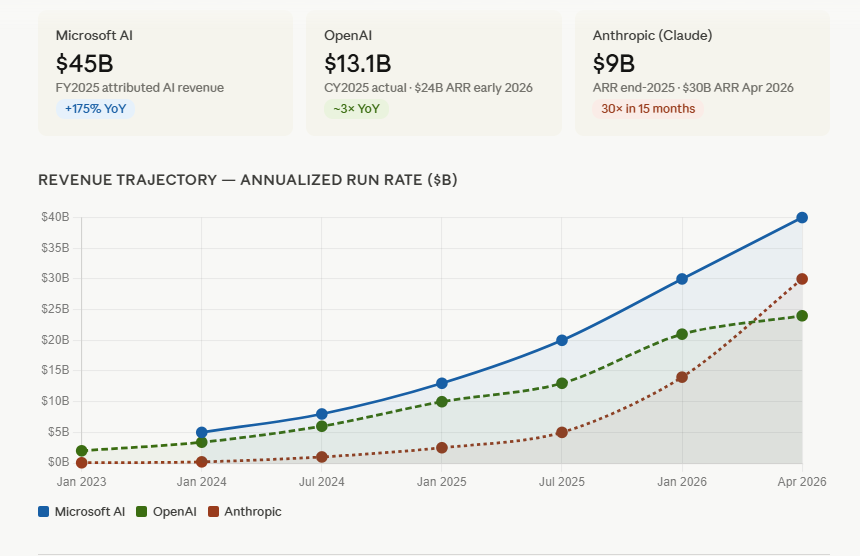
The financial landscape of the AI market is complex, with estimates suggesting OpenAI and Anthropic could generate substantial revenue. However, the breakdown of these figures reveals a significant reliance on different revenue streams. Reports indicate that a substantial portion of OpenAI’s revenue stems from consumer subscriptions, while Anthropic primarily generates income by selling AI compute capacity to other providers.
This leaves a critical question: who is truly capturing the revenue from the enterprise "surface"? The data increasingly points to Microsoft. The company’s strategic investments and product development have positioned it to capitalize on the demand for integrated AI solutions.
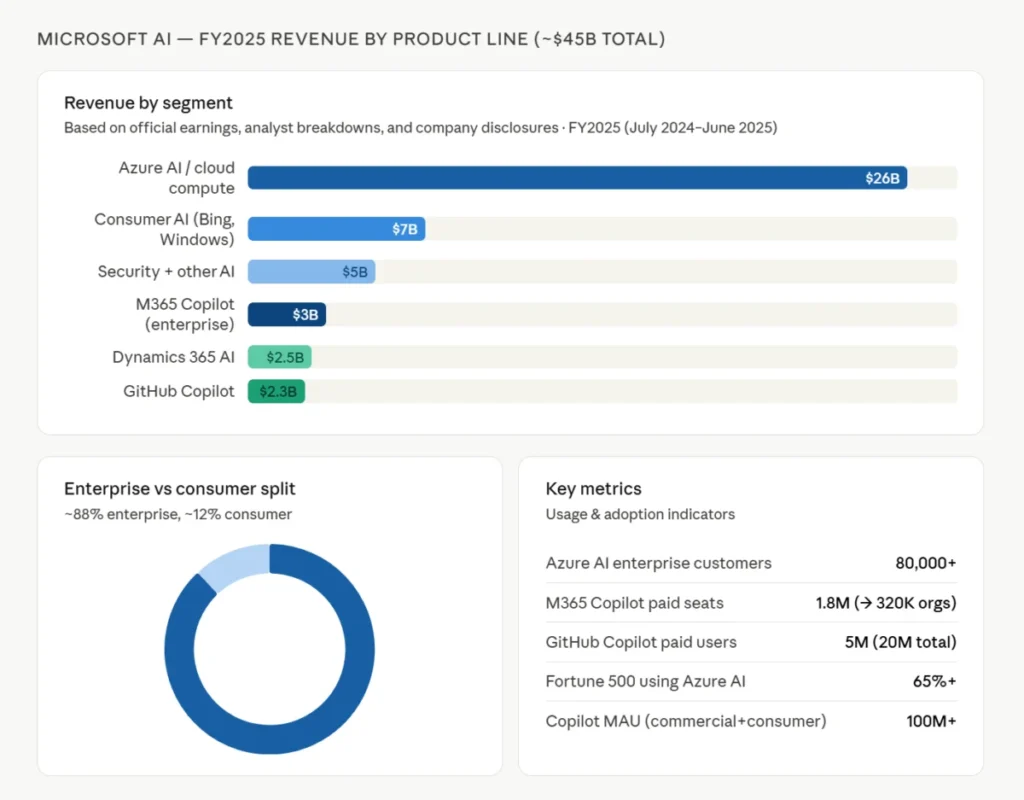
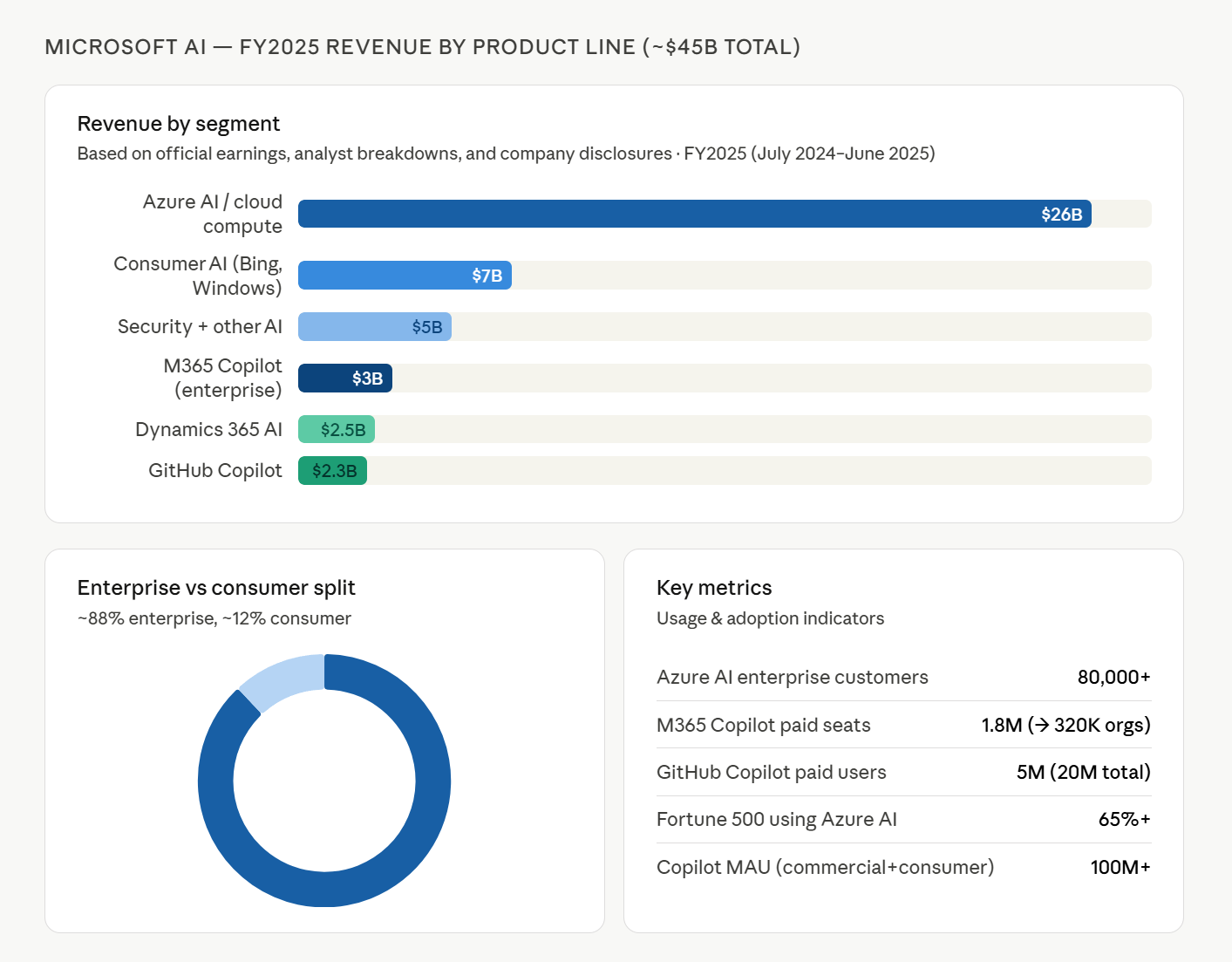
Microsoft’s revenue figures in the AI domain are substantial and growing rapidly. The company reported significant revenue from its cloud services, bolstered by its AI offerings. With an estimated 15 million licensed users of Copilot and an average subscription price of $25 per month, Copilot alone generates billions in annual revenue. When factoring in Azure API services and the broader AI ecosystem, Microsoft’s AI revenue is estimated to be in the tens of billions of dollars, with a projected growth rate of 39%.
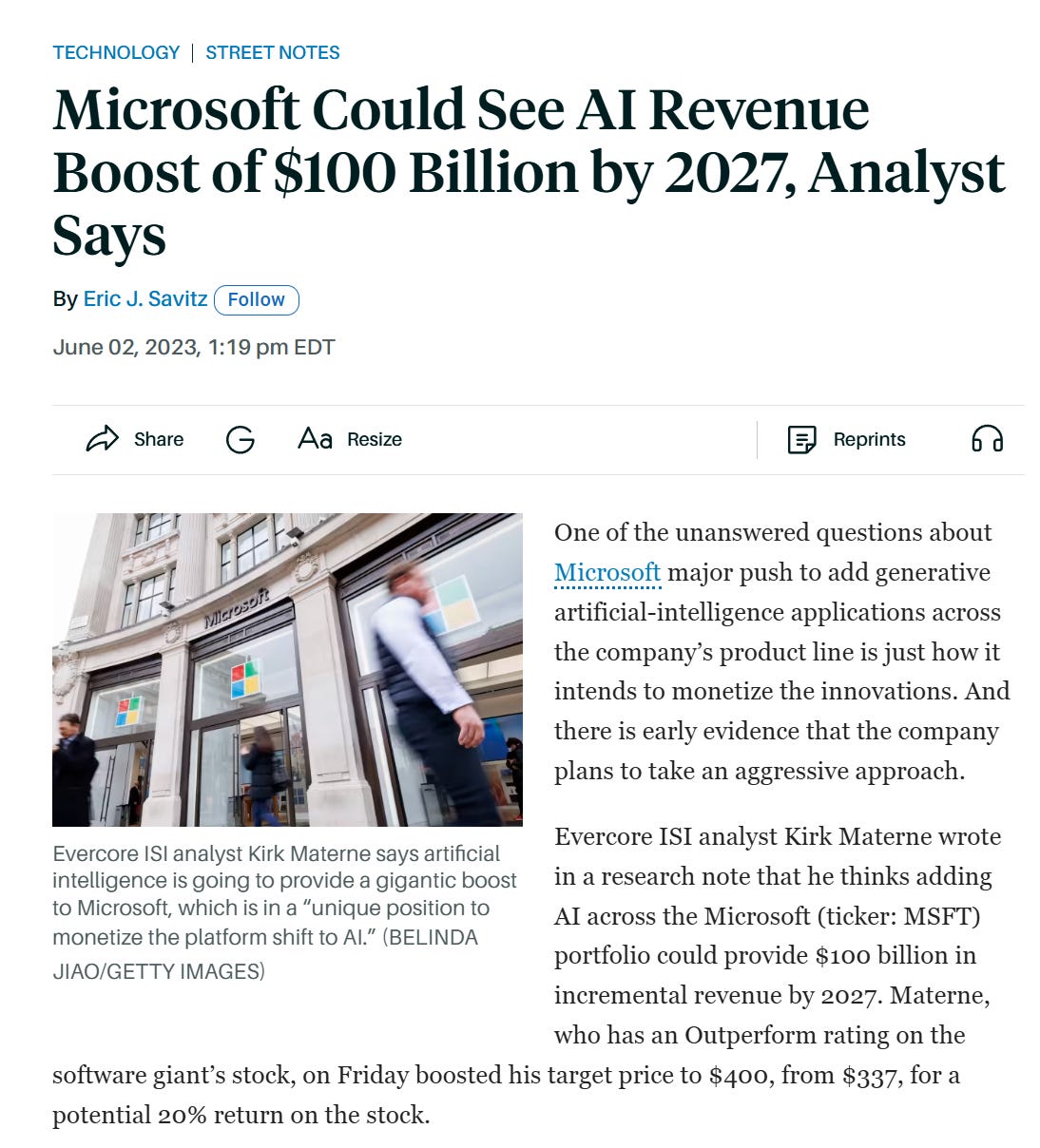
Microsoft’s own projections indicate a potential for over $100 billion in new AI revenue within the next three years, a figure that some analysts believe could be achieved even faster. This aggressive growth trajectory is directly linked to its success in building and deploying comprehensive AI solutions.
The Evolution of Copilot: From Fragmented Features to an Integrated Platform
Microsoft’s journey with Copilot has been marked by rapid evolution and strategic shifts. Initially, the focus was on licensing OpenAI’s ChatGPT for Bing, followed by the introduction of Microsoft Copilot, which was initially perceived as an advanced virtual assistant. However, the vision quickly expanded.
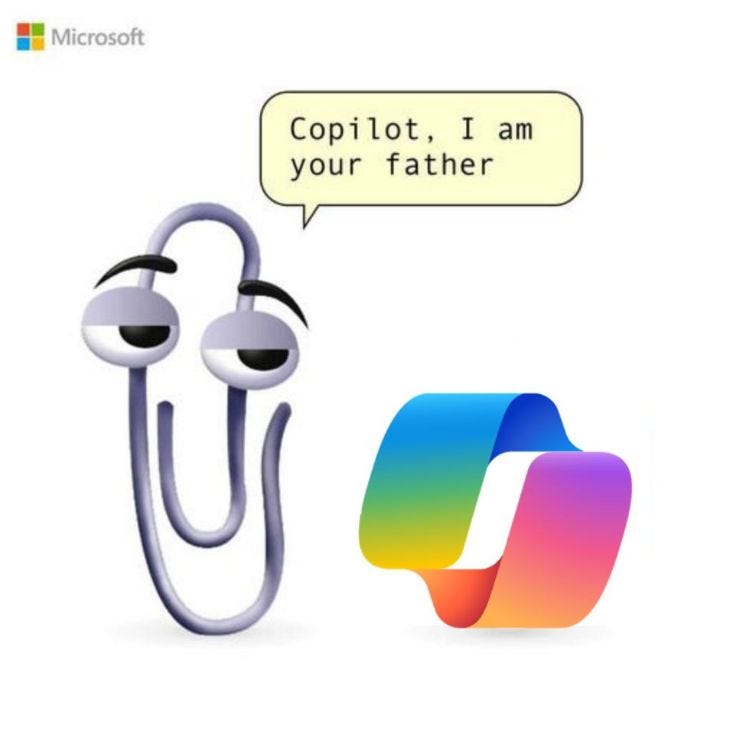
The early iterations of Copilot were characterized by a proliferation of specialized "surfaces" across Microsoft’s product suite. Copilot for Microsoft 365, versions integrated into Dynamics, Excel, GitHub, and other applications, demonstrated an ambitious effort to embed AI capabilities throughout the company’s software portfolio. This was further augmented by the development of Copilot Studio, Agent 365, and Work IQ, alongside numerous other Copilot-powered applications.
Crucially, Microsoft also invested heavily in its underlying infrastructure, developing M365 Graph Connectors to integrate corporate data into Copilot, and offering fine-tuning capabilities to optimize AI models with proprietary information. This rapid pace of product development, while impressive, initially felt somewhat disjointed.
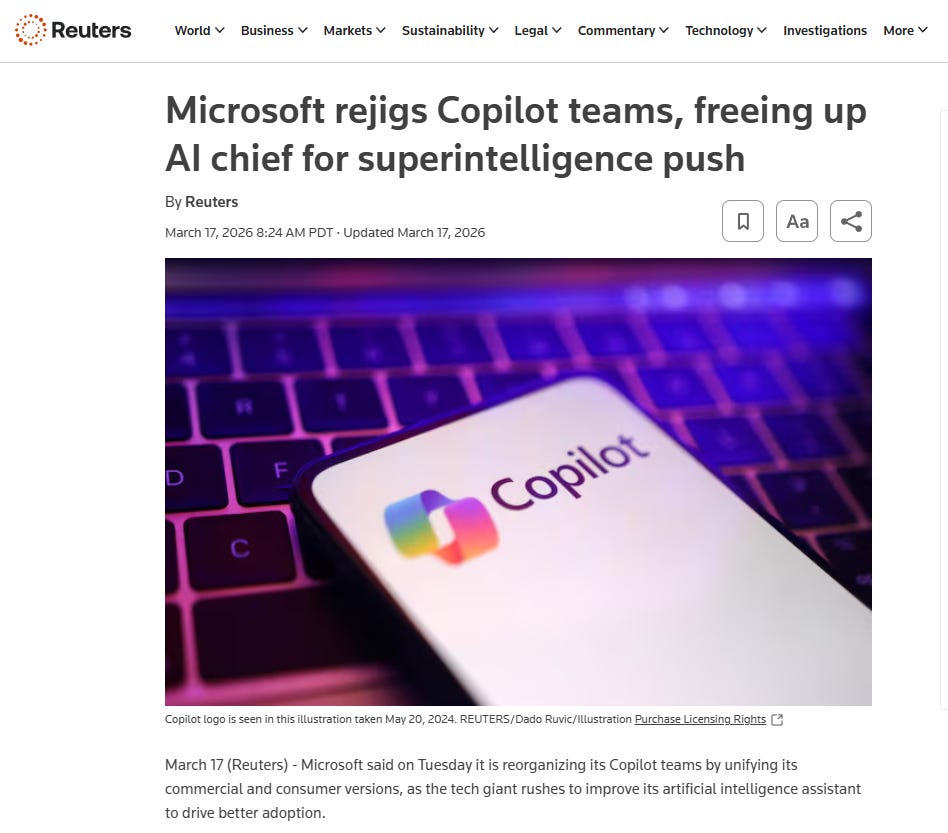
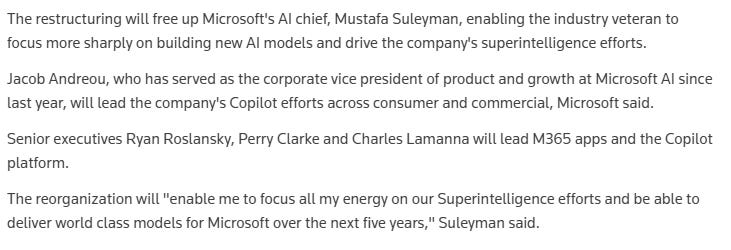
The current strategy, however, represents a significant maturation. Recognizing the potential for customer confusion and the need for a unified approach, Microsoft has consolidated its Copilot product teams under a single organizational structure, led by seasoned executives. This strategic realignment, spearheaded by Satya Nadella, allows for a more cohesive development of AI offerings.
The leadership structure now places Jacob Andreou, formerly of Snap, at the helm of Copilot growth. Ryan Roslansky (LinkedIn), Perry Clarke (Copilot Core), and Charles Lamanna (Agents and Apps) form a core leadership team focused on the overall enablement of AI agents and maximizing corporate user value, moving beyond single-application functionality. This integrated approach allows Microsoft to operate with the strategic focus of companies like Nvidia, where all engineering layers are unified under a singular vision.
This consolidation effectively:
- Unifies the AI Strategy: A single leadership team can now drive a cohesive vision for Copilot across all Microsoft products and services.
- Enhances Integration Capabilities: The focus shifts from individual application features to a broader platform strategy, enabling deeper integration with enterprise systems.
- Optimizes Resource Allocation: Centralized management allows for more efficient allocation of engineering talent and financial resources towards key AI initiatives.
- Accelerates Innovation: A streamlined organizational structure can foster faster development cycles and quicker iteration on new AI features and applications.
Microsoft’s Strategic Advantages in the Enterprise AI Arena
Microsoft’s strategic positioning in the enterprise AI market is fortified by several key advantages:
1. The Integrated Enterprise Toolset: The corporate market fundamentally requires integrated solutions. This includes desktop applications, development tools, robust IT management for AI agents, and seamless connectivity with legacy systems. While competitors like ServiceNow and Okta are active in this space, Microsoft’s comprehensive approach, encompassing its Work IQ strategy and the extensive development of Agent 365 and Copilot Studio, offers a compelling proposition. The forthcoming release of Work IQ APIs promises even deeper integration opportunities, enabling corporate cloud vendors concerned about agent-based displacement to plug into the Copilot ecosystem.
2. A Robust Application Development Ecosystem: The application development landscape is vast, and Microsoft is well-positioned to become the central hub for AI-powered development. Every vendor in ERP, finance, productivity, analytics, and other sectors will need to provide APIs to integrate with the "Copilot-land" ecosystem. While navigating the various integration points (Teams, Graph, Work IQ, Fabric) can initially be complex, the path towards a more unified development environment is becoming clearer.
3. The Ubiquitous Microsoft Desktop Experience: For end-users, PC buyers, and IT helpdesks, the prospect of a unified AI experience within the familiar Microsoft desktop environment is highly attractive. The current Copilot experience is continuously improving, and Microsoft’s top UI designers are expected to further enhance its aesthetic appeal and usability, moving beyond its current "Frankensteinish" appearance to a more polished and intuitive interface.
4. A Powerful Partner Network: Microsoft’s extensive partner network is poised to accelerate its AI adoption. As APIs for corporate applications become more accessible, a growing number of vendors will seek opportunities to integrate their services with Copilot, further expanding its reach and functionality.
Unlocking Value: Microsoft’s Deep AI Capabilities
Beyond its strategic market positioning, Microsoft is actively developing and deploying unique AI capabilities that enhance the value proposition of its platform:
-
Deep Research and Contextual Understanding: Features like the "Researcher" button, which leverages the Microsoft Graph, enable deep dives into corporate data, calendars, and other information to provide insightful advice and context. As this capability expands with memory and context integration, it offers significant value to individuals and leaders.
-
Intelligent Routing and Optimization: New Microsoft Agents are being developed to compare queries across multiple AI models, helping users optimize token usage and cost. In the future, these agents will be capable of decomposing complex AI tasks and distributing them across different specialized agents, further enhancing efficiency.
-
Agentic Interfaces for Core Applications: The new Copilot provides agentic interfaces for interacting with complex documents within Microsoft applications like Excel, PowerPoint, and Word. Users can ask questions, modify tables, run reports, and create graphs directly within Copilot, seeing real-time changes in the documents. This seamless in-app integration across the Microsoft suite is a significant differentiator.
-
Intelligent Context Layer in Work IQ: The upcoming release of the Work IQ API will allow companies to import and build "context" into Copilot. This extends Copilot’s capabilities into true agentic solutions for HR, finance, sales, and other business functions, enabling highly specialized and automated workflows.
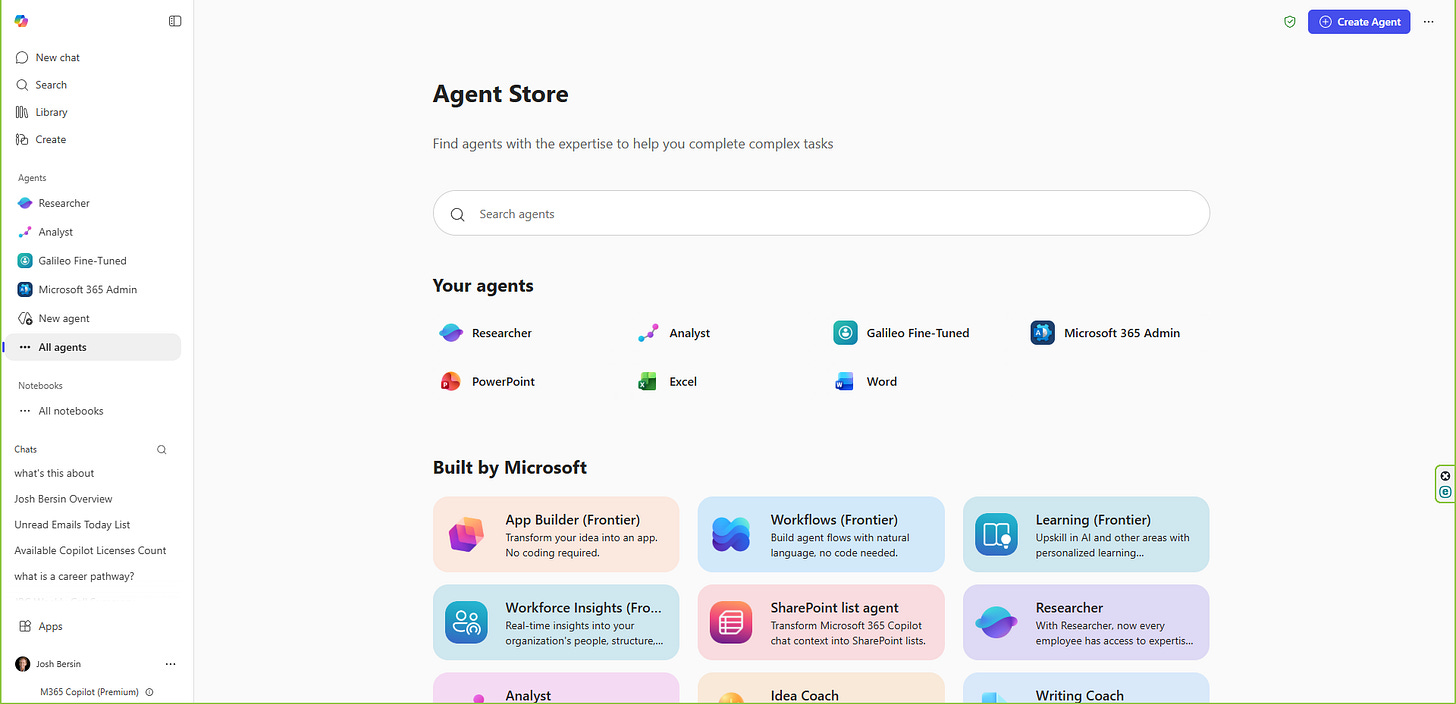
The integration of platforms like Galileo through the Graph connector and as a fine-tuned model exemplifies how third-party solutions can leverage Microsoft’s AI infrastructure to provide enhanced value to employees. This open platform approach allows for the creation of world-class management and HR advisory tools for every employee.
In conclusion, while OpenAI and Anthropic garner significant attention for their foundational AI models, Microsoft’s strategic focus on the "surface" – the user experience, integration, and ecosystem – positions it for significant leadership in the enterprise AI market. By building a comprehensive and integrated platform that connects powerful AI models with the existing workflows and data of businesses, Microsoft is not just participating in the AI race; it is poised to redefine its trajectory. The company’s ability to leverage its vast existing customer base, robust partner network, and continuous innovation in application development suggests a future where Microsoft’s "surface" strategy emerges as the most impactful force in enterprise AI.