
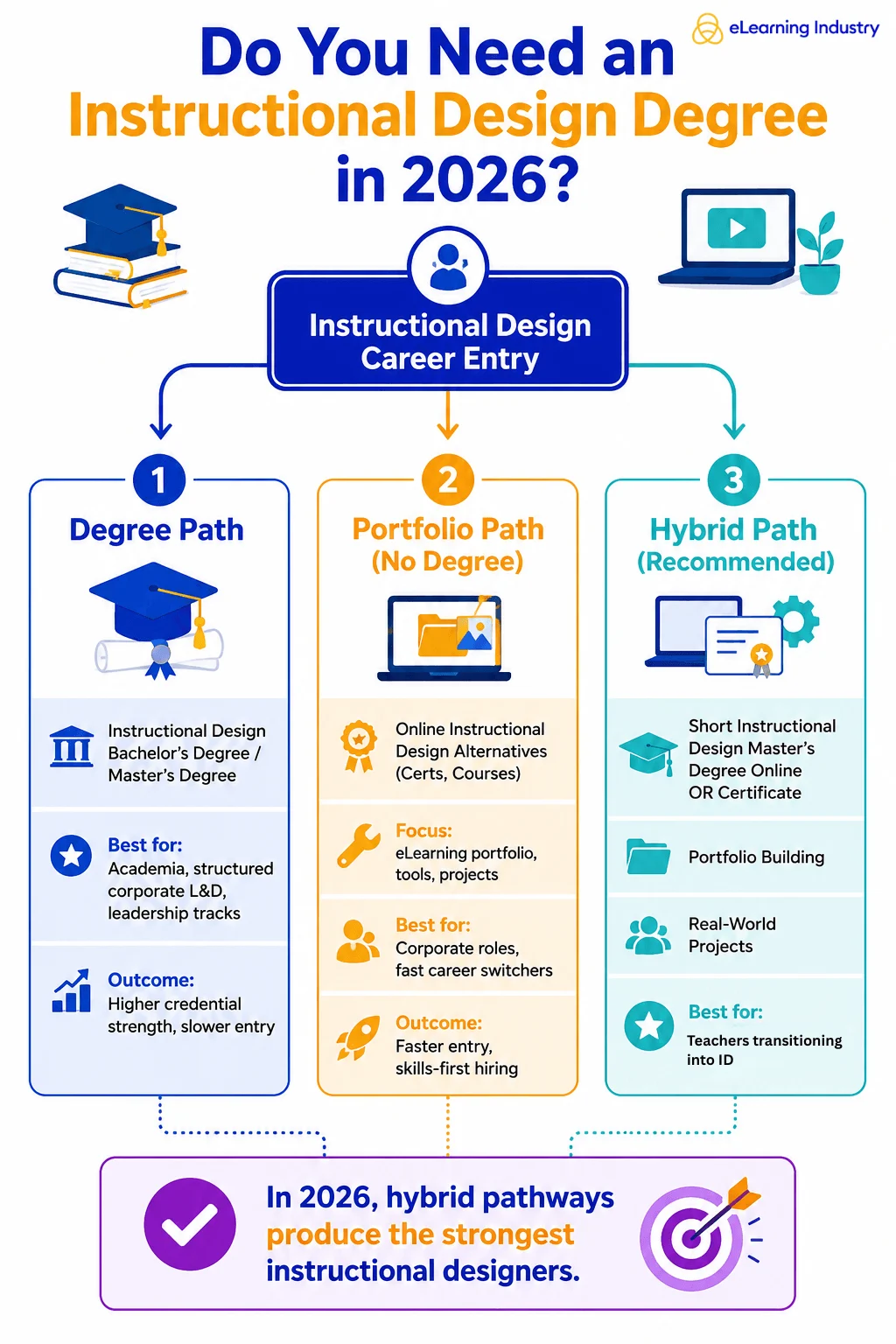
As the global workforce undergoes a profound digital transformation, the field of Instructional Design (ID) has emerged as a cornerstone of both corporate resilience and academic innovation. In 2026, the question of whether a formal Instructional Design degree is a prerequisite for professional entry has become more nuanced than ever. While the discipline remains rooted in the science of how humans learn, the methods of delivery and the credentials required to practice have shifted toward a hybrid model that balances traditional academic rigor with immediate, demonstrable technical proficiency.
Instructional Design is defined as the systematic development of instructional specifications using learning and instructional theory to ensure the quality of instruction. It is the process of analysis of learning needs and goals and the development of a delivery system to meet those needs. In the current economic climate, professionals in this field are tasked with creating effective learning experiences across diverse sectors, including K-12 education, higher education, government agencies, and the private corporate sector. For the thousands of K-12 teachers who have exited the classroom over the last five years, Instructional Design represents the most viable and lucrative bridge into the corporate world, specifically within Learning and Development (L&D) departments.
The Historical Evolution of Instructional Design Requirements
To understand the 2026 landscape, one must look at the trajectory of the field over the past several decades. The roots of Instructional Design can be traced back to World War II, when the military required a systematic approach to training thousands of soldiers quickly and effectively. By the 1960s and 70s, the field moved into academia, focusing on behavioral and cognitive psychology.
The 1990s and 2000s saw the introduction of the first digital Learning Management Systems (LMS), which shifted the focus toward "e-learning." However, the most significant catalyst for change occurred between 2020 and 2024. The global pandemic forced a decade’s worth of digital adoption into a two-year window, creating a massive surge in demand for professional designers who could translate physical curriculum into digital formats. By 2026, the market has stabilized, but the expectations for practitioners have heightened. Employers no longer just seek someone who can "put a PowerPoint online"; they require architects of human performance who can leverage Artificial Intelligence (AI), data analytics, and user experience (UX) design to drive measurable business outcomes.
The Degree Debate: When Academic Credentials Remain Vital
Despite the rise of "skills-first" hiring, formal education in Instructional Design has not lost its value; rather, its value has become more specialized. In 2026, a degree remains a non-negotiable asset in several key sectors.
Higher education institutions and government bodies continue to prioritize candidates with an instructional systems design degree or an online Instructional Design master’s degree. For these organizations, a degree serves as a proxy for a candidate’s understanding of deep pedagogical theory and their ability to navigate complex, bureaucratic systems. Furthermore, for those aiming for leadership-track roles—such as Director of Learning or Chief Learning Officer—a graduate-level credential is often a prerequisite for moving past automated resume filters.
Supporting data suggests that while entry-level roles may be accessible via portfolios, mid-to-senior-level positions in the "Fortune 500" sector still show a 65% preference for candidates with a Master’s degree in a related field. These programs provide a structured environment to study adult learning theory (Andragogy), which is essential for ensuring that corporate training actually results in behavioral change rather than just "check-the-box" compliance.
The Rise of the Skills-First Economy
Conversely, 2026 has seen a significant shift in the tech and startup sectors toward performance-based hiring. For many hiring managers at agencies and EdTech firms, the "where" of an education is secondary to the "what." This shift is particularly beneficial for transitioning teachers who may not have the time or financial resources to pursue a second multi-year degree.
In these environments, a candidate’s portfolio—a digital showcase of their ability to use authoring tools like Articulate Storyline, Adobe Captivate, and Vyond—serves as the primary evidence of competency. Industry analysts note that in 2026, a high-quality portfolio demonstrating a solve for a real-world business problem (e.g., reducing employee turnover through better onboarding) is often more persuasive than a degree from a prestigious university that lacks practical application.
Evaluating Degree Paths for Career Changers
For professionals, particularly educators, choosing the right academic path is a strategic financial decision. In 2026, the options generally fall into three categories:

1. The Bachelor’s Degree: Primarily suited for those without a prior undergraduate degree, these programs provide a foundational understanding of curriculum development and instructional technology. However, for most career changers, this is the least efficient path due to the time commitment.
2. The Master’s Degree: This remains the "gold standard" for career transitioners. Most Master’s programs in 2026 are offered in accelerated, online formats that can be completed in 12 to 18 months. These programs are increasingly focusing on "Learning Experience Design" (LXD), which blends traditional ID with UX principles.
3. The PhD or EdD: These are research-heavy degrees intended for those who wish to influence the field at a systemic level, conduct high-level academic research, or work in executive-level consultancy. For the average person looking to build training modules for a healthcare company or a retail chain, a PhD is generally considered "over-qualified" and unnecessary.
The Online Advantage: Flexibility and Modernity
By 2026, the stigma once associated with online degrees has entirely vanished, replaced by the realization that an online Instructional Design degree is often superior to an on-campus one. This is because the medium is the message: an ID student learning online is experiencing the very environment they will eventually be expected to build for others.
Modern online programs offer several advantages:
- Remote Collaboration: Students use Slack, Microsoft Teams, and Zoom to complete projects, mimicking the remote and hybrid work environments prevalent in the 2026 corporate world.
- Global Networking: Learners are no longer limited by geography, allowing a teacher in a rural area to collaborate with a tech professional in a major urban hub.
- Technological Immersion: Online programs are more likely to integrate the latest AI-driven authoring tools and LMS platforms into their curriculum.
Industry Implications and Expert Perspectives
Industry leaders have begun to weigh in on the evolving requirements of the field. "We are looking for ‘T-shaped’ professionals," says a Chief People Officer at a leading global logistics firm. "We need them to have a broad understanding of business strategy and human psychology, but a very deep, specialized skill set in digital development and data analysis. Whether they got that through a Master’s degree or a intensive boot camp and a brilliant portfolio is becoming less relevant than the evidence of their work."
This sentiment is backed by recent labor statistics. As of 2026, the demand for instructional coordinators and designers is projected to grow by 10% over the next decade, a rate faster than the average for all occupations. This growth is driven by the need for companies to constantly upskill their workforce in the face of AI-driven automation.
Identifying Program Red Flags
As the demand for ID credentials has grown, so too has the number of sub-par programs. In 2026, savvy students are warned to avoid programs that:
- Focus exclusively on theory without requiring the creation of tangible artifacts.
- Do not provide access to or training on industry-standard software.
- Are taught by faculty who have not worked in a corporate or digital-first environment in the last five years.
- Lack a strong career services component or a network of alumni in the private sector.
Conclusion: The Balanced Approach to Career Entry
In 2026, the most successful Instructional Designers are those who view their education as a continuous, multi-modal process. While a degree provides the theoretical backbone and the "shortlist" credibility required for certain sectors, it must be supplemented by a robust portfolio and a mastery of current technology.
For teachers and other career changers, the transition into Instructional Design is not merely about changing job titles; it is about adopting a new mindset. The classroom-centric focus on "compliance and seat time" has been replaced by a corporate focus on "competency and performance." Whether achieved through a formal degree or a self-directed path of intensive upskilling, the goal remains the same: to design learning experiences that are as efficient as they are engaging, ensuring that in an increasingly complex world, knowledge is not just transferred, but transformed into action.






