The recent announcement by Block Inc. CEO Jack Dorsey, outlining plans to lay off approximately 40% of its workforce, a staggering 4,000 employees, and replace them with artificial intelligence, has sent ripples through the corporate and technological worlds. This bold move, articulated with stark simplicity and a notable lack of specific detail, raises profound questions about the accelerating integration of AI into the modern workforce and its implications for human employment. While the immediate reaction has been one of shock and speculation, a closer examination of Block’s financial standing, industry trends, and the practical realities of AI implementation suggests a more nuanced picture than a simple job-elimination strategy.
The Announcement and Initial Reactions
Block Inc., the parent company of prominent financial technology platforms Square and Cash App, revealed its intention to drastically reshape its workforce through an AI-driven transition. With a global headcount exceeding 10,000 employees, the proposed reduction of 4,000 positions represents a significant strategic pivot. The announcement, delivered with brevity, offered little insight into the specific roles targeted or the precise mechanisms by which AI would assume responsibilities previously held by human employees.

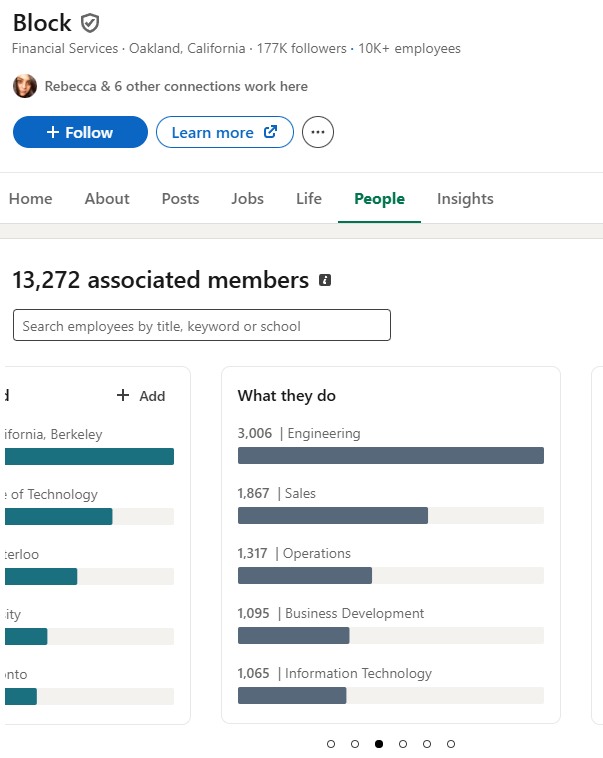
This lack of immediate detail has fueled uncertainty and prompted industry experts to scrutinize the underlying motivations and potential consequences. LinkedIn data indicates that Block Inc. employs roughly 13,000 individuals, with a substantial portion concentrated in engineering, IT, operations, and sales – departments often considered ripe for automation. The news quickly garnered attention from those within the AI development sphere, with individuals connected to leading AI research firms like Anthropic highlighting the magnitude of the announcement and its potential to foreshadow a broader trend of job displacement across various industries.
Unpacking the Strategy: Beyond the Surface
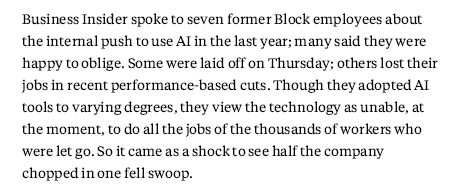
Initial reports, including an investigation by Business Insider that interviewed seven Block employees, revealed a common thread of uncertainty regarding the practical implementation of this AI-driven transformation. None of the interviewed employees could provide clear specifics on how the business would transition to an AI-augmented model. This ambiguity suggests that the company’s internal communication or strategic planning may be in its nascent stages, or that the full scope of the change is yet to be disseminated.
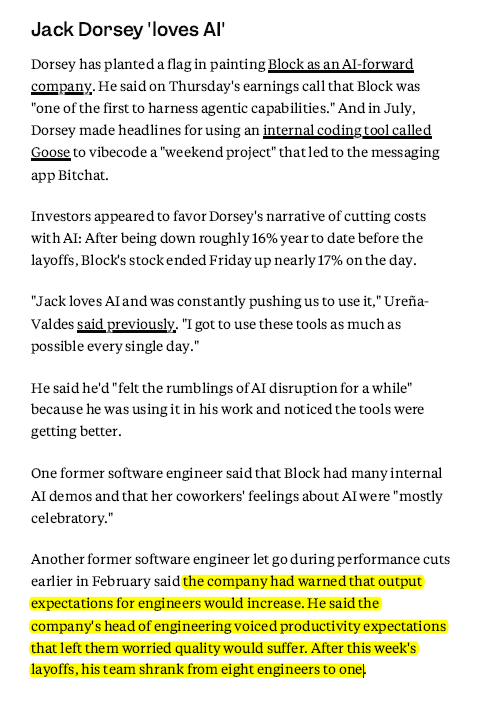
Jack Dorsey’s well-documented enthusiasm for artificial intelligence adds another layer to this narrative. His public statements often express a deep interest in the potential of AI to revolutionize various sectors. This personal conviction, coupled with the business imperatives of a company like Block, may be driving this ambitious, albeit currently opaque, workforce strategy.

AI as a Catalyst for Performance Management?
The significant scale of Block’s planned layoffs has also led some observers to question whether AI is being used as a convenient justification for performance management and organizational streamlining. The history of corporate restructuring often includes periods of significant layoffs, sometimes under the guise of technological advancement or market shifts.
A comparison can be drawn to the substantial workforce reductions seen at Twitter (now X) following Elon Musk’s acquisition, where the discovery of perceived bureaucratic inefficiencies was a key driver. It is plausible that Block Inc. is leveraging the current discourse around AI to address internal inefficiencies and optimize its organizational structure. This perspective is supported by research indicating that AI, in its current form, often serves more as a task-automation tool than a direct job-replacement solution. A comprehensive study on organizational redesign around AI, involving over 70 companies, found that most organizations focused on AI as a means to enhance individual productivity, rather than achieve significant job reduction. Substantial job displacement typically requires a more profound re-engineering of business processes.
Financial Context and Operational Efficiency
An analysis of Block Inc.’s financial performance in comparison to industry peers such as Visa, Mastercard, and Shopify, while acknowledging their differing business models, reveals a potential underlying motivation for aggressive cost-cutting measures. Block exhibits lower profitability and a considerably smaller gross margin compared to these competitors. This financial disparity suggests that the company may be operating at a less efficient scale, prompting a strategic re-evaluation of its operational costs.
The pressure from investors, who have expressed dissatisfaction with Block’s financial performance, could be a significant factor driving this decisive action. The AI-driven workforce reduction may, therefore, be an attempt to demonstrate a commitment to operational efficiency and improved financial returns, addressing investor concerns about the company’s scale and profitability.
The Realities of AI Transformation: A Deeper Analysis
The narrative of AI as a simple job eliminator requires a more critical examination. While AI excels at automating specific tasks, its broader integration into enterprise operations presents a more complex economic and operational landscape.
1. AI Transformation: A Short-Term Strategy?
The idea that AI can unilaterally eliminate a large segment of jobs is often a short-sighted view. The development, implementation, and ongoing management of sophisticated AI systems require significant human capital. Building and maintaining AI agents, along with the necessary infrastructure for training, verification, and operational oversight, necessitates a skilled workforce. The non-deterministic nature of AI also introduces the need for continuous monitoring and human intervention to ensure accuracy and prevent unexpected errors, especially in critical customer-facing applications like those offered by Block.
2. The Significant Cost of AI Implementation
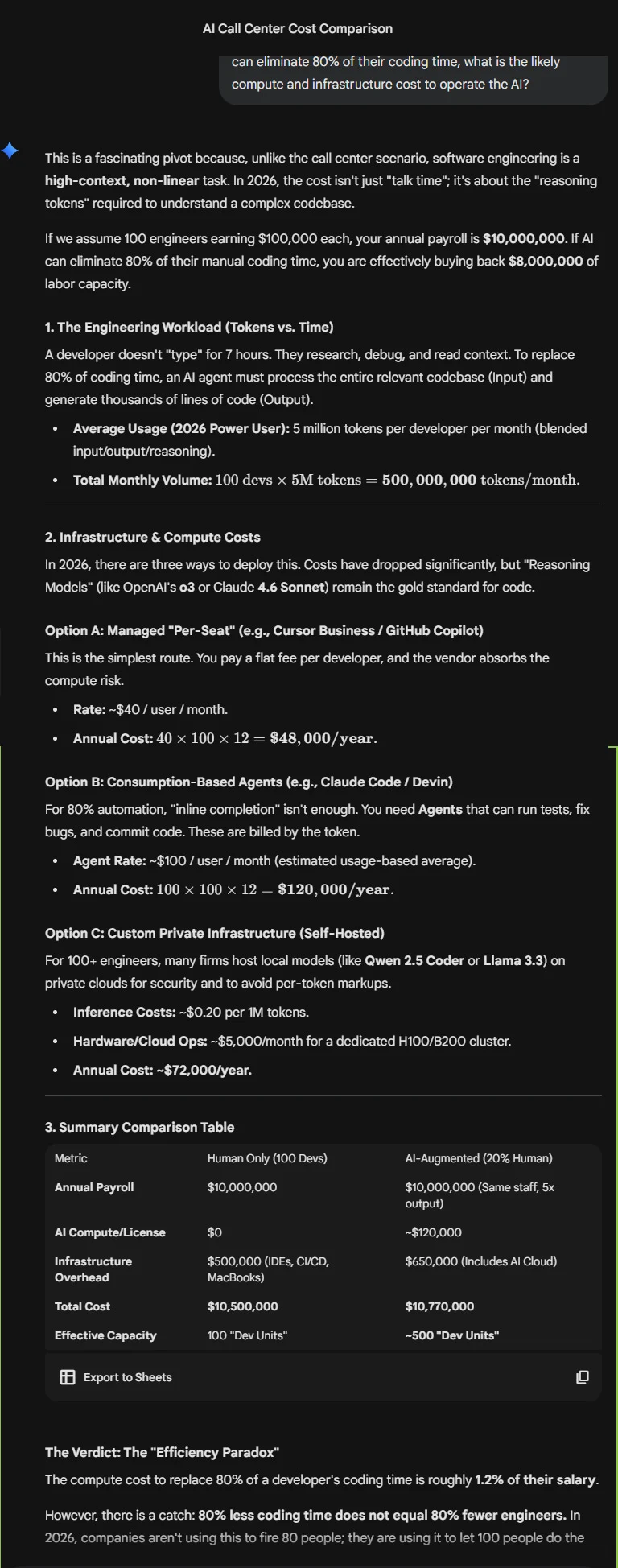
The financial implications of replacing human roles with AI are not as straightforward as a direct cost-for-cost comparison. While the elimination of a customer support center, for instance, might seem to offer substantial savings, the total cost of AI ownership must be considered. This includes not only the direct compute costs but also the expenses associated with training AI models, maintaining the AI ecosystem, and ensuring robust data governance and ethical compliance.
For example, replacing a customer service representative earning $35,000 annually with an AI agent might seem cost-effective. However, the ongoing costs of AI development, integration, and maintenance can offset a significant portion of these savings. In specialized fields like software engineering, where human engineers command higher salaries, the cost-effectiveness of AI replacement becomes even more complex. While AI tools can augment an engineer’s productivity by automating routine coding tasks, the high-context, non-linear nature of complex software development still requires human expertise. The cost of AI "reasoning tokens" and the extensive infrastructure required to support these advanced AI models can, in some scenarios, exceed the direct compensation of a human engineer.
3. Re-engineering Processes: The True ROI of AI
The most impactful transformations driven by AI do not originate from job displacement but from fundamental business process re-engineering. Companies that have successfully leveraged AI for significant gains have focused on optimizing workflows, enhancing customer experiences, and developing new service offerings. Examples include Allianz’s use of digital twins to improve claims processing, Travelers’ application of AI for employee enablement, and Hubspot’s development of AI-powered services for clients. Even internal AI tools, like Josh Bersin’s own Galileo platform, are designed to scale business operations exponentially, enabling outreach to a broader client base.
While Block’s announcement may initiate with layoffs, its long-term success will likely depend on its ability to fundamentally re-engineer its business operations around AI capabilities. This implies a strategic shift from merely cutting costs to creating new value and efficiencies through intelligent automation and process optimization. The company’s ability to achieve this will be closely watched by investors and industry analysts alike.
Broader Implications and Lessons Learned
The Block Inc. situation serves as a salient reminder that pronouncements of AI-driven job elimination should be approached with critical analysis. The true potential of AI lies not just in reducing headcount but in fundamentally transforming how businesses operate, innovate, and deliver value.
For businesses contemplating similar AI integration strategies, the key takeaway is to move beyond a simplistic job-elimination mindset. Instead, the focus should be on identifying opportunities for process re-engineering, enhancing talent density, and creating a more agile and productive workforce. This involves a strategic vision that encompasses the entire AI lifecycle, from development and implementation to ongoing management and ethical considerations.
The journey towards an AI-integrated future is not merely about replacing human workers; it is about redefining work itself. Companies that successfully navigate this transition will be those that embrace AI as a tool for innovation, efficiency, and the creation of new forms of value, ultimately shaping a more dynamic and adaptive future of work. The ongoing evolution of AI necessitates a proactive and strategic approach, ensuring that technological advancements translate into sustainable growth and a redefined understanding of human-machine collaboration.