
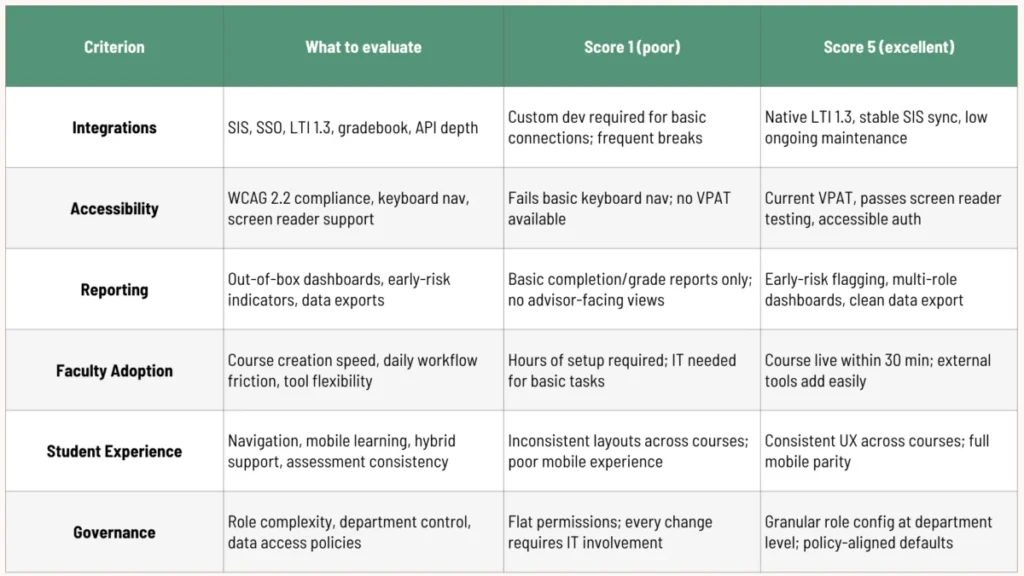
The selection of a Learning Management System (LMS) represents one of the most significant financial and operational decisions a higher education institution can make, yet many universities approach the process using outdated corporate procurement models. Unlike a corporate training department, which often serves a singular objective of employee compliance or skill-upgrading, a university is a multifaceted ecosystem involving dozens of stakeholder groups, complex academic workflows, and rigid institutional governance structures. The platform that performs flawlessly in a controlled vendor demonstration can often fail to meet the rigorous demands of a real-world deployment within six months. To mitigate these risks, higher education leadership teams must adopt a specialized evaluation framework that prioritizes institutional context over generic feature lists, focusing on integrations, accessibility, reporting, faculty adoption, student experience, and governance.
The Evolution of the Higher Education Digital Landscape
The history of the LMS in higher education has transitioned through several distinct eras. In the late 1990s and early 2000s, platforms like WebCT and Blackboard functioned primarily as digital repositories for syllabi and static documents. The mid-2000s saw the rise of open-source alternatives like Moodle, which introduced a social-constructivist approach to online learning. By the 2010s, the shift toward cloud-native architectures, led by platforms such as Canvas by Instructure and D2L Brightspace, redefined expectations for uptime, scalability, and user interface design.
Following the global disruption of 2020, which forced a near-universal pivot to emergency remote teaching, the role of the LMS has shifted again. It is no longer a peripheral tool for distance education but the central nervous system of the modern campus. As institutions move toward permanent hybrid models, the 2026 EDUCAUSE Students and Technology Report highlights that student experience and institutional strategy are now inextricably linked. This evolution necessitates a more sophisticated procurement logic that accounts for the deep technological dependencies of the modern university.
Critical Criteria for Evaluation: A Holistic Approach
When evaluating an LMS, institutions must look beyond the surface-level user interface to assess how the platform will integrate into a complex web of existing systems.
1. Seamless Technological Integrations
Integration is frequently the primary point of failure for LMS implementations, leading to budget overruns and delayed launches. A university learning platform does not exist in a vacuum; it must communicate fluently with the Student Information System (SIS) for enrollment management and role provisioning. Furthermore, it must support Single Sign-On (SSO) through the institution’s identity providers to ensure security and ease of access.
The industry standard for this interoperability is LTI (Learning Tools Interoperability) 1.3. Platforms that implement this standard effectively allow for "deep linking" and secure data exchange with third-party academic tools, library databases, and external gradebooks. Institutions should prioritize vendors who demonstrate a commitment to open standards, as this reduces the need for expensive custom development and future-proofs the digital ecosystem.
2. Accessibility and Universal Design
For higher education, accessibility is not merely a feature—it is a legal and ethical mandate. The W3C’s WCAG 2.2 standards provide a rigorous baseline for keyboard navigation, screen reader compatibility, and accessible authentication flows. Universities serve a diverse student body, including those with visual, auditory, and motor impairments.
A platform that treats accessibility as an afterthought creates significant compliance risks under the Americans with Disabilities Act (ADA) and Section 508 of the Rehabilitation Act. Retrofitting accessibility into a platform after it has been deployed is significantly more costly and disruptive than selecting a platform built with universal design principles from the ground up.
3. Advanced Reporting and Learning Analytics
While basic LMS reporting might cover login frequency and final grades, modern academic operations require granular data to drive student success initiatives. Effective reporting modules must provide course-level visibility and early-warning indicators for students at risk of falling behind.
Data exports should be compatible with institutional research tools, allowing registrars, advisors, and faculty to make evidence-based decisions. According to industry analysis, the ability to leverage learning analytics for retention strategies is becoming a primary differentiator for top-tier institutions.
4. Faculty Adoption and Workflow Efficiency
The success of an LMS is ultimately determined by the faculty who use it daily. If a platform is cumbersome or requires extensive IT intervention to build a basic course, adoption will stall. High-friction workflows lead to "shadow IT" practices, where instructors use external, unvetted tools to circumvent the official LMS, thereby creating data silos and security risks.
Evaluation teams should measure the "time-to-task" for common faculty actions, such as grading an assignment, updating a syllabus, or integrating a third-party simulation. When adoption is consistent across all departments, it ensures a uniform experience for students and maximizes the institution’s return on investment.

5. Student Experience and Mobile Continuity
UNESCO’s global higher education roadmap emphasizes that digital environments must support equitable access and student agency. For the modern student, this means a mobile-first experience. The LMS must provide a consistent interface across devices, ensuring that a student can start an assignment on a laptop and check their feedback on a smartphone without confusion.
Fragmented experiences—where different courses have vastly different layouts or submission flows—increase the cognitive load on students and lead to higher support volumes for the university’s help desk. Continuity between in-person and digital learning components is essential for maintaining engagement in hybrid environments.
6. Institutional Governance and Scalability
In a multi-campus or multi-school university system, role complexity is a major hurdle. Governance refers to the platform’s ability to handle granular permissions: who can publish content, who can access sensitive student data, and how templates are managed across different departments.
A "flat" access control model, which is common in corporate-grade systems, is often insufficient for the hierarchical nature of academia. The platform must allow for department-level control while maintaining institutional oversight of data retention and privacy policies, particularly in compliance with regulations like FERPA and GDPR.
Market Data and Financial Implications
The global Higher Education LMS market is projected to continue its growth as institutions replace legacy systems with more agile, cloud-based solutions. According to market share data from 2024, Instructure (Canvas) and Moodle maintain significant leads in the North American and European markets, respectively, while D2L Brightspace has seen increased adoption in the mid-to-large university segment.
The financial cost of a failed LMS selection extends far beyond the contract price. Industry analysts suggest that the "total cost of ownership" includes faculty training, data migration, help desk staffing, and the potential loss of tuition revenue if student retention drops due to a poor digital experience. A well-vetted LMS can reduce administrative overhead by up to 15% through automated enrollment and grading workflows.
Perspectives from the Field: Stakeholder Reactions
University Chief Information Officers (CIOs) emphasize that the "demo experience" is often deceptive. "A vendor can make any platform look intuitive in a 30-minute presentation," says one veteran EdTech consultant. "The real test is how it handles 40,000 concurrent users during finals week and how easily it connects to a 20-year-old legacy SIS."
Faculty senates often express concern regarding the learning curve associated with new technology. Their primary demand is for platforms that "get out of the way of teaching." Meanwhile, student government associations are increasingly vocal about the need for better mobile apps and more transparent grade tracking, viewing the LMS as a critical service they pay for through their technology fees.
Strategic Analysis: The Risk of Common Selection Mistakes
Many institutions fall into predictable traps during the procurement process. One of the most common is over-weighting the "feature count." A platform with 100 features that are difficult to use is less valuable than a platform with 50 features that are flawlessly executed.
Another mistake is ignoring the mobile experience during the evaluation phase. Most evaluation committees review platforms on high-end desktop monitors in conference rooms, failing to realize that a significant portion of the student body will access the same content on mid-range mobile devices with varying internet speeds. Finally, failing to involve a diverse range of faculty—from the "early adopters" to the "tech-skeptics"—can lead to a selection that lacks broad institutional buy-in.
Conclusion: Moving Toward a Decision
The process of choosing an LMS for higher education is a balancing act between technological capability and institutional culture. By utilizing a weighted scorecard—rating candidates from 1 to 5 across the six criteria of integrations, accessibility, reporting, faculty adoption, student experience, and governance—institutions can move from subjective impressions to data-driven decisions.
Ultimately, the platform that wins the contract should be the one that most closely aligns with the institution’s long-term strategic goals. Whether the priority is expanding online enrollment, improving student retention, or reducing the administrative burden on faculty, the LMS must serve as a reliable foundation for the university’s academic mission. In the rapidly evolving landscape of higher education, the ability to ask the right questions before the procurement begins is what separates successful digital transformations from costly institutional setbacks.






