Nearly 60,000 miles of global travel, spanning Europe, Asia, and the Middle East, have revealed a significant shift in corporate strategy: Artificial Intelligence is no longer a theoretical concept but a tangible business tool with rapidly expanding applications. Conversations with hundreds of companies indicate a clear trajectory towards AI integration, with its maturity varying across organizations but its presence undeniable. This widespread adoption is supported by emerging data, underscoring a pivotal moment where AI has moved from experimentation to essential operational integration.
A comprehensive survey by Wharton provides compelling evidence of this rapid integration. The report reveals that 46% of business leaders are now utilizing Generative AI on a daily basis, with an additional 80% employing it weekly. Crucially, these adopters are actively measuring the impact, with 72% tracking Return on Investment (ROI), and a substantial 74% reporting a positive financial return. This widespread positive outcome is not confined to technology departments; Human Resources (HR) is emerging as a key beneficiary, ranking as the third most active department in AI use cases, closely following Information Technology (IT) and Finance.
The financial commitment to AI reflects this growing reliance. Budget allocations are escalating, with 23% of large corporations now investing $20 million or more annually in AI initiatives, and 43% dedicating over $10 million per year. This significant financial outlay is driven by demonstrable gains, primarily in productivity.
The Dawn of Individual Productivity Enhancement
The most prevalent AI use case, accounting for the initial wave of adoption, is focused on "stage one" usage: enhancing individual productivity. AI tools are proving invaluable for tasks such as summarizing lengthy meetings, dissecting complex data sets, efficiently retrieving information, and assisting in the creation and analysis of documents. These personal productivity gains, while fundamental, are recognized as merely the starting point of AI’s transformative potential.
This initial phase of AI adoption bears a strong resemblance to the early days of groundbreaking digital tools like word processing, spreadsheets, and internet search engines. These technologies, much like current AI applications, initially focused on augmenting individual capabilities. Microsoft’s Copilot, for instance, is increasingly positioned as the next iteration of the Microsoft Office Suite, designed to streamline individual workflows and enhance personal efficiency.
Expanding Beyond Personal Productivity: Corporate Agents and Knowledge Management
The capabilities of AI extend far beyond individual task optimization. Approximately 12% of companies are currently deploying "corporate agents," sophisticated AI systems designed for knowledge and information management. IBM’s "Ask HR" is a prime example, offering employees a direct interface for querying HR-related information. These internal AI agents are poised to revolutionize how employees access information, potentially replacing complex internal portals and SharePoint sites, and also serving as robust customer support systems. The expectation is that virtually every organization will eventually implement such agents.
A notable case study involves a large healthcare company that has successfully integrated an employee chatbot, or agent, over the past four years. The remarkable success of this initiative has led to the consolidation of nearly all HR applications behind this single interface. Employees now utilize the agent to manage inquiries related to payroll, benefits, work schedules, and even professional development.
Recruitment is another area where AI is demonstrating significant value. Job candidates can engage with AI agents for initial interactions, complete AI-driven assessments, and even undergo AI-avatar interviews. This capability allows for 24/7 engagement, removing the scheduling constraints often associated with human recruiters and hiring managers.
While high-ROI, multi-functional agents (representing "stage three" of adoption) are still in development, companies are actively deploying AI-powered coaching and learning platforms. Many large enterprises are implementing AI-native learning systems, reporting substantial improvements in workforce enablement, with some experiencing up to a 30-40% reduction in staff requirements for certain training functions. The demand for specialized AI solutions in HR has led to significant growth for platforms like Galileo, which now serves as a digital HR business partner and a comprehensive learning resource.
Crossing the Rubicon: The Point of No Return for AI Adoption
The current phase of AI integration signifies a "crossing the Rubicon" moment – a point of no return where the adoption of AI as a fundamental business tool is irreversible. Despite prevalent anxieties surrounding AI’s potential negative impacts on careers and daily life, its practical utility, ease of understanding, and pragmatic applications are becoming increasingly evident. While acknowledging AI’s imperfections, including a notable rate of errors in some large language models, the ability to learn how to effectively use these tools, coupled with the development of trusted data sets, is yielding significant operational benefits.
The narrative surrounding AI has shifted from speculative fears, such as AI companions or existential threats, to a more grounded understanding of its capabilities, bolstered by substantial capital investment. The literal trillion-dollar investment in AI infrastructure, engineering, and power generation has contributed to making these technologies more accessible and reliable.
However, the inherent "probabilistic nature" of AI, meaning it generates answers based on patterns and probabilities rather than absolute certainty, necessitates a human element of verification. While the potential for generating incorrect answers, poorly written reports, or flawed findings remains, users are developing a greater comfort level with "checking" AI outputs. This iterative process of interaction and validation is crucial for maximizing AI’s effectiveness.
New challenges are also emerging, such as the environmental impact of AI’s energy demands, with some reports indicating significant water consumption for AI operations. These considerations are becoming critical factors in the ongoing development and deployment of AI technologies.
The Future Trajectory: From Single-User Tools to Integrated, Intelligent Agents
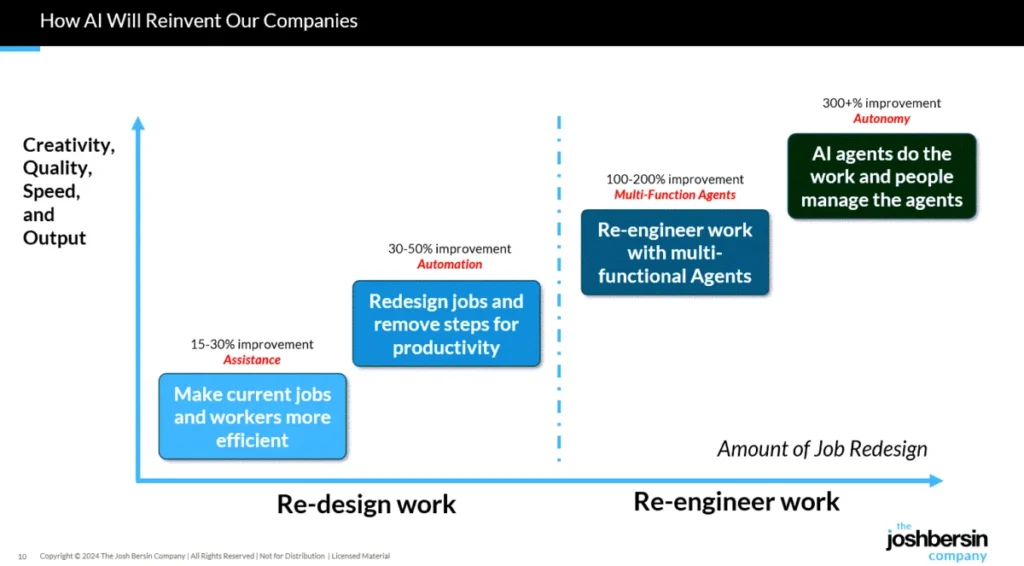
The current landscape of AI adoption is merely the prologue to a more profound transformation. The next wave of significant ROI will stem from "multi-functional agents" – AI systems capable of handling complex, end-to-end business processes. Current AI tools, while valuable for individual productivity, are akin to power steering in a vehicle; they assist with specific tasks but do not autonomously drive the entire operation. The ultimate goal is for AI to navigate entire journeys, from origin to destination.
This transition is already evident in areas like recruitment and training, where agents are being developed to manage the entire hiring lifecycle – from drafting job requisitions and engaging with candidates to scheduling interviews and screening resumes. The integration of these agents with onboarding and performance review processes will create a comprehensive "hiring and career" agent. The development of such multi-functional AI agents requires a collaborative approach between vendors and buyers to define and build these complex systems.
Organizations are moving away from the notion of hundreds of individual AI tools, each performing a narrow function, towards integrated "smart" agents that manage entire business workflows. This encompasses processes such as "design to build to distribute to sell," or "position to target to market to close a sale," followed by "bill to collect to renew and support." The individual use cases currently being explored will increasingly converge into more holistic solutions.
The emergence of these multi-functional agents, often developed internally by IT departments rather than solely by external vendors, will necessitate a significant redefinition of existing job roles. Positions focused on discrete tasks, such as interview scheduling or appointment setting, may become redundant as AI agents manage these functions within broader workflows.

The evolution of platforms like Galileo exemplifies this shift. What began as an HR assistant is now capable of answering questions, developing customized training modules, and resolving complex inquiries related to pay, rewards, and internal company policies. These agents are increasingly able to "build solutions" from initial problems or ideas to proven outcomes, mirroring the autonomous capabilities of a self-driving car.
Agents with Memory and Personalized Interaction
A second critical development on the horizon is the advent of AI agents that possess memory and a personalized understanding of users. Platforms like Galileo are already demonstrating this capability by remembering past interactions and user behaviors, allowing them to learn from usage patterns and business contexts. This enhances autonomy, personalization, and overall value.
Consider a manager facing a staffing challenge. An AI agent like Galileo might proactively inquire about the specific responsibilities of the proposed new hire, benchmark salary expectations against industry standards, and even suggest exploring internal candidates before initiating a new requisition. Months later, if the manager faces a similar issue, the agent could recall previous hiring outcomes and propose a development plan for the existing team as an alternative.
This evolution signifies a move from AI assisting with isolated tasks to AI proactively guiding and optimizing entire operational segments. As these "steering wheel" agents become more sophisticated and integrated, the AI will increasingly take on the role of steering the entire operation, a development expected to accelerate significantly in the coming year.
Data Management: The Critical Foundation for AI Success
Companies with established AI experience consistently highlight the paramount importance of robust data management, including data labeling and governance. This lesson has been learned through practical application, including the development of platforms like Galileo. Inaccurate, outdated, or poorly labeled data directly impairs AI performance.
AI systems operate on probabilities and complex mathematical calculations, not on inherent understanding. Even minor data inaccuracies can lead to a disproportionately high percentage of errors in AI outputs. Reports indicating that a significant percentage of AI queries produce erroneous answers underscore the criticality of data integrity. Consequently, organizations like IBM, Walmart, and Bristol Myers Squibb have recognized data ownership as a mission-critical discipline.
IBM’s "Ask HR" agent, for example, manages over 6,000 HR policies, with each policy having a designated owner responsible for its upkeep. IBM is now developing agents to continuously monitor these policies and track regulatory changes across numerous jurisdictions, proactively identifying potential compliance issues. This iterative process of data governance and AI oversight will become a standard practice across industries.
Inter-Agent Communication: The Next Frontier
The "crossing the chasm" phase also necessitates the development of agent-to-agent communication protocols. While these protocols (such as A2A and MCP) are still maturing, significant progress is being made. Integrations like Galileo’s connection with SAP’s Joule are indicative of this trend, with further inter-agent collaborations anticipated.
A cautionary note for organizations is to avoid accumulating a large number of disparate AI agents without considering their interoperability. The true utility of AI lies in its ability to work cohesively. Many clients are opting for shorter contract terms to mitigate the risk of investing in technologies that may quickly become obsolete.
The development of comprehensive "Agentic AI Blueprints," particularly for HR, is crucial for guiding the integration of these agents and preventing the fragmentation of AI investments. Such blueprints will ensure that AI solutions work in concert, akin to a well-coordinated self-driving car, rather than pulling in conflicting directions.
Vendor Landscape and Emerging Risks
The AI vendor landscape presents both opportunities and risks. The future trajectory of major AI providers like OpenAI remains a subject of ongoing observation. Microsoft’s Copilot is expanding across multiple functionalities, while competitors such as Google’s Gemini and Anthropic face increasing competition from emerging players. Market consolidations are also a possibility, particularly in the event of economic downturns.
However, vendors focusing on specific, high-value business areas, such as Galileo, Paradox, Eightfold, Sana, and Arist, are well-positioned for sustained growth. The Human Capital Management (HCM) sector, encompassing major players like SAP, Workday, ADP, HiBob, and ServiceNow, is actively integrating AI agents into their core payroll and workflow systems. These HCM giants aspire to become comprehensive multi-functional AI providers, evidenced by strategic acquisitions aimed at enhancing their AI capabilities.
Addressing Fears: Job Security and Skill Evolution
Throughout extensive discussions, common concerns have emerged regarding job security, the authenticity of candidate profiles, and the potential for AI to diminish human cognitive skills.
The prevailing sentiment is that resisting this technological revolution is not a viable option. Instead, embracing AI presents a unique opportunity to re-engineer existing processes and unlock new career paths. Proactive engagement with AI tools, whether independently or through guided platforms, is essential for fostering fluency and identifying emerging opportunities.
The notion of AI fundamentally replacing human jobs is viewed with skepticism. Historical parallels, such as the introduction of spreadsheets and their impact on accounting, suggest a transformation rather than elimination of roles. While AI may automate routine tasks, it simultaneously creates demand for new skills and higher-value contributions. Accountants, for example, have not disappeared but now focus on more strategic analysis rather than manual data entry.
Similarly, professionals in creative and analytical fields—designers, authors, analysts—can leverage AI as a powerful "personal supercomputer." Just as craftspeople adopt advanced tools to enhance their creations, individuals in these fields can utilize AI to augment their capabilities, enabling the production of more sophisticated and elegant work.
Conclusion: Embracing the "Superworker" Era
The era of AI integration is no longer a future prospect but a present reality. The initial uncertainties have largely subsided, replaced by a clear understanding of AI’s potential to enhance productivity and drive business transformation. The path forward involves embracing AI not as a replacement for human intellect but as a powerful co-pilot, enabling individuals to become "Superworkers" who can learn, apply, and leverage this technology to its fullest potential. The onus is now on individuals and organizations to navigate this new landscape, drive innovation, and unlock the full promise of artificial intelligence.