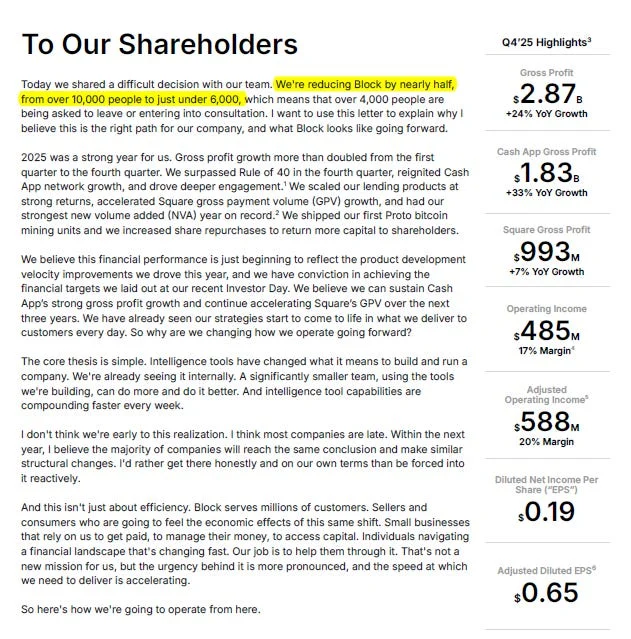
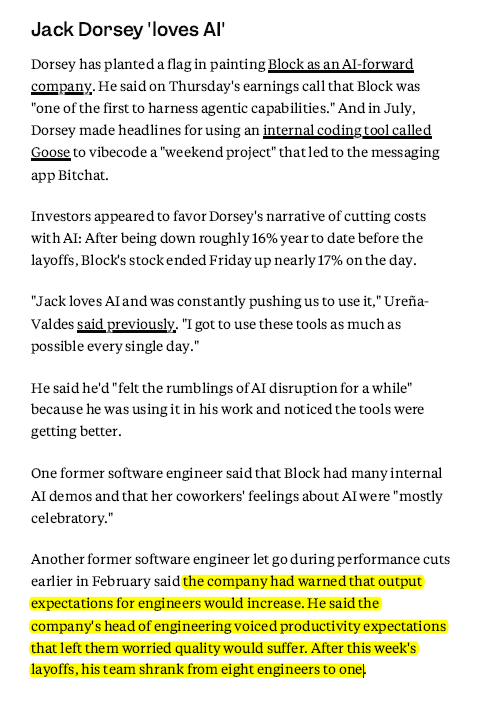
Last week, Jack Dorsey, CEO of Block Inc., the financial technology powerhouse behind Square and Cash App, made a significant announcement that has sent ripples across the business and technology sectors. The company revealed plans to lay off approximately 40% of its workforce, totaling around 4,000 employees, with the stated intention of replacing these roles with artificial intelligence (AI). The announcement, delivered with stark simplicity, offered few specific details regarding the execution of this ambitious workforce transformation, leaving many to question the precise nature and scope of this AI-driven overhaul.
The Announcement and Initial Reactions
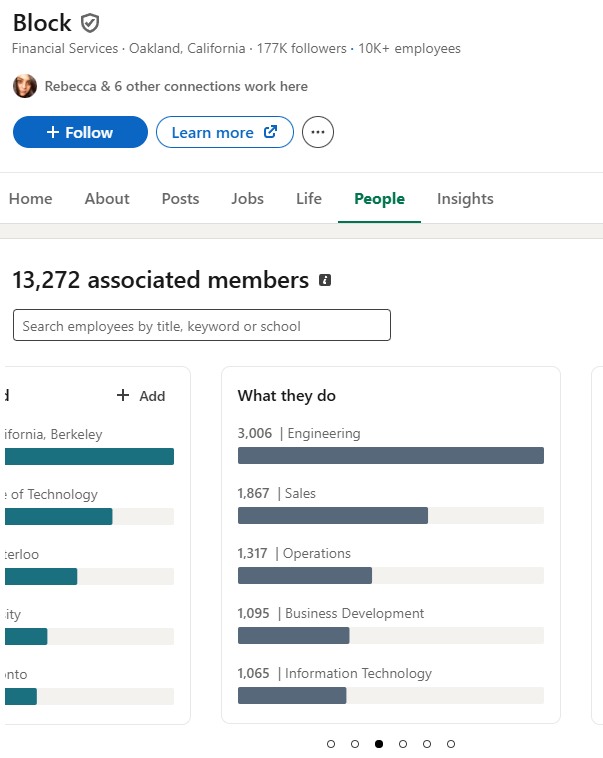
The news broke through various channels, with Dorsey’s direct communication underscoring the magnitude of the proposed changes. Block Inc., which boasts a global workforce exceeding 10,000 individuals, operates in a highly competitive financial services landscape. LinkedIn data indicates a workforce of around 13,000, with a significant concentration in engineering, IT, operations, and sales departments – areas that often intersect with the functionalities that AI is poised to augment or automate.

The assertion that AI will directly replace such a substantial portion of the workforce immediately drew attention from industry insiders and observers. One such individual, with connections at Anthropic, a leading AI research company, highlighted the profound implications of Dorsey’s announcement, emphasizing the growing trend of AI integration and its potential to reshape employment landscapes more broadly. This perspective suggests that Block Inc.’s move is not an isolated incident but potentially a harbinger of wider industry shifts.
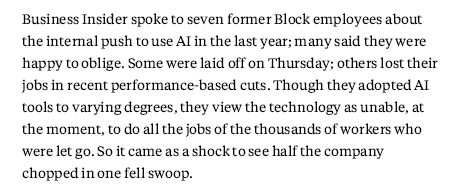
However, initial inquiries into the specifics of Block Inc.’s plan yielded limited clarity. A report by Business Insider, which interviewed seven employees familiar with the company’s internal discussions, revealed a general lack of precise information about how this "business transformation" would unfold. This ambiguity fueled speculation about the underlying motivations and the feasibility of such a drastic replacement of human capital with artificial intelligence.
Examining the "AI Transformation" Narrative
The narrative presented by Block Inc. hinges on the idea that AI can efficiently and effectively assume the responsibilities currently handled by thousands of employees. This aligns with a broader discourse surrounding the capabilities of generative AI and large language models, which have demonstrated remarkable proficiency in tasks ranging from customer service and content creation to complex data analysis and even code generation.

Jack Dorsey’s personal enthusiasm for AI is well-documented. His public pronouncements often highlight the transformative potential of this technology, suggesting a genuine belief in its capacity to drive innovation and efficiency. This personal conviction likely plays a significant role in the strategic direction of Block Inc.
Is AI a Catalyst for Performance Management?
The significant scale of the proposed layoffs has led some to question whether AI is the primary driver or if it serves as a convenient rationale for underlying performance management issues or strategic restructuring. Historically, periods of rapid technological advancement have sometimes been leveraged by companies to streamline operations and address perceived inefficiencies within their existing organizational structures.
The precedent set by Elon Musk’s takeover of Twitter, which saw substantial layoffs amidst a drive to eliminate perceived bureaucracy, offers a potential parallel. In Block Inc.’s case, it is plausible that AI is being presented as a solution to streamline the organizational chart and enhance overall operational efficiency, potentially addressing concerns about the company’s profitability and market position.
Research conducted on organizational redesign in the context of AI integration offers a more nuanced perspective. A comprehensive study involving over 70 companies indicated that a primary focus on AI as a tool for individual productivity enhancement often yielded minimal job reduction. Significant workforce impact, akin to what Block Inc. is proposing, typically necessitates a fundamental re-engineering of business processes and operational models. This re-engineering, detailed in publications like "The Rise of the Superworker" and research on "Dynamic Work Design," suggests a more complex and strategic approach than simply swapping human employees for AI systems.
Financial Performance and Strategic Imperatives
A deeper look at Block Inc.’s financial standing provides further context for the company’s strategic decisions. Comparative analysis with entities like Visa, Mastercard, and Shopify – while operating in distinct but related sectors – reveals that Block Inc. exhibits lower profitability and a less robust gross margin. This financial disparity suggests that the company may be operating at a scale that is less efficient than its competitors, prompting a drive for improved operational performance.
The stock market’s reaction to Block Inc.’s announcement and its broader financial performance has also been a significant factor. Investor sentiment, often driven by profitability and growth projections, can exert considerable pressure on corporate leadership to demonstrate a clear path toward increased efficiency and shareholder value. In this context, the AI-driven workforce reduction could be interpreted as a strategic move to address investor concerns and enhance the company’s financial trajectory.
The Realities of AI Transformation in the Workplace
While the allure of AI-driven efficiency is strong, a thorough examination of its practical implementation reveals several critical considerations that temper the notion of a simple job-replacement scenario.
1. AI Transformation: A Short-Term Strategy?
The immediate impulse to view AI as a means to eliminate jobs may prove to be a short-sighted strategy. The development, implementation, and ongoing management of enterprise-level AI systems require a dedicated and skilled workforce. Building and deploying AI agents and superagents, along with maintaining the necessary infrastructure, necessitates new roles in areas such as AI model development, training, validation, and system oversight. This is particularly true given the non-deterministic nature of AI, where unforeseen behaviors and errors can occur, requiring human intervention for correction and assurance of service reliability, especially in critical applications like financial transactions managed by Cash App.
2. The Significant Cost of AI Implementation
Beyond the initial development, the operational costs associated with AI can be substantial. While AI might appear to offer cost savings, particularly in areas like customer support, the financial equation is complex. Replacing a human customer service agent, for instance, who might earn $35,000 annually, with an AI equivalent, even if it reduces operational costs by 50-60%, still incurs expenses for licensing, compute power, maintenance, and ongoing training. These costs can range from $15,000 to $20,000 per year per AI agent, not including the broader ecosystem management and data governance.
The cost dynamics become even more pronounced in fields like software engineering. While AI can automate many coding tasks, the development and maintenance of these AI coding tools, along with the computational resources they require, can sometimes exceed the cost of employing human engineers. For a team of 100 engineers earning $100,000 each, representing an annual payroll of $10 million, an AI capable of automating 80% of their manual coding tasks might seem like a significant saving. However, the "reasoning tokens" and complex context required for advanced software development mean that AI costs are not simply about "talk time" but about the intricate processing power needed to understand and generate sophisticated code.
Gemini’s analysis, as presented in the source material, highlights the intricate cost breakdowns, suggesting that the capital and operational expenses for AI infrastructure can be substantial, potentially accounting for one-third to one-half or even more of the cost of a human workforce. The underlying infrastructure, including data centers, further contributes to these significant expenditures.
3. The True ROI: Re-engineering Processes, Not Just Displacement
The most impactful transformations driven by AI are not rooted in job displacement but in the fundamental re-engineering of business processes. Companies that achieve substantial gains from AI typically focus on leveraging it to enhance productivity, introduce new services, and improve operational efficiency across the board.
Examples of this strategic approach include Allianz, which uses digital twins to optimize claims processing and knowledge sharing; Travelers, which employs AI to accelerate employee enablement and time-to-market; and HubSpot, which develops AI to expand client services. At a more personal level, AI tools like Galileo are enabling businesses to scale operations exponentially, reaching customer bases that were previously inaccessible through traditional methods.
While Block Inc.’s announcement may involve initial layoffs, the long-term success of its AI strategy will likely depend on its ability to fundamentally re-engineer its business operations around these new technologies. This would involve not only automation but also the creation of new roles and responsibilities to manage and leverage AI effectively. The pursuit of increased "talent density" – maximizing the productivity of each employee – and moving beyond a "hire to grow" model that can dilute individual output is a hallmark of forward-thinking organizations.
Key Takeaways for Businesses and Employees
The Block Inc. announcement serves as a potent reminder for both businesses and employees to approach claims of AI-driven job elimination with a critical eye.
- For Businesses: AI should be viewed not merely as a cost-cutting tool for immediate job reduction but as a strategic imperative for business re-engineering. The true return on investment lies in optimizing processes, creating new value, and fostering innovation. Companies that embrace this holistic approach are more likely to achieve sustainable growth and competitive advantage.
- For Employees: The evolving landscape necessitates adaptability and a focus on developing skills that complement AI capabilities. Understanding how AI can augment human roles, rather than replace them, is crucial. Continuous learning and upskilling, particularly in areas related to AI management, data analysis, and complex problem-solving, will be paramount for career resilience.
The future of work is undoubtedly being shaped by AI, but its impact will be most profound when it is integrated thoughtfully, strategically, and with a clear understanding of both its capabilities and limitations. Whether Block Inc.’s bold move will ultimately result in a true AI-powered transformation or a more conventional performance management exercise remains to be seen, but the conversation it has ignited is critical for navigating the future of employment.