As global demographics shift and digital learning environments expand across borders, the educational landscape is undergoing a fundamental transformation. Historically, instructional design has often operated under the "default learner" myth—the assumption that a single, standardized approach to teaching can effectively serve all students regardless of their background. However, modern educational research and the rise of globalized workforces have propelled Culturally Responsive Teaching (CRT) to the forefront of pedagogical strategy. CRT is defined as a comprehensive approach that utilizes the cultural knowledge, prior experiences, frames of reference, and performance styles of diverse students to make learning encounters more relevant to and effective for them. It is not merely a set of activities but a pedagogical mindset that views cultural identity as an asset rather than a barrier to academic or professional achievement.
The emergence of CRT reflects a growing recognition that learning is a social and cultural process. When learners see their identities reflected in the curriculum and feel that their lived experiences are valued, engagement increases, and cognitive barriers are reduced. For Learning and Development (L&D) professionals and Educational Technology (EdTech) teams, this shift requires a departure from "one-size-fits-all" content toward a more nuanced, inclusive, and adaptive design framework.
The Historical Evolution and Chronology of Culturally Responsive Frameworks
The development of culturally responsive frameworks did not happen in a vacuum; it was the result of decades of research into the intersections of race, culture, and cognition. To understand the current state of CRT, one must look at the chronological progression of its core theories.
In the early 1990s, Dr. Gloria Ladson-Billings introduced the concept of "Culturally Relevant Pedagogy." Her landmark study, published in 1994 in the book The Dreamkeepers, focused on three primary goals: student learning and achievement, cultural competence, and the development of a sociopolitical consciousness. Ladson-Billings argued that for students of color to succeed, the school environment must affirm their cultural identities while providing the tools to critique societal inequities.
By 2000, Dr. Geneva Gay expanded this foundation with her seminal work, Culturally Responsive Teaching: Theory, Research, and Practice. While Ladson-Billings focused on the broader pedagogical theory, Gay provided a more detailed focus on instructional methods. She defined CRT as using the cultural characteristics and experiences of ethnically diverse students as conduits for teaching them more effectively.
The evolution continued in 2012 with Dr. Django Paris and the introduction of "Culturally Sustaining Pedagogy" (CSP). This framework builds upon the work of Gay and Ladson-Billings but goes a step further by arguing that education should not just "respond" to cultural differences but actively "sustain" the linguistic and cultural pluralism of a society. This timeline illustrates a move from simple recognition of diversity toward an active, ongoing commitment to preserving and leveraging it within the learning process.
Statistical Data and the Modern Imperative for CRT
The demand for CRT is supported by significant demographic data and organizational research. In the United States, data from the National Center for Education Statistics (NCES) indicates that while the student population is increasingly diverse—with students of color making up more than 50% of public school enrollment—the teaching workforce remains approximately 80% white. This "cultural gap" can lead to misunderstandings in communication, discipline, and assessment if educators are not trained in culturally responsive techniques.
In the corporate sector, the shift is equally pronounced. A 2020 report by McKinsey & Company, Diversity Wins, found that companies in the top quartile for racial and ethnic diversity are 36% more likely to have financial returns above their respective national industry medians. This economic reality has forced L&D departments to realize that inclusive training is not just a "nice-to-have" but a business necessity. Furthermore, a Deloitte study on inclusive leadership found that when employees feel included and "seen" in their professional development, their team performance increases by 17%, and decision-making quality improves by 20%.
Core Principles for Instructional Design and L&D
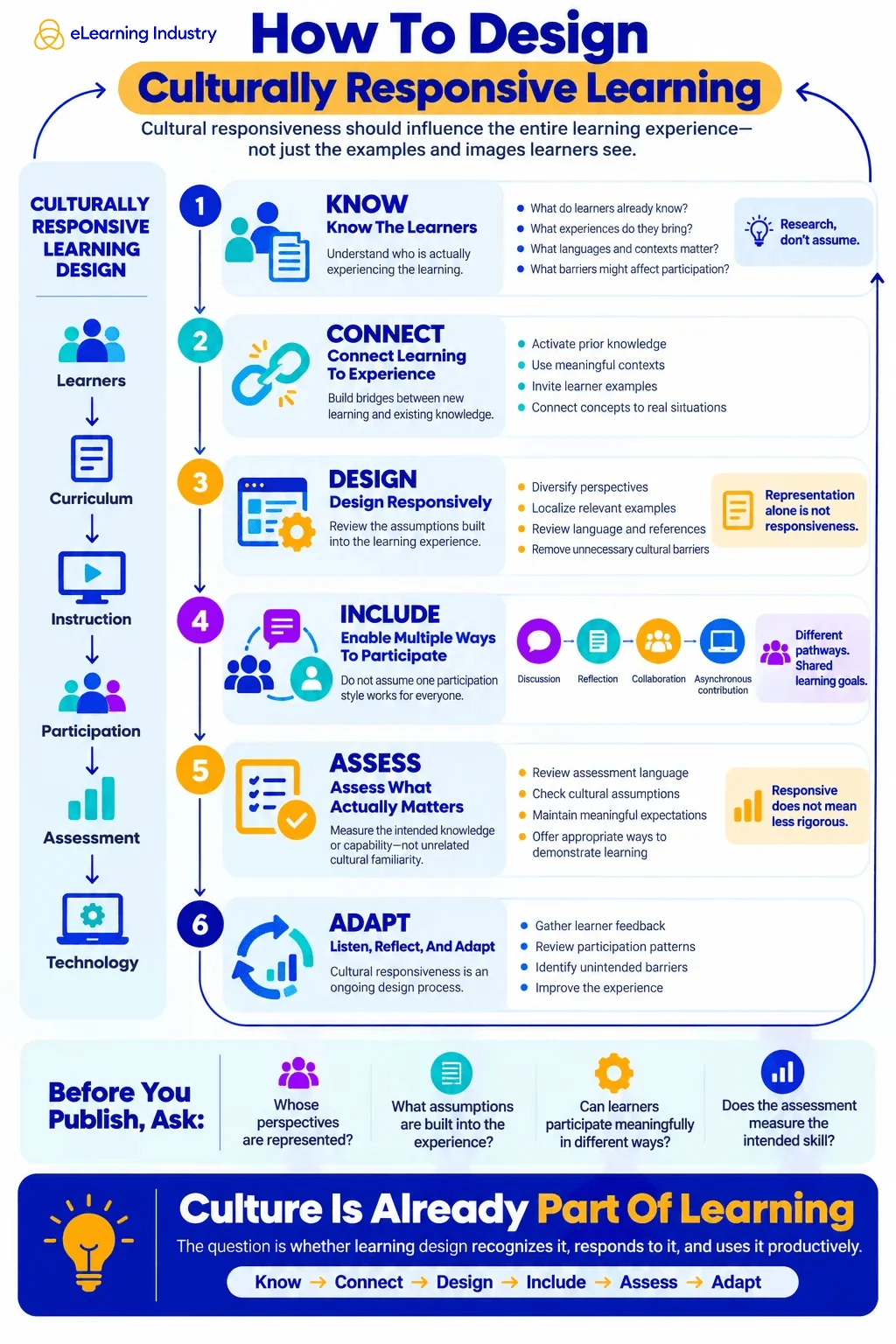
While there is no singular checklist for CRT, educational experts generally agree on several pillars that should guide the design of any learning experience. For instructional designers, these principles can be synthesized into five priority areas:

- Relational Trust: Establishing a connection between the instructor and the learner that acknowledges the learner’s humanity and background.
- Contextual Relevance: Ensuring that the subject matter is tied to real-world applications that the learner recognizes.
- High Expectations with High Support: Maintaining rigorous academic or professional standards while providing the scaffolding necessary for diverse learners to reach them.
- Instructional Adaptability: Moving away from rigid delivery methods to accommodate different ways of processing information.
- Participatory Equity: Designing environments where all learners, regardless of their cultural communication style, have a meaningful way to contribute.
These principles serve as a safeguard against "tokenism"—the practice of making only superficial changes, such as changing the names in a case study or adding diverse stock photos, without altering the underlying instructional approach.
Comprehensive Strategies for Implementation
To transition from theory to practice, educators and designers can employ several specific strategies. These methods ensure that the learning environment is truly responsive:
- Self-Reflective Practice: Educators must first identify their own "cultural lenses" and biases. This includes questioning what they define as "professional" behavior or "correct" communication.
- Asset-Based Thinking: Instead of viewing a learner’s native language or different background as a deficit to be overcome, CRT views these as strengths to be integrated into the lesson.
- Diversified Content and Voices: This involves auditing the curriculum to see whose research is cited, whose stories are told, and which experts are featured in video content.
- Linguistic Mindfulness: In a globalized digital environment, designers must be careful with idioms, metaphors, and jargon that may not translate across cultures. Using "Plain English" or localized translations ensures that cognitive load is spent on learning the material, not deciphering the language.
- Flexible Assessment: Traditional testing often favors those familiar with specific cultural formats. Culturally responsive assessment allows learners to demonstrate mastery through various means, such as portfolios, oral presentations, or collaborative projects.
The Digital Frontier: CRT in EdTech and AI
As education moves into the digital and AI-driven space, the application of CRT faces new challenges and opportunities. Research published in ResearchGate regarding culturally responsive online design highlights that cultural responsiveness does not automatically transfer from the physical classroom to the virtual one; it must be intentionally engineered.
In EdTech, "localization" is a critical component of CRT. This goes beyond mere translation. It involves adapting measurements, workplace scenarios, and even user interface (UI) elements to suit local norms. For example, a leadership course designed for a North American audience might emphasize individual achievement and direct confrontation, whereas a version for a more collectivist culture might need to emphasize consensus-building and "saving face."
Furthermore, as AI begins to personalize learning paths, there is a risk of "algorithmic bias." If an AI system suggests learning materials based on a user’s nationality or ethnicity without a nuanced understanding of their individual goals, it risks reinforcing stereotypes. Culturally responsive EdTech requires that AI models be trained on diverse datasets and that human oversight remains central to the design process.
Broader Impact and Expert Perspectives
The move toward CRT has met with various reactions from the educational community. Proponents, including the National Education Association (NEA), argue that cultural competence is a core requirement for 21st-century educators. They contend that CRT is the key to closing the "achievement gap" (often reframed as the "opportunity gap") by making education accessible to those who have been historically marginalized.
Critics occasionally express concern that CRT might compromise academic rigor or focus too much on social issues at the expense of core subjects. However, experts like Geneva Gay have countered this by emphasizing that CRT is specifically designed to improve academic performance by removing the cultural disconnect that often leads to student disengagement. The goal is to make the material more challenging and accessible simultaneously.
In the corporate world, the implication of CRT is a more agile and innovative workforce. When employees from diverse backgrounds are trained in a way that respects their perspectives, they are more likely to contribute the "divergent thinking" that drives innovation.
Conclusion: A Continuous Process of Improvement
Culturally Responsive Teaching is not a destination but a continuous process of evolution. As new cultural nuances emerge and technology provides new ways to connect, the strategies for being "responsive" will continue to change. For L&D leaders and instructional designers, the path forward involves a commitment to ongoing feedback, rigorous self-reflection, and a willingness to dismantle the "default learner" model in favor of a more inclusive, effective, and human-centric approach to education. By treating culture as a catalyst for learning rather than an obstacle, the educational community can create environments where every learner, regardless of their origin, has the opportunity to excel.