The pervasive discourse surrounding artificial intelligence in hiring often settles on a simplistic binary: a candidate was either passed or rejected by the AI. This superficial understanding, however, bypasses the crucial intricacies of AI bias audits, the very tools designed to ensure fairness and equity in algorithmic recruitment. The true value of an audit lies not in its headline-grabbing outcome, but in its rigorous examination of a defined system, a specific candidate population, a fixed time window, and a named metric. A favorable result validates conclusions about that particular test, not a sweeping generalization about all roles or future AI deployments. This approach to assessing hiring tools has deep roots, predating the advent of AI by decades, with the Uniform Guidelines on Employee Selection Procedures, established in 1978, providing the legal and methodological bedrock. The four-fifths rule, a cornerstone of these guidelines, continues to form the backbone of how these critical audits are scored today.
Understanding the Nuances: Bias Isn’t Monolithic
A fundamental misunderstanding of AI hiring bias stems from treating all disparities as identical problems. Effective audits, however, recognize that bias manifests in distinct ways, each requiring a specific diagnostic approach. Failing to differentiate these types leads to flawed assessments and a misinterpretation of audit results.
- Historical or Representation Bias: This type of bias emerges when certain career paths are underrepresented in the training data used for AI models. For instance, if historical hiring data predominantly features men in leadership roles, an AI trained on this data might inadvertently perpetuate this imbalance. Detecting this requires comparing subgroup representation within the applicant pool against their ultimate outcomes, assessing if certain groups are consistently overlooked despite comparable qualifications.
- Proxy-Variable Bias: This occurs when seemingly neutral data points, such as ZIP codes, educational institutions, or employment gaps, indirectly correlate with protected characteristics like race or gender. An AI might learn to penalize candidates from certain ZIP codes due to historical segregation, or disadvantage those with resume gaps that disproportionately affect caregivers, who are often women. Audits address this through proxy analysis, identifying these indirect correlations, and employing counterfactual pairs to isolate the impact of these proxy variables.
- Aggregation Bias: This insidious form of bias arises when overall performance metrics mask significant disparities at the subgroup level. An AI might achieve a satisfactory average success rate across all candidates, yet exhibit substantial underperformance for specific racial or gender groups. To combat this, audits demand disaggregated reporting, presenting results for each subgroup separately rather than relying on blended, aggregate figures.
- Interaction or Automation Bias: This bias is rooted in human behavior rather than the AI itself, occurring when users exhibit over-reliance on an AI system’s output without critical evaluation. Recruiters might blindly accept an AI’s recommendation, even if it’s flawed, leading to biased outcomes. Auditing this involves scrutinizing override rates – instances where human reviewers deviate from the AI’s recommendation – and analyzing advancement patterns to identify instances where AI suggestions are consistently followed, potentially amplifying existing biases.
Crucially, a testing methodology designed to detect one type of bias will not reliably identify another. This inherent complexity is why a single, simplistic metric rarely encapsulates the full picture of an AI system’s fairness.
The Four-Fifths Rule: The Mathematical Backbone of Bias Audits
The four-fifths rule, a quantitative measure established decades ago, remains a foundational element in evaluating potential adverse impact in hiring. Its arithmetic is straightforward: the selection rate for any protected group must be at least 80% of the selection rate for the group with the highest selection rate.
The "selection rate" refers to the proportion of candidates from a particular group who advance to the next stage of the hiring process. For example, if 50% of male applicants are invited for an interview, and only 30% of female applicants receive the same opportunity, the women’s selection rate is 60% of the men’s (30% / 50% = 0.60 or 60%). This 60% falls below the 80% threshold, triggering an alert for potential adverse impact and necessitating a closer examination.
It is vital to understand that the four-fifths rule does not explain why a disparity exists; it merely flags that a gap of this magnitude warrants further investigation. It serves as an early warning system, indicating that a hiring process may be unintentionally disadvantaging certain groups. Companies like Eightfold.ai, for instance, conduct audits that apply this rule across various protected categories, offering detailed methodologies and underlying data rather than isolated statistics. This transparency is crucial for building trust and allowing for independent verification.
Counterfactual Pairs: Isolating Algorithmic Influence
While the four-fifths rule identifies the presence of a disparity, it doesn’t definitively prove that the AI algorithm caused it. The observed gap could, in part, be a reflection of the applicant pool’s composition during a specific recruitment cycle. To isolate the algorithm’s direct influence, a second, distinct testing methodology is required: counterfactual pairs.
This technique involves taking a candidate’s profile and creating an identical duplicate, with the sole alteration being a signal that maps to a protected characteristic. For example, a resume might be modified to change a name commonly associated with a particular gender or ethnicity, while all qualifications and experience remain precisely the same. Both versions are then processed by the AI. If the AI’s evaluation or score changes significantly between the two identical profiles, it provides strong evidence that the algorithm itself is introducing bias, independent of the applicant pool’s demographics.
A robust audit doesn’t perform this test as a one-off check. Instead, it systematically applies counterfactual pairs across a diverse range of roles, seniority levels, and demographic signals. The aggregate results of these repeated comparisons offer a more comprehensive understanding of the algorithm’s behavior. This process moves beyond metaphorical discussions of "opening a black box" to a concrete, repeatable procedure that yields quantifiable outcomes. Audits that omit this crucial step provide only half of the answer, leaving the question of algorithmic culpability unresolved.
The Critical Role of Sample Size in Statistical Validity
The integrity of any AI bias audit is profoundly influenced by sample size. Small numbers can distort results, not due to malicious intent, but because they lack statistical power. If only a handful of candidates from a specific demographic group apply for a role, the outcome for even one individual can dramatically skew the group’s overall advancement rate. A change of 15 or 20 percentage points might appear statistically significant, but on such a thin sample, it is often meaningless and incapable of supporting any reliable conclusion.
Rigorous audits establish minimum sample thresholds. If a demographic group’s applicant numbers fall below this threshold, the audit will decline to publish a specific advancement rate for that group. While this might appear evasive to those unfamiliar with statistical principles, it is, in fact, a demonstration of integrity. Presenting a confident-looking statistic derived from insufficient data is less honest than acknowledging the limitations of the available information. Publishing numbers only when the sample size can genuinely support a claim, and clearly stating when it cannot, represents a more challenging but ultimately more trustworthy discipline.

Independent Audits: Beyond the Label to Practical Implementation
The phrase "independently audited" is frequently used, sometimes loosely, and its true meaning warrants precise definition. Genuine independence in an AI bias audit hinges on three critical conditions:
- No Contingent Fees: The auditor’s compensation must not be tied to achieving a favorable result. This prevents any incentive for the auditor to overlook or downplay biases to satisfy the vendor.
- Auditor-Designed Methodology: The auditor should develop its own testing methodology, rather than working from a pre-written script provided by the AI vendor. This ensures an objective and comprehensive approach.
- Certified Auditors: The auditing entity itself should be certified by a recognized body that rigorously reviews auditors, not just their final reports. This third condition is often the most overlooked and the most difficult for external parties to verify unless the vendor explicitly names the auditor and their credentials.
Furthermore, testing a model used for resume matching and then applying those results to a different tool, such as one used for live interview analysis, is an unacceptable shortcut. These are functionally different tools making distinct decisions, and the findings from one cannot be substituted for the other. A truly independent audit requires tailored testing for each specific application of AI within the hiring process.
Transforming Claims into Evidence: A Seven-Step Process
For claims of AI fairness to be credible, they must be backed by reproducible evidence. This transformation occurs when every conclusion drawn from an audit can be traced back to a clear, documented process. A robust audit typically involves the following key steps:
- Define the Scope: Clearly delineate the specific AI system, the candidate population, the time period, and the precise metrics being evaluated.
- Select Appropriate Tests: Employ a suite of tests designed to detect various types of bias, including the four-fifths rule and counterfactual pair analysis.
- Establish Minimum Sample Sizes: Set statistically sound thresholds to ensure the reliability of reported findings for each subgroup.
- Conduct Testing: Execute the chosen tests systematically and thoroughly.
- Analyze Results: Interpret the data generated by the tests, identifying any statistically significant disparities.
- Report Findings Transparently: Present detailed results, including methodology, data, and any identified adverse impacts, avoiding reliance on aggregated, blended metrics.
- Document Remediation: Outline any steps taken to address identified biases and commit to re-auditing.
A clear description of how a system is designed to work is not a substitute for actual outcome testing. Similarly, a table of results devoid of methodology offers a claim of fairness, not evidence of it.
Purpose-Built Models vs. General LLMs: A Comparative Analysis of Fairness
The distinction between purpose-built AI models for hiring and general-purpose Large Language Models (LLMs) is critical when evaluating fairness. LLMs, while powerful for language generation and understanding, are often trained on vast, uncurated datasets designed for broad fluency, not necessarily for the nuanced requirements of equitable hiring.
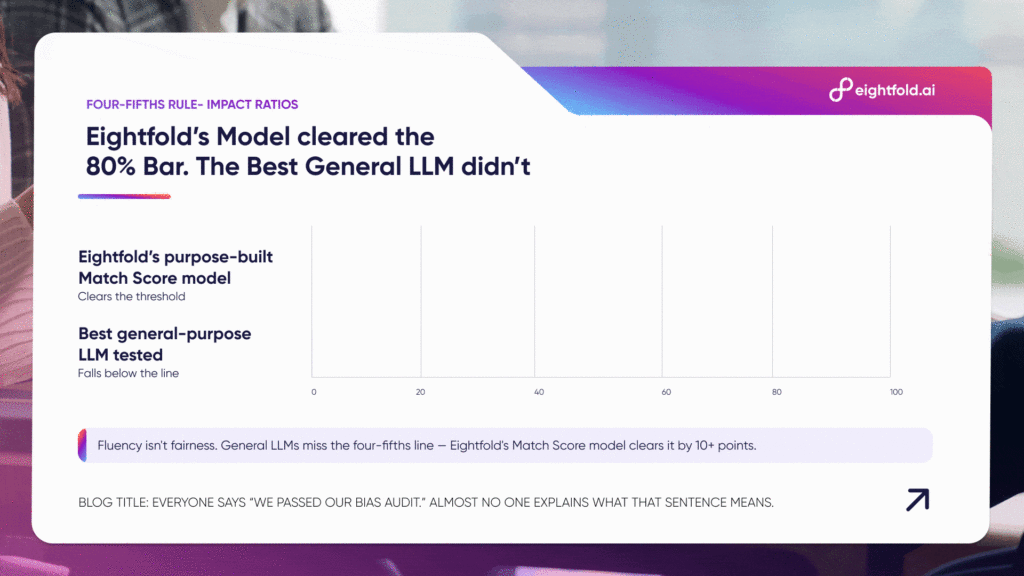
Internal research conducted by Eightfold.ai, for instance, highlights this divergence. Their purpose-built matching model achieved an intersectional impact ratio of 0.906, significantly outperforming a leading general-purpose LLM, which registered 0.773. This suggests that LLMs, when applied to hiring without specific fine-tuning and rigorous bias mitigation, are structurally prone to under-scoring candidates in ways that can perpetuate inequality, rather than as isolated, occasional errors. It is important to distinguish between internal research comparisons and formal, third-party published bias audits, as each provides different levels of assurance.
A Passing Result: A Snapshot in Time, Not a Permanent Certification
The outcome of an AI bias audit is a point-in-time assessment, a snapshot of the system’s performance under specific conditions. It is not a permanent certification of fairness. An AI model trained on historical data may behave differently when encountering a significantly altered candidate pool. Even if the underlying code remains unchanged, the practical performance of the system can shift.
This dynamic reality underscores the necessity of regular re-auditing. Regulatory frameworks, such as New York City’s Local Law 144, mandate annual audits for AI used in hiring. An audit without a defined re-test date is akin to a photograph: it captures a moment accurately but offers no insight into subsequent changes. Continuous monitoring and periodic re-evaluation are essential to ensure ongoing fairness.
Accountability in Practice: Defining Roles in the Audit Ecosystem
Publishing audit results does not absolve individual stakeholders of their responsibilities. A credible governance model clearly delineates accountability:
- Independent Auditor: Owns the testing process and the documented findings. They cannot have their fees contingent on a favorable outcome.
- Talent and Product Leaders: Own the workflow context and the specific version of the AI system being tested. They cannot influence or approve their own results.
- Legal and Compliance Teams: Own the review of disclosures and the assessment of regulatory exposure. They cannot alter the underlying findings of the audit.
- Executives: Own the funding for remediation efforts and overall oversight. They cannot condition fees on the achievement of favorable outcomes.
Ultimately, human decision-makers remain accountable for all material hiring decisions. A favorable audit result serves as evidence supporting those judgments, not as a replacement for them.
Unanswered Questions: Navigating Vendor Evaluations Beyond the Audit
Understanding the mechanics of a rigorous AI bias audit empowers organizations to critically evaluate published findings. However, it doesn’t fully equip them to handle vendors who have not published such audits. The crucial questions that distinguish genuine transparency from deflection, and the red flags to watch for before signing a contract, require a separate, yet equally important, checklist. This vendor evaluation process, distinct from the audit methodology itself, is a critical next step in ensuring responsible AI adoption. It requires a proactive approach to interrogating vendors about their bias mitigation strategies, data governance, and ongoing commitment to fairness, even before a formal audit is commissioned.