
The discourse surrounding Artificial Intelligence in hiring often gets truncated at a simple verdict: a candidate was passed or didn’t pass. This binary outcome, however, represents the least informative aspect of any AI-driven hiring process. A comprehensive audit, far from being a mere "pass/fail" stamp, delves into the intricate workings of a specific system, analyzes a defined candidate population within a fixed temporal frame, and evaluates performance against named metrics. A positive result, therefore, speaks volumes about the tested scenario, not about the universal applicability of the AI across all roles or future deployments. This rigorous approach to evaluating selection procedures has roots stretching back decades, predating the algorithmic era. The Uniform Guidelines on Employee Selection Procedures, established in 1978, laid the groundwork for such empirical testing in employment law. Its cornerstone, the four-fifths rule, remains a foundational element in scoring these critical audits today.
The Nuance of Bias: Understanding Differentiated Challenges
It is a critical misconception to treat all disparities in hiring outcomes as a monolithic problem. Effective audits recognize that different types of bias manifest in distinct ways, requiring tailored diagnostic tools. The failure to differentiate can lead to misdiagnosis and ineffective remediation.
| Bias Type | Manifestation | Diagnostic Test |
|---|---|---|
| Historical / Representation | Underrepresentation of certain career paths within the training data. | Comparative subgroup coverage against outcomes. |
| Proxy-Variable | Indirect correlation of protected traits through seemingly neutral data points like ZIP codes, educational institutions, or employment gaps. | Proxy analysis coupled with counterfactual pair testing. |
| Aggregation | Masking of significant subgroup-level disparities within an overall average. | Reporting disaggregated results, not blended averages. |
| Interaction / Automation | Over-reliance on AI output without critical human review or validation. | Review of override rates and subsequent advancement patterns. |
A testing methodology designed to detect one form of bias may prove entirely ineffective against another. This inherent complexity underscores why a single, aggregated statistic rarely encapsulates the full story of fairness within an AI hiring system.
The Four-Fifths Rule: The Arithmetic of Adverse Impact
The four-fifths rule, a straightforward arithmetical principle, serves as a primary indicator of potential adverse impact. It involves calculating the advancement rate – termed the "selection rate" by regulatory bodies – for each demographic group at a specific hiring stage. This rate is then compared against the group with the highest selection rate. If any group’s rate falls below 80% of this top rate, the disparity is flagged for further scrutiny.
For instance, if 50% of male applicants advance to the interview stage, but only 30% of female applicants do, the women’s selection rate is 60% of the men’s (30/50 = 0.60). This falls significantly below the 80% threshold, triggering a requirement for a deeper investigation into the contributing factors. Crucially, this rule does not ascertain the reason for the gap; it merely identifies that a statistically significant disparity exists and warrants attention. Companies like Eightfold.ai, for example, utilize this comparison as a cornerstone of their bias audit process, openly publishing their methodology and data to provide transparency beyond superficial numbers.
Beyond the Four-Fifths: Counterfactual Pairs for Algorithmic Attribution
While the four-fifths rule effectively flags the existence of disparities, it cannot definitively attribute the cause to the algorithm itself versus inherent characteristics of the applicant pool. To isolate the AI’s influence, a second, distinct testing methodology is required: counterfactual pairs.
This method involves taking a single candidate’s profile, duplicating it, and then altering only a single data point that is demonstrably linked to a protected characteristic. For example, a name commonly associated with a specific gender or ethnicity might be changed, while all qualifications and experience remain identical. When both versions of the profile are processed by the AI system, any divergence in the evaluation outcome, despite identical qualifications, points directly to the algorithm’s independent impact on the decision.
A robust audit does not perform this test in isolation. Instead, it is replicated across numerous roles, seniority levels, and demographic signals. The aggregate results of these repeated counterfactual analyses provide a more definitive understanding of the algorithm’s inherent biases, independent of applicant pool fluctuations. This rigorous, repeatable procedure, rather than a metaphorical "opening of a black box," yields quantifiable evidence. Audits that omit this crucial step only address half of the fairness equation.
The Significance of Sample Size in Statistical Validity
The reliability of any bias audit hinges critically on the sample size of the data analyzed. Small sample sizes can structurally distort results, not due to intentional bias, but due to statistical anomalies. For instance, if only a handful of candidates from a particular demographic group apply for a role, the outcome of a single individual can dramatically skew the group’s overall advancement rate, creating an appearance of significant disparity where none might truly exist. A statistically sound audit establishes minimum sample size thresholds, refusing to publish rates for groups that fall below these benchmarks, thereby preventing misleading conclusions.

While withholding a statistic based on insufficient data might appear evasive to those unfamiliar with the statistical underpinnings, it is, in fact, a practice rooted in intellectual honesty. Publishing a seemingly precise statistic derived from a minuscule dataset is less truthful than presenting no statistic at all; it is a veneer of accuracy over conjecture. The discipline of reporting findings only when statistically supported, and clearly articulating when data is insufficient, is a more challenging but ultimately more credible approach.
Independence: From Paper Declarations to Practical Enforcement
The term "independently audited" is frequently used, sometimes loosely. True independence in an audit process necessitates the fulfillment of three core conditions. Firstly, the auditor must not be compensated based on the favorability of the audit’s outcome; their fees should be fixed, irrespective of the results. Secondly, the auditor must be empowered to design its own testing methodology, rather than adhering to a pre-scripted framework provided by the vendor being audited. This ensures an objective and critical evaluation. Thirdly, and often overlooked, the auditing entity itself must be certified by an independent body that rigorously vets auditors, not just their reports. This external credentialing provides a crucial layer of assurance regarding the auditor’s competence and integrity. The third condition is the most susceptible to being sidestepped and the hardest to verify externally unless the vendor clearly identifies the auditor and their credentials. Furthermore, it highlights why testing a resume-matching model and then extrapolating those findings to a live conversational interview product would be a flawed shortcut, as these tools perform fundamentally different functions and their bias profiles are not interchangeable.
From Claims to Evidence: The Seven Pillars of Reproducible Fairness
Transforming a claim of fairness into verifiable evidence requires a traceable record for every conclusion drawn. This process can be distilled into seven essential steps:
- Clear Definition of the System Under Test: Precisely identifying the AI tool or algorithm being evaluated, including its specific version and deployment context.
- Defined Scope of Audit: Clearly outlining the candidate population, the time period covered, and the specific hiring stages being analyzed.
- Selection of Appropriate Metrics: Choosing quantitative measures that accurately reflect fairness and adverse impact, aligned with regulatory guidelines and ethical considerations.
- Development of a Rigorous Methodology: Employing established statistical techniques, such as the four-fifths rule and counterfactual pair analysis, to assess potential biases.
- Execution of Tests: Systematically applying the defined methodology to the relevant data, ensuring data integrity and accuracy throughout.
- Documentation of Findings: Presenting all results, including statistical data, methodologies, and limitations, in a clear, comprehensive, and accessible manner.
- Independent Review and Verification: Engaging a credentialed, unbiased third-party auditor to validate the methodology, execution, and findings.
Functionally distinct AI tools necessitate their own dedicated audits. A detailed description of a system’s intended design, while informative, cannot substitute for empirical testing of its actual outcomes. Similarly, a table of results devoid of underlying methodology represents an assertion of fairness, not proof of it.
Purpose-Built AI vs. General LLMs: A Tale of Two Audit Outcomes
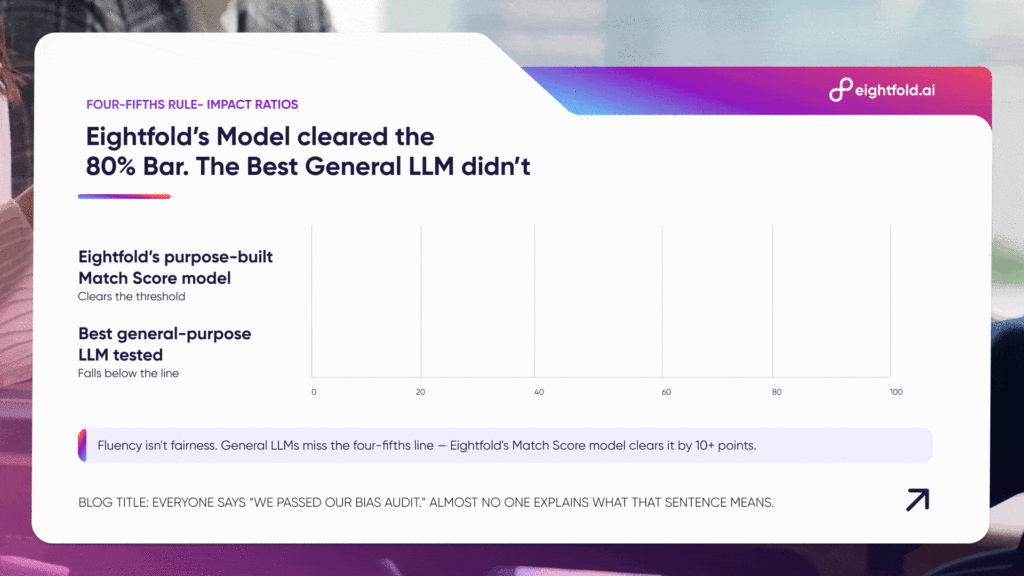
When evaluating AI for hiring, it’s crucial to differentiate between purpose-built models designed for specific recruitment tasks and general-purpose Large Language Models (LLMs). Their performance on bias audits can vary significantly. Internal research conducted by Eightfold.ai, for instance, revealed that while the most effective general-purpose LLM tested achieved an intersectional impact ratio of 0.773, their own purpose-built matching model achieved a ratio of 0.906. This suggests that LLMs, often optimized for fluency and conversational ability rather than verified hiring outcomes, may exhibit structural biases that manifest consistently, rather than sporadically. It is imperative to distinguish between internal research findings and official third-party bias audits when assessing such figures.
A Passing Grade: A Snapshot in Time, Not a Permanent Certification
The outcome of an AI bias audit is not a static certification but a snapshot of performance at a particular moment. A model trained on historical data, when applied to a contemporary and potentially altered applicant pool, effectively becomes a different system in practice, even if the underlying code remains unchanged. This dynamic reality is precisely why regulatory frameworks, such as New York City’s Local Law 144, mandate annual re-audits, rather than a one-time assessment at the system’s launch. An audit without a scheduled re-evaluation date is akin to a photograph: accurate for the moment it was captured, but offering no insight into subsequent developments.
Accountability Post-Audit: Defining Roles in Fairness
The publication of audit results does not equitably distribute accountability. A robust governance model clearly delineates responsibilities:
| Role | Responsibility | Prohibited Actions |
|---|---|---|
| Independent Auditor | Testing, documented findings, adherence to methodology. | Accepting fees contingent on favorable results; influencing findings. |
| Talent & Product Leaders | Workflow context, version of system tested. | Shaping or approving their own audit results. |
| Legal & Compliance | Disclosure review, assessment of regulatory exposure. | Altering underlying audit findings. |
| Executives | Funding remediation, oversight of AI systems. | Conditioning fees on favorable audit outcomes. |
Ultimately, human decision-makers remain accountable for all material hiring decisions. A favorable audit result serves as supporting evidence for that judgment, not a substitute for it.
Unanswered Questions: Navigating the Path Forward
Understanding the architecture of a rigorous AI bias audit empowers stakeholders to critically evaluate published results. However, it does not fully equip them to navigate interactions with vendors who have not yet published such audits. Identifying probing questions that distinguish genuine accountability from evasive deflection, and recognizing red flags during vendor evaluations before a contract is signed, constitute a separate, albeit crucial, checklist. This vendor evaluation framework, distinct from the audit methodology itself, will be the focus of future discussions.