
The U.S. Equal Employment Opportunity Commission (EEOC) concluded its 2025 fiscal year on September 30, marking one of the most volatile and statistically unusual periods in the agency’s 60-year history. Despite entering the year with a robust budget and a significant backlog of workplace discrimination charges, the Commission filed only 93 merit lawsuits over the twelve-month period. This figure represents a ten-year low in litigation activity and stands as one of the lowest filing totals in the last three decades. The year was defined by a dramatic shift in administrative leadership, unprecedented personnel actions at the highest levels of the agency, and a fundamental pivot in enforcement priorities following the inauguration of the Trump administration in January 2025.
A Comparative Analysis of Litigation Volume
To understand the significance of the 93 filings in FY 2025, one must look at the historical context of the agency’s activity. During the Obama administration, it was not uncommon for the EEOC to file upwards of 300 merit lawsuits annually. While those numbers dipped during the first Trump administration and the subsequent COVID-19 pandemic—averaging around 100 to 110 filings between FY 2020 and FY 2022—the Biden administration attempted a significant ramp-up. In FY 2023, bolstered by a Democratic majority and a new General Counsel, the EEOC filed 144 lawsuits, signaling what many expected to be a new era of aggressive enforcement.
However, that momentum stalled. After a surprisingly quiet FY 2024, which saw 96 filings, the FY 2025 total of 93 confirms a sustained downward trend in the volume of new litigation. Legal analysts point out that the current volume is nearly a third of what was seen a decade ago, suggesting that the agency is either becoming more selective in the cases it pursues or is being hampered by internal structural changes.
Chronology of Leadership Upheaval and the Quorum Crisis
The trajectory of FY 2025 was irrevocably altered in January 2025. Following the presidential transition, the executive branch moved with unprecedented speed to reshape the Commission’s leadership. President Trump elevated Andrea Lucas to Acting Chair and terminated the sitting General Counsel, Karla Gilbride. While the removal of a General Counsel is not without precedent—President Biden took similar action against a Trump appointee in 2021—the subsequent actions regarding the Commissioners were historic.
In an action that tested the constitutional limits of presidential power over independent agencies, the administration fired Commissioners Charlotte Burrows and Jocelyn Samuels, both of whom had years remaining on their Senate-confirmed terms. This move left the EEOC without a quorum, as only Acting Chair Lucas and Commissioner Kalpana Kotagal remained. Under the agency’s bylaws, the loss of a quorum significantly restricts the Commission’s ability to authorize new litigation, particularly in "systemic" cases involving large-scale patterns of discrimination or those that involve major expenditures of agency resources.
The lack of a quorum created a legal bottleneck. While the General Counsel has certain delegated authorities to file routine cases, the absence of a full Commission prevents the agency from taking positions that deviate from established precedent or pursuing cases likely to generate significant public controversy. This structural paralysis is a primary factor behind the record-low filing numbers seen in the latter half of the fiscal year.
Monthly Filing Trends: A Tale of Two Administrations
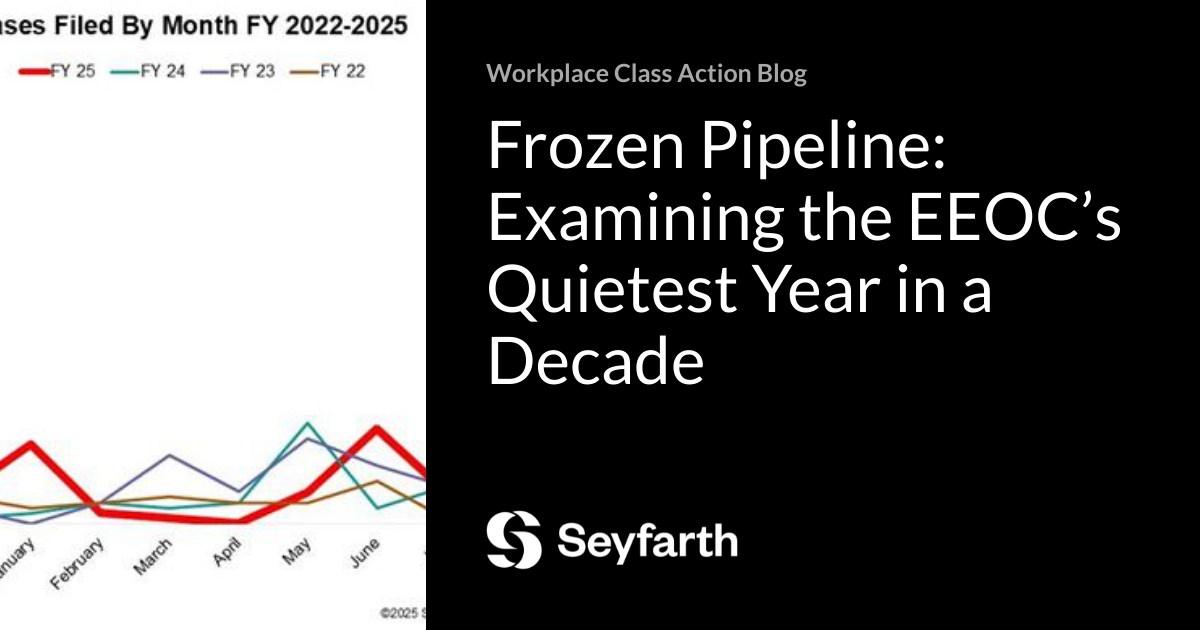
The timing of the FY 2025 filings reflects the political transition. The fiscal year began in October 2024 with a flurry of activity as the outgoing administration sought to solidify its enforcement legacy. In the first four months of the fiscal year, the Commission filed 24 lawsuits. January 2025 alone saw 15 filings, a spike attributed to enforcement personnel acting before the change in leadership.

After the transition, filing activity fluctuated. June 2025 saw a five-year high for that month with 18 lawsuits, suggesting the new leadership had begun to clear a path for its specific priorities. However, the traditional "September Surge"—the period when the EEOC typically rushes to file cases before the fiscal year ends—was notably muted. In September 2025, the EEOC filed 35 lawsuits. While this was the busiest month of the year, it paled in comparison to the 71 filings recorded in September 2023 or the 56 recorded in September 2024.
Geographic Hotspots and Quiet Districts
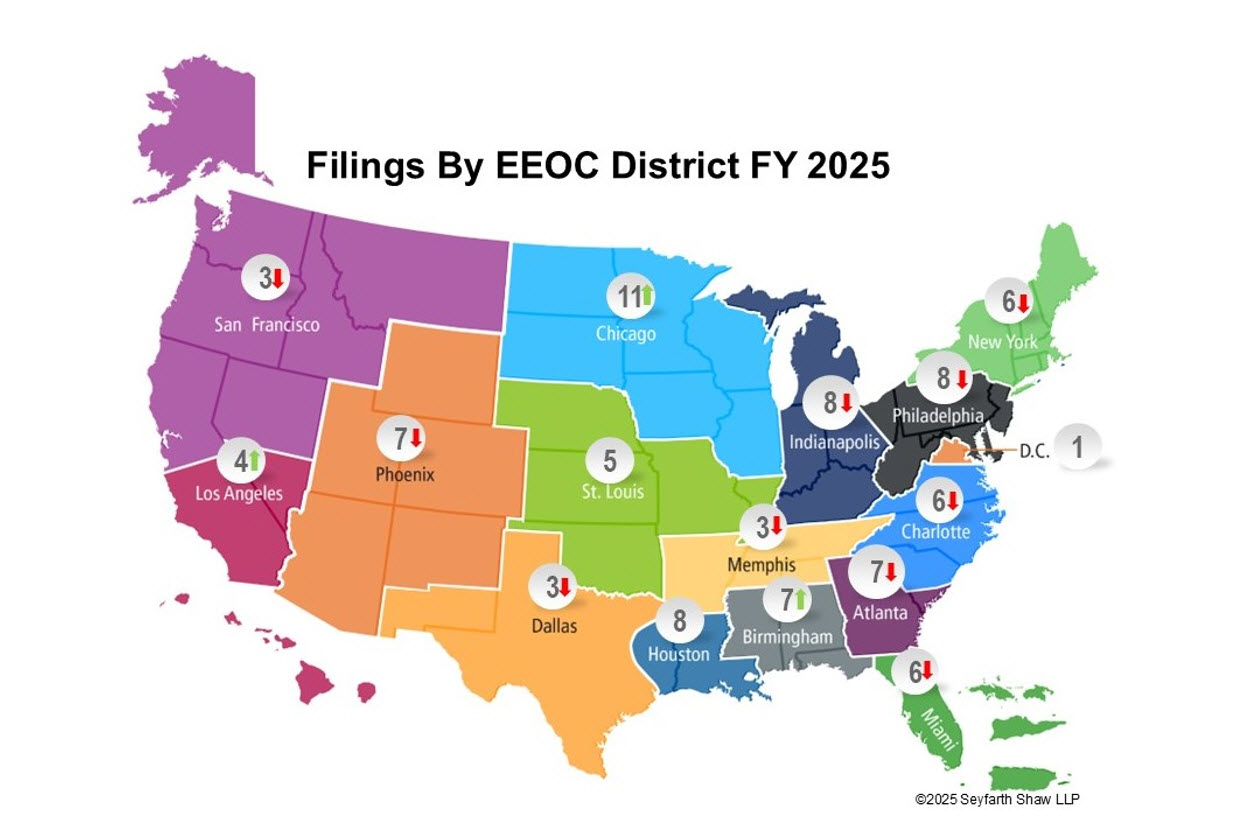
An analysis of the EEOC’s 15 District Offices reveals a stark geographic divide in enforcement activity. The Chicago District Office emerged as the national leader in FY 2025, filing 11 merit lawsuits. Other active regions included Philadelphia, Indianapolis, and Houston, each contributing 8 filings. These offices have consistently remained the most litigious branches of the agency over the past several years.
In contrast, West Coast offices that were once engines of EEOC litigation have fallen silent. The Los Angeles, New York, and San Francisco offices filed only 4, 6, and 3 lawsuits, respectively. This decline is a sharp departure from the Obama era, when West Coast districts frequently filed dozens of cases annually. Analysts suggest this shift may reflect different regional management styles or a redirection of resources toward the Midwest and South.
Shifting Priorities: From LGBTQ Rights to Religious Freedom
Perhaps the most significant enrichment of the FY 2025 data lies in the types of claims being pursued. While the Americans with Disabilities Act (ADA) and Title VII remain the primary vehicles for EEOC litigation, the specific focus within those statutes has pivoted.

The Rise of Religious Accommodation
One of the most notable trends is the resurgence of religious discrimination claims. In August 2025, the EEOC issued a public statement touting its commitment to protecting religious freedom. This followed a massive 600% increase in religion-based charges filed during the COVID-19 pandemic, largely related to vaccine mandates. In FY 2025, the Commission filed 11 lawsuits asserting religious discrimination or failure to accommodate religious beliefs, a significant increase from previous years. Acting Chair Andrea Lucas characterized this as a return to "evenhanded enforcement," arguing that religious protections had previously "taken a backseat to woke policies."
The Focus on "Biological Truth"
The transition also brought a swift reversal in the agency’s stance on LGBTQ+ issues. In early 2025, following an executive order regarding gender ideology, the EEOC moved to dismiss two pending lawsuits involving transgender workers that had been filed during the Biden administration. Acting Chair Lucas issued a memorandum stating that "sex is binary and immutable," signaling that the agency would no longer pursue harassment claims based on the use of non-preferred pronouns. Instead, the Commission shifted its sex-discrimination focus toward pregnancy-related violations, filing 10 lawsuits under the Pregnancy Discrimination Act and the Pregnant Workers’ Fairness Act (PWFA).
Disability and Mental Health
Despite the overall decline in filings, the ADA remained a top priority with 34 lawsuits. A key sub-trend within this category is the focus on "invisible" disabilities. The EEOC increasingly targeted employers for failing to accommodate mental health conditions such as PTSD, anxiety, and depression, as well as vision and hearing impairments.
Race and "Anti-American Bias"
Race-based filings reached a decade low, with only three lawsuits filed in FY 2025. Notably, two of these cases were grounded in theories of "reverse discrimination" or "anti-American bias." These lawsuits alleged that employers gave preferential treatment to non-American or non-Black workers, reflecting the new leadership’s vow to protect American citizens from what they term "discriminatory globalist hiring practices."
Implications for the Private Sector and Employers
The record-low litigation numbers of FY 2025 should not be interpreted by employers as a signal to relax compliance efforts. Rather, the data suggests a more targeted and ideologically driven enforcement strategy.
First, the "follow-the-leader" phenomenon remains a significant risk. Even when the EEOC pulls back from certain types of litigation—such as LGBTQ+ claims—the private plaintiffs’ bar often steps in to fill the void, using previous EEOC investigations as a roadmap. Second, the Commission’s willingness to sue smaller, regional businesses and local government entities in FY 2025 indicates that no employer is "too small" to be targeted if the case aligns with the agency’s new priorities.
Furthermore, the healthcare industry remained a primary target for EEOC activity this year. Hospitals and clinics faced a disproportionate number of ADA and religious accommodation suits, likely a lingering effect of pandemic-era policy disputes.
Conclusion
Fiscal Year 2025 was a year of profound transition for the EEOC. The agency moved from a period of high-volume, broad-spectrum enforcement under the Biden administration to a leaner, more ideologically focused posture under the Trump administration. While the 93 filings represent a historical low, the structural changes—specifically the loss of a quorum and the firing of senior leadership—suggest that the agency is currently in a state of recalibration. As the administration seeks to confirm new Commissioners and a permanent General Counsel in the coming months, the legal community expects a gradual increase in activity, albeit focused on a vastly different set of workplace issues. For now, the "sluggish" pace of FY 2025 stands as a testament to the powerful impact of executive shifts on independent federal agencies.








