
Organizations are increasingly investing in leadership development programs with the explicit expectation that these initiatives will cultivate leaders who think more innovatively, act with greater intentionality, and contribute more meaningfully to organizational success. This shift signifies a growing demand for demonstrable impact, where the investment in development must yield tangible returns. While evaluation is crucial in supporting these goals, its effectiveness hinges on a deliberate and well-conceived design.
The most impactful leadership development evaluations transcend the simplistic pursuit of measuring every possible outcome or reducing complex change to a single metric. Instead, they are strategically crafted to provide the precise evidence needed to answer the critical questions faced by decision-makers. This nuanced approach acknowledges that leadership development is not a monolithic process with a uniform outcome. Its effects are deeply personal, highly contextual, and intrinsically social. Some changes manifest rapidly, while others emerge organically as leaders apply new learnings in real-world scenarios. Therefore, impact is best understood as a dynamic pattern of evidence that unfolds across individuals, their relationships, and the broader systems within which they operate.
Consider a compelling illustration of this principle in action: a statewide initiative in Vermont aimed at enhancing leadership within its school districts. Principals participated in a comprehensive leadership development program. Initial indicators of success were promising, revealing increased psychological well-being among participants and a notable strengthening of peer collaboration. Teachers also observed positive transformations in their principals’ leadership styles. Over time, this program contributed to a significant reduction in principal turnover across the state, a phenomenon that translated into an estimated $1.4 million in cost savings. This case exemplifies how a program designed to foster individual leadership growth ultimately catalyzed measurable, system-level change.
The inherent tension between the escalating pressure to demonstrate impact and evaluation methodologies that oversimplify the multifaceted outcomes of leadership development can be a significant challenge for organizations. A more expansive understanding of "evidence" can help alleviate this pressure. While quantitative data is invaluable for identifying trends, particularly at scale, it captures only a fraction of the story. Many of the most profound and meaningful changes in leadership involve fundamental shifts in how individuals think, make decisions, and engage with others.
Drawing on decades of experience in evaluating the impact of leadership development, a more holistic perspective views evaluation not as a singular method or outcome, but as a series of intentional choices about what evidence will be most pertinent and useful at any given juncture. This perspective underpins core evaluation practices and provides a robust framework for understanding impact, while simultaneously allowing organizations the flexibility to expand and deepen their evidence collection as their questions evolve.
Understanding the Gradual Emergence of Leadership Development Impact
The impact of leadership development is rarely a singular, instantaneous event. Instead, it unfolds as a complex pattern of evidence, differing in its manifestation from one leader to another and evolving over time. The developmental journey is shaped by a leader’s unique identity, the specific roles they inhabit, and the situational contexts they encounter as they explore and integrate new ways of thinking and leading.
Consequently, the same developmental experience can catalyze vastly different forms of growth. One leader might gain profound clarity on strategic priorities, while another develops heightened self-awareness regarding their responses under pressure. A third may find themselves more confident and prepared to engage in challenging conversations or make difficult decisions they previously avoided. These variations underscore how leadership development resonates with each leader’s individual journey and current developmental stage.
Timing is another critical factor. Certain effects, such as immediate insights or renewed motivation, can be observed quickly. Others emerge later, as leaders actively test new ideas in practice and encounter reinforcement or resistance from their organizational environment. Especially in the nascent stages, many outcomes function as catalysts, setting a positive direction and building momentum, even if the full scope of change is not yet visibly consistent. When viewed through this lens, the impact of leadership development takes shape over time, influenced by context and lived experience. Effective evaluation, therefore, helps organizations discern what is beginning to shift and anticipate where these shifts may lead.
A Framework for Understanding Leadership Development Impact
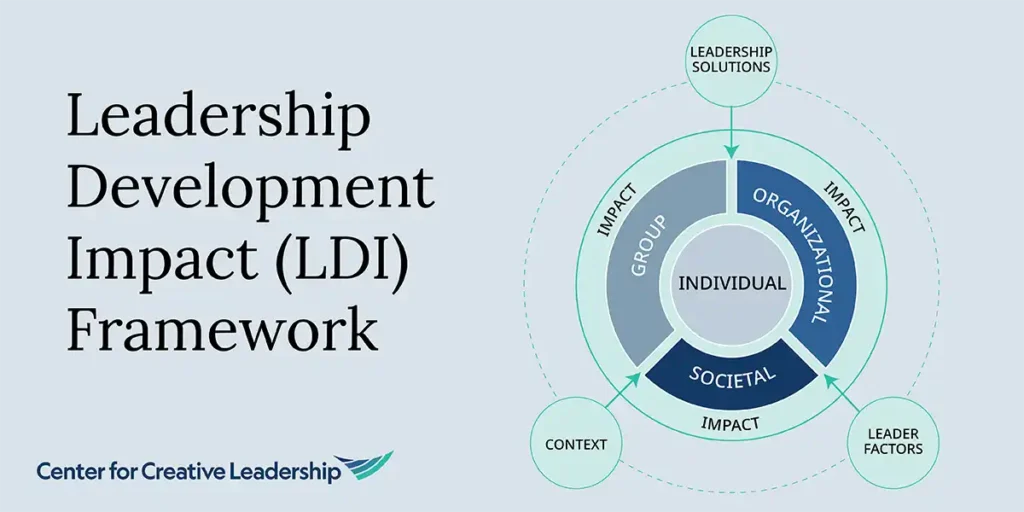
Measuring the impact of leadership development necessitates a deep understanding of what constitutes impact itself – not just its definition, but also the enabling and undermining factors. A comprehensive approach, such as the Leadership Development Impact (LDI) framework, begins by identifying the foundational conditions that foster a successful program.
Research on learning motivation and support consistently demonstrates that learning is not solely a product of curriculum design but is equally dependent on the engagement of individuals and the surrounding environment. A leader who actively seeks development will likely experience a program differently than one who is distracted or disengaged. The latter, even if possessing a desire to learn, may not be adequately supported by their organization to fully leverage the developmental opportunity, potentially leading to missed benefits for both the individual and the organization.
Facilitating a successful leadership development experience extends beyond merely equipping leaders with new skills. These experiences possess the potential to influence a range of interconnected areas:
- Individual leaders: Enhanced self-awareness, improved decision-making capabilities, and greater confidence.
- Teams: Stronger collaboration, more effective communication, and increased psychological safety.
- Organizations: Improved performance, enhanced innovation, and a more resilient culture.
These areas of impact are not mutually exclusive; development at any level can cascade to other levels and vice versa. Leadership is inherently a social process, enacted through interpersonal interactions. The LDI framework reinforces a fundamental principle: leadership development is rarely the sole determinant of outcomes. Instead, it often acts as a critical inflection point, influencing how leaders interpret experiences, make choices, and engage with others within a larger organizational ecosystem. For instance, a leader who acquires more effective feedback techniques may foster greater trust and psychological safety within their team. Similarly, a team that adopts enhanced boundary-spanning practices can improve inter-team collaborations and collective success. Crucially, leadership development and its resulting impact do not occur in isolation.
From Internal Shifts to Tangible External Impact
While impact may not follow a single, linear path, it often reflects a progression from internal clarity to outward application over time.
Leadership Development: The Initial Spark of Identity and Confidence
A common early outcome of leadership development is a recalibration of how leaders perceive themselves and their roles. Participants frequently report heightened self-awareness, including a clearer understanding of their strengths, typical tendencies, and their influence on others. Many also re-evaluate their internal standards for effective leadership, refining their focus and their methods of self-assessment. These internal shifts profoundly shape how leaders interpret situations and make future decisions. Even when these changes remain largely internalized initially, they often translate into meaningful actions and behaviors.
For example, a modest increase in confidence can empower a leader to pursue an innovative idea previously deemed too risky to share. Another leader might feel more empowered to voice their opinions in meetings where they previously remained silent. A third might feel prepared to apply for a senior leadership role they would have previously overlooked. Each scenario represents a distinct outcome and impact, stemming from a transformed self-perception.
Adapting Tools and Skills: A Personalized Integration
These internal transformations do not operate in a vacuum; they directly influence how leaders interpret and apply the tools and frameworks acquired through their development programs. In the early stages, leaders often experiment with these new resources, utilizing them selectively based on their specific roles, immediate challenges, and contextual nuances. Over time, leaders integrate what proves most effective into their unique leadership style. This individualized process means that skill development appears uneven and personalized, reflecting opportunities and readiness rather than a rigid, sequential mastery.
Leadership’s Relational Nature: Development Through Connection
As these newly integrated tools become part of a leader’s personal approach, their impact becomes evident in their interactions with others. Teams may experience improvements in communication clarity, increased openness, or strengthened collaboration as leaders implement their refined approaches. In many instances, these relational effects become noticeable even as individual leaders continue to refine their personal practices. Given that leadership inherently involves influence and followership, these shifts offer valuable insights into how development is shaping the broader environment within which leaders operate.
Organizational Impact: Accumulation Through Shared Experience
As these relational shifts compound, they extend beyond individual interactions to shape organizational functioning. This is particularly true when leadership development initiatives are implemented across multiple cohorts or over extended periods. Leaders begin to develop a shared lexicon and set of expectations, their approaches become more aligned, and connections across different teams and departments strengthen as common challenges and priorities emerge. These outcomes develop through accumulation rather than immediate, drastic change, becoming more apparent as leaders collectively navigate new situations.
A Foundation for Measuring Leadership Development Impact
Understanding the trajectory of impact is the initial step. The subsequent crucial question is how to measure it effectively and where to begin the measurement process. A core set of evidence consistently supports a meaningful understanding of impact.
At the Center for Creative Leadership (CCL), our standard evaluation methodology is designed to identify early indicators of impact, revealing what leaders are gaining from their experiences and how they are beginning to apply their learnings. This approach centers participant experiences as a valid and essential form of evidence, as leaders themselves are best positioned to articulate shifts in their thinking, identify the most relevant takeaways, and articulate their future intentions.

Our standard evaluations focus on:
- Participant reflections: Capturing leaders’ immediate thoughts on what resonated, what felt most applicable, and their initial intentions for application.
- Reported behavioral shifts: Gathering information on the specific actions leaders have taken or intend to take upon returning to their roles.
- Perceived relevance and applicability: Assessing how leaders perceive the value and usefulness of the program content in their day-to-day work.
- Confidence and intent: Measuring changes in leaders’ self-assurance and their stated commitment to applying new skills and approaches.
This evidence enables organizations to understand which program components were most impactful and for whom, and where leaders are likely to focus their efforts upon returning to their work environments. Because it is grounded in participant experiences and voices, it also captures early signals that might otherwise be missed, such as how leaders are reframing challenges, their beliefs about what will drive the most significant difference, and the support they anticipate needing. This approach supports continuous learning and improvement, strengthens communication with stakeholders, and provides a clear view of emerging trends and areas where additional support might be beneficial.
Building Leadership Development Evaluation to Match Organizational Needs
Standard evaluation evidence provides a solid foundation for comprehending this early impact. From this starting point, organizations can expand their approach to explore additional questions related to application, sustainability, and broader influence by intentionally collecting evidence aligned with their specific goals.
The Undervalued Power of Qualitative Data
Quantitative data excels at facilitating comparison and identifying patterns, but qualitative insight provides crucial meaning, explanation, and context. Participant voice is not merely anecdotal; it often serves as the most direct evidence of internal shifts—changes in mindset, confidence, judgment, and intent—that precede and shape observable behaviors. When used in conjunction, quantitative and qualitative evidence offer a more comprehensive understanding than either could provide in isolation.
While our standard leadership development evaluations incorporate a blend of data types, more in-depth qualitative data, gathered through interviews, focus groups, or other analytical methods, adds unparalleled depth. When collected systematically, employing consistent questions and rigorous analysis across participants, qualitative evidence enhances validity by illustrating not just whether change is occurring, but how leaders are making sense of it and translating it into action.
The Test of Time: What Truly Sticks
Follow-up assessments conducted after a leadership development experience offer a clearer perspective on how learning is integrated into practice. These follow-ups reveal what leaders are attempting, the challenges they encounter, and how their application varies across different contexts. This insight helps organizations understand what is proving effective and where ongoing support is most needed.
Immediately following a program, metrics related to receptiveness to content, initial reactions, and stated intentions are key indicators of later uptake. After two months, leaders are likely to have begun experimenting with new ideas and skills. Within three to six months, simpler skills, mindset shifts, and behavioral changes typically begin to manifest. It is important to recognize that different outcomes have varying rates of change; a mindset shift might occur almost instantaneously, whereas a fundamental organizational culture shift can take years to materialize.
Multiple Perspectives: Enriching Interpretation
In certain situations, organizations benefit from incorporating perspectives beyond those of the direct participant. Input from managers, peers, or other individuals who work closely with leaders can shed light on how developmental changes are being experienced and interpreted within the broader organizational environment.
Evidence derived from multiple perspectives adds richness to interpretation and can bolster confidence in emerging trends. This is particularly valuable when organizations aim to understand how leadership development is manifesting in day-to-day interactions, without necessarily requiring experimental designs or the need to definitively prove that the program alone caused the observed change.
Identifying Patterns Across Cohorts and Levels
When leadership development initiatives are implemented across multiple cohorts or as part of a more extensive developmental journey, it becomes possible to look beyond individual experiences and identify broader patterns. Shared language, priorities, and approaches to leadership may begin to take hold across teams or groups, indicating a more widespread adoption of new leadership principles.
This type of evidence is especially useful for leadership strategies designed to shift organizational norms, strengthen interpersonal relationships, or foster more collective forms of leadership, where impact is expected to build through accumulation rather than immediate, dramatic change.
Relationships as a Measurable Outcome
Evaluation efforts can also focus on the development of relationships and collaboration within intact cohorts or working groups. Examining how leaders connect, coordinate, and work across boundaries within these groups can illuminate how leadership development influences shared work and collective capacity. These approaches are most effectively applied to smaller groups and with intentional design, where the cultivation of relationships is a central objective of the development effort.
Organizational Data: Providing Context and Scope
When aligned with existing internal data, the evaluation of leadership development programs can also leverage broader organizational indicators such as employee engagement, inclusion metrics, or internal mobility patterns. When used thoughtfully, these indicators help contextualize leadership development within the larger organizational landscape. At this level, evidence supports interpretation rather than direct attribution, offering insights into how leadership development may be contributing more broadly to organizational goals.
It is important to note that these elements are not necessarily sequential upgrades; they can be combined and tailored based on the specific questions an organization seeks to answer and its capacity for evidence collection. This allows for the creation of an evaluation approach that is both purposeful and proportionate to the organization’s needs.
An effective leadership development evaluation provides a structured view of selected outcomes at a specific point in time. The insights it yields depend on the questions being asked, the timing of evidence collection, and the perspectives included. When designed and interpreted with care, evaluation supports learning, sensemaking, and informed decision-making regarding how to reinforce progress and identify areas where deeper insight may be beneficial.
Nine Questions to Guide Leadership Development Evaluation Design
Before embarking on the design of an evaluation, it is beneficial to pause and consider what outcomes are expected. Assumptions, such as the belief that impact will be uniform across all participants or that quantitative data inherently carries more weight than qualitative insights, can unduly influence these expectations. Clarifying these assumptions makes it easier to define the evidence that is truly necessary. At its core, evaluation is a design choice, and the most effective approaches begin with a clear understanding of what one intends to learn and the rationale behind it.
- What decision will this evidence inform? Different decisions require varying levels and types of evidence. The information used to support learning and program improvement may differ significantly from what is needed to justify larger-scale investments or program expansion.
- What level of evidence is considered "enough"? Begin by explicitly defining what constitutes credible evidence. In many leadership development contexts, participant self-reporting is a legitimate and necessary form of evidence, particularly for shifts in awareness, confidence, priorities, and intent that are not directly observable. Subsequently, determine whether additional perspectives (from peers, managers, or direct reports) would provide valuable context or triangulation for the decision at hand. How much certainty is required, and what investment is reasonable to achieve it?
- Which outcomes are most important, and at what level? Are the primary interests focused on individual growth, team dynamics, organizational patterns, or broader system-level influence? Clarity in this area helps align the evidence collection with what is most critical to the organization.
- What time horizon aligns with the impact you care about? Some outcomes emerge rapidly, while others require more time to materialize. The further one moves from the delivery of the program, the more challenging it becomes to gather data without structured follow-up mechanisms. Long-term insights are achievable but typically necessitate more intentional design and investment.
- How will you balance depth and breadth? Every evaluation involves trade-offs: one can explore many questions about a few outcomes, or fewer questions across a broader range of outcomes. These design considerations shape the conclusions that can be reasonably drawn.
- What types of evidence will provide the clearest understanding? Avoid confusing qualitative data with anecdotal information. Dismissing rich descriptions of significant shifts or transformative experiences in favor of uncontextualized numbers is often a mistake, as numbers are not inherently more credible and can obscure or miss key insights.
- Is there an alternative explanation for the observed pattern? It is not uncommon for leaders to rate themselves lower after a program, not because their capabilities have declined, but because their understanding of effective leadership has expanded. Without proper context, this can be misinterpreted. Thoughtful interpretation considers what such rating movements may truly reflect.
- Are you attempting to understand impact or prove the program’s direct causation? Many stakeholders implicitly expect evaluations to demonstrate not only that change occurred but that the program was the direct cause. Causal research demands substantial resources, and the most effective methods for establishing causality can sometimes undermine best practices for facilitating quality development.
- What is reasonable to ask of participants and stakeholders? Leaders are often pressed for time. Longer surveys, repeated follow-ups, and multi-perspective data collection methods increase the burden. Effective evaluation balances the pursuit of insight with respect for participants’ time and attention.
Leveraging Leadership Development Evaluation for Better Decisions
Leadership development does not produce uniform results, and evaluation should not be about forcing such uniformity. The objective is to understand impact in a way that is genuinely useful, highlighting early indicators of success, directing attention to areas where leaders may need reinforcement, and surfacing patterns that inform future investment and design decisions.
Participant voice is central to this sensemaking process. Leaders’ accounts of what has changed and why often provide the clearest explanations for patterns observed in quantitative data. When approached in this manner, evaluation serves both accountability and learning objectives.
Organizations forfeit significant value when evaluation is reduced to a single checkpoint at the conclusion of an experience. The emphasis should be on the quality of interpretation and utilization of data, rather than simply the volume of data collected. When approached as an ongoing capability, grounded in the fundamental principles of how leadership develops, evaluation becomes a powerful tool for strengthening leadership development initiatives. It supports clearer judgment, more confident investment decisions, and continued growth for both leaders and their organizations as they evolve.
Organizations that cultivate the strongest leaders consistently treat evaluation as an integral capability. Exploring how a robust approach to measuring impact and evaluating leadership development can empower your organization to achieve similar success is a vital next step.








