The distinction between accuracy and fairness in artificial intelligence, particularly within the critical domain of talent acquisition, is a nuanced but crucial one. While a model might exhibit impressive overall accuracy, its performance can vary significantly across different demographic subgroups. This disparity can manifest as a situation where a system correctly identifies qualified candidates for one gender at a rate of 92%, but only 78% for another. While these figures might average out to an acceptable overall metric, they represent a tangible and potentially harmful inequity in real-world application. This underscores the fundamental challenge: achieving statistical parity does not automatically equate to equitable outcomes.
Recognizing this critical difference, the Talent Intelligence Platform has been architected around a core principle that transcends mere performance metrics. Fairness is not an add-on feature; it is an integral, structural component of the platform, embedded from the earliest stages of development. This commitment means that fairness is continuously evaluated at every stage of the model lifecycle, benchmarked against every preceding version, and rigorously measured across multiple dimensions before any model is deployed to a customer. This proactive and embedded approach is designed to address potential biases at their root, rather than attempting to correct them after they have been encoded into the system.
This article delves into the framework that underpins this approach, explaining why specific fairness metrics hold greater significance for AI systems deployed in hiring contexts, and exploring the implications of this dedicated focus on equitable AI.
The Architecture of Fairness: How the Talent Intelligence Platform Operates
To fully grasp the significance of fairness within the Talent Intelligence Platform, it is essential to understand its operational mechanics. The platform does not generate an isolated score for an individual candidate. Instead, it produces a candidate-position match score. This score quantifies the degree to which a specific candidate aligns with the requirements of a particular role, as defined by the hiring organization. This means that the same candidate will receive different scores for different positions, and conversely, a single position will yield varied scores for different candidates.
This fundamental distinction profoundly shapes how fairness is assessed. The operative question shifts from "Does the model disproportionately favor Group A over Group B?" to a more precise inquiry: "For a given position, does the model identify qualified candidates from Group A and Group B with equivalent reliability?" This reframing is pivotal in identifying and mitigating potential biases that might otherwise go unnoticed.
Furthermore, explainability is a foundational design principle. The algorithms are selected, in part, for their capacity to elucidate the rationale behind their scoring. This transparency empowers recruiters and hiring managers to understand precisely why a candidate achieved a particular ranking. This is not merely a usability enhancement; it serves as a practical mechanism for scrutinizing model behavior. This inherent transparency is a key factor enabling the Talent Intelligence Platform to meet rigorous standards such as FedRAMP Moderate and ISO 42001 certification, benchmarks that general-purpose AI tools often cannot attain. In scenarios requiring an audit of hiring decisions, the underlying reasoning is readily accessible. This level of transparency is a core design element, not an afterthought.
The integration of responsible AI principles is a continuous endeavor. Ashutosh Garg, CEO and Co-Founder of Eightfold, has emphasized the company’s dedication to this mission, articulating the strategic importance of building AI systems that are not only powerful but also equitable. This commitment is further evidenced by Eightfold’s ongoing research into advanced methods for embedding anti-bias and fairness objectives directly into the foundational algorithms that models optimize against. The aspiration is to evolve AI systems to actively combat bias during their development, rather than simply detecting it after the fact.
Embedding Fairness During Model Training: A Proactive Approach
The commitment to fairness begins long before a model undergoes evaluation; it is intrinsically woven into the fabric of the training process itself. To prevent data leakage, which could compromise the integrity of subsequent evaluations, training data is meticulously divided into distinct train and test sets. This ensures that the model is assessed on data it has not previously encountered during its learning phase.
A critical intervention point is the incorporation of early stopping mechanisms, triggered by classification performance across protected categories. If, during the training phase, a model begins to exhibit divergent performance across demographic subgroups – meaning it performs substantially better for one group than for another – the training process is immediately halted. This preemptive measure prevents the entrenchment of biased patterns before they become deeply embedded within the model’s architecture. This represents a direct intervention during the training stage, not a post-hoc correction.
The objective is to ensure that every candidate receives an evaluation of consistent quality, irrespective of when they apply, the size of the candidate pool, or their demographic group affiliation. Each candidate should receive the equivalent of a rigorous, standardized evaluation, with an unwavering benchmark. Early stopping is one of the key mechanisms that enforce this standard at the model level, ensuring a level playing field throughout the development process.
Eightfold’s ongoing research actively explores novel techniques for integrating anti-bias and fairness objectives directly into the loss functions that models optimize against. As the field of AI ethics matures, the ultimate goal is for AI models to proactively optimize against bias, rather than merely detecting its presence after training is complete. This forward-thinking research aims to establish a new paradigm in AI development, where fairness is not just a compliance metric but an intrinsic aspect of algorithmic design.
Differentiating Fairness: Group vs. Individual Metrics
Post-training evaluation employs two complementary frameworks for quantifying fairness: group fairness metrics and individual fairness metrics.
Group fairness metrics scrutinize whether the model yields consistent outcomes across demographic groups defined by protected characteristics such as gender, race, or age. If a model exhibits meaningfully different performance levels for candidates belonging to different groups, this constitutes a fairness concern, regardless of individual-level consistency. This broad-stroke analysis is essential for identifying systemic biases that might affect entire populations.
Individual fairness metrics, conversely, examine whether two similar candidates receive comparable scores, based on a predetermined similarity threshold. This approach is designed to detect instances where overall group-level statistics appear acceptable, yet individual-level disparities persist. For example, a model might assign different ratings to two equally qualified candidates based on subtle variations in résumé formatting that correlate with demographic characteristics. This fine-grained analysis ensures that even seemingly minor differences do not lead to inequitable outcomes for individuals.
Both frameworks are indispensable. Group fairness can inadvertently mask problems at the individual level, while individual fairness might overlook systemic patterns affecting larger populations. A comprehensive understanding of a model’s fairness requires the integration of both perspectives.
Understanding Parity-Based and Confusion Matrix-Based Metrics
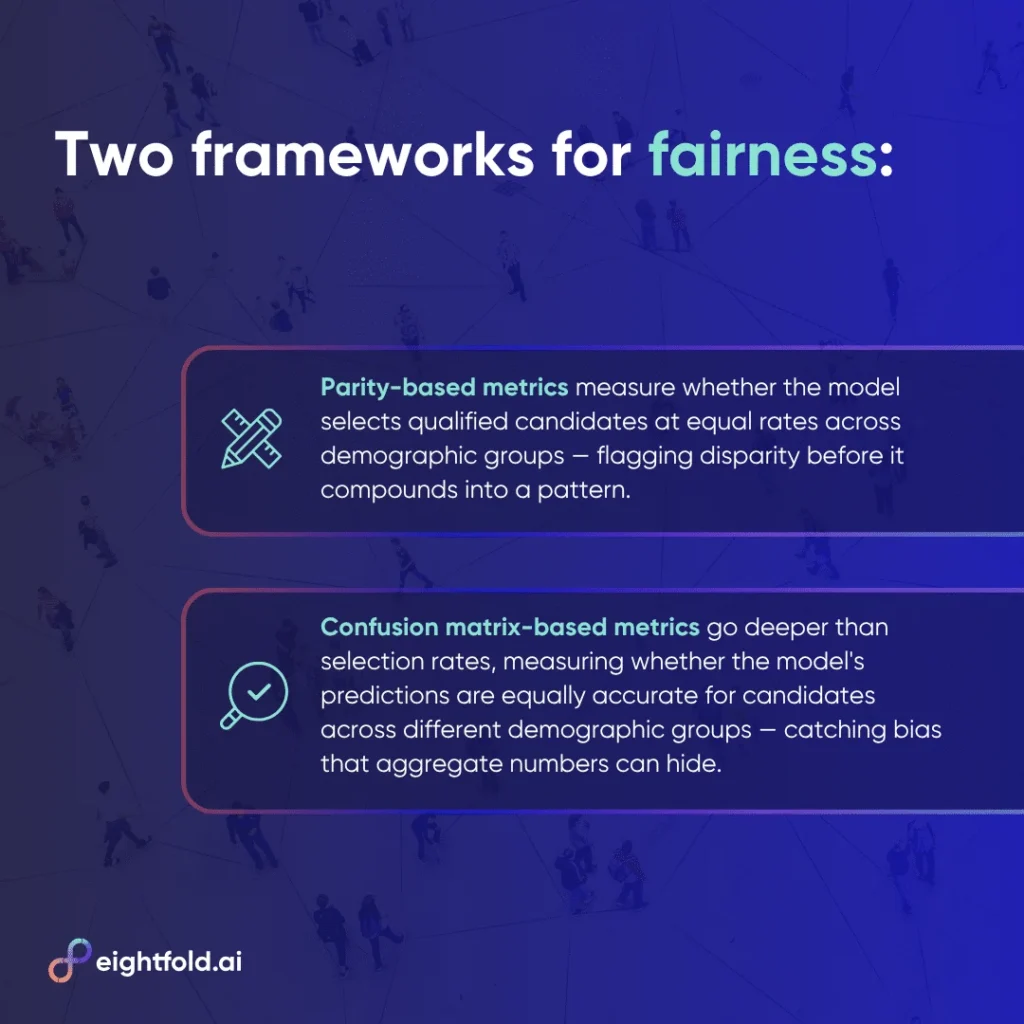
Within the realm of group fairness, a primary category of metrics focuses on predicted positive rates. These metrics assess the rate at which the model assigns a positive outcome (e.g., a high match score indicating suitability) to candidates across different groups.
Parity-based metrics, such as demographic parity and equalized odds, are valuable screening tools due to their straightforward calculation and interpretability. Demographic parity, for instance, requires that the selection rate is the same across all groups. Equalized odds, a more stringent metric, mandates that the true positive rate and the false positive rate are equal across groups. Their primary limitation, however, is that equal selection rates do not always translate to equal model quality across groups. This is where confusion matrix-based metrics become crucial.
Confusion matrix-based metrics delve deeper, examining the accuracy of the model’s predictions for different groups, rather than solely focusing on the rates of positive classification. These metrics, including predictive parity, sufficiency, and accuracy equality, analyze the components of a confusion matrix – true positives, true negatives, false positives, and false negatives – to provide a more granular assessment of model performance. Predictive parity, for example, requires that the precision (the proportion of positive predictions that are actually correct) is the same across groups. Sufficiency aims for equal recall (the proportion of actual positives that are correctly identified) across groups. Accuracy equality seeks to ensure that the overall accuracy of the model is consistent across demographic segments. By dissecting the performance at this level, these metrics offer a more robust understanding of where biases might be present.
Evaluation in Practice: A Continuous and Granular Process
These metrics are not calculated once at the initial launch of a model. Instead, every new iteration of a model undergoes a comprehensive battery of evaluations. The results are rigorously benchmarked against the performance of the previous version. A model that demonstrates improvements in accuracy metrics but shows a regression in fairness metrics will not be approved for deployment.
Furthermore, metrics are evaluated across multiple dimensions. This includes segmentation by job title clusters, by language, and by other relevant contextual factors. A model that performs fairly on average but exhibits disparities in specific contexts – such as certain industries, languages, or types of roles – will fail the evaluation, even if aggregate numbers appear satisfactory. Compliance is not a one-time hurdle; it is a standard that must be maintained at every level of specificity. This granular approach ensures that fairness is not an abstract concept but a practical reality across diverse applications of the AI system.
This dedication to continuous, multi-dimensional evaluation is a testament to the principle that fairness is not an add-on feature but the very foundation upon which the Talent Intelligence Platform is built.
Limitations of Evaluation: The Need for Ongoing Vigilance
Even a model that successfully passes rigorous pre-release evaluation operates within a dynamic and ever-changing environment. Production data may diverge from the data used for training, usage patterns can evolve, and candidate populations can shift in ways that a static model cannot fully anticipate. This inherent variability underscores the importance of ongoing monitoring and adaptation.
Consequently, thorough model evaluation, while essential, represents only one component of a comprehensive responsible AI strategy. The work that continues after a model is launched – including ongoing monitoring, robust governance structures, and mechanisms for detecting and correcting data drift – is where the commitment to fairness is either sustained or quietly abandoned. The proactive identification and mitigation of bias requires a continuous feedback loop and an adaptive approach to AI deployment.
Eightfold encourages organizations to delve deeper into the principles of responsible AI. A whitepaper on bias audit results is available for download, offering further insights into the methodologies and outcomes of their fairness-focused approach. This commitment to transparency and continuous improvement is vital in building trust and ensuring that AI systems in talent acquisition serve to enhance equity, not perpetuate inequality.