
This week, Gloat, a recognized leader in skills intelligence and talent marketplace solutions, has made a significant and strategic entry into the burgeoning field of AI Agents for Human Resources. This move signals a new wave of competition within the core HR technology sector, as companies increasingly leverage artificial intelligence to transform workforce management. Gloat’s new offering, dubbed Gloat Agentic HR, provides a robust toolset designed to harness existing business rules and security protocols from leading HR systems like Oracle, Workday, and SuccessFactors. The platform aims to empower organizations to rapidly develop and deploy AI Agents across widely used communication and collaboration tools, including Microsoft Copilot, Teams, and Slack, as well as other emerging AI applications.
The Evolving Architecture of AI Agents in HR
Understanding Gloat’s strategic positioning requires a look at the foundational architecture of AI agents within the enterprise. This landscape can be broadly categorized into five distinct layers:
-
Systems of Record (Layer 1): At the base of this architecture lie the core enterprise systems that store, manage, and update an organization’s critical data. These include Human Capital Management (HCM) applications such as Workday, SAP, Oracle, and UKG, alongside broader Enterprise Resource Planning (ERP) systems that house financial, customer, inventory, and product information. These systems are the bedrock of operational data.
-
Cross-System Applications (Layer 2): Building upon the systems of record, this layer encompasses applications that bridge the gap between various specialized systems. In large enterprises, the average company utilizes approximately 400 distinct applications, with over 100 directly impacting employee experience. These can range from time-tracking systems and Learning Management Systems (LMS) to Applicant Tracking Systems (ATS) and IT provisioning tools. Historically, companies have relied on platforms like ServiceNow, a global leader in this space valued at over $13.5 billion and experiencing consistent 20% annual growth, to build integrated ecosystems. Employee experience platforms from Microsoft Viva, Zoom’s Workvivo, Firstup, and Staffbase, as well as tools built on Google and Slack, also operate within this layer. However, many of these were not originally designed with "agentic" capabilities in mind.
-
AI Agents (Layer 3): This is the layer where intelligent automation and personalized interaction come to the forefront. AI Agents are far more than simple portals or automated workflows; they possess the ability to maintain user intelligence and perform tasks autonomously on behalf of the user. The HR technology landscape is currently experiencing an influx of hundreds of such agent tools. These range from solutions offered by nimble startups to those being embedded directly into existing enterprise systems. Their primary function is to facilitate the creation of cross-functional solutions tailored to employee needs.
-
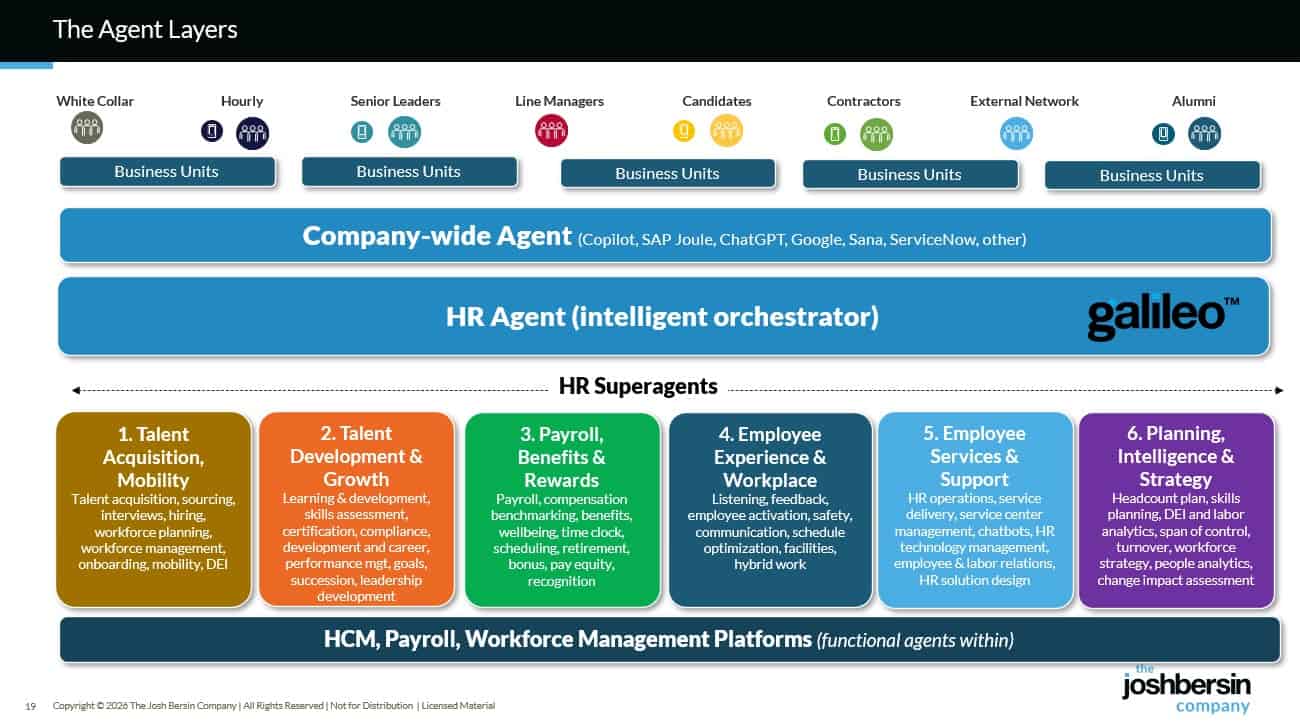
"Superagents" (Layer 4): Sitting atop the agent layer, Superagents act as orchestrators, stitching together and accessing multiple functional agents. Their purpose is to provide users with an even more seamless and intuitive "walk up and use" experience, abstracting away the complexity of underlying agent interactions.
-
User Interface/Experience (Layer 5): While not always explicitly defined as a layer in technical diagrams, the ultimate interface through which users interact with these agents is crucial. This includes conversational interfaces, virtual assistants, and integrated features within existing productivity suites.
This layered architecture is currently experiencing rapid innovation, with numerous players entering the market. Notable examples include Sana (an offering from Workday), Oracle Agent Studio, Microsoft Copilot Studio, Leena.ai, and new agent capabilities from ServiceNow (following its acquisition of MoveWorks). SAP’s Joule Studio, alongside foundational AI models from Anthropic, OpenAI, and Google, further populate this dynamic ecosystem. Platforms like Galileo, which function as AI-powered HR advisors, exemplify the "Superagent" concept by providing employees with a centralized point for inquiries and access to underlying agents.
The Criticality of Business Rules and Context
While the potential of AI agents in HR is immense, their effective implementation hinges on navigating a complex web of business rules, security protocols, and legacy systems. A payroll reconciliation agent, for instance, must be meticulously "trained" with a company’s specific rules and security parameters to accurately monitor transactions, reconcile taxes, and account for employee changes, pay adjustments, and terminations. Furthermore, for agents to perform advanced functions like monitoring pay equity or adjusting compensation based on performance, they must seamlessly integrate and communicate with other agents and systems.
This interconnectedness highlights the importance of agent architecture. Consider a scenario where an organization aims to redeploy 5,000 employees from an existing business unit to new roles. An agent designed for this task would need to assess job fit, identify skill gaps, and gauge redeployment potential. To achieve this effectively, the agent must interact with a multitude of other agents, drawing information about skill requirements, learning resources, location constraints, licensing regulations, union agreements, and compensation structures. Building such a comprehensive "Superagent" requires deep understanding of an organization’s intricate operational landscape.
Common use cases for these advanced agents extend across global onboarding, promotion processes, annual reviews, compensation management, talent acquisition, employee certification, and time and schedule management. The complexity arises from the need for these agents to not only access data but to interpret and act upon it within the unique context of each enterprise.
The Emerging Battleground: Enterprise Agents and the Role of Context
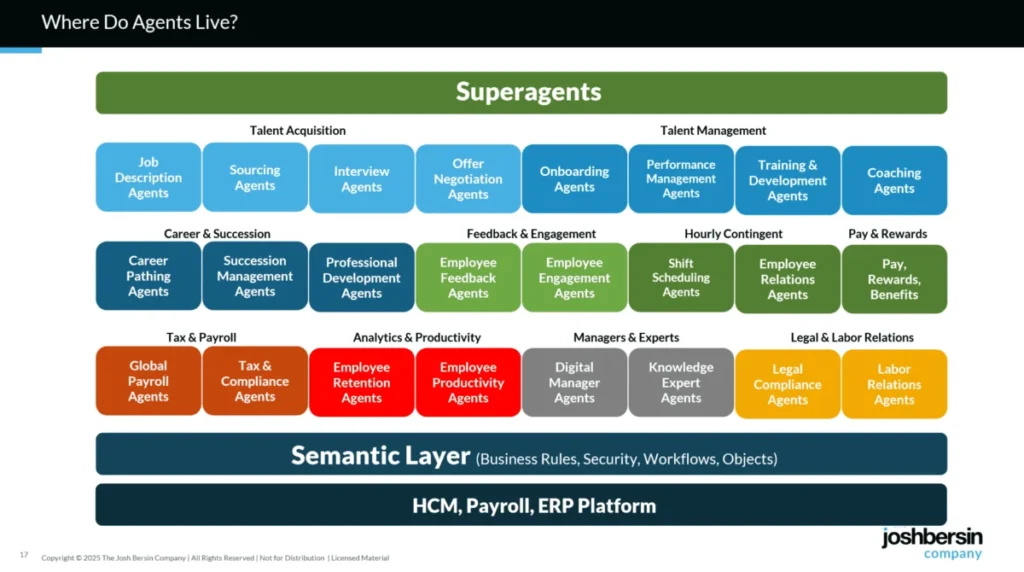
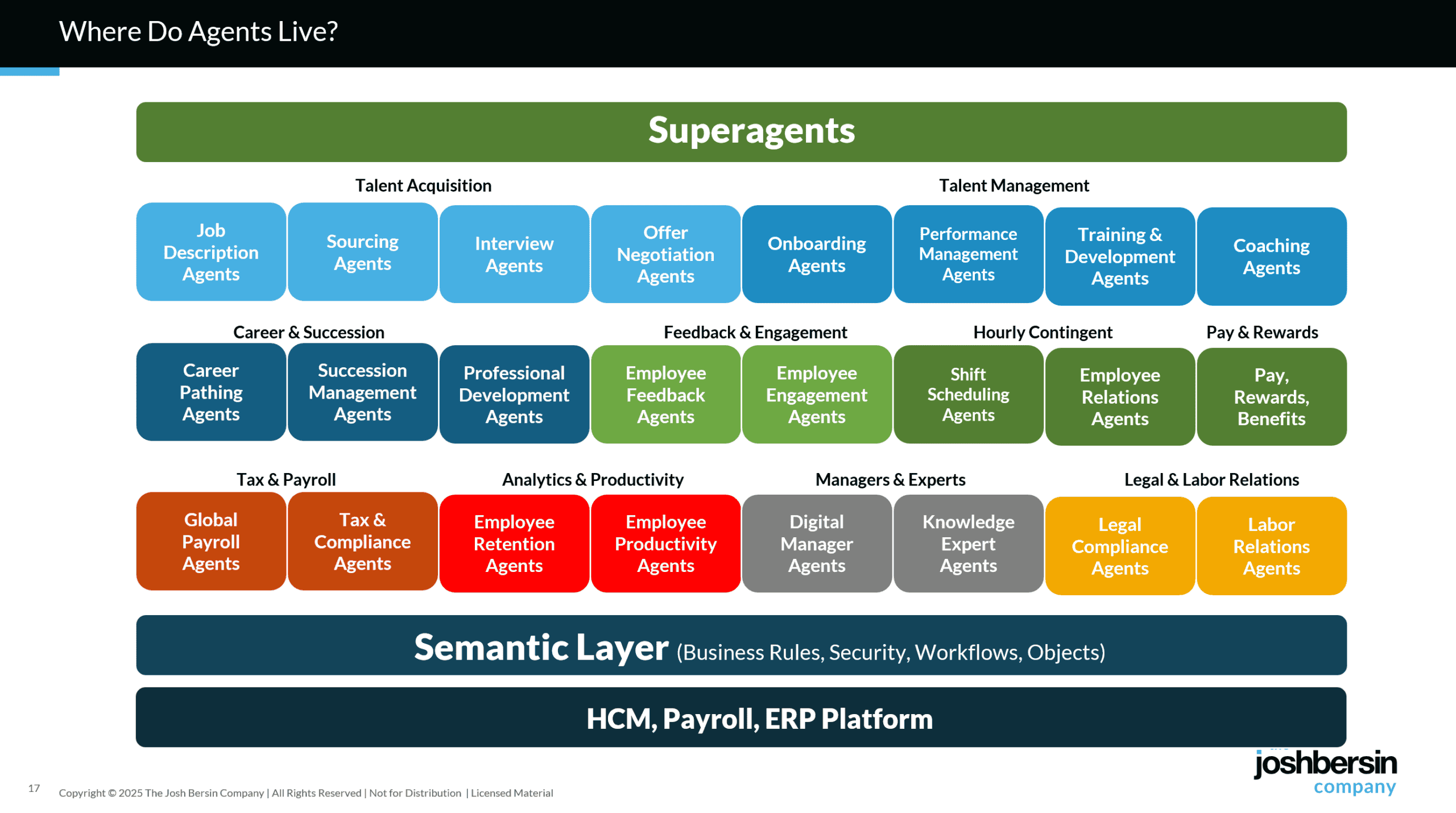
The race to develop and deploy effective AI agents for HR is intensifying, with virtually every major HR technology vendor actively building out their agent capabilities. While some offerings focus on simpler coaching tools, others are venturing into more sophisticated functionalities. Leading vendors such as Workday, Oracle, SAP, and ServiceNow are investing heavily in "AI Studios" to democratize agent development.
However, the core challenge and the impending battleground lie not solely in the selection or creation of individual agents, but in the ability to seamlessly integrate them. This integration is fundamentally dependent on how well agents can access and leverage an organization’s unique business rules, existing workflows, and critical business "objects." These objects, such as a company’s defined career framework or performance review model, represent the codified value and operational logic of the business. As organizational strategies and market conditions evolve, these rules and objects must also adapt. The goal is to avoid hard-coding these dynamic elements into agents, instead enabling agents to tap into a "semantic layer" that continuously maintains and reflects this essential organizational information.
Major HCM vendors are acutely aware of this. They possess established semantic layers—like Workday’s Business Process Framework—and are increasingly integrating them into their agent development tools. This makes their existing semantic layers a crucial asset, potentially giving them an advantage in the agent market and challenging the notion of a "SaaSpocalypse" where monolithic systems are entirely replaced. Any HR agent or development tool will likely seek to leverage these foundational semantic layers for robust functionality.
Gloat’s Strategic Intervention: Loomra and Agentic HR
Gloat’s recent launch of Gloat Agentic HR aims to liberate organizations from the constraints of traditional, siloed approaches by introducing a novel "agent-driven auto-discovery and ingestion" engine named Loomra. This sophisticated engine mines an organization’s systems to identify and replicate entities, workflows, and business rules, crucially maintaining synchronization as the underlying HCM systems evolve. In essence, Loomra creates a dynamic, up-to-date replica of an organization’s core HR logic and objects, providing a fertile ground for building custom applications.
Gloat’s platform then offers an intuitive agent builder, enabling users to visually construct their own agents. These agents can be directly integrated into popular collaboration platforms like Microsoft Teams, Copilot, and Slack. Building on its existing expertise, Gloat has already developed pre-built agents for critical HR functions such as Workforce Redeployment, Career Development, Internal Talent Sourcing, Succession Planning, and Learning & Reskilling.
The Power of Workforce Context
What sets Gloat’s Agentic HR platform apart is the underlying workforce context layer powered by Loomra. This engine has been developed over nearly a decade, accumulating enterprise-scale workforce data. It models intricate relationships, including skill adjacencies, career trajectories, organizational patterns, and workforce connections across millions of employees globally.
This deep contextual understanding allows Gloat’s agents to move beyond simple information retrieval. Instead of merely answering queries like "show me employees who know Python," these agents can proactively reason about which employees are best positioned to transition into AI engineering roles, identify teams most vulnerable to future skill gaps, and recommend talent redeployment strategies in alignment with shifting business priorities.
Competitive Landscape and Gloat’s Positioning
Gloat’s approach offers a compelling proposition: organizations can potentially accelerate their AI adoption by leveraging Gloat’s platform to build upon their existing HCM infrastructure, rather than waiting for legacy vendors to develop needed capabilities. The open nature of the Gloat platform also facilitates integration with other internal systems. The depth and breadth of Gloat’s context engine are particularly noteworthy, as few, if any, other HCM vendors appear to have developed a comparable system to date.
However, the market for HR agent tools is intensely competitive. Organizations deeply invested in specific ecosystems will likely gravitate towards native solutions: ServiceNow users will opt for ServiceNow’s offerings, Workday customers will lean towards Sana, Oracle users will engage with Oracle AI Studio, and SAP clients will utilize Joule Studio. Gloat’s challenge will be to convincingly demonstrate that its tools offer superior ease of use, seamless integration with diverse HCM systems, and a more profound level of context-awareness compared to its rivals. As the enterprise landscape shifts from "systems of record" to "systems of context," Gloat’s ability to establish itself as a leader in this transition will be critical.
Future Outlook
The evolution of application development tools has historically seen new platforms emerge, with companies typically selecting solutions that align with their existing infrastructure. Gloat’s new platform represents an innovative step forward, pushing the boundaries of the agent industry. The company’s success will likely depend on its ability to demonstrate tangible value and seamless integration for its early customers. As the market matures, close observation of customer adoption and real-world use cases will be essential to understanding the long-term impact of Gloat’s strategic entry into the agentic HR space. Further insights are expected as Gloat begins sharing experiences from its early adopting clients.







