

The global manufacturing sector is currently navigating a period of unprecedented complexity, characterized by rapid technological advancement and shifting consumer expectations. As products become more sophisticated, the traditional distributor model faces a critical bottleneck: the gap between product innovation and the distributor’s ability to communicate that value to the end user. Industry data suggests that a significant percentage of channel sales are lost not because of product inferiority, but because of a lack of "partner readiness." In the competitive landscape of modern manufacturing, the product that is easiest to understand and explain is invariably the product that dominates the market share.
The Critical Correlation Between Knowledge and Revenue
In a distributor-led ecosystem, the manufacturer’s sales force is effectively external. This creates a unique challenge in maintaining brand consistency and technical accuracy. When comparing two manufacturers with similar product quality, the differentiator is often the depth of their partner enablement programs. Consider a hypothetical but common industry scenario: Brand A and Brand B. Brand A invests in a structured certification program, provides specific objection-handling scripts, and utilizes systematic onboarding for new distributor representatives. Brand B, conversely, relies on a repository of static PDF manuals and occasional, uncoordinated conference calls.
The result is a stark disparity in sales performance. Representatives for Brand A enter conversations with high confidence, able to pivot from technical specifications to value-based outcomes. They are equipped to handle customer skepticism because they have been trained on specific market pushbacks. For Brand B, the distributor’s team is often left to interpret complex data on their own, leading to hesitant pitches and a tendency to default to price-based selling rather than value-based selling. This "readiness gap" directly impacts the bottom line, as distributors naturally gravitate toward selling products they feel most comfortable discussing.
Strategic Business Outcomes of Structured Enablement
The transition from ad hoc information sharing to structured partner enablement yields measurable business wins that extend beyond simple sales figures. By treating distributor training as a core business function, manufacturers can achieve several high-level objectives:

- Accelerated Time-to-Market: When a new product is launched, the speed at which the entire channel can begin selling is vital. Structured training ensures that the "ramp-up" period is minimized.
- Brand Integrity and Messaging Consistency: A centralized training platform prevents the "broken telephone" effect, where product benefits are diluted or misrepresented as they move down the distribution chain.
- Reduced Support Overhead: Well-trained partners require less intervention from the manufacturer’s internal technical support teams, as they can solve basic queries and configurations independently.
- Enhanced Partner Loyalty: Distributors view manufacturers who provide high-quality training tools as "partners of choice." Providing easy-to-access, valuable training content makes the distributor’s job easier, fostering a long-term, symbiotic relationship.
For the distributors themselves, the benefits are equally tangible. Structured training allows for faster employee onboarding, reducing the burden on local managers. Furthermore, certification programs often serve as a gateway to premium vendor opportunities, such as access to exclusive product lines or joint marketing funds.
A Five-Step Framework for Launching Distributor Training
For many manufacturers, the challenge lies in how to transition from a legacy system of scattered documents to a modern, trackable Learning Management System (LMS). Implementing a structured program requires a strategic, phased approach to ensure adoption and scalability.
Step 1: Identification of High-Friction Business Priorities
The most common mistake in digital transformation is attempting to digitize every manual and process simultaneously. This often leads to a bloated, unmanageable system that lacks clear ROI. Instead, manufacturers should identify a single, high-friction area where training can provide an immediate impact. This might involve analyzing internal data to find products with high return rates due to improper installation, or identifying regions where sales of a specific product line are lagging despite high market potential. By solving a specific problem first, the manufacturer creates a proof-of-concept that justifies further investment.
Step 2: Mapping the Complex Distributor Ecosystem
Manufacturing channels are rarely monolithic; they comprise national dealers, regional independent shops, service technicians, and sales managers. Each of these cohorts has different learning needs. A technician requires deep-dive technical specs and troubleshooting guides, while a sales rep needs high-level value propositions and competitive comparisons. Utilizing a sophisticated LMS, such as iSpring LMS, allows manufacturers to mirror their organizational structure digitally. This enables the automation of routine tasks and the creation of "learning groups" that receive targeted content relevant to their specific roles.
Step 3: Transforming Static Content into Interactive Assets
Most manufacturers possess a wealth of information in the form of PowerPoints, PDFs, and recorded webinars. However, these formats are often passive and difficult to track. To ensure engagement, these materials must be converted into interactive e-learning modules. Modern authoring tools, including AI-enhanced suites, allow for the quick conversion of static decks into narrated courses with knowledge checks and simulations. The goal is to move beyond technical specifications and incorporate practical sales guidance, such as how to identify the target audience and address common regional objections.

Step 4: Implementing Sequential Certification Tracks
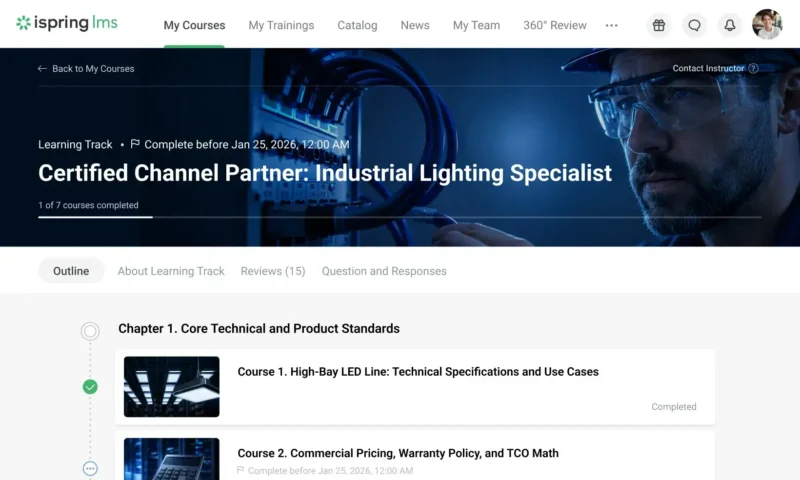
To ensure a high standard of partner readiness, training should be organized into sequential "learning tracks" rather than isolated courses. This structure guides the learner through a logical progression of knowledge, culminating in a certification. To maintain standards over time, manufacturers can set expiration dates on certifications, triggering automatic recertification reminders. This is particularly crucial in industries with frequent regulatory changes or rapid product iterations. Furthermore, the integration of on-the-job training modules—where local supervisors use mobile checklists to grade real-world performance—bridges the gap between digital theory and physical execution.
Step 5: Data-Driven Optimization and Tracking
The final stage of a successful rollout is the implementation of a robust analytics framework. Manufacturers need to track three layers of data: completion rates (are they learning?), assessment scores (do they understand?), and the correlation with sales data (is it working?). Advanced LMS platforms provide real-time reports that allow headquarters to see exactly where the rollout is succeeding and where partners are struggling. This transparency transforms training from a "cost center" into a strategic data source that informs high-stakes business decisions.
Case Study: Suzuki Australia’s Strategic Training Mandate
The efficacy of this structured approach is best illustrated by Suzuki Australia’s motorcycle division. Facing the launch of a new model, the company recognized that the success of the rollout depended entirely on the technical and sales proficiency of their dealership network across the continent.
Suzuki implemented a mandatory training program using iSpring’s platform. The strategy was rigorous: the technical and sales staff at every dealership were required to complete specific training modules and pass assessments before the new motorcycles were even shipped to their location. This "gatekeeper" approach ensured that on the day of the launch, every representative in the country was fully prepared to support the product.
The result was a 100% training completion rate among selling dealers. By linking product availability to training readiness, Suzuki transformed a routine launch into a synchronized, high-performance event. This case serves as a benchmark for how manufacturers can use training analytics to de-risk major product introductions.
Analysis of Implications for the Manufacturing Sector
The shift toward structured partner readiness signifies a broader trend in the "Professionalization of the Channel." As the global economy moves toward more specialized, high-tech manufacturing, the "handshake and a brochure" era of distribution is ending.
The implications are clear: manufacturers who fail to provide a digital, scalable training infrastructure will find their products sidelined by distributors who prefer the ease and support of more "enablement-heavy" brands. Furthermore, the rise of AI in training—allowing for personalized learning paths and instant content updates—means that the gap between leaders and laggards will only widen.
In conclusion, partner readiness is no longer an optional support function; it is a critical driver of channel sales. By implementing a structured, tech-enabled training program, manufacturers can ensure their brand message remains intact, their partners remain loyal, and their sales remain consistent in an increasingly complex global market. The investment in a robust LMS and authoring environment is, ultimately, an investment in the scalability and resilience of the entire distribution network.






