
The traditional boundaries of corporate training and academic instruction are undergoing a fundamental transformation as digital ecosystems become the primary infrastructure for knowledge transfer. In this evolving landscape, "how to start coding" has transitioned from a niche technical query into a strategic imperative for professionals in Learning and Development (L&D), Human Resources (HR), and general education. As automation, data analytics, and artificial intelligence (AI) become embedded in organizational workflows, coding literacy is increasingly recognized not merely as a technical specialty, but as a foundational pillar of modern digital fluency.
The convergence of Instructional Design, learning technologies, and process automation has created a demand for professionals who can do more than curate content; they must now understand the underlying logic of the platforms they manage. This shift reflects a broader trend in the global labor market, where the World Economic Forum identifies technological literacy as one of the fastest-growing core skills required by the year 2025. For the L&D professional, this means moving beyond the role of a "user" of software and toward the role of a "builder" or "architect" of learning experiences.
The Definitive Distinction: Coding, Programming, and Engineering
To understand how to enter this field, professionals must first navigate the often-conflated terminology of the software world. Coding is the fundamental act of writing instructions that a computer can execute using structured languages such as Python or JavaScript. It is the "literacy" aspect of the digital age. Programming, conversely, is a broader discipline that involves designing logic, solving complex problems, and organizing instructions into functional applications. Software engineering represents the most advanced tier, involving system planning, scalability, and lifecycle management.
For those in L&D and education, the objective is rarely to become a full-stack software engineer. Instead, the focus is on "coding fundamentals"—the building blocks of logic such as variables, loops, conditionals, and functions. Mastering these basics allows professionals to collaborate more effectively with IT departments, evaluate the technical viability of new authoring tools, and customize Learning Management Systems (LMS) to meet specific organizational needs.
A Strategic Framework for Non-Technical Professionals
The journey from zero technical knowledge to functional coding literacy requires a structured approach. Industry experts suggest a five-step strategic framework designed to minimize cognitive load and maximize professional utility.
Step 1: Identifying the Use Case
The primary reason many professionals abandon coding is the lack of immediate application. In a professional context, learning should be driven by a specific problem. For an HR professional, this might involve automating the collection of employee feedback data. For an Instructional Designer, it may involve using JavaScript to create custom triggers within an e-learning module that standard tools cannot support. By tying the learning process to a tangible work scenario, the individual moves from abstract theory to practical solution-building.
Step 2: Selecting the Entry Language
The "best" language to learn is the one that solves the immediate problem. Python has emerged as the premier choice for data analysis and general automation due to its readable, English-like syntax. JavaScript remains the industry standard for web-based interactivity and is essential for anyone working with modern LMS platforms or web-based content. Meanwhile, SQL (Structured Query Language) is indispensable for professionals who need to extract and analyze large datasets from organizational databases.
Step 3: Mastering the Fundamentals
Regardless of the language chosen, the underlying logic remains consistent. New learners are encouraged to focus on the "Basics of Coding 101," which includes:
- Variables: Storing and retrieving data.
- Data Types: Understanding the difference between text, numbers, and lists.
- Conditionals: "If-then" logic that dictates how a program responds to different inputs.
- Loops: Automating repetitive tasks.
- Functions: Creating reusable blocks of code to improve efficiency.
Step 4: Contextual Practice
Effective learning occurs when code is written within a familiar environment. Rather than solving generic puzzles, an L&D professional might practice by writing a script that renames hundreds of training assets or by creating a basic HTML/CSS template for a departmental newsletter. This hands-on approach reduces the "fear of the terminal" and builds confidence through incremental successes.

Step 5: Transitioning to Application
The final stage of the roadmap involves a mindset shift from being a learner to being a problem solver. At this point, the professional begins to look at every manual, repetitive task through the lens of automation. This transition turns coding from a separate "skill to be learned" into a "tool to be used," effectively integrating it into their daily professional identity.
The Role of AI in Modern Coding Education
The rise of generative AI has fundamentally altered the timeline for learning to code. Tools such as ChatGPT, GitHub Copilot, and Claude act as real-time tutors, capable of explaining complex syntax, debugging errors, and even generating boilerplate code. For a beginner, AI serves as a bridge, lowering the barrier to entry and allowing non-technical staff to produce functional code much earlier in their learning journey.
However, industry analysts warn that AI should supplement, not replace, the understanding of logic. While an AI can write a script, the human professional must have enough coding literacy to verify the output, ensure security compliance, and integrate the script into the existing organizational infrastructure.
Chronology of the Instructional Designer’s Evolution
The demand for coding in education has followed a clear chronological progression over the last two decades:
- 2000–2010: The era of "Flash" and basic SCORM packages. Technical needs were mostly handled by specialized developers.
- 2010–2020: The rise of cloud-based LMS and "drag-and-drop" authoring tools. The need for coding seemed to decrease, but data silos began to form.
- 2020–Present: The "Post-Pandemic Digital Acceleration." The explosion of remote work and digital-first learning created a need for integrated systems, custom data tracking (xAPI), and automation, bringing coding back to the forefront as a necessary skill for the "Modern Instructional Designer."
Supporting Data and Industry Trends
Recent labor statistics highlight the growing intersection of tech and education. According to LinkedIn’s "Workplace Learning Report," 83% of L&D leaders agree that the "people professional" role is becoming more cross-functional, requiring a mix of soft skills and technical hard skills. Furthermore, job postings for Instructional Designers that mention "JavaScript," "Python," or "Data Analytics" have seen a 25% increase in salary offerings compared to those that do not, signaling a clear market value for coding literacy.
In the HR sector, the shift toward "People Analytics" has made SQL and Python highly sought-after. Organizations are no longer satisfied with basic participation rates; they demand deep-dive analytics into how training impacts bottom-line performance—a task that requires the ability to manipulate and query complex data structures.
Broader Impact and Organizational Implications
The democratization of coding skills within L&D and HR has profound implications for organizational agility. When non-technical staff possess coding literacy, the "bottleneck" at the IT department is reduced. Small-scale automations and customizations can be handled internally, allowing the technical teams to focus on enterprise-level architecture.
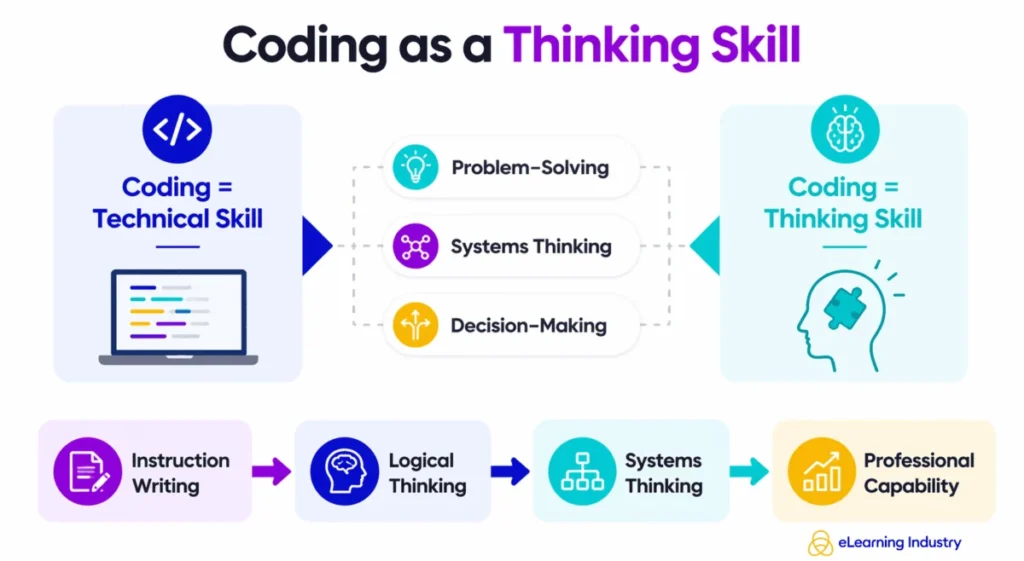
Moreover, coding literacy fosters a "systems thinking" mindset. Professionals who understand how code works are better equipped to troubleshoot software issues, advocate for better technology purchases, and design workflows that are scalable. This leads to a more resilient digital infrastructure and a more innovative corporate culture.
Conclusion and Realistic Expectations
Learning to code is a marathon, not a sprint. For a professional starting from zero, the first month is typically dedicated to achieving basic literacy—understanding what code is and how to read it. By the three-month mark, most dedicated learners can complete small, independent projects. After six months of consistent application, coding usually becomes a seamless part of their professional workflow.
The ultimate takeaway for the modern professional is that coding is not an end in itself; it is a powerful lens through which to view problem-solving. By breaking complex challenges into logical, executable steps, professionals in L&D, HR, and education can significantly amplify their impact, ensuring they remain relevant in an increasingly automated world. The question is no longer whether one should learn to code, but how quickly they can integrate these digital fundamentals into their professional repertoire.






