Effective employee recognition programs extend far beyond mere celebration; they are crucial tools for cultivating a workforce that understands the significance of its contributions. When recognition is delivered consistently and genuinely, it fosters a profound sense of clarity, enabling employees to connect their daily tasks to a larger organizational purpose, transcending the confines of their immediate to-do lists. This vital connection is not serendipitous. Research conducted by the Achievers Workforce Institute (AWI) reveals that employees who receive recognition at least monthly are 3.9 times more likely to perceive how their work aligns with the broader company objectives. Recognition serves as a bridge, linking effort to tangible impact, thereby fueling engagement, motivation, and ultimately, performance. In essence, recognition plays a pivotal role in bridging the gap between individuals and their overall performance.
This article delves into seven exemplary employee recognition programs implemented by Achievers customers, each offering actionable insights for HR leaders and organizations seeking to enhance their own recognition strategies. These case studies underscore the transformative power of strategic recognition in today’s dynamic work environment.
The Strategic Imperative of Employee Recognition
In the contemporary business landscape, where employee retention and engagement are paramount, recognition programs have evolved from optional perks to strategic imperatives. The AWI’s research consistently highlights a strong correlation between regular recognition and employee satisfaction, productivity, and loyalty. Companies that prioritize a culture of appreciation often experience lower turnover rates, higher employee morale, and improved overall business outcomes. The shift from a transactional approach to recognition, focusing solely on monetary rewards, to a more holistic strategy that emphasizes genuine appreciation and alignment with company values, marks a significant evolution in HR practices.
Seven Pillars of Impactful Recognition: Case Studies in Excellence
1. Cineplex: Elevating Frontline Performance Through Integrated Recognition
Cineplex, a leading entertainment company with thousands of frontline employees across its theaters and experiential venues, faced the challenge of maintaining high levels of motivation and focus on guest experience in a fast-paced, shift-based environment. Their innovative approach transformed recognition from a feel-good initiative into a powerful performance driver. By embedding recognition into daily leadership practices, incentives, and ongoing campaigns, Cineplex ensured that appreciation was not an afterthought but a direct reinforcement of desired behaviors. This strategic integration resulted in heightened employee motivation, significant improvements in Net Promoter Score (NPS) across its locations, and an estimated $400,000 in incremental revenue generated through recognition-powered campaigns.
Takeaway for HR Leaders: Integrate recognition into the core fabric of leadership. When recognition is frequent, visible, and directly linked to the behaviors that yield tangible results, it becomes a scalable mechanism for performance enhancement, not merely a morale booster.
2. Sobeys: Driving Operational Excellence Through Feedback, Learning, and Rewards
Sobeys, one of Canada’s largest grocery retailers employing over 131,000 individuals, sought a scalable recognition solution that could encompass its diverse workforce, from hourly associates to support teams, while remaining aligned with key business priorities. Their "Bring It!" recognition program established a unified system where recognition, feedback, and learning converged to reinforce performance. A particularly impactful initiative at Sobeys’ retail support centers involved leveraging feedback surveys and gamified learning modules to optimize cube truck utilization, a critical logistics metric. Employees engaged with quizzes tied to operational goals, earned points for high performance, and provided valuable feedback for process improvements. This concerted effort led to a substantial increase in cube utilization, rising from 77.3% to 86.2%, fostering team cohesion and driving measurable operational gains.
Takeaway for HR Leaders: Amplify the impact of recognition by integrating it with feedback and learning opportunities. Rewarding employees for knowledge acquisition and idea generation, in addition to outcome achievement, can drive significant operational improvements while keeping teams engaged and focused on strategic objectives.
3. General Motors: Unifying a Global Workforce Through Values-Based Recognition
During a significant cultural and business transformation aimed at achieving its vision of "zero crashes, zero emissions, and zero congestion," General Motors needed a recognition strategy to unite its global workforce of over 160,000 employees across six continents. GM strategically aligned its recognition program with seven core behaviors that define its operational ethos. This approach ensured that employees worldwide were recognized for embodying the same fundamental values, moving beyond a sole focus on results. The implementation of a single, global recognition program fostered clarity, consistency, and momentum throughout the organization. Real-time peer recognition, milestone celebrations, and public acknowledgments became commonplace. Within months of its launch, participation surged, recognition emerged as a key driver of improved engagement survey scores, and employees reported feeling more valued and more closely aligned with the company’s vision and core behaviors.
Takeaway for HR Leaders: Ground recognition in shared values and ensure its consistent delivery across teams and locations. This approach serves as a potent catalyst for breaking down organizational silos and driving culture change, even within complex, global enterprises.
4. Seattle Children’s Hospital: Enhancing Engagement Through Patient-Centric Recognition
Seattle Children’s Hospital recognized the opportunity to create a more inclusive recognition framework that acknowledged the entire care team, encompassing not just clinicians but all individuals contributing to a patient’s experience. While patient families were eager to express gratitude, their feedback was often informal, delayed, or directed towards a select few visible roles. The hospital sought to formalize and amplify patient appreciation, making it more timely, visible, and meaningful for staff across all departments. By integrating patient feedback directly into the hospital’s recognition platform via the Achievers API, patients and families could submit real-time recognition. This ensured that contributions from custodial, administrative, and support staff were celebrated alongside clinical care. During a pilot program, patient-submitted recognitions correlated with a 10% increase in employee engagement and fostered a "pay it forward" culture, where patient appreciation inspired greater peer-to-peer recognition.
Takeaway for HR Leaders: Recognition need not be confined to internal sources. Establishing mechanisms for external stakeholders, such as customers or patients, to express gratitude through external recognition tools can significantly elevate engagement, inclusion, and a sense of belonging across all roles, including those often overlooked.

5. Scotiabank: Scaling Global Recognition for Consistency and Relevance
With a workforce of nearly 90,000 employees spread across 30 countries, Scotiabank required a recognition program capable of scaling globally without compromising consistency or relevance. Its previous platform lacked the functionality for cross-team recognition, mobile accessibility, and meaningful analytics, hindering its ability to build momentum and visibility at scale. The objective was clear: to establish a unified enterprise-wide recognition experience that reinforced core values, engaged leaders, and operated seamlessly across diverse regions. Scotiabank’s initiative successfully transformed recognition into a daily habit rather than a sporadic event. Leaders were empowered as recognition champions, peer-to-peer recognition was actively promoted through initiatives like "Pay It Forward," and recognition was seamlessly integrated into daily workflows via Microsoft Teams. The results were compelling: 93% of employees actively utilize the platform, recognition sent per employee increased by nearly 60%, and one campaign alone boosted active users by 40% month-over-month.
Takeaway for HR Leaders: Global recognition programs achieve optimal effectiveness when they are simple, visible, and integrated into everyday tools. When leaders champion these behaviors and employees can recognize each other irrespective of their work location, recognition becomes a shared language, transcending the limitations of siloed programs.
6. Kellanova: Boosting Pride and Connection Through Increased Recognition Frequency
Kellanova identified a critical need to revamp its recognition practices when a global survey revealed that only about half of its employees felt regularly appreciated for their work. With over 30,000 employees across four regions, many in manufacturing and frontline roles, recognition was often inconsistent, siloed, and predominantly top-down. The company aimed to implement a simpler, more inclusive approach to ensure that both everyday contributions and significant achievements were acknowledged. Kellanova’s strategic shift made recognition a daily, peer-driven habit. By launching a mobile-first, global recognition platform, the company empowered employees to easily recognize one another across teams, regions, and roles. Recognition was systematically linked to company values, supported by meaningful rewards, and expanded into a broader engagement hub, thereby enhancing pride, connection, and participation worldwide.
Takeaway for HR Leaders: If recognition feels infrequent or uneven, prioritize frequency and accessibility. When recognition is easy to deliver, inclusive, and integrated into the daily workflow, it cultivates pride, strengthens connections, and fosters loyalty at scale.
7. Rogers: Doubling Sales by Rethinking Frontline Rewards
Rogers sought a more effective method to motivate its fulfillment representatives to excel in upselling and cross-selling during customer activations, as commission-based approaches had consistently fallen short. The company required a simpler, more engaging, and sustainable solution that still delivered a clear return on investment. Rogers introduced a non-cash, points-based rewards program that provided instant recognition to representatives for selling additional services. Within six months, program participation reached nearly 70%, significantly exceeding industry benchmarks. More importantly, the program directly contributed to a 93% increase in sales of additional services, demonstrating the potent impact of recognition-powered rewards on frontline performance.
Takeaway for HR Leaders: Immediate, visible recognition tied to specific behaviors can effectively drive participation, foster healthy competition, and yield measurable business outcomes.
Foundational Elements of an Impactful Recognition Program
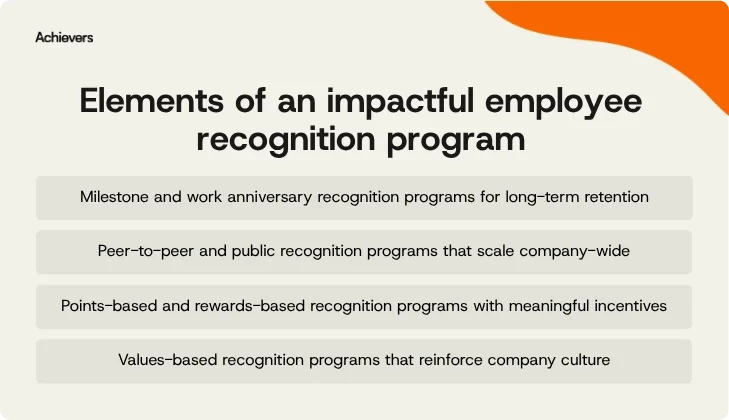
The most successful recognition programs are built upon a foundation of several interconnected elements that collectively foster clarity, consistency, and momentum:
-
Milestone and Work Anniversary Recognition Programs: These programs are essential for long-term employee retention. Automation ensures that significant milestones are not overlooked, while the true value lies in contextualizing these moments by acknowledging an employee’s learning, contributions, and advancements. When executed thoughtfully, milestone recognition quietly reinforces loyalty without requiring elaborate gestures.
-
Peer-to-Peer and Public Recognition Programs: Empowering employees to recognize each other for good work, collaboration, and everyday contributions democratizes appreciation, extending it beyond managerial oversight. Peer-to-peer recognition fosters a more frequent and accurate reflection of how work truly gets done. The visibility inherent in these programs is critical. Research from the State of Recognition Report indicates that employees recognized by their peers report higher productivity and a stronger sense of belonging, underscoring recognition’s role in fostering a collective identity.
-
Points-Based and Rewards-Based Recognition Programs: These programs strategically pair appreciation with tangible incentives that employees can select and utilize. They offer a consistent and scalable method of acknowledging contributions without conflating recognition with compensation. When rewards are thoughtfully applied, they enhance recognition rather than overshadow it. Clear guidelines, equitable budgets, and the autonomy for employees to choose their preferred reward type are crucial for maintaining high participation and building trust.
-
Values-Based Recognition Programs: These programs focus on acknowledging employees for how they achieve results, not solely for the results themselves. By directly linking recognition to an organization’s stated values, employees gain a clear understanding of expected, encouraged, and rewarded behaviors. Transparent categories, shared language, and visible examples of recognition help leaders identify successful practices and areas for improvement, thereby translating organizational values from abstract concepts into tangible actions.
Achievers’ Recognition Platform: Connecting People and Performance
The overarching theme across these successful examples is that impactful employee recognition programs are not about perfunctory gestures or simple reward distribution. They are fundamentally about enabling individuals to understand that their work is meaningful and that their contributions are valued by others.
Achievers champions this philosophy through its employee recognition platform, which is meticulously designed to connect people and performance by making appreciation frequent, visible, and an integral part of the daily work experience. By delivering recognition in pivotal moments, tied to concrete behaviors and tangible impact, appreciation transcends being a mere pleasantry and actively shapes how work is conducted. Recognition, therefore, is not solely about celebrating success; it is a powerful mechanism for actively shaping it.