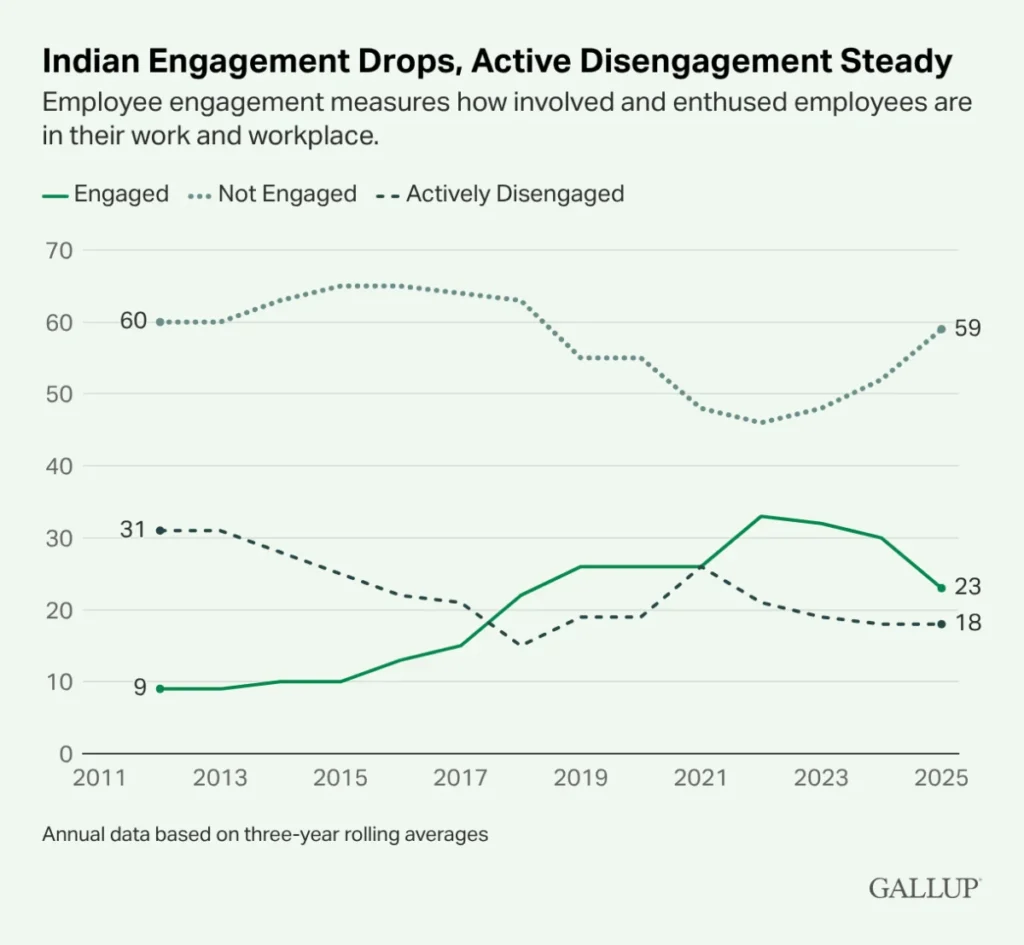
Employee engagement in India has seen a significant downturn in 2025, with only 23% of the workforce reporting feeling engaged at their jobs. This figure represents the lowest level recorded in four years, signaling a concerning trend for the nation’s labor market. While this percentage remains marginally above the current global average of 20%, it marks a noticeable retreat from the comparatively higher engagement levels India had achieved in recent years, according to comprehensive research by Gallup. The implications of this decline extend beyond individual job satisfaction, impacting national productivity and economic output.
Gallup’s definition of engaged employees is crucial to understanding this shift. Engaged employees are characterized by a strong emotional connection to their work and their workplace. They are invested in their roles, contribute discretionary effort, and are aligned with their organization’s objectives. Conversely, "not engaged" employees typically exhibit minimal effort beyond the basic requirements of their job. The actively disengaged, a more problematic category, often experience frustration and a profound disconnection from organizational goals, potentially acting as a drag on team morale and productivity.

The economic ramifications of this disengagement are substantial. Gallup estimates that workplace disengagement currently costs India approximately $351 billion annually in lost productivity. This staggering figure equates to roughly 9% of the country’s Gross Domestic Product (GDP), highlighting the significant economic burden of an uninspired workforce. This represents a considerable loss of potential output and innovation, impacting businesses’ bottom lines and the nation’s overall economic growth trajectory.
Despite the recent dip, it is important to contextualize these findings within a broader historical perspective. India’s workforce engagement levels have shown considerable improvement over the past decade. A decade ago, the country was often ranked among the least engaged labor markets globally. The current data, therefore, suggests that while progress has been made, maintaining and building upon those gains has become a challenge. The recent trend indicates a shift from active frustration to a more prevalent state of detachment or uncertainty about individual roles within organizations. This subtle but significant change suggests that while outright dissatisfaction may have decreased for some, a lack of clear purpose and connection has emerged as a new hurdle.
A particularly striking aspect of the 2025 data is the disproportionate decline in engagement among managers. Manager engagement saw a sharp fall from 39% in 2024 to 30% in 2025. This represents a steeper decline than that experienced by individual contributors, whose engagement dropped from 24% to 19%. This sharp decrease among leadership positions is a critical concern, as managers are often the primary interface between employees and organizational strategy. Their disengagement can have a cascading effect throughout their teams.

Several factors may be contributing to this pronounced decline in manager engagement. One potential factor identified by the report is the shrinking of management ranks. It is plausible that fewer managers are now overseeing larger teams, leading to increased workloads, greater responsibilities, and a reduced capacity to connect with their own roles and provide adequate support to their direct reports. Previous research consistently underscores the pivotal role managers play in shaping employee engagement across an organization. They are often responsible for a significant portion of the variation in team performance and the overall workplace experience. When managers themselves are disengaged, their ability to foster engagement in others is severely hampered.
These findings arrive at a time of significant flux within the global and Indian corporate landscape. Companies are continuously reorganizing work structures, often leading to flatter management hierarchies and a reassessment of traditional workforce strategies. The rise of hybrid and remote work models, coupled with evolving employee expectations, necessitates adaptive leadership approaches. The decline in manager engagement suggests that current strategies may not be adequately addressing the unique pressures and challenges faced by those in leadership positions within these evolving environments.
Gallup’s data offers insights into the root causes of disengagement. It suggests that many disengaged employees are not necessarily disconnected from the concept of work itself, but rather lack crucial elements such as strong communication, clear role definition, and tangible support from leadership. In an era where organizational change is constant, a lack of consistent and transparent communication can breed uncertainty and detachment. Employees who are unclear about their responsibilities or how their contributions align with broader organizational objectives are more likely to disengage. Furthermore, a perceived lack of support from superiors can erode motivation and a sense of value.
The report emphasizes the growing importance of leadership support and development in counteracting these trends. Organizations that prioritize robust manager training, provide ongoing support for leadership roles, and invest in leadership development programs are likely to be better positioned to improve engagement levels. This includes equipping managers with the skills to navigate complex team dynamics, foster psychological safety, and communicate effectively in diverse work settings. Investing in leadership capabilities is not just about developing individuals; it is about building a more resilient and engaged organizational culture.
To further understand the trajectory of employee engagement in India, it is beneficial to look at the broader context of economic and social changes that have shaped the workforce. Over the past two decades, India has witnessed rapid economic growth, a burgeoning middle class, and a significant increase in the number of educated professionals entering the workforce. This demographic shift has brought with it higher expectations regarding work-life balance, career progression, and a sense of purpose. The traditional model of employment, characterized by long-term loyalty and hierarchical structures, is increasingly being challenged by a generation of workers seeking more dynamic and fulfilling career paths.
The "quiet quitting" phenomenon, where employees fulfill their basic job duties without going above and beyond, has also been a growing concern globally and is likely contributing to the rise of "not engaged" employees in India. This trend can be fueled by a variety of factors, including burnout, a lack of recognition, and a perceived disconnect between individual effort and organizational rewards. While not as overtly disruptive as active disengagement, quiet quitting represents a significant loss of potential productivity and innovation.

The shift in engagement patterns also correlates with broader societal trends. Increased awareness of mental health and well-being has led employees to re-evaluate their relationship with work. A job that demands excessive hours, offers little flexibility, or fails to provide a sense of accomplishment can quickly lead to burnout and disengagement. The pandemic accelerated these conversations, prompting many to prioritize their personal well-being and seek work environments that align with their values.
The implications of declining employee engagement extend beyond immediate productivity losses. It can also impact employee retention, as disengaged workers are more likely to seek opportunities elsewhere. High turnover rates can be costly for organizations, leading to increased recruitment expenses, loss of institutional knowledge, and disruption to team cohesion. Furthermore, a disengaged workforce can negatively affect customer service, innovation, and the overall reputation of a company.
Looking ahead, the challenge for Indian businesses and policymakers is to reverse this downward trend. This will require a multi-faceted approach that addresses the root causes of disengagement. Key strategies could include:

- Enhanced Leadership Training: Equipping managers with the skills to effectively lead, motivate, and support their teams in the current work environment. This includes training in communication, conflict resolution, emotional intelligence, and performance management.
- Clear Role Definition and Communication: Ensuring that employees understand their roles, responsibilities, and how their contributions fit into the larger organizational picture. Regular and transparent communication from leadership is essential.
- Focus on Employee Well-being: Implementing programs and policies that support employee mental and physical health, promote work-life balance, and create a positive and inclusive work environment.
- Recognition and Rewards: Implementing fair and effective systems for recognizing and rewarding employee contributions, ensuring that effort is acknowledged and valued.
- Career Development Opportunities: Providing employees with opportunities for growth, learning, and advancement within the organization. This demonstrates a commitment to their long-term development and fosters a sense of loyalty.
- Adaptable Work Models: Embracing flexible work arrangements, where appropriate, to accommodate diverse employee needs and preferences, and to foster a sense of autonomy and trust.
The decline in employee engagement in India is a complex issue with significant economic and social implications. While the country has made strides in improving engagement over the past decade, the recent dip serves as a wake-up call. Addressing this trend requires a concerted effort from businesses, leaders, and policymakers to foster work environments that prioritize employee well-being, clear communication, strong leadership, and a sense of purpose. The future of India’s economic prosperity and the well-being of its workforce depend on the ability to cultivate a more engaged and motivated labor market. The $351 billion lost productivity figure underscores the urgency of this challenge. By investing in their people and adapting to the evolving nature of work, Indian organizations can aim to reverse this concerning trend and build a more resilient and productive future.