Customer onboarding has evolved from a simple administrative checklist into a sophisticated, multi-layered strategic system designed to transition a buyer from the initial point of purchase to the full, realized value of a product or service. In the contemporary business landscape, particularly within the Software as a Service (SaaS) and business-to-business (B2B) sectors, onboarding represents the most critical phase of the customer lifecycle. It is defined as the comprehensive process of guiding new users through setup, training, and integration, ensuring they achieve their "first value moment"—the point at which the customer realizes the practical benefits of their investment—as rapidly as possible.
Defining the Scope of Modern Customer Onboarding
At its most fundamental level, customer onboarding is an educational and operational bridge. While often confused with simple product orientation, the scope of onboarding is significantly broader. It encompasses technical configuration, user education, and relationship management. For organizations operating in complex markets, the distinction between various onboarding terms is vital for operational clarity. Product onboarding specifically focuses on the user experience within an application, teaching them how to navigate features. In contrast, customer onboarding addresses the holistic journey, including business alignment and long-term success planning.
In service-oriented sectors, this process is frequently termed "client onboarding," where the focus shifts toward professional services and bespoke integrations. Regardless of the nomenclature, the primary objective remains constant: reducing the "time to value" (TTV). By minimizing the gap between the purchase and the realization of benefits, companies can mitigate the risk of early-stage churn, which remains one of the primary threats to recurring revenue models.
The Economic Imperative: Why Onboarding Functions as a Growth System
Onboarding is increasingly recognized not merely as a support function but as a primary growth engine. Market data suggests that the cost of acquiring a new customer is five to twenty-five times higher than retaining an existing one. Consequently, the onboarding phase serves as the first major opportunity to secure a high Customer Lifetime Value (LTV). When a company invests in a robust onboarding strategy, it effectively builds a foundation for expansion, upselling, and cross-selling opportunities.
A poor onboarding experience, characterized by confusion, technical friction, or a lack of clear guidance, creates a "value gap." This gap occurs when the customer’s expectations, set during the sales process, do not align with their initial experience of the product. Industry research indicates that over 60% of customers consider the quality of onboarding when deciding whether to renew a subscription. Therefore, onboarding acts as a defense mechanism against churn. By establishing trust and demonstrating competence early, organizations foster a sense of psychological safety, encouraging users to engage more deeply with the platform.
Christopher Pappas, CEO of eLearning Industry, emphasizes this strategic shift: "Customer onboarding is more than just a step. It’s the first real sign of our promise to the customer. When we do onboarding right, we don’t just get users started, but set the stage for long-term growth."
A Chronological Blueprint of the Onboarding Journey
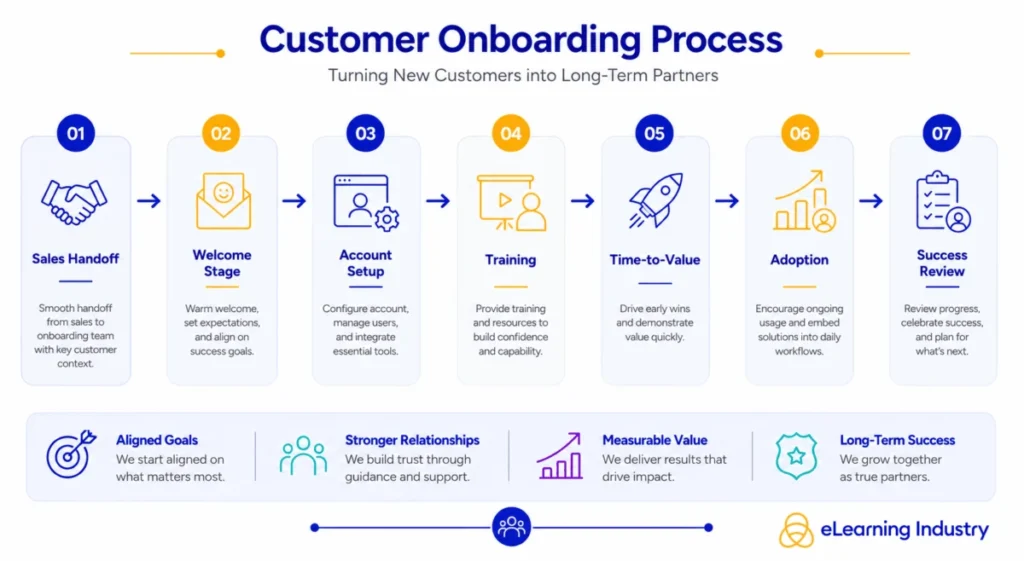
To be effective, the onboarding process must follow a structured, predictable timeline. A haphazard approach leads to inconsistencies that can frustrate high-value clients. The modern onboarding journey typically follows a six-stage chronology:
- The Pre-boarding Phase: This begins the moment a contract is signed. It involves sending a "Welcome" package and ensuring that the internal transition from the sales team to the customer success team is seamless.
- The Kickoff Meeting: This is the formal introduction where stakeholders from both sides align on goals, timelines, and key performance indicators (KPIs). It is the stage where "success" is defined in the customer’s own words.
- Configuration and Technical Setup: This phase involves the "heavy lifting"—integrating software with existing systems, migrating data, and setting up user permissions.
- User Training and Education: This is a pedagogical stage where users are taught not just how to use features, but how to achieve specific business outcomes using the tool.
- The First Value Moment: The organization monitors the customer closely to ensure they complete a meaningful task or achieve a goal using the product for the first time.
- The Transition to Success Management: Once the initial setup is complete, the customer is handed over to a long-term Customer Success Manager (CSM) for ongoing support and growth.
Strategic Best Practices for Maximizing User Adoption
Successful organizations do not treat onboarding as a "one size fits all" solution. Instead, they implement several best practices designed to personalize and streamline the experience.
Setting Success Milestones
Rather than overwhelming a new user with the entire suite of product features, effective onboarding breaks the journey into manageable milestones. These milestones should be time-bound and outcome-oriented. For example, a milestone might be "Complete team invitation by day three" or "Generate first report by day seven." These small wins build momentum and reinforce the customer’s decision to buy.

Goal-Centric Alignment
Too often, companies build onboarding around their own internal workflows. However, the most successful frameworks are built around the customer’s specific business goals. If a customer purchased a CRM to improve lead conversion, the onboarding process should prioritize the lead management features over general administrative settings.
Proactive Support and Feedback Loops
Waiting for a customer to submit a support ticket is a reactive strategy that often comes too late. Proactive onboarding involves using in-app analytics to identify when a user is "stuck" and intervening with automated tips or a personal check-in. Furthermore, building feedback loops—such as short surveys after the kickoff or training phases—allows the organization to iterate and improve the process in real-time.
The Role of Technology and Automation in Scaling Success
As businesses scale, maintaining a high-touch onboarding experience for every customer becomes operationally difficult. This is where customer onboarding software and automation become indispensable. These tools act as a central repository for all onboarding activities, replacing fragmented email chains and spreadsheets.
Workflow automation allows teams to trigger specific actions based on user behavior. For instance, if a user has not logged in for three days during the first week, an automated nudge can be sent to offer assistance. Task tracking ensures that both the vendor and the customer stay accountable to the agreed-upon timeline. Moreover, engagement analytics provide the data necessary to identify "friction points"—stages in the process where a high percentage of users drop off or take an unusually long time to complete a task.
Segmented Models: SaaS, Enterprise, and Self-Service Frameworks
The specific tactics used in onboarding vary significantly depending on the business model and the complexity of the product.
- The SaaS Model: Usually focuses on high-volume, high-velocity adoption. It relies heavily on automated welcome sequences, in-app walkthroughs, and digital academies. The goal is to get the user to a "self-sufficient" state as quickly as possible.
- The Enterprise Model: Characterized by high-touch, human-led interactions. Because enterprise deals often involve hundreds of users and complex integrations, the onboarding process may take months. It requires project management expertise and frequent stakeholder meetings to ensure alignment across multiple departments.
- The Self-Serve Model: Common in Product-Led Growth (PLG) companies, this model aims for zero-touch onboarding. The product itself must be intuitive enough to guide the user through setup without human intervention, often using "gamified" checklists to encourage completion.
Measuring Success: Key Performance Indicators and Analytics
To treat onboarding as a growth system, organizations must measure its effectiveness using specific metrics. The most critical KPI is often Time to First Value (TTFV). A shorter TTFV is almost always correlated with higher retention rates. Other essential metrics include:
- Activation Rate: The percentage of new users who perform a specific "core" action within a set timeframe.
- Training Completion Rate: The percentage of users who finish the educational modules provided.
- Feature Adoption Rate: The breadth and depth of feature usage across the customer’s user base.
- Customer Effort Score (CES): A metric derived from surveys asking how easy it was for the customer to get started.
By analyzing these metrics, leaders in Learning & Development (L&D) and Customer Success can pinpoint exactly where the onboarding process is failing and deploy targeted interventions.
Industry Perspectives and Long-term Implications
The shift toward sophisticated onboarding is a response to the "Subscription Economy," where the power has shifted from the seller to the buyer. In an era where switching costs are decreasing, the initial experience is the primary differentiator. Industry analysts suggest that companies with top-tier onboarding experiences see a 20% increase in revenue from existing accounts compared to those with mediocre processes.
Furthermore, the integration of Artificial Intelligence (AI) into onboarding is set to further personalize the journey. AI can analyze a new user’s industry and role to automatically tailor the training content they receive, making the process even more relevant.
Conclusion
Customer onboarding should no longer be viewed as a post-sale afterthought or a routine administrative task. It is a strategic imperative that dictates the long-term viability of a business. By transforming onboarding into a structured, data-driven growth system, organizations can ensure that their customers do not just "start" using a product, but thrive with it. Those who master the art of the "first impression" through a disciplined onboarding framework will find themselves better positioned to maintain loyalty, reduce churn, and drive sustainable revenue growth in an increasingly competitive global market. Success in the modern economy is not defined by the initial sale, but by the successful integration and continued satisfaction of the customer—a journey that begins and ends with effective onboarding.