The moment is stark and universally understood: a colleague confides that someone significant in their life has passed away. For many leaders, the immediate desire to offer support is quickly followed by a disquieting wave of uncertainty, often described as a "quiet panic" about what to do next. This article delves into the critical, yet often overlooked, challenges of supporting grieving employees in the professional sphere, drawing on extensive research to highlight the profound impact of loss on individuals and organizations, and to identify key areas for leadership development.
The etymology of "bereaved," derived from a word meaning "to be robbed," offers a profound insight into the subjective experience of grief. It underscores that grief is not a problem to be managed or a hurdle to be overcome, yet this is precisely the expectation often placed upon individuals in many organizational cultures. Bereavement, one of the most universal human experiences, affects nearly all working adults, frequently more than once. Despite its prevalence, most leaders receive inadequate preparation for supporting grieving employees. While good intentions abound, effective support often falls short, revealing a significant gap between what leaders aim to do and what genuinely helps. This gap, the research suggests, represents a crucial opportunity for leadership development, not to transform leaders into grief counselors, but to equip them with the skills to be present, honest, and willing to engage with situations they cannot fix.
Bereavement at Work: The Pervasive Toll of Loss
The intersection of profound personal loss and the demands of professional life creates a complex dynamic. Bereavement in the workplace is the reality when the experience of death and grief collides with the structured environment of work. Grief, inherently unpredictable and boundaryless, does not cease at the office door. It infiltrates professional life, impacting not only the bereaved individual but also their colleagues and the broader organizational fabric.
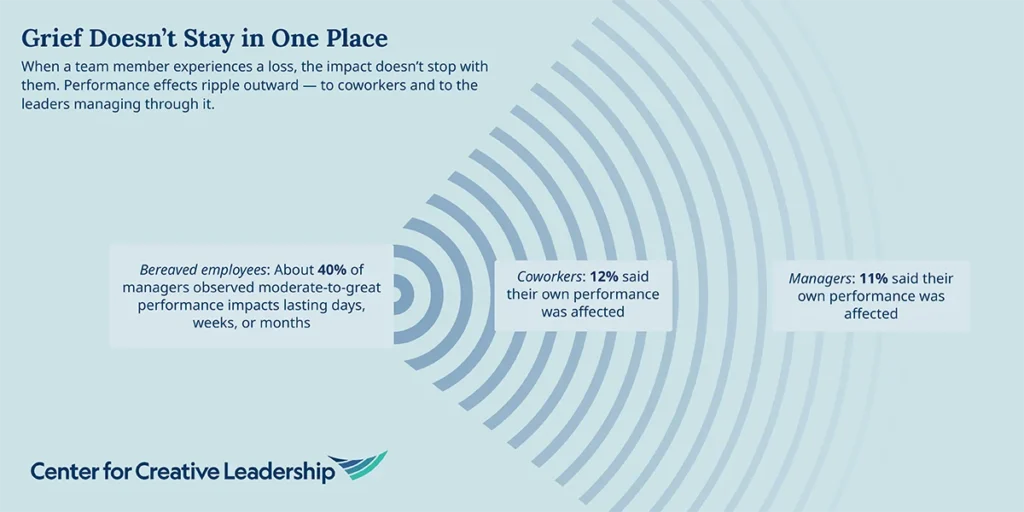
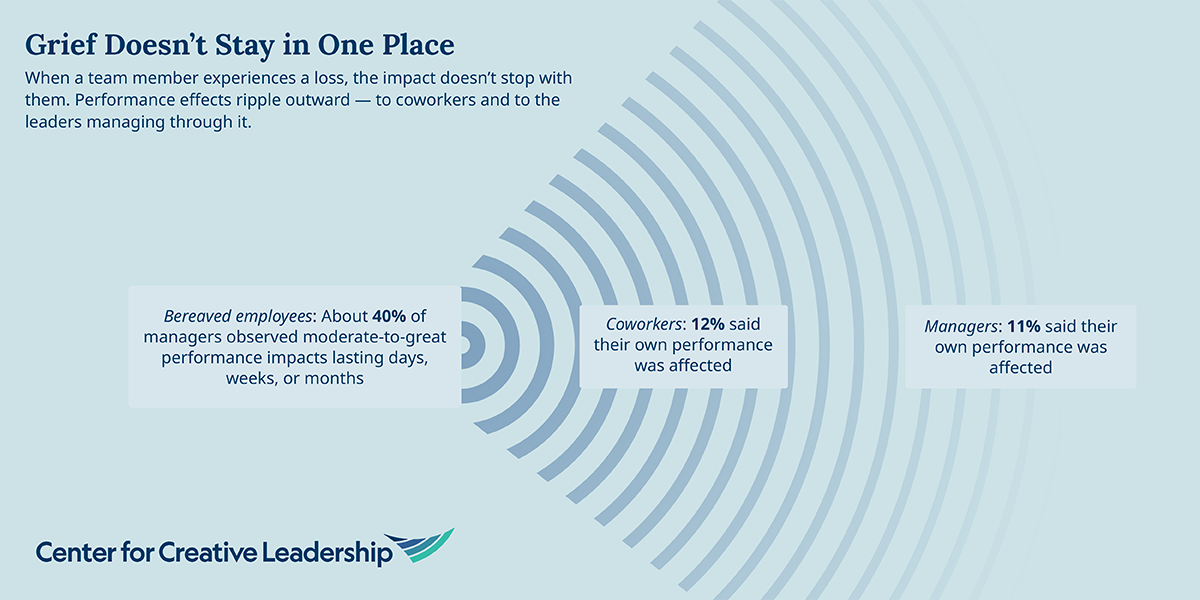
Research employing a three-perspective approach—surveying managers, coworkers, and bereaved employees—reveals a wider impact than often recognized. Data indicates that a staggering 90% of managers observed some level of performance impact in a bereaved employee, with approximately 40% noting moderate to significant declines lasting for days, weeks, or even months. More surprisingly, 11% of managers reported their own performance was affected, and 12% of coworkers experienced similar impacts. This demonstrates that bereavement ripples outward, disrupting the equilibrium of teams and departments.
The challenges are further exacerbated by the realities of bereavement leave policies. A substantial 73% of bereaved employees reported not having sufficient time off to grieve adequately. Compounding this, 28% of employees had no access to bereavement leave whatsoever. Consequently, individuals are often compelled to return to work before they are emotionally or mentally prepared, attempting to navigate the arduous emotional landscape of grief while simultaneously fulfilling professional responsibilities. This emotional burden is often compounded by practical responsibilities, such as funeral arrangements, estate management, and supporting other grieving family members. These statistics are not merely abstract productivity metrics; they are poignant indicators of the immense, often silent, burdens employees carry without adequate organizational support.
Supporting Grieving Employees: When Good Intentions Fall Short
The inherent human desire to help is a powerful motivator for leaders when a team member experiences loss. However, the capacity to want to help does not always translate into the knowledge of how to help effectively. Research indicates a concerning disparity: while 60% of bereaved employees felt their manager offered compassion to a great extent, a significant 20%—one in five individuals—reported receiving little to no support during one of life’s most challenging periods. This absence of leadership presence can leave employees feeling isolated and unsupported.
It is crucial to clarify what is not expected of leaders in these situations. Leaders are not tasked with finding the perfect words, fixing grief (an impossible endeavor), or accelerating an employee’s healing process (an unreasonable expectation). They are not therapists. Instead, effective support for grieving employees, as highlighted by research, is far simpler: it involves showing up, paying attention, offering options, and deferring to the employee’s lead.

Subtle Signals, Significant Impact: The Art of Observation
A critical finding from the research underscores the importance of proactive observation by leaders. Many managers tend to wait for overt signs of distress, such as an emotional breakdown or a missed deadline, before intervening. However, grief in the workplace rarely manifests so clearly. More often, it appears as subtle, harder-to-read changes in behavior and performance, as described by managers in the study. These may include:
- Reduced engagement: A noticeable decrease in participation in meetings or team activities.
- Changes in communication patterns: Becoming more withdrawn or, conversely, unusually verbose.
- Variations in productivity: Fluctuations in output, with periods of intense focus followed by noticeable dips.
- Increased errors: A rise in mistakes that are uncharacteristic for the individual.
- Hesitation or indecisiveness: Struggling with routine tasks that previously required little effort.
These are not immediate red flags, but rather subtle signals that, if missed, represent a lost opportunity to provide timely support. Conversely, certain leadership actions can inadvertently worsen the situation. These include:
- Minimizing the loss: Statements that downplay the significance of the deceased or the grieving process.
- Forcing a return to normalcy: Pressuring the employee to immediately resume pre-loss productivity levels.
- Making it about the business: Focusing solely on the impact of the employee’s absence on work output.
- Avoiding the topic: Acting as if the loss has not occurred, creating an awkward silence.
Checking in does not require certainty; it requires the capacity to notice.
Small Gestures, Lasting Impressions: The Power of Consistent Presence
In supporting grieving employees, consistent, low-key presence often carries more weight than grand gestures. Simple acts of kindness can create lasting positive impressions: a signed card expressing condolences, a quiet offering of coffee, or a brief, non-intrusive check-in that does not demand the employee feign normalcy. These actions signal an understanding and acknowledgment of the individual’s human experience.
In contrast, employees often recall unhelpful actions that, while perhaps well-intentioned, missed the mark. These can include:
- Overly enthusiastic attempts at cheering up: Trying to force positivity rather than acknowledging the sadness.
- Sharing personal anecdotes that are not relevant: Making the conversation about the leader’s own experiences.
- Offering unsolicited advice: Providing solutions without being asked.
- Disappearing after the initial notification: Failing to maintain contact and support over time.
The gesture itself is less important than the signal it sends: "I see you as a person, not merely as a role within this organization."
One Size Doesn’t Fit Grief: The Importance of Personalization
One of the most critical findings from the research is that grief is deeply personal, and employees require individualized support. Some may need space and solitude, while others may find solace in talking. Some may wish to immerse themselves in work as a distraction, while others require adjusted expectations and reduced workloads. However, many leaders tend to adopt a one-size-fits-all approach to bereavement at work, often defaulting to avoidance or excessive checking-in, rather than proactively asking about needs.
The solution is elegantly simple and relies on a fundamental leadership skill: asking. Questions like, "How can I support you right now?" or "Would you prefer to ease back in, or jump in?" are invaluable. Asking signals that the employee’s experience is valued and removes the guesswork that often leads to mismatched support. It is also important to acknowledge that employees may not always know what they need; offering options, allowing them time to adjust, and revisiting these conversations over time are key components of effective support.
When Leaders Get It Right: The Impact of Empathy and Flexibility
Bereaved employees vividly remember leaders who demonstrated genuine support during their time of loss. The most impactful responses often involved nothing more complex than flexibility, consistent presence, and protection from undue pressure. Leaders who excel in these situations typically:
- Paid attention and acted on observations: They noticed subtle changes and responded proactively.
- Advocated for additional time off: They understood when more leave was necessary and supported those requests.
- Checked in consistently but not excessively: They maintained contact without becoming overbearing.
- Allowed employees to set the pace: They respected the individual’s need to dictate their return to work and workload.
- Actively listened: They provided a non-judgmental space for employees to share their experiences.
- Acknowledged the loss directly: They understood the profound importance of validating the employee’s grief.
Bereavement at Work: A Critical Leadership Development Opportunity
Even well-established leadership development programs often contain gaps when it comes to navigating unscripted human moments. A colleague’s bereavement is a prime example of such a moment, one for which most leaders are woefully unprepared. The research indicates that a significant 73% of managers acknowledge needing training on how to support a bereaved employee, indicating a clear demand for foundational human skills to support their teams effectively.
The capabilities required to respond compassionately and effectively to a grieving employee are not new to leadership development; they are, in fact, at its very core. These include emotional intelligence, self-awareness, empathy, the ability to conduct difficult conversations, and coaching presence. Bereavement in the workplace serves as a high-stakes, real-world test of these essential leadership skills, one for which many leaders have never been specifically prepared.
The answer lies not in creating isolated bereavement programs, but in integrating these principles into existing leadership development frameworks. Every module on emotional intelligence can, in part, address how a leader might navigate grief in the workplace. Discussions on empathy can explore how to sit with someone who is grieving. Coaching skills training can prepare leaders to ask, without rushing, "How are you really doing?" and "What else do you need to be supported?" This is not about adding a new layer to leadership development; it is about applying a new lens to the competencies that already form its foundation.
The Path Forward: Readiness for Human Connection
Bereavement is an inevitable aspect of organizational life, touching every workplace and team. The critical question is whether leaders will be adequately prepared when they encounter it. This readiness is not contingent on possessing perfect words, but on cultivating the skills to notice, to inquire, and to follow the lead of the individual experiencing loss. It is, fundamentally, about being "human first," as one research participant eloquently put it.
Organizations should consider where in their leadership curricula managers learn to sit with another person’s pain or practice saying, "I don’t know what to say, but I am here." Developing leaders who can genuinely show up for their people in the ways they most need is a critical and profoundly worthwhile endeavor.
The ongoing research into bereavement at work continues to uncover valuable insights. Organizations and individuals interested in staying informed on the latest findings are encouraged to subscribe to relevant newsletters and updates. By fostering environments that acknowledge and support employees through profound loss, businesses can not only strengthen their teams but also cultivate a more compassionate and resilient organizational culture.