The proliferation of artificial intelligence in hiring processes has spurred a wave of regulatory action across the globe. However, a critical oversight in many compliance checklists is the tendency to lump these distinct AI hiring laws into a single, undifferentiated category. This approach is not only inaccurate but also dangerously outdated, as the legal frameworks governing AI in employment are dynamic, with varying effective dates, enforcement mechanisms, and definitions of compliance. For employers operating across state lines and international borders, understanding these nuances is paramount to avoiding costly legal missteps and maintaining ethical hiring practices. Treating AI hiring laws as a monolithic entity risks rendering compliance strategies obsolete the moment they are formulated, leading to potential misrepresentations to candidates and regulators alike.
Understanding the Divergent Timelines and Obligations
The critical flaw in a generalized approach to AI hiring law compliance lies in the fundamental differences between each regulation. These are not minor variations; they represent distinct legal obligations with separate enforcement mechanisms and, crucially, different timelines for activation and ongoing adherence. Miscalculating a single effective date or misunderstanding a specific requirement can lead to significant liabilities. This could manifest as incorrectly assuring a candidate that a specific compliance control is in place when it is not, or conversely, asserting that a regulation does not apply when it has already come into effect.
A detailed examination of key AI hiring regulations reveals a complex tapestry of legal requirements:
New York City Local Law 144: The Pioneer in AI Hiring Audits
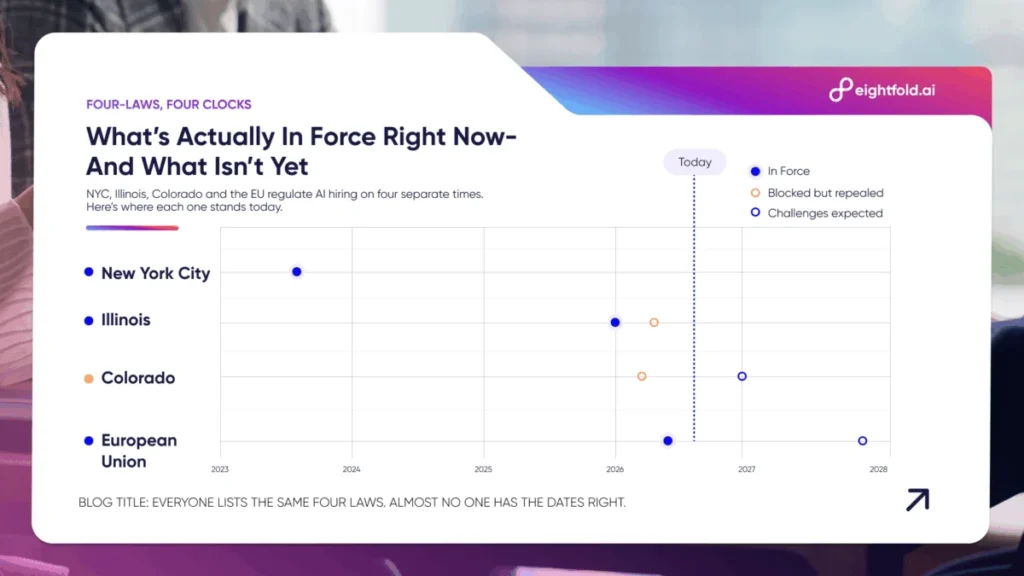
Status: In effect since July 5, 2023.
Key Requirement: This landmark legislation mandates that any automated tool used to evaluate candidates for roles based in New York City must undergo an independent bias audit. This audit must be conducted annually and its findings, including selection rates and impact ratios by demographic category, must be published in an accessible location for candidates. Employers are also required to provide candidates with at least ten business days’ notice before using an automated tool in the hiring process, along with instructions on how to request an alternative selection process.
Background and Context: NYC Local Law 144 emerged from growing concerns about the potential for algorithmic bias to perpetuate or even exacerbate existing inequalities in the hiring process. The city’s Department of Consumer and Worker Protection (DCWP) is responsible for its enforcement. A tool operating without a current, independently verified bias audit is considered non-compliant, regardless of its perceived performance. The law emphasizes transparency and accountability, requiring employers to not only conduct audits but also to publicly disclose key metrics derived from these audits. This proactive approach by New York City set a precedent for other jurisdictions considering similar legislation.
Implications: For businesses hiring for positions within New York City, compliance with Local Law 144 is not optional. It necessitates a robust system for managing AI tools, conducting regular audits, and ensuring transparent communication with candidates. The annual nature of the bias audit means that companies must maintain ongoing vigilance and integrate these requirements into their operational workflows.
Illinois HB 3773: Integrating AI into Existing Anti-Discrimination Frameworks
Status: Effective January 1, 2026, with implementing rules still under development.
Key Requirement: Illinois has adopted a more integrated approach, folding AI-assisted employment decisions directly into the state’s existing Human Rights Act. The law requires employers to notify candidates when AI plays a role in hiring, promotion, discipline, or discharge decisions. Crucially, employers must be able to explain the function of these AI tools in plain language. The law clarifies that discriminatory outcomes resulting from AI are not treated as novel "AI violations" but are prosecuted under the same framework as human-driven discriminatory decisions, a statute that Illinois has enforced for decades.
Background and Context: The Illinois approach underscores the principle that algorithmic decision-making is not an excuse for discrimination. The adage, "the algorithm decided, not us," is explicitly rejected as a defense. This legislative strategy aims to ensure that the existing protections against employment discrimination are extended to cover AI-influenced decisions.
Challenges and Delays: A notable development is the withdrawal of proposed implementing rules by the Illinois Department of Human Rights in June 2026. The department cited a need for continued coordination with other state agencies, with no revised timeline provided for the release of new rules. Despite this, the core statutory duties regarding notification and non-discrimination remain in full effect. Employers are still obligated to provide notice and ensure fairness, but the precise regulatory details on acceptable notice language and timing are currently unsettled.
Implications: While the statute is live, the lack of finalized implementing rules creates a degree of uncertainty for employers. They must adhere to the spirit and letter of the law by providing notifications and avoiding discriminatory outcomes, but the specific implementation details remain fluid. This necessitates ongoing monitoring of regulatory updates from Illinois authorities.
Colorado Senate Bill 26-189: A Revised and Lightened Approach
Status: Scheduled to take effect on January 1, 2027, with potential for further litigation.
Key Requirement: Colorado’s journey with AI regulation has been marked by significant revisions. The original AI Act (SB 24-205) was considerably more stringent, mandating impact assessments, an explicit duty to prevent algorithmic discrimination, and ongoing risk-management programs. However, this initial legislation faced a federal court challenge and was blocked from enforcement in April 2026. In response to legal pressure and industry pushback, Colorado repealed the original act and enacted Senate Bill 26-189, which significantly lightens the regulatory burden. The new law, effective from 2027, requires advance notice before using "covered automated decision-making technology." It also mandates a plain-language explanation within 30 days of an adverse decision, a right to request data correction, and a right to request human reconsideration, albeit qualified by the phrase "to the extent commercially reasonable."
Background and Context: The repeal and reenactment of Colorado’s AI legislation highlight the challenges in crafting effective and constitutionally sound AI regulations. The initial bill was viewed by some as overly burdensome, prompting legal challenges. The revised SB 26-189 represents a compromise, focusing on transparency and recourse rather than extensive pre-deployment assessments.
Ongoing Uncertainty: Reports indicate that legal challenges to this revised version are anticipated. Therefore, the January 1, 2027 effective date should be treated as a target rather than a settled certainty. The qualification of "commercially reasonable" for human reconsideration introduces another layer of interpretation that may be subject to legal scrutiny.
Implications: Employers need to be prepared for the January 1, 2027, effective date, ensuring they can provide the required advance notice and post-decision explanations. However, they should also remain aware of the potential for further legal developments that could alter the landscape once again.
The European Union AI Act: A Comprehensive Framework for High-Risk Applications
Status: High-risk hiring obligations effective December 2, 2027.
Key Requirement: The EU’s AI Act establishes a comprehensive regulatory framework for AI systems, categorizing them based on risk. For recruitment and employee evaluation tools, designated as "high-risk," specific obligations will become effective on December 2, 2027. These include mandatory risk management, technical documentation, human oversight, and formal conformity assessments.
Background and Context: The EU AI Act is a landmark piece of legislation aiming to ensure that AI systems developed and used within the European Union are safe, transparent, traceable, non-discriminatory, and environmentally sustainable. The recent Digital Omnibus deferral, finalized in July 2026 as Regulation (EU) 2026/1744, pushed the implementation of Annex III high-risk obligations, including those pertaining to recruitment, from August 2026 to December 2, 2027.

Immediate Transparency Duty: Importantly, Article 50 of the AI Act, which mandates transparency, was not subject to this delay. This means that any candidate interacting with an AI interviewer within the EU should already be informed that they are engaging with an AI system during that conversation.
Penalties for Non-Compliance: The penalties for non-compliance with high-risk AI provisions are significant, with fines reaching up to €15 million or 3% of global annual turnover, positioning it as a substantial deterrent.
Implications: Businesses operating within or targeting the EU market must prepare for the December 2, 2027 deadline by establishing robust compliance programs for their high-risk AI systems. This includes detailed documentation, ongoing risk assessment, and ensuring human oversight is integrated into AI-driven processes. The immediate transparency requirement also necessitates prompt adjustments to candidate communication protocols.
The Federal Baseline: Enduring Anti-Discrimination Laws
It is crucial to recognize that these emerging AI-specific laws do not supersede existing federal anti-discrimination statutes in the United States. Title VII of the Civil Rights Act of 1964, the Americans with Disabilities Act (ADA), and the Age Discrimination in Employment Act (ADEA) continue to provide a fundamental legal baseline for employers. Title VII and the ADA apply to employers with 15 or more employees, while the ADEA covers those with 20 or more. These laws prohibit employment discrimination regardless of whether the decisions are made by a human or an AI.
Furthermore, guidance from the Equal Employment Opportunity Commission (EEOC) on algorithmic risk, such as its 2022 ADA technical assistance and 2023 Title VII guidance, complements these statutes. While not enacted laws themselves, they offer important insights into how federal agencies interpret and will enforce existing anti-discrimination principles in the context of AI. It is also important to note that a vendor’s audit results do not absolve an employer of its own legal responsibilities and potential liabilities.
AI Hiring Compliance: Four Distinct Levers, One Employer Imperative
The differences between these AI hiring laws are not merely cosmetic; they represent fundamentally distinct regulatory philosophies and operational requirements.
- New York City’s Audit-and-Publish Model: This approach demands proactive, annual validation of AI tools through public disclosure of audit results. Compliance is measured by the ability to demonstrate fairness through data, irrespective of intent.
- Illinois’s Integrated Civil Rights Framework: Illinois leverages its existing anti-discrimination statutes, treating AI-assisted decisions as subject to the same legal scrutiny as human decisions. The focus is on preventing discriminatory outcomes within an established legal structure.
- Colorado’s Notice-and-Recourse Model (Post-Revision): The revised Colorado law emphasizes transparency and candidate recourse. Employers must inform candidates in advance, provide explanations for adverse decisions, and offer avenues for data correction and human review, with the latter qualified by commercial reasonableness.
- The European Union’s Product-Safety Approach: The EU AI Act adopts a framework akin to product safety regulation. High-risk AI systems must be classified, meticulously documented, rigorously assessed, and proven compliant before deployment. This is a more proactive, pre-market approval-style regulation.
While the underlying concern across all these regulations is the prevention of bias and discrimination, the mechanisms for achieving and demonstrating compliance are entirely dissimilar. A vendor capable of addressing only one of these compliance models will likely be insufficient for an employer operating across multiple jurisdictions.
Building a Dynamic and Effective AI Hiring Compliance Checklist
Given the evolving nature of these regulations, a static checklist is insufficient. A truly effective compliance strategy requires a dynamic approach that acknowledges and adapts to the nuances of each legal framework. Key elements of such a strategy include:
- Jurisdictional Mapping: Clearly identify all jurisdictions where the employer hires or plans to hire, and map the specific AI regulations applicable in each. This includes considering the location of the role, the candidate, and the employer’s footprint.
- Understanding "In Force" Definitions: Recognize that "in force" can mean different things. Some laws are fully operational with clear enforcement, while others may be statutes with pending regulations or ongoing legal challenges.
- Defining Audit Validity: Critically assess what constitutes a valid bias audit. This involves understanding statistical methodologies, sample sizes, and how to differentiate between genuine bias and random data fluctuations. This is often a complex statistical and methodological question, not solely a legal one.
- Vendor Accountability and Contracts: While vendors may perform certain tasks, employers remain ultimately responsible for compliance. Contracts should clearly delineate responsibilities, and employers must conduct due diligence on vendor tools and processes.
- Regular Review and Updates: The landscape of AI regulation is in constant flux. Compliance strategies and checklists must be reviewed at a minimum quarterly, and more frequently when new tools are introduced or when expanding into new geographic areas.
What Remains Unaddressed: The Deeper Challenges
Beyond the immediate compliance requirements, several critical questions remain largely unanswered by current legislation:
- The Nuances of Audit Validity: None of the laws definitively specify what constitutes a statistically sound and legally defensible bias audit. Questions regarding appropriate sample sizes, methodologies, and the interpretation of disparate impact ratios are often left to interpretation and may require expert statistical analysis. This is a significant gap that goes beyond mere legal compliance.
- The Evolving Nature of Law: Effective dates can and do shift. The content of these laws can be amended or challenged, as seen in Colorado. Relying on outdated information can lead to severe consequences.
It is imperative for employers to consult with legal counsel to ensure their compliance strategies are robust and current. The information provided in any public forum, including this article, should serve as a starting point for understanding, not a substitute for professional legal advice tailored to a specific business context.
Frequently Asked Questions
Q: Does a later EU deadline impact live obligations in NYC or Illinois?
A: No. Each jurisdiction’s timeline operates independently. Employers must meet all applicable deadlines currently in force, regardless of pending regulations elsewhere.
Q: Is an employer responsible for a vendor’s AI tool?
A: Yes. While contracts can allocate tasks, they do not absolve the employer of their own employment law liabilities. A human decision-maker must remain involved at critical junctures.
Q: Is a Local Law 144 alternative process the same as an ADA accommodation?
A: No. These are distinct processes with separate requirements and do not substitute for one another.
Q: What should staffing firms understand about the EU AI Act?
A: Firms developing or materially modifying AI tools are considered "providers" with documentation duties. Those simply using tools for recruitment are "deployers" following provider instructions. Both roles have obligations that should be clearly defined in contracts, with legal counsel.
Q: How does location affect AI hiring law coverage?
A: Location is multifaceted. Map the candidate’s location, the role’s location, and the employer’s footprint. NYC coverage, for example, can hinge on the job’s location, even if interviews occur elsewhere. Remote work nuances are jurisdiction-specific and require legal counsel.
Q: What if an NYC audit is older than 12 months?
A: The tool cannot be used for covered NYC hiring activities until a current, independent bias audit is completed and the required summary is published.
Q: How frequently should this regulatory map be reviewed?
A: At a minimum, quarterly reviews are recommended. Additionally, reviews should occur before launching any new AI tool or expanding into new role locations, as these regulatory timelines evolve rapidly.