As the global economy grapples with the rapid integration of artificial intelligence and a widening skills gap, the "Four Stages of Competence" model has re-emerged as a critical framework for corporate training and organizational development. Originally developed in the 1970s, this psychological model—often referred to as the conscious competence learning matrix—provides a structured roadmap for how individuals transition from total ignorance of a skill to reflexive mastery. In an era where the World Economic Forum predicts that 50% of all employees will need reskilling by 2025, understanding these stages is no longer a theoretical exercise but a strategic necessity for business continuity.
The Genesis and Evolution of the Competence Model
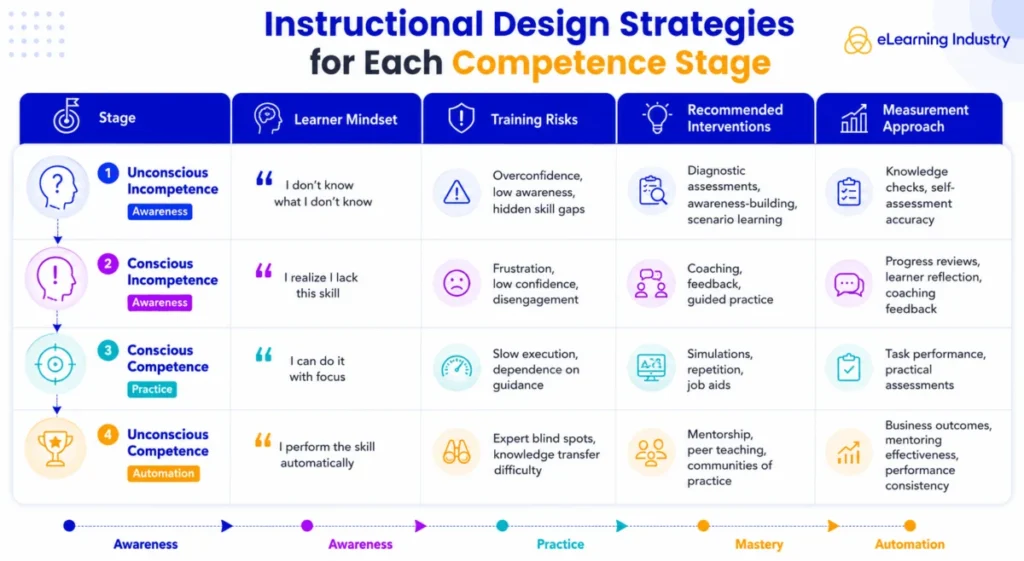
The Four Stages of Competence model is widely attributed to Noel Burch of Gordon Training International, though its roots are often linked to the work of Abraham Maslow and other pioneers of humanistic psychology. The framework posits that learners move through a linear progression of awareness and ability. This journey begins with a lack of awareness regarding one’s own deficiencies and concludes with "automaticity," where a skill is performed without conscious thought.
Historically, the model served as a tool for personal development and classroom teaching. However, the contemporary corporate landscape has adopted it to address more complex challenges, such as digital transformation and leadership transitions. By identifying where an employee sits on this spectrum, Instructional Designers (IDs) and Learning and Development (L&D) leaders can tailor interventions that minimize frustration and maximize the return on training investment.
Stage 1: Unconscious Incompetence and the Dunning-Kruger Effect
The first stage, unconscious incompetence, is characterized by a "blind spot." At this level, the individual does not understand how to do something and, more importantly, does not recognize the deficit. In many cases, this leads to misplaced confidence, a phenomenon closely related to the Dunning-Kruger Effect, where low-ability individuals overrate their own competence.
In the modern workplace, this often occurs during the adoption of new technologies. An employee might believe they are proficient in data analysis because they can navigate a basic spreadsheet, unaware of the advanced capabilities of AI-driven analytics tools. From a risk management perspective, this stage is the most dangerous. Unconscious incompetence in high-stakes environments—such as healthcare or heavy manufacturing—can lead to safety violations and costly operational errors.
L&D professionals argue that the goal at this stage is not immediate skill acquisition but "conscious-raising." Through diagnostic assessments, peer benchmarking, and simulated "stress tests," organizations can gently reveal the gap between an employee’s current performance and the required standard.
Stage 2: Conscious Incompetence and the Psychological Hurdle
The transition to stage two, conscious incompetence, is often the most psychologically taxing part of the learning journey. Here, the "veil of ignorance" is lifted. The learner recognizes the importance of the skill and becomes acutely aware of their inability to perform it. While this realization is necessary for growth, it frequently results in a temporary drop in morale and self-efficacy.
Industry data suggests that this is the "quit zone"—the point at which employees are most likely to disengage if they feel unsupported. According to recent workforce surveys, nearly 40% of employees who receive poor job training leave their positions within the first year. To mitigate this, organizations must foster a culture of psychological safety.
"When learners recognize their limitations, they reach a state of conscious incompetence," notes the framework. "This stage can feel uncomfortable because employees now see what they cannot do well yet. Still, it is an important stage because motivation and growth often start here." At this juncture, mentorship and incremental feedback are vital. Training must be broken down into manageable "micro-learning" segments to prevent cognitive overload.

Stage 3: Conscious Competence and the Burden of Effort
Once a learner acquires the necessary knowledge, they enter the stage of conscious competence. At this level, the individual can perform the task successfully, but only through intense concentration and deliberate effort. The skill has not yet been "hard-wired" into the brain’s neural pathways.
For example, a new manager in this stage might successfully conduct a performance review, but they must strictly follow a checklist and rehearse their talking points extensively. While the outcome is positive, the process is mentally exhausting.
Instructional Designers support this stage by providing "just-in-time" performance aids, such as checklists, workflow guides, and simulations. The objective is to provide a safety net that allows for repetition. Research in neurobiology suggests that repetition is the primary driver of myelin production—the fatty tissue that insulates nerve fibers and speeds up electrical signals in the brain—which is essential for moving to the final stage of mastery.
Stage 4: Unconscious Competence and the Expert Blind Spot
The pinnacle of the model is unconscious competence. Here, the skill has become second nature. An expert in this stage can perform complex tasks while simultaneously focusing on other variables. A seasoned pilot, for instance, can manage cockpit communications and weather changes with a level of "flow" that requires minimal conscious thought.
However, this stage introduces a unique organizational risk known as the "expert blind spot." Because the skill is now automatic, experts often struggle to explain the individual steps of a process to beginners. They may skip over foundational details that they perceive as "obvious," leading to gaps in training for new hires.
Christopher Pappas, CEO of eLearning Industry, emphasizes the need for a nuanced approach to measuring this progress: "Many organizations focus on course completion to measure learning, but real progress comes from tracking how employees build their skills over time. Training works best when we understand where people are in their development and provide the support they need to keep growing."
Strategic Implications for the AI-Driven Workplace
The integration of AI and automation has created a "continuous loop" of the four stages. Even seasoned experts who have reached unconscious competence in their fields are being pushed back to stage one as new tools redefine their roles.
- Reskilling and Upskilling: As manual tasks are automated, employees must move through the competence stages for "soft skills" like critical thinking and emotional intelligence.
- Onboarding Efficiency: Companies using the competence model report faster "time-to-productivity" for new hires. By identifying unconscious incompetence during week one, training can be front-loaded to address specific gaps rather than using a generic orientation.
- Leadership Development: Transitioning from a technical role to a leadership role requires moving through the stages of emotional intelligence and conflict resolution. Organizations that recognize this transition provide coaching rather than just "management training."
Sector-Specific Applications: From Sales to Healthcare
The application of the Four Stages of Competence varies across industries, each with its own set of stakes and metrics.
- Sales Enablement: In high-pressure sales environments, moving from conscious competence (following a script) to unconscious competence (natural, consultative dialogue) is the difference between a mid-level performer and a top-tier earner. Role-playing and real-time feedback loops are the primary tools used here to build "muscle memory."
- Technical and Compliance Training: In regulated industries like healthcare or aerospace, competence is a matter of legal and physical safety. These sectors often utilize competency-based curricula where a learner must prove mastery at stage three (conscious competence) through rigorous testing before they are permitted to work in the field.
- Digital Transformation: When a company migrates to a new Enterprise Resource Planning (ERP) system, the entire workforce is effectively reset to stage one. Change management professionals use the competence model to predict the "dip" in productivity that occurs during stage two (conscious incompetence) and plan support resources accordingly.
Conclusion: Building a Resilient Workforce
The Four Stages of Competence model remains one of the most enduring tools in the L&D arsenal because it mirrors the reality of human cognition. It acknowledges that learning is not a switch that is flipped, but a gradual process of neurological and behavioral change.
In a volatile labor market, the organizations that will thrive are those that do not merely "train" their employees, but those that understand the journey from ignorance to mastery. By aligning instructional design with the specific needs of each competence stage, leaders can reduce the friction of change, accelerate the acquisition of new skills, and foster a culture of lifelong learning. As the pace of technological change continues to accelerate, the ability to move through these four stages efficiently may become the ultimate competitive advantage.