
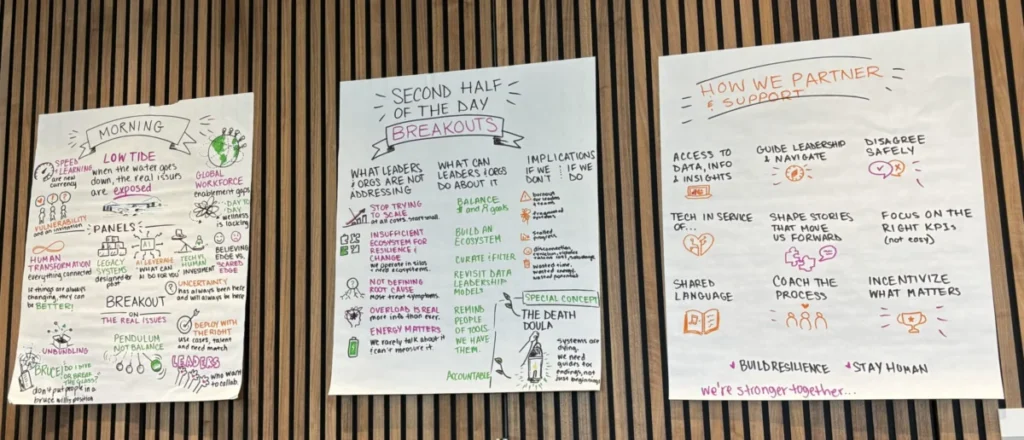
A recent summit in the Chicago area, orchestrated by workforce strategists Ian Ziskin and Cheryl Perkins, brought together a diverse group of Chief Human Resource Officers (CHROs), Chief Executive Officers (CEOs), academics, coaches, and other industry leaders. The gathering aimed to provide a candid and unvarnished examination of the systemic challenges plaguing modern workplaces and to collaboratively explore innovative solutions for the future of work. The event, attended by representatives from HR Executive magazine, fostered an environment for direct dialogue designed to move participants from a state of frustration to one of actionable possibility.
"Organizations are navigating unprecedented levels of complexity," stated Cheryl Perkins, CEO of Innovationedge LLC and co-founder of the summit. "Leaders are tasked with balancing significant workforce shifts, the accelerating integration of Artificial Intelligence, evolving employee expectations, and the relentless pace of change, all while striving to cultivate healthy, high-performing organizations." Perkins emphasized that the summit’s core objective was to facilitate the candid conversations necessary to challenge existing assumptions and identify new pathways towards creating workplaces that are more human-centric, effective, and sustainable.
A central theme that emerged from the discussions was a critical misdiagnosis of current organizational challenges. Many companies, the experts observed, are convinced they are undergoing a technological transformation when, in reality, they are grappling with a fundamental human transformation. This mismatch is manifesting in widely reported symptoms such as pervasive change fatigue, declining workforce engagement, overburdened leadership, and fragmented technology adoption. These issues, participants agreed, often trace back to a single root cause: an overemphasis on technology without a corresponding focus on the human element.
Josh Greenwald, Chief People Officer at Sword Health, articulated this sentiment succinctly. "I think we’re approaching this concept of AI transformation incorrectly," he remarked. "This is more about human transformation. We spend too much emphasis on technology. Technology is just the medium to actually make us smarter." This perspective highlights a growing consensus that technological advancements, while powerful, are merely tools that can amplify human capabilities; they are not inherently solutions to underlying organizational or human-centric problems.
The "Low Tide" Phenomenon: Unearthing Legacy Issues
The summit featured dedicated panels that delved into the current pressures on leaders and the imperative for organizations to re-evaluate their foundational structures. Jamie Jacobs, CEO of Gig Talent, introduced the concept of the "low tide" problem. He explained that during periods of economic prosperity, organizations often fail to address underlying issues. However, as economic conditions tighten, these submerged problems become starkly visible. "We’re seeing the things on the beach," Jacobs observed, referring to legacy organizational systems and leadership models designed for a bygone era. He argued that these outdated structures are the root cause of many contemporary workplace struggles.
Stela Lupushor, Founder of Reframe.Work Inc. and a faculty member at NYU, noted that the intersection of human-centered design and technological investment is reaching a new level of maturity. However, she pointed out that most organizations are still fixated on adoption as the primary goal, rather than focusing on achieving tangible, material organizational gains. This often leads to the deployment of AI across siloed systems, yielding only modest efficiencies and leading to the conclusion that the investment was not worthwhile.
Srikant Chellappa, CEO of Engagedly, underscored the fragmentation of current technology implementations. "No systems are talking amongst themselves," he stated. "Deploying AI with the right use cases, in the right context… nobody knows what that is." This lack of integration and clear strategic direction contributes to inefficient resource allocation and diminishes the potential impact of technological investments.
The evolving landscape of employment, characterized by shifting patterns in traditional employment, the rise of gig and fractional work arrangements, and a move towards skills-based organizations, was also a significant topic of discussion. Anthony Nyberg, Director of the Center for Executive Succession at the University of South Carolina’s Darla Moore School of Business, explained that these trends are responses to mounting pressures within the workforce. He highlighted that existing organizational policies and support systems were not designed to handle the redistribution of burdens inherent in these new work models. "The risks are no longer bundled by organizations," Nyberg warned. "They’ve transferred onto the workers." This shift places greater responsibility and potential vulnerability on individual employees, often without adequate organizational support.
Leaders in Isolation: The Burden of Uncharted Territory
A critical concern raised during the summit was the predicament of leaders themselves. Many executives are being asked to guide their organizations through this period of intense change while simultaneously grappling with their own uncertainties and challenges. Harriet Harty, Founder and CEO of Harriet Harty Executive Solutions and a former CHRO at Allstate Insurance, posited that leaders are increasingly isolated in their roles. "I think leaders are in a silo right now," she observed. "They know what needs to happen, but don’t have the clarity around where they need to go. The how has never been given to them." This lack of clear direction and support can lead to paralysis and hinder effective decision-making.

Liz Huldin, CHRO at Great Day Improvements, connected this leadership isolation to talent strategy. She explained that misalignment at the executive level can foster dissatisfaction, even among high-performing employees who have invested heavily in their careers but find themselves unable to adapt at the pace required by the evolving business environment. This can lead to talent attrition and a decline in overall organizational agility.
Gabriel Machado, Director of Contract Manufacturing Services at Rockline Industries, offered a compelling analogy, suggesting that organizations often approach problems like machines to be fixed, rather than gardens to be cultivated. "It’s more about creating the conditions so that things can move in the right direction," he said. "The human element is a big component." This perspective emphasizes the need for a nurturing and adaptive approach to organizational development, recognizing the organic and complex nature of human systems.
An audience member raised a crucial point about the underlying trust deficit within organizations. This deficit, she argued, exacerbates challenges related to change management, technology adoption, and workforce readiness. Organizations are accelerating their pace of operations and communication, expecting employees to navigate constant uncertainty without sufficient support or resources to make sense of it all. "Where is the conversation in all of this?" she questioned. "Leaders talk about what we’re going to say to them, but we’re not necessarily talking with them." This highlights a critical need for genuine dialogue and a shift from top-down communication to collaborative engagement.
Simplifying the Path Forward: Essential Capabilities for the Future Workforce
The discussion also turned to the practical implications of AI’s growing role in the workplace. Shannon Wallis, founder of Cascade Leadership, noted that major employers like Microsoft and Amazon are scaling back on hiring recent graduates, as entry-level tasks are increasingly being automated by AI agents. This phenomenon means that managers being promoted to higher responsibilities may not have had the foundational experience of building their leadership skills through traditional entry-level roles. "You don’t go from 0 to 10 masterfully," she cautioned, underscoring the need for structured leadership development programs.
Jill Wrobel, Executive Vice President and CHRO at Brunswick Corporation, the host company for the summit, shared insights from her organization’s experience. Brunswick has successfully implemented productivity tools that are well-received by employees. However, Wrobel emphasized that achieving significant gains beyond incremental improvements requires a fundamental redesign of workflows and strategic business model choices. "In order to get the tech investment to pay off, we actually have to change how this works," she stated. This sentiment reinforces the idea that technology is an enabler, not a substitute, for strategic organizational change.
Josh Greenwald offered a concise framework for building a future-ready workforce, urging a focus on four core capabilities: "If we just focus on those four things and don’t try to overcomplicate it, you create a whole new generation of the workforce." While the original text did not explicitly list these four capabilities, the implication is that they are fundamental to equipping individuals for the evolving demands of the workplace. These would likely include critical thinking, adaptability, digital literacy, and collaborative problem-solving, among others.
The Reshaping of Knowledge Work and the Imperative for Resilience
The insights shared at the summit arrive at a pivotal moment. As Anthony Nyberg highlighted, the nature of disruption has fundamentally changed. Previous waves of automation primarily impacted frontline and operational roles. However, the current AI era is profoundly reshaping knowledge work and management structures. Significantly, those with the most power and influence in organizations are now facing direct disruption. This group also possesses the greatest capacity to impede change if they feel threatened. "This is the first time in the history of our industrial society that the change is happening from supervisor up," Nyberg remarked, indicating a paradigm shift in how organizational evolution is being driven.
Ian Ziskin, co-founder of the summit, summarized the overarching sentiment and the critical need for action. "Fear, uncertainty, and a constant sense of feeling overwhelmed are currently paralyzing leaders and the workforce," he concluded. "We must rethink our approach to defining and building leadership capabilities and help all people feel more change-ready and resilient. AI is a powerful tool to help, but it is not a substitute for common sense and human touch." This final statement encapsulates the core message of the summit: that while technology offers immense potential, it must be guided by human wisdom, empathy, and strategic foresight to navigate the complexities of the modern workplace effectively.
The "What’s Not Working @ Work?" Summit was presented by Ian Ziskin, president of EXec EXcel Group, and Cheryl Perkins, CEO of Innovationedge LLC. The event was generously sponsored by the Center for Executive Succession at the University of South Carolina, Engagedly, Gig Talent, the Innovation Resource Center for HR, Talent Connections, Cyberhill Partners, and Brunswick Corporation, underscoring the broad industry recognition of the critical issues addressed.







