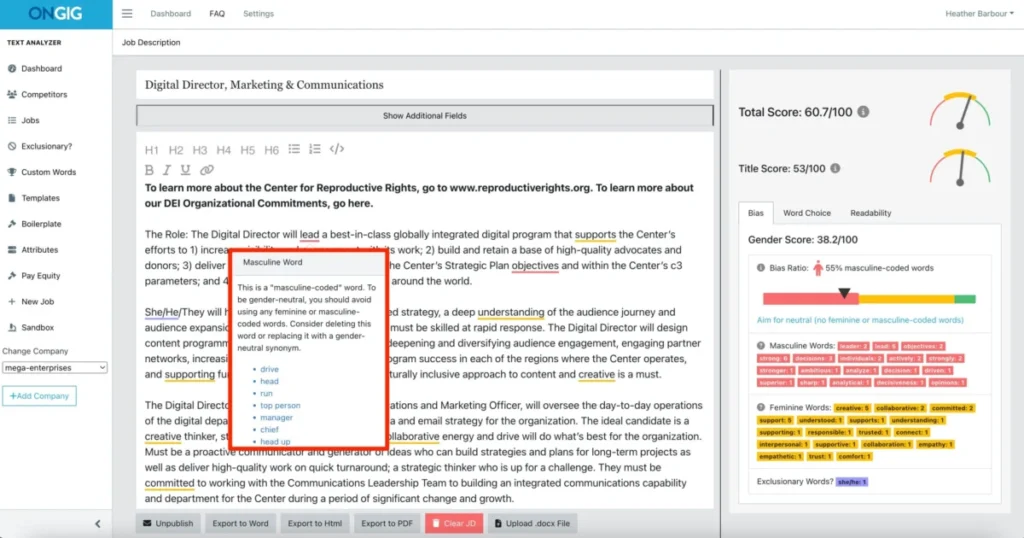
A new analysis by Ongig, a leader in recruitment technology, highlights the persistent challenge of gender-biased language in job descriptions, revealing that words like "strong," "lead," and "independently" remain prevalent offenders. The study, which reviewed nearly 50,000 job descriptions in the United States between January 1 and July 13, 2026, underscores how subtle linguistic choices can significantly deter female applicants and impede diversity initiatives. The findings reinforce the critical need for companies to adopt gender-neutral language to foster more inclusive hiring practices and expand their talent pools.
The Methodology Behind the Findings
Ongig’s comprehensive analysis utilized its proprietary Text Analyzer software, a specialized tool designed to detect gender bias in recruitment language. This week, the Text Analyzer processed a substantial dataset of 48,246 random job descriptions sourced from U.S.-based companies of varying sizes and across diverse industries. The software’s capabilities are rooted in a sophisticated masculine vocabulary library, which has been meticulously compiled from extensive social science and artificial intelligence research. This library allows the Text Analyzer to accurately flag words and phrases that, while often used without conscious intent, have been scientifically shown to resonate more strongly with one gender over another.
The focus of this particular report was on identifying words that were most frequently flagged by the Text Analyzer and subsequently swapped out by users seeking gender-neutral alternatives. This data, collected between January 1 and July 13, 2026, offers a real-time perspective on the most prevalent linguistic biases currently embedded in job advertisements. Ongig’s continuous monitoring and regular updates to its vocabulary library reflect an understanding that language is dynamic, and its nuances, particularly concerning gender perception, evolve over time. This ongoing research is critical for providing up-to-date insights into inclusive hiring practices.
The Pervasive Influence of Gendered Language
The presence of gendered language in job advertisements transcends mere stylistic preference; it has well-documented, tangible consequences for recruitment outcomes. Academic research has consistently highlighted how certain words can subconsciously signal a workplace culture that may be perceived as more aligned with traditional masculine traits, thereby subtly discouraging female candidates from applying. A foundational study in this field, "Evidence That Gendered Wording in Job Advertisements Exists and Sustains Gender Inequality," led by researchers Danielle Gaucher, Justin Friesen, and Aaron C. Kay from Duke University and the University of Waterloo, robustly demonstrated this phenomenon. Their work established that even when women are fully qualified for a role, the presence of masculine-coded language can create an unwelcoming or alienating perception, leading to lower application rates from female candidates.
This effect is not based on individual women being "weak" or unable to handle "strong" language, but rather on collective psychological responses within a marketing cohort. Language acts as a cultural cue, shaping expectations about the workplace environment, team dynamics, and the type of personality favored for a role. Consequently, companies striving for genuine diversity and inclusion must move beyond surface-level commitments and scrutinize the very language they use to attract talent.
The Top 10 Masculine-Biased Words of 2026 and Their Gender-Neutral Alternatives
Ongig’s latest report identifies a clear hierarchy of masculine-biased terms that were most frequently flagged and replaced within the first half of 2026. Understanding these words and their gender-neutral counterparts is an essential step for any organization committed to equitable hiring.
-
"Strong" (42 times swapped): This descriptor, often used to denote desired skills or experience (e.g., "strong leadership," "strong analytical skills"), can inadvertently evoke connotations of aggression, dominance, or a singular, unyielding capability. Its consistent presence at the top of the list underscores a deep-seated reliance on language that subtly leans masculine.
- Gender-Neutral Alternatives: able, proven, exceptional, sound, steady, excellent, solid, robust, effective, capable, distinguished, adept.
-
"Lead" (26 times swapped): While "lead" is a fundamental verb in professional contexts, its frequent usage without further qualification can imply a hierarchical, assertive, or even authoritarian approach to management, which may not appeal universally. It can suggest a singular, dominant figure rather than a collaborative or facilitative leader.
- Gender-Neutral Alternatives: drive, head, run, chief, manage, steer, guide, direct, oversee, coordinate, facilitate, spearhead.
-
"Independently" (13 times swapped): Emphasizing "independence" can inadvertently downplay the value of teamwork, collaborative problem-solving, or the need for a supportive organizational structure. While autonomy is a valuable trait, its overemphasis can suggest a preference for solitary work or a lack of team integration, traits sometimes associated with a masculine work ethic.
- Gender-Neutral Alternatives: alone, exclusively, unaided, unsupervised, self-directed, autonomously, on one’s own initiative, proactively, self-reliant.
-
"Strengthen" (12 times swapped): Similar to "strong," "strengthen" conveys a sense of robust action, enhancement, and sometimes even confrontation, which can carry a subtle masculine undertone. It often appears in roles focused on improvement and development, which can be framed more inclusively.
- Gender-Neutral Alternatives: build, reinforce, improve, develop, grow, enhance, fortify, consolidate, optimize, advance.
-
"Competitive" (10 times swapped): The term "competitive" can suggest a cutthroat, aggressive environment or a singular focus on individual achievement over collective success. While some roles inherently involve competition, its pervasive use can deter candidates who prioritize collaboration, a supportive culture, or work-life balance.
- Gender-Neutral Alternatives: attractive, fair, results-oriented, enthusiastic, comparative, dynamic, market-aligned, high-performing, challenging.
-
"Leaders" (10 times swapped): Using "leaders" without further context can conjure images of traditional, often male-dominated, leadership archetypes. It is crucial to broaden the descriptive language to embrace diverse leadership styles, including those focused on mentorship, collaboration, and inspiration.
- Gender-Neutral Alternatives: managers, people, stars, pioneers, principals, mentors, top talent, executives, directors, team heads, innovators, visionaries.
-
"Analyze" (9 times swapped): While the act of "analyzing" is neutral, the way it is often presented in job descriptions can be associated with a detached, objective, and sometimes aggressive problem-solving approach. Framing the process or outcome differently can make it more inviting.
- Gender-Neutral Alternatives: parse, examine, review, study, dissect, break down, research, evaluate, investigate, assess, scrutinize, interpret.
-
"Champion" (8 times swapped): This word carries strong connotations of vigorous advocacy, robust support, and often a proactive, assertive stance. While positive, its masculine bias can be mitigated by using more collaborative, facilitative, or supportive language.
- Gender-Neutral Alternatives: support, advocate for, promote, back, uphold, endorse, foster, spearhead, drive forward, encourage.
-
"Analysis" (7 times swapped): As the noun form of "analyze," "analysis" shares similar subtle biases. Describing the output, findings, or process of analysis in a more descriptive, less abstract, or less purely objective way can be beneficial for inclusivity.
- Gender-Neutral Alternatives: investigation, study, test, testing, research, data, evaluation, examination, review, insight, findings, assessment.
-
"Independent" (7 times swapped): Similar to "independently," this adjective emphasizes self-reliance and autonomy, which, while valuable, can overshadow the importance of teamwork, collective intelligence, and mutual support in a role.
- Gender-Neutral Alternatives: self-directed, autonomous, self-sufficient, self-reliant, resourceful, proactive, enterprising, unassisted.
Evolution of Bias: Shifts and Persistent Patterns in 2026
The 2026 data provides valuable insights into both the continuity and the subtle shifts in the landscape of biased language. Words like "strong" and "lead" consistently appear as top offenders year after year, indicating a deeply ingrained pattern in professional lexicon that recruitment professionals must continually address. This persistence suggests that these terms are fundamental to how many organizations describe desirable traits and leadership roles.
However, the emergence of "strengthen" and "champion" on this year’s list signifies an evolving challenge. These words, often found in descriptions for leadership, strategy, and advocacy roles, sound benign on the surface but carry research-backed masculine associations. Their inclusion suggests that as companies strive for more strategic and impactful hires, they may inadvertently introduce new forms of subtle bias through these specific terms. Conversely, words such as "objectives" and "decisions," which featured prominently in earlier Ongig analyses, have dropped out of the top ten this round. This shift could indicate either a growing awareness and conscious effort by companies to reduce their biased usage or that other terms are currently presenting a more significant challenge in the ongoing effort to create gender-neutral job descriptions. This dynamic nature of biased language necessitates continuous monitoring and adaptation by organizations committed to true inclusivity.
The Business Imperative: Tangible Benefits of Inclusive Language
The adoption of gender-neutral language in recruitment is far from a mere exercise in political correctness; it is a strategic business imperative with quantifiable benefits. Decades of research have consistently shown that diverse teams, particularly those with gender balance, outperform homogeneous ones in critical areas such as innovation, problem-solving, employee engagement, and ultimately, financial returns. By inadvertently deterring female applicants through biased language, companies risk excluding a significant portion of highly qualified talent, thereby hindering their own growth and competitive advantage.
A compelling demonstration of this impact came from a late 2022 partnership between Ongig and a prominent global employment website. Their joint research, which meticulously examined the impact of gendered and other biased language on application rates, revealed a direct and positive correlation between Ongig’s bias scoring and higher application rates. Specifically, implementing gender-sensitive language in job postings led to a 13% increase in total application starts and a significant 21% boost in applications from female candidates across various industries.
Further illustrating these benefits, a pilot program involving a firm operating in traditionally male-dominated sectors like engineering and finance saw remarkable results after adopting Ongig’s Text Analyzer. By consciously updating their job advertisements to remove gender-biased words, the firm experienced an impressive 22% increase in female applicants. These quantitative results provide a powerful, data-driven argument for the widespread adoption of inclusive language, demonstrating its direct contribution to widening talent pools and fostering greater gender diversity within organizations. This translates directly into improved business outcomes and a more robust talent pipeline.
Navigating Nuance: Intent vs. Impact
It is crucial to clarify the underlying principle behind identifying masculine-biased words. The intent of this research is not to suggest that qualities like strength or leadership are exclusive to men, nor that women cannot or should not embody these traits. Indeed, countless women are "strong" and exceptional "leaders." The objective is to highlight that, as a marketing cohort, women, when exposed to job descriptions laden with certain masculine-coded words, tend to apply at a lower rate. This phenomenon is deeply rooted in psychological and sociological factors, where language acts as a subtle signal about an organization’s culture, expected behaviors, and the perceived "fit" for a role, influencing self-selection processes among candidates.
The goal is to neutralize these unconscious signals, ensuring that job postings are perceived as equally inviting and relevant to all qualified candidates, regardless of their gender identity. By removing linguistic barriers, companies can maximize their potential talent pool and ensure that individuals are judged on their capabilities and potential, not on their response to subtly gendered cues. This approach fosters an environment of true meritocracy and inclusion.
Practical Application and Future Outlook
For organizations looking to implement these crucial findings, the immediate step involves a thorough review of current job descriptions. Actively replacing the identified masculine-biased words with their gender-neutral synonyms is a practical and impactful starting point. Tools like Ongig’s Text Analyzer offer an automated and efficient solution, flagging biased language in real-time and providing instant, context-aware suggestions for alternatives. This streamlines the process for HR and recruitment teams, enabling them to easily create more inclusive job advertisements.
Beyond gender-specific language, the broader scope of inclusive language extends to eliminating exclusionary terms related to race, age, disability, and other protected characteristics. A holistic approach aims to create truly equitable hiring practices that resonate with a diverse candidate pool.
The continuous evolution of language and societal understanding means that the effort to combat unconscious bias in recruitment is an ongoing process, not a one-time fix. Regular audits of job descriptions, coupled with a commitment to utilizing advanced linguistic analysis tools, will be essential for companies aiming to build diverse, high-performing teams in the coming years. As the 2026 data confirms, what might seem like minor word choices can have profound implications for diversity and inclusion outcomes, making conscious language usage a foundational cornerstone of modern talent acquisition strategy. This forward-looking approach ensures that companies remain competitive in attracting and retaining the best talent from all demographics, fostering innovation and resilience in an ever-changing global market.
Frequently Asked Questions on Masculine Biased Words
-
1. What are the most common masculine biased words in job postings in 2026?
Based on Ongig’s Text Analyzer data from January 1 to July 13, 2026, the top 10 masculine-biased words frequently flagged and swapped out in job descriptions are "strong," "lead," "independently," "strengthen," "competitive," "leaders," "analyze," "champion," "analysis," and "independent." These words, while seemingly neutral in isolation, have been shown through sociological and psychological research to carry subtle masculine connotations that can influence applicant behavior and perceptions. -
2. How does masculine language in job descriptions affect who applies?
Extensive research, including studies by Duke University and the University of Waterloo, indicates that job postings heavy with masculine-biased language tend to result in lower application rates from women, even when they are fully qualified for the role. This is because such language can subconsciously signal a work environment or organizational culture that might be perceived as less welcoming, less supportive, or not aligned with their preferred professional style. Ongig’s own analysis found that proactively removing gender-biased words boosted total application starts by 13% and specifically increased female application starts by 21%, highlighting a direct and measurable impact on diversity in talent pools. -
3. Has the list of masculine biased words changed over time?
Yes, the list of most frequently flagged masculine-biased words evolves over time, reflecting shifts in common professional lexicon and ongoing research into linguistic bias. While terms like "strong" and "lead" consistently appear year after year due to their pervasive use in describing desired attributes, new words emerge onto the list. For instance, in the 2026 data, "strengthen" and "champion" are new entrants to the top 10, indicating new areas of linguistic bias in current job advertisements. Conversely, words that were prominent in previous analyses, such as "objectives" and "decisions," have dropped off the current top 10, suggesting either a successful reduction in their biased usage or that other terms have become more significant points of concern. -
4. What should I use instead of masculine biased words in job ads?
To create more inclusive job advertisements, it is highly recommended to replace masculine-biased words with gender-neutral alternatives that convey the same core meaning without the subtle bias. For example, instead of "strong," consider using "able," "proven," "exceptional," or "effective." For "lead," opt for "drive," "manage," "guide," or "oversee." Instead of "strengthen," use "build," "improve," or "develop." Tools like Ongig’s Text Analyzer can significantly assist in this process by identifying biased words in real-time and suggesting appropriate, neutral synonyms, thereby facilitating the creation of more welcoming and equitable job descriptions that appeal to a broader and more diverse candidate pool.
Authored by Rob Kelly, this insightful report was published on July 21, 2026, within the "Writing Job Descriptions" category of the Ongig Blog, reinforcing the company’s ongoing commitment to transforming job descriptions for greater inclusivity and effectiveness.