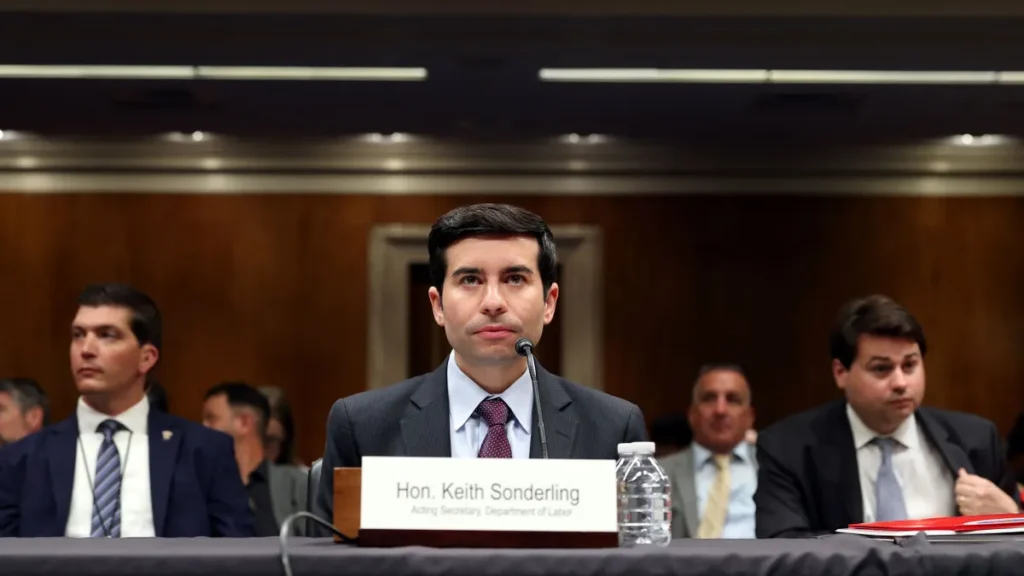
In a significant development for the U.S. labor landscape, President Donald Trump announced on Monday, June 30, 2026, his intention to nominate Keith Sonderling to serve as the next Secretary of Labor. The announcement, made via the President’s social media platform, signals a potential shift in the Department of Labor’s (DOL) priorities towards fostering a more business-friendly regulatory environment and promoting employer self-auditing initiatives. Sonderling, a Republican with extensive experience across various federal agencies, has been serving as Acting Secretary since April, following the resignation of his predecessor, Lori Chavez-DeRemer, amid reports of an investigation into potential misconduct. His anticipated confirmation by the Senate would cement a policy direction emphasizing compliance through proactive internal measures rather than solely through punitive governmental oversight.
Sonderling’s Ascent and Policy Foundations
Keith Sonderling’s career trajectory within federal agencies has consistently aligned with a philosophy that seeks to balance regulatory requirements with practical considerations for employers. Prior to assuming the role of Acting Secretary, he served as the Deputy Secretary of Labor, gaining intimate knowledge of the department’s sprawling operations and policy mandates. His tenure in this capacity, combined with earlier experience in the U.S. Department of Labor’s Wage and Hour Division, provided him with a comprehensive understanding of the intricacies of wage compliance, overtime rules, and employee classification that form the bedrock of federal labor law. The Wage and Hour Division is responsible for enforcing some of the nation’s most fundamental labor laws, including the Fair Labor Standards Act (FLSA), which governs minimum wage, overtime pay, recordkeeping, and child labor standards. Sonderling’s background here suggests a deep familiarity with the challenges businesses face in adhering to these complex regulations.
Beyond his roles within the DOL, Sonderling also served as a Commissioner for the U.S. Equal Employment Opportunity Commission (EEOC). This experience is particularly salient, as the EEOC is the primary federal agency responsible for enforcing federal laws that make it illegal to discriminate against a job applicant or an employee because of a person’s race, color, religion, sex (including pregnancy, sexual orientation, and gender identity), national origin, age (40 or older), disability, or genetic information. His time at the EEOC provided him with a crucial perspective on civil rights in the workplace and the mechanisms for addressing discrimination and promoting diversity. It was during this period that Sonderling became a vocal proponent of federal agency opinion letters, advocating for their role as "liability shields" for employers. He argued that these letters offer clear, specific guidance on complex legal questions, thereby reducing uncertainty for businesses and potentially preventing costly litigation. This approach, he contended, benefits not only employers but also courts, workers, and unions by providing transparent interpretations of the law.
A Focus on Proactive Compliance and Self-Auditing
A cornerstone of Sonderling’s policy vision, articulated throughout his various federal roles, is the promotion of employer self-audits. He has consistently championed programs that encourage businesses to proactively review their own compliance with labor laws, identify potential violations, and take corrective action before external intervention becomes necessary. This strategy is rooted in the belief that fostering a culture of internal compliance can be more efficient and effective than relying solely on reactive enforcement. The DOL has, under Sonderling’s influence, begun to emphasize educational initiatives and resources designed to empower employers to understand and meet their obligations, often highlighting the long-term benefits of compliance, such as reduced legal risks, improved employee morale, and enhanced public reputation.
For instance, at the DOL, Sonderling has voiced support for programs that incentivize businesses to perform these internal assessments and report employment law violations, demonstrating a commitment to remedial action. This approach is seen by proponents as a pragmatic way to manage the vast regulatory landscape, especially given the limited resources of federal enforcement agencies. The U.S. economy, comprising millions of businesses and a workforce exceeding 160 million individuals, presents an immense challenge for comprehensive, top-down enforcement. Self-audits, therefore, are positioned as a scalable solution that can significantly enhance overall compliance across diverse industries. Advocates argue that such programs can lead to faster resolution of issues, preventing minor infractions from escalating into major legal disputes.
His advocacy for self-audits extended notably to the burgeoning field of artificial intelligence (AI) in the workplace. In a 2021 American Bar Association conference, Sonderling urged employers to conduct thorough self-audits before implementing AI tools for tasks such as hiring, performance management, or scheduling. He stressed the critical importance of evaluating algorithms "early and often for biased outcomes and reengineer as appropriate." This proactive stance reflects a recognition of the transformative potential of AI while simultaneously acknowledging its inherent risks, particularly concerning the perpetuation or creation of new forms of discrimination. He called upon the EEOC to take a leadership role in providing guidance in this evolving area, inviting stakeholders to contribute to the development of robust frameworks.
AI and the Future of Work: A Balanced Perspective
Sonderling’s perspective on artificial intelligence in the workplace is particularly noteworthy, reflecting a nuanced understanding of its promises and perils. He has articulated a vision where AI can be a powerful tool for eliminating bias, especially in the early stages of the hiring process. In an op-ed published in HR Dive later in 2021, he wrote, "I believe that we can – and we must – realize the full potential of AI to enhance human decision-making in full compliance with the law." This statement underscores his conviction that technological advancement can coexist with, and even bolster, legal and ethical standards in employment.
However, Sonderling’s enthusiasm for AI is tempered by a cautious realism. He emphasized the need for stakeholders to be "vigilant" about the technology’s limitations and "mindful of the legal and ethical obligations that bind us all." This dual perspective suggests that under his leadership, the DOL would likely pursue policies that encourage the responsible adoption of AI while simultaneously developing guidance and enforcement mechanisms to mitigate its potential for discriminatory outcomes or adverse impacts on workers. This aligns with broader national and international discussions about AI ethics, data privacy, and algorithmic fairness, topics that are rapidly gaining prominence as AI integration into daily operations accelerates.
The implications for employers are significant. With AI adoption growing rapidly – a 2023 survey indicated that over 50% of HR professionals were already using or planning to use AI in their operations – clear guidance from federal agencies is becoming increasingly crucial. Sonderling’s emphasis on early and continuous auditing of AI tools suggests that employers will be expected to demonstrate due diligence in ensuring their AI systems are free from bias and comply with anti-discrimination laws. This proactive stance could shape how companies develop, procure, and implement AI solutions, potentially leading to greater investment in AI auditing tools and ethical AI development practices.
The Context of the Nomination: A Department in Transition

Sonderling’s nomination comes at a pivotal time for the Department of Labor. His predecessor, Lori Chavez-DeRemer, had served for a relatively short period before her abrupt resignation in April 2026. The reports of an investigation into potential misconduct created a vacuum of leadership, which Sonderling quickly filled as Acting Secretary. This transition highlights the importance of stable leadership at the DOL, an agency critical to the economic well-being of millions of American workers and businesses.
The Secretary of Labor heads a cabinet-level department responsible for administering and enforcing over 180 federal laws covering approximately 10 million employers and 125 million workers. These laws govern a vast array of issues, including occupational safety and health, wage and hour standards, unemployment insurance, worker benefits, and collective bargaining rights. The Secretary plays a crucial role in shaping labor policy, interpreting regulations, and directing enforcement efforts across agencies like the Occupational Safety and Health Administration (OSHA), the Employee Benefits Security Administration (EBSA), and the Wage and Hour Division.
Given this expansive mandate, the Secretary of Labor’s policy leanings can have profound effects on the national economy and individual workplaces. A nominee like Sonderling, who advocates for "employer-friendly regulations" and self-auditing, suggests a potential shift towards fewer prescriptive mandates from the federal government and greater reliance on industry-led compliance efforts. This could manifest in various ways, from streamlining existing regulations to prioritizing guidance and technical assistance over aggressive enforcement actions, particularly for businesses that demonstrate a good-faith effort to comply.
Reactions and Anticipated Challenges
Following President Trump’s announcement, Sonderling promptly issued a statement on his LinkedIn profile, expressing deep gratitude for the nomination. He affirmed that, if confirmed by the Senate, he would "look forward to advancing the President’s agenda on behalf of America’s workers, families, unions, and job creators." The inclusion of "unions" alongside "job creators" in his statement suggests an intent to project an image of balanced advocacy, despite his known positions favoring business flexibility. However, the DOL did not provide additional comment by press time, maintaining official protocol pending Senate confirmation.
The nomination is likely to elicit varied reactions from different stakeholders. Business associations, such as the U.S. Chamber of Commerce or the National Federation of Independent Business (NFIB), are expected to welcome Sonderling’s nomination. His emphasis on reducing regulatory burdens, fostering self-compliance, and providing clear guidance aligns well with their longstanding advocacy for policies that support economic growth and reduce operational costs for businesses. They would likely view his approach as pragmatic and conducive to job creation.
Conversely, labor unions and worker advocacy groups, such as the AFL-CIO or the National Employment Law Project (NELP), may express skepticism or concern. Their primary focus is typically on robust enforcement of worker protections, ensuring fair wages, safe working conditions, and the right to organize. A perceived shift towards "employer-friendly" regulations and self-audits could be interpreted as a weakening of federal oversight and a potential for reduced worker protections. These groups might scrutinize Sonderling’s past statements and actions, particularly concerning the Wage and Hour Division and EEOC, to assess his commitment to enforcing labor laws vigorously. They may argue that self-audits, while potentially beneficial, should not replace strong governmental enforcement mechanisms.

Civil rights organizations and legal experts specializing in discrimination law may also closely examine Sonderling’s approach, particularly concerning AI in hiring and employment. While his call for early auditing of AI for bias is commendable, concerns may arise regarding the effectiveness of self-regulation without stringent external validation or oversight. Questions about data transparency, algorithmic accountability, and the potential for disparate impact could be central to their evaluations.
Broader Implications for Labor Policy
Sonderling’s potential confirmation as Secretary of Labor carries significant implications across several key areas of labor policy:
- Regulatory Philosophy: The DOL could pivot towards a philosophy that prioritizes technical assistance, educational outreach, and voluntary compliance programs over a more enforcement-heavy approach. This could involve reviewing existing regulations for potential streamlining or simplification to reduce compliance burdens on businesses.
- Wage and Hour Enforcement: While the core mandates of the FLSA would remain, the emphasis in enforcement might shift. Instead of solely pursuing penalties, the Wage and Hour Division could increase its focus on helping employers understand and correct violations through educational campaigns and, as Sonderling has advocated, through self-auditing programs that encourage employers to proactively address issues.
- Equal Employment Opportunity: The EEOC, under the influence of the broader administration’s labor policy, might continue to emphasize guidance documents, such as opinion letters, to provide clarity for employers. Sonderling’s focus on AI ethics and bias detection could lead to the development of new federal guidelines or best practices for the responsible implementation of AI in HR, potentially making the U.S. a leader in this critical area.
- Worker Safety and Health (OSHA): While not explicitly mentioned in the initial reports, a "business-friendly" approach could extend to OSHA, potentially leading to a greater emphasis on cooperative programs, consultation services, and employer-led safety initiatives rather than strictly punitive enforcement. This might involve reviewing safety standards to ensure they are both effective and practical for businesses to implement.
- Labor-Management Relations: While Sonderling has expressed a desire to advance the agenda "on behalf of…unions," his overarching philosophy might lead to policies that seek to balance the interests of labor and management, potentially with a lean towards fostering conditions that are perceived as favorable for business growth, which proponents argue ultimately benefits workers through job creation.
In conclusion, Keith Sonderling’s nomination for Secretary of Labor marks a critical juncture for U.S. labor policy. His extensive experience across federal agencies, coupled with his consistent advocacy for employer-friendly regulations, self-auditing, and responsible AI integration, indicates a clear direction for the Department of Labor. Should he be confirmed, the labor landscape could see a renewed emphasis on proactive compliance, clear regulatory guidance, and a collaborative approach between government and industry, shaping how millions of Americans work and how thousands of businesses operate in the years to come. The Senate confirmation process will undoubtedly provide a platform for a thorough examination of these philosophies and their potential impact on workers, businesses, and the broader economy.